 The University of Arizona Press

September 10, 2026
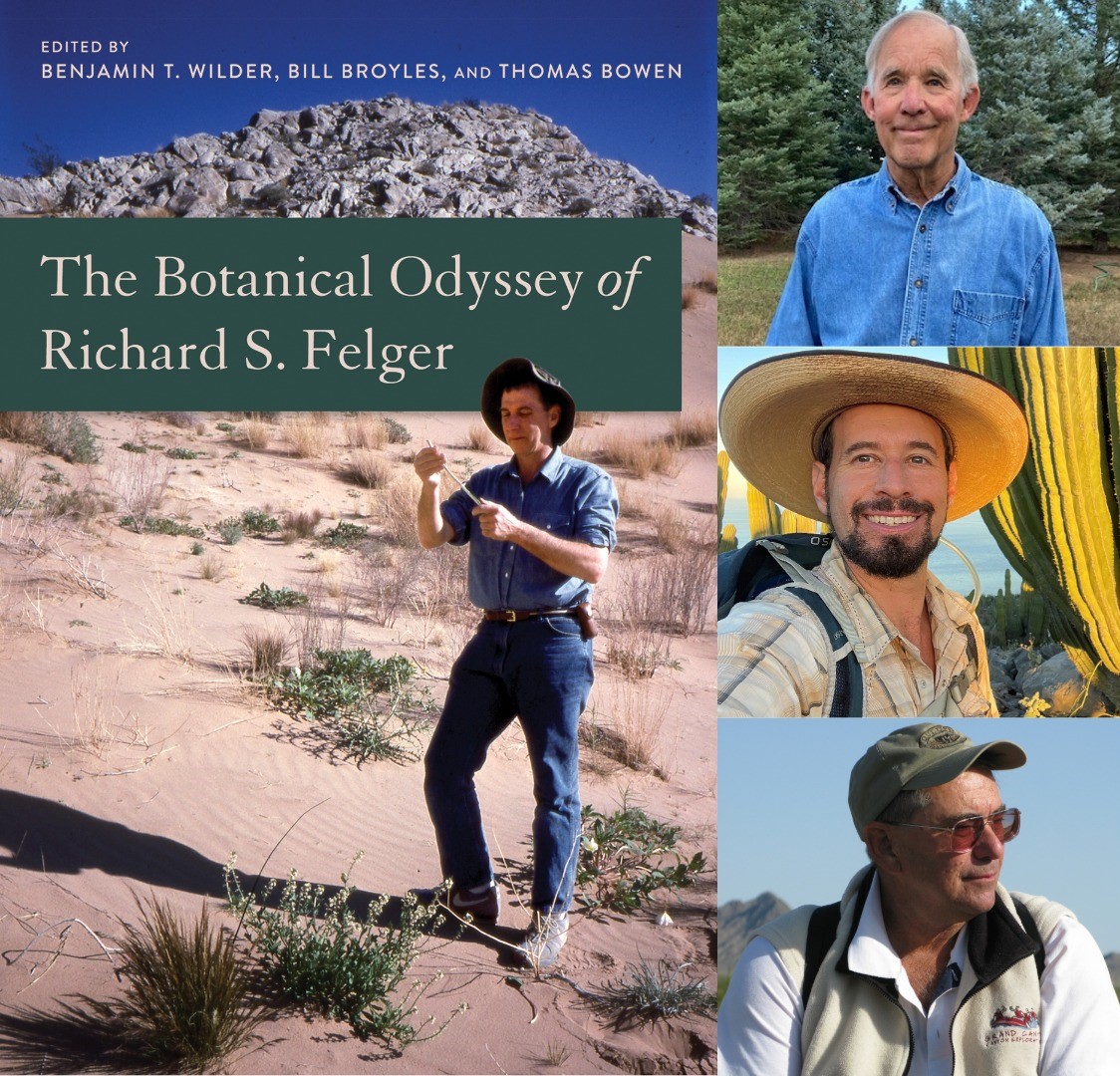
Felger’s own voice, paired with reflections from twenty colleagues, creates a rich, multifaceted narrative, offering readers a rare glimpse into the life of a scientific icon whose legacy continues to inspire desert researchers and conservationists across the globe. The Botanical Odyssey of Richard S. Felger is a vibrant tribute to Richard Stephen Felger, who was one of the most influential scientists of the American Southwest and northwestern Mexico. Known as a desert botanist, Felger’s work transcended regional boundaries, blending rigorous fieldwork with global ecological vision. This work offers an intimate and multifaceted portrait of a man whose tireless advocacy for biodiversity and biocultural conservation shaped generations of desert scientists.
Edited by Benjamin Theodore Wilder, Bill Broyles, and Thomas Bowen, this book is both a celebration and a resource. The work is separated into four parts. With humor, insight, and deep empathy, Felger’s own voice leads the journey in part 1, recounting his most memorable field experiences with masterful prose and sly wit. Part 2 brings together heartfelt reflections from colleagues who worked alongside Felger in the field, revealing the eccentric brilliance and relentless curiosity that defined his career. Part 3 explores his family history and the unconventional path that shaped his life’s work, while part 4 presents a comprehensive bibliography of his most important publications. Read an excerpt from the book’s Chapter 1: A Sapling Grows Up below.
I thought about lots of things walking to Third Street grammar school and then bicycling to John Burroughs Junior High on sycamore-shaded sidewalks in mid-twentieth-century early smog days. Our street trees were European sycamores, the London plane, even though our street was named Las Palmas. I would have preferred California sycamores, even though the trunk grows too crooked for a normal street tree. Native trees for native microcosms reaching native birds.
I imagined all the people gone, as they will be someday. Trees and vines growing through the ruins. Most non-natives will vanish from lack of artificial water. I figured which ones would reproduce. Natives would return in stages of succession, even though I did not know there was an ecological theory of succession. There were still vacant lots sporting native plants, although the majority of the Los Angeles flora consisted of weedy Eurasian invasives. Sometimes I thought about bringing extirpated mountain lions and condors and resurrecting Ice Age La Brea Tar Pits creatures—ground sloths, dire wolves, sabertoothed tigers, and mammoths. What would it be like to see muscular sabertoothed tigers in action? Or might they use their sabers to rake rotting flesh off mammoths mired in the tar? What’s wrong with a heroic animal being a scavenger? America’s national symbol is a carrion eater and so is Mexico’s.
The rundown house that looked like a miniature castle, where a young movie star once lived, had Italian cypress trees. Tall dark columns, green on the outside and itchy scratchy dead twigs inside full of spiders and mites. Those trees would live on in this Mediterranean climate but would not spread. I never saw seedlings and later learned they are a sterile horticultural selection, cloned by cuttings. Olive trees, also cloned Mediterranean selections, would keep going, some for centuries or a thousand years, but I never saw seedlings. Each tree produces thousands of one seeded olives every year, so maybe a few would germinate and survive and admit olives to a future flora.
Our neighbor, a world-renowned allergist, had a whole grove of olive trees providing the neighborhood with hay fever. Olive pollen is a top listed allergen. A favorite trick was to give fresh juicy olives to a new kid from back East. Unprocessed olives will pucker your mouth for a long time.
Sidewalk edges and street cracks would fill first with weedy non-natives like Bermuda grass, but to make things more interesting, I imagined natives like coastal prickly pear (Opuntia littoralis) and Los Angeles manzanita (Arctostaphylos glauca). They would thrive in cracks opening from earthquakes. Being a California kid, I thought earthquakes were normal. Native and naturalized species could move in from vacant lots and big open spaces like the La Brea Tar Pits, about a mile away, still vaguely natural. The tar pits were our hunting grounds. Most were not fenced, incredible as it might seem in our litigious society. After spring rains, we found California tree frogs breeding in water topping off tar pools. Two striped garter snakes lurked for fat little frogs. Some years later the Los Angeles County Museum of Art and the Page Museum of tar pit fossils and their parking lots smothered our hunting grounds.
Benjamin T. Wilder is a biogeographer, botanist, and desert ecologist whose research looks at the origin and future of the Sonoran Desert. He is co-founder and director of the Next Generation Sonoran Desert Researchers (N-Gen). He is the co-author of Plant Life of a Desert Archipelago with his mentor Richard Felger and Humberto Romero Morales. His scientific and conservation efforts strive to combine multiple disciplines and perspectives to better understand and care for the desert that drives his passion.
Bill Broyles is a student in the Sonoran Desert’s schoolhouse, where he studies and writes about human and natural history of southwestern Arizona and northwestern Sonora. His books include Sunshot, Dry Borders with Richard Felger, Among Unknown Tribes, Flying for the U.S. Border Patrol, 1940–2005, and Remembering Ranches Around Ajo, Arizona.
Thomas Bowen is professor emeritus in the Department of Anthropology, California State University, Fresno, and a research associate at the Southwest Center at the University of Arizona. His research has focused on the archaeology and history of the islands in the Gulf of California, especially as it relates to the Seri people. His books and monographs include Unknown Island, The Record of Native People on Islands in the Gulf of California, and On Desert Shores.
