The University of Arizona Press

November 4, 2026
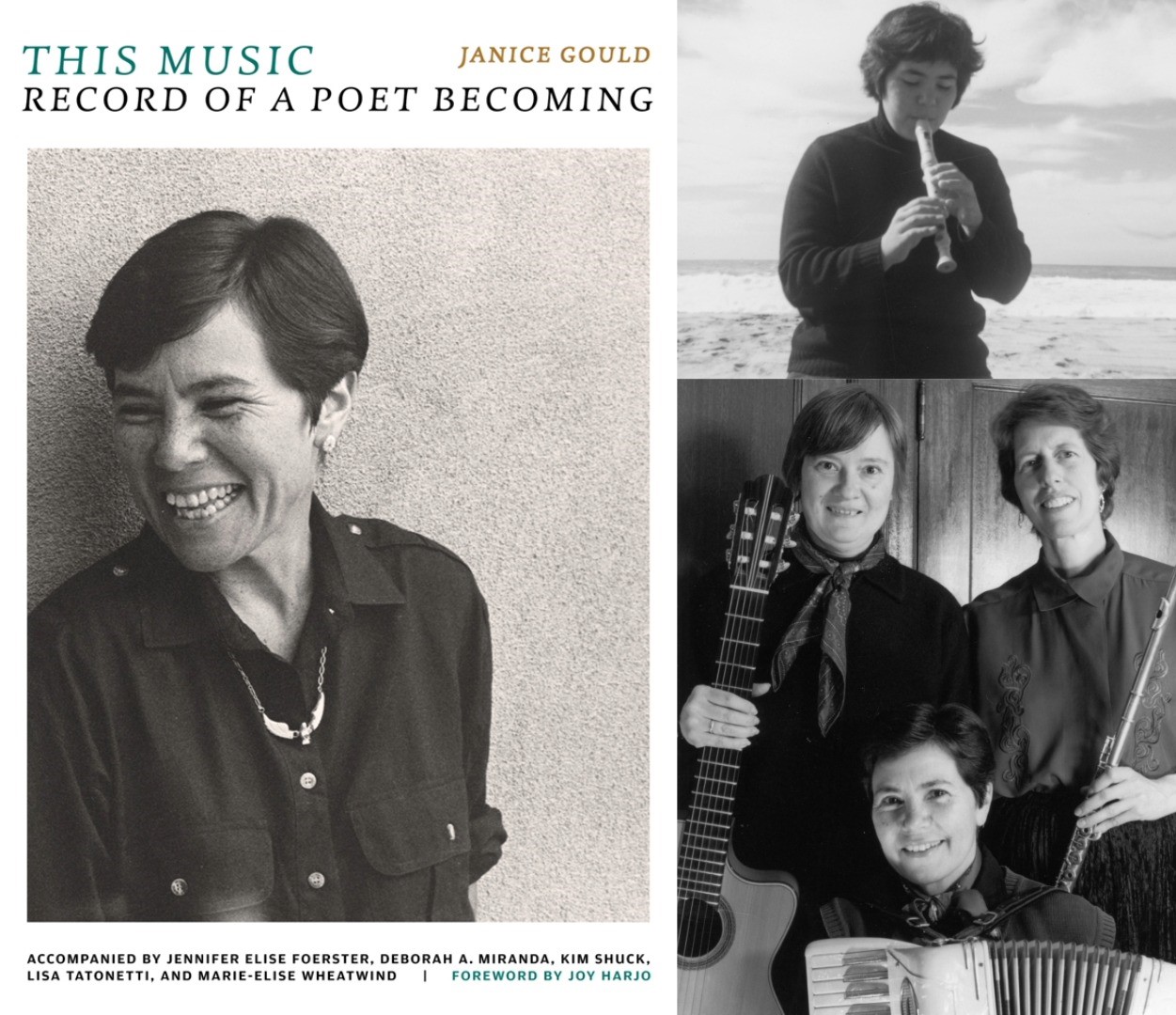
This Music: Record of a Poet Becoming is the final, intimate work of celebrated Koyoonk’auwi (Concow) poet and essayist Janice Gould, completed posthumously by a collective of close friends and literary scholars. The collaborators are Jennifer Elise Foerster (Editor), Deborah A. Miranda (Editor), Lisa Tatonetti (Editor), Kim Shuck (Editor), Marie-Elise Wheatwind (Editor), Joy Harjo (Foreword) .
Told through lyrical prose poems and personal photographs, this memoir traces Gould’s life as a queer/Two-Spirit California Native coming of age in the late 1960s, navigating family, identity, activism, and art. With reflections on her mixed-blood heritage, her experiences in lesbian feminist circles, and her journey as a poet and musician, Gould’s voice resonates with clarity, tenderness, and fierce honesty.
Today we share insights from Marie-Elise Wheatwind about Janice and her music, as well as a few audio and video clips.
“Down by the Riverside,” filmed at an Open Mic at a Colorado Springs co-housing community center:
Tell us a little about “Trio Pan Dulce” and its importance to Janice.
As an undergraduate at Merritt Community College, Janice writes in This Music about different classmates sharing music from their Latin American homelands, suggesting songs for her to learn, or giving her albums to encourage her to expand her repertoire of music. When Janice met Janna MacAuslan and Kristan Aspenyears later after moving to Portland, Oregon, she worked for them, helping to set up and operate their Alternative Sound Company for concerts in the parks. It was not unlike the stagecraft work she learned in high school, and pursued briefly again in college theater classes. Janice admired Kristan and Janna’s knowledge of music from other countries, and their professional level of performing. Even though Janice had stopped practicing the oboe during her teen years when she considered an orchestral career, her camaraderie with the former Musica Femina Flute Guitar Duo evolved naturally into Trio Pan Dulce.
They shared favorite songs from Central and South American countries, along with a mutual love of diverse languages and cultures the music represented. Janice and Janna easily adapted songs to play together, so that Kristan could join them with her flute, and Janice could add some accordion keyboard arrangements. Janice enjoyed their close-knit friendship, which included a feminist sisterhood and deep commitment to activist causes. This included providing entertainment for annual “Chef’s Night Out” extravaganzas at Portland’s Performing Arts Center to raise money for the Oregon food bank, and playing a benefit for Artichoke Music, a longtime, but struggling folk music venue. They agreed on the name Trio Pan Dulce as a nod to the “sweet bread” taste of a specific Mexican pastry, but also the underlying “bread of life” allusion to music being a way of “breaking bread” with others: sharing bread being akin to playing instruments or singing with others in times of protest, solidarity, or communion.
Trio Pan Dulce performs “Manhã de Carnaval” (song from Black Orpheus), by Luís Bonfá (2 guitars, voice, flute) Brazil:
A couple of chapters in the book talk about Janice playing Flamenco guitar; how was that different than playing folk guitar for her?
The most obvious difference is that folk guitar can be a solitary activity that invites others to join in, to sing along or harmonize. Conversely, Janice and Janna played Flamenco guitar as a duo and as accompanists to dancers who performed together as a troupe with occasional soloists. While a folk guitarist can change the mood of a song simply by adjusting its tone and rhythm to guide the vocalists, a Flamenco guitarist’s role is the opposite: to follow the lead of the dancers, whose footwork, arm movements, and elaborate palmas, or handclaps, dictate a complex tempo or pace which the guitarist must match. Only occasionally does the guitarist insert a burst of melodic virtuosity with a falsetta. Most folk music is in 3/4 or 4/4 time, with occasional meters of 6/8 or 2/4. Flamenco, on the other hand, can be a 12-beat count or any division of 12, repeated in a rhythmic cycle or compás, depending on which beats are accented in each style, or palo. The voice or cante lilts above this complex rhythmic base. Being a Flamenco accompanist is a humbling role, as it requires unspoken communication between all the players, not unlike how jazz musicians follow each other’s cues for developing the music in performance.
“Sonrisa Flamenca” was a dance performanc, accompanied by Janna & Janice on guitar, Janice on vocals. “Bulerias” is the Fin de Fiesta of all the dancers in the final dance of the evening:
What stories or memories connected to Janice playing other instruments stand out to you?
When Janice first lugged her accordion upstairs to my flat in Berkeley graduate students housing to play for me, I was determined to be polite and listen. My only memories of accordion music were as a small child, occasionally watching The Lawrence Welk Show with my grandparents. I liked the harmonized music of the “Lovely Lennon Sisters,” but polkas on the accordion did not interest me. I was pleasantly surprised by the music Janice played from Argentina, Brazil, Mexico, and the Gypsy music of Romania and Spain. I had no idea accordions were part of almost every country and culture. I also didn’t know that the bandoneon, a complex “button concertina” with a very large span of bellows movement, made different sounds depending on whether the bellows pushed in, or stretched out. The first time Janice was offered one “to try,” she immediately knew what to do, and could play something melodic and lively on it in a matter of minutes.
One of the things Janice loved was watching how her accordion music inspired people to dance. I have memories of tables and chairs being moved in her family home to make room for a line of couples facing each other while Janice played a Virginia Reel, or watching people dance on the lawns near the Mackenzie River in late afternoons during the Flight of the Mind Summer Writing Workshops where she taught poetry. Her training on piano made even children’s instruments something she could “tinker” and play with, regardless of their quality of sound. She once picked up an African percussion Kalimba, also known as a thumb piano, freshly unwrapped and left under a Christmas tree when we were visiting a friend. Janice plucked at its metal prongs, holding it close to her ear, nodding at its different tones as she pulled and pressed, creating bell-like vibrations. Then she lowered the small instrument and offered it towards us, performing spontaneously with an impish and impressive verve, stopping all conversation as we listened in quiet admiration.
Trio Pan Dulce performs “Milonga Tradicional” by S. Arriagada (guitar, accordion, flute) Argentina:
What do you hope readers understand about the relationship between music, memory, and Indigenous survivance through Janice Gould’s life and legacy?
Janice’s love of music came first from her mother, who left her family home and many siblings at a young age, after her mother died. In the handful of formative years Vivian lived in the Sierra Nevada foothills, music was embedded in her heart and memory. It showed as an early gift, and the child was fortunate to have adoptive mothers who encouraged her to study music throughout childhood and into her early college years. Janice could see in her mother’s family photographs (taken by the three sisters who adopted Vivian) that she came from a family of fiddlers and dancers, and therefore her own “Indigenous survivance” included an understanding of her “mixed blood” roots, leading to a respect for many languages and styles of expressive movement, including a love for international folk dancing. I feel a need to add that Janice’s dad often commented that he “couldn’t carry a tune in a bucket,” and yet he loved all kinds of opera, and encouraged his daughters in their many musical endeavors. (Janice’s younger sister sang professionally in light opera productions.) Both parents spared no expense in buying their daughters the best quality instruments, and attended their rehearsals, recitals and performances.
The prose poems in Janice’s final book have a through-line or underlying “soundtrack” of music within its pages that previous editors suggested might not hold the book together, but clearly it’s there. Throughout her life, whether in darker periods of estrangement, duende, and despair, or in the more pensive transformations of contemplation and creativity, Janice moved from a once subdued self-expression to a more secure and bold declaration of self-confidence. Her memories of music gesture back to the frustrations of practice, then to the choral and instrumental communities she found, as her love of all things linguistic and lyrical merged. It was something that those of us who co-edited her book whole heartedly agreed on: This Music was to remain its “working title.” We were also fortunate to have Joy Harjo’s foreword, which provides a prelude to our memories and praise, as Joy’s own progression as a poet and musician is an extraordinary example of someone whose creativity is not hampered or limited by others. Like Janice, Joy’s “Indigenous survivance” is not limited to one form, and her talents continue to flourish as she performs in the different platforms of poetry—written and spoken—and in her music, which has its elements of jazz, as well as art, theater, and storytelling as an active, ongoing example of resilience from family to students, and the younger Indigenous generations of inter-connected communities.
In this evening performance at the School for Advanced Research, Joy Harjo reads an early draft of Janice’s poem “This Music,” with Janice on guitar, playing music created as accompaniment to her poem-in-process. This took place during Janice’s SAR residency in Santa Fe, New Mexico. The poem was shortened and revised, and later published in a chapbook, The Force of Gratitude (2017, Headmistress Press).
Additional Music
Radio Tribute to Janice Gould, Talking Earth Program, KBOO 90.7, Portland, Oregon
Lavanda, Janice’s response to a request from The Lavendar Review to post “likes” & “shout-outs” praising the magazine
Gracias a la Vida, recorded at a 25th Anniversary celebration of two friends in September 2004 (photo credit: Margaret Randall)
De Colores, filmed at an Open Mic at a Colorado Springs co-housing community center
What Have They Done to the Rain, filmed at an Open Mic at a Colorado Springs co-housing community center
“Poetry, Dance, and Song from Andalusia: Federico Garcia Lorca’s Poem of the Deep Song:”
Marie-Elise “Mimi” Wheatwind earned three MA degrees, supporting herself as a cabdriver, waitress, house cleaner, and bookseller while attending various colleges and universities in California, Utah, Arizona and New Mexico. During the 34 years she shared homes and literary adventures with her spouse, Janice Gould, Wheatwind also published poetry, stories, and nonfiction, and worked as an adjunct professor, high school teacher, and academic librarian, before co-editing Gould’s last manuscript, This Music: Record of a Poet Becoming.