 The University of Arizona Press

Located in Tucson, the University of Arizona Press has a long tradition of publishing diverse perspectives regarding the border and immigration. This week, alongside other members of the Association of University Presses (AUPresses), we’re sharing a roundup of recent works whose authors provide valuable context on current events.
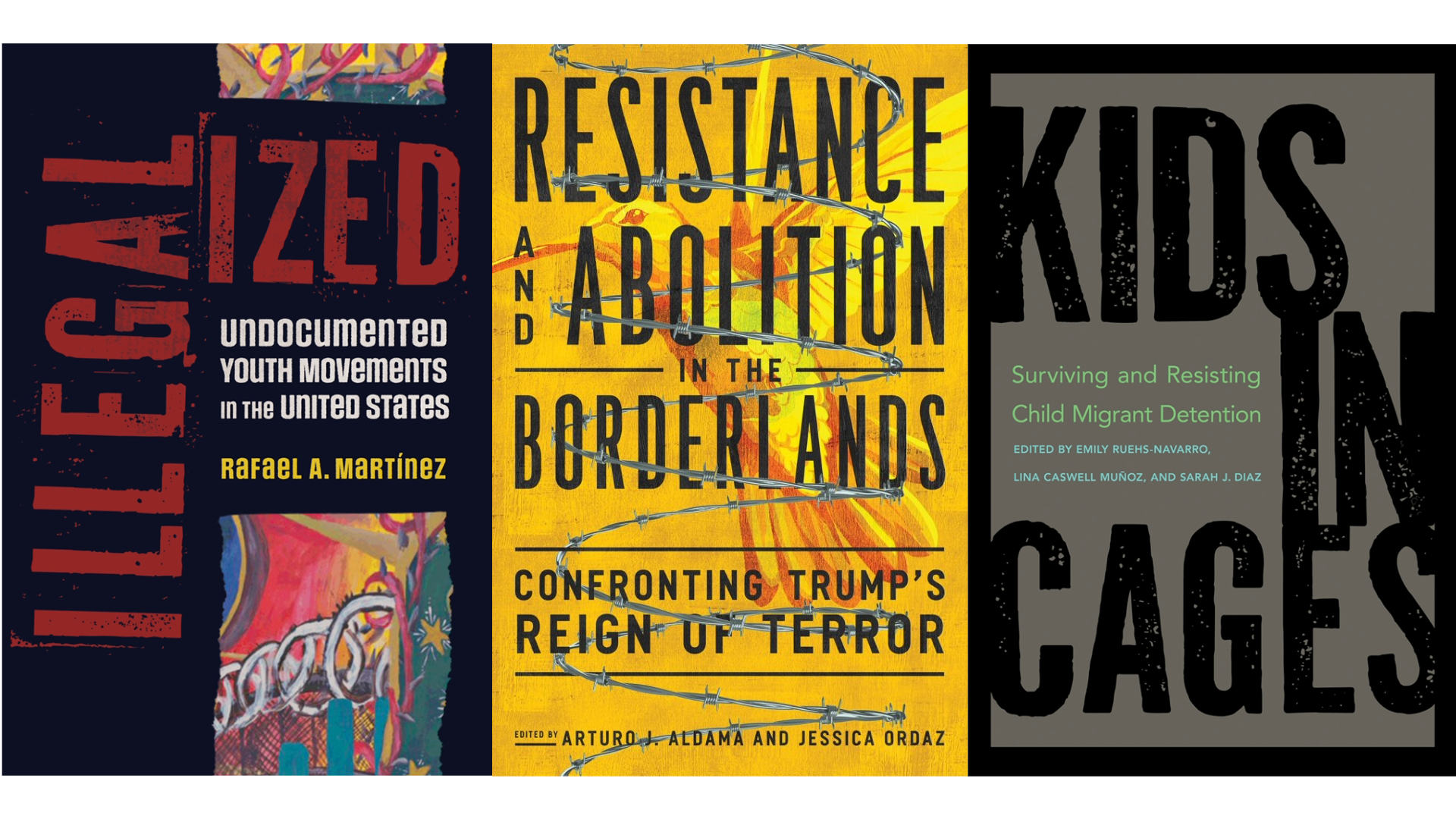
Illegalized: Undocumented Youth Movements in the United States

Illegalized takes readers on a journey through the history of the rise of undocumented youth social movements in the United States in the twenty-first century. The book follows the documentation trail of undocumented youth activists spanning over two decades of organizing. Each chapter carefully analyzes key organizing strategies used by undocumented youth to produce direct forms of activism that expose and critique repressive forms of state control and violence. This inquiry is particularly generative in relation to how immigrant bodies are erased, contained, and imagined as “aliens” or “illegal.”
Rafael A Martínez, an undocu-scholar, intricately weaves his lived experience into this deeply insightful exploration. Martínez’s interdisciplinary approach will engage scholars and readers alike, resonating with disciplines such as history, American studies, Chicana and Chicano studies, and borderlands studies.
Illegalized shows that undocumented youth and their activism represent a disruption to the social imaginary of the U.S. nation-state and its figurative and physical borders. It invites readers to explore how undocumented youth activists changed the way immigrant rights are discussed in the United States today.
Resistance and Abolition in the Borderlands: Confronting Trump’s Reign of Terror

While there is a long history of state violence toward immigrants in the United States, the essayists in this interdisciplinary collection tackle head-on the impacts of the Trump administration.
This volume provides a well-argued look at Trump’s first term (2017-2021). Insightful contributions delve into the impact of Donald Trump’s rhetoric and policies on migrants detained and returned, immigrant children separated from their parents and placed in detention centers, and migrant women subjected to sexual and reproductive abuses, among other timely topics. The contributors document a long list in what the book calls “Trump’s Reign of Terror.”
Las Horas Imposibles / The Impossible Hours

In Las Horas Imposibles / The Impossible Hours, Octavio Quintanilla takes us on a profound journey to witness what it means to erase those boundaries devised by genre and politics intent on stifling memory, imagination, and creativity.
Presented in Spanish with English translations, this poetry collection comprises lyric and concrete poems—or frontextos—that explore intimacy and different shades of violence as a means to reconcile the speaker’s sense of belonging in the world. From the opening poem to the last in the first section, Quintanilla captures the perilous journeys that migrants undertake crossing borders as well as the paths that lovers forge to meet their endless longing. These themes are skillfully woven by Quintanilla, guiding us back and forth across the Rio Grande to encounter the apparitions of the disappeared and to witness the willingness of many to risk life and limb for a better life.
Kids in Cages: Surviving and Resisting Child Migrant Detention

In recent years, the plight of immigrant children has been in the national spotlight. A primary issue of concern is the experience of child migrants in detention by the U.S. government.
The authors in this volume approach the topic of child migrant detention from a range of perspectives. Some authors, particularly those who provide a legal perspective, chronicle the harms of detention, arguing that despite governmental assurances of child protection, detention is fundamentally a state-sanctioned form of violence. The social scientists in the volume have worked closely with detained youth themselves; in these chapters, authors highlight the ways in which youth survive detention, often through everyday acts of resistance and through the formation of temporary relationships. Practitioners including psychologists, activists, and faith leaders look at forms of resistance to detention. From retheorizing psychological interventions for detained youth to forming hospitality homes that act as alternatives to detention, these practitioners highlight ways forward for advocates of youth. At the heart of these narratives lies a crucial debate: the tension between harm-reduction strategies and abolition.
Walled: Barriers, Migration, and Resistance in the U.S.-Mexico Borderlands
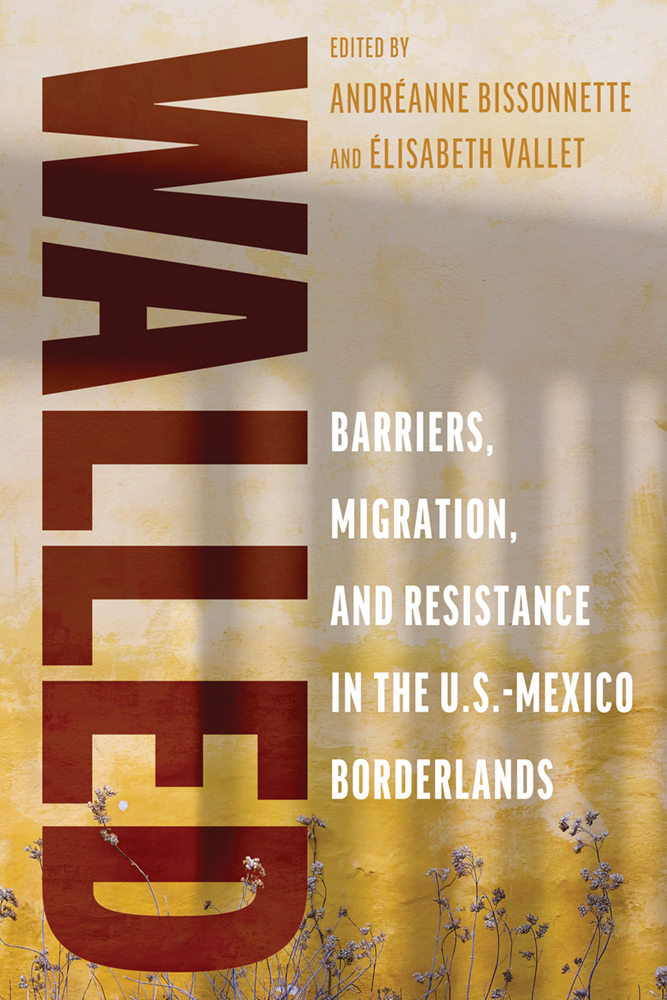
In 1993, then-U.S. President Bill Clinton oversaw the construction of the first stretch of the U.S.-Mexico border walls. Since that pivotal moment, every subsequent U.S. president has allowed for the construction of additional miles of walls or fences. Despite his initial pledge to halt the expansion of border walls, in July 2022, President Joe Biden authorized the construction of new sections in four locations within Arizona. This decision underscores the enduring complexity and contentious nature of the U.S.-Mexico border infrastructure.
From the bustling San Diego–Tijuana region to the borderlands of Brownsville-Matamoros, the U.S.-Mexico border is marked by extensive stretches of walls. Over the past thirty years, these walls have evolved from purely physical barriers into multifaceted systems encompassing administrative, legal, legislative, and biometric components. Walled invites readers to reflect on the transformations of the border since the construction of the initial fourteen miles of wall, and the subsequent addition of 1,940 miles. It provides a comprehensive exploration of the border’s evolution, and its profound and lasting impacts.
Accompaniment with Im/migrant Communities: Engaged Ethnography

This collection brings together the experiences and voices of anthropologists whose engaged work with im/migrant communities pushes the boundaries of ethnography toward a feminist, care-based, decolonial mode of ethnographic engagement called “accompaniment.”
Accompaniment as anthropological research and praxis troubles the boundaries of researcher-participant, scholar-activist, and academic-community to explicitly address issues of power, inequality, and the broader social purpose of the work. More than two dozen contributors show how accompaniment is not merely a mode of knowledge production but an ethical commitment that calls researchers to action in solidarity with those whose lives we seek to understand. The volume stands as a collective conversation about possibilities for caring and decolonial forms of ethnographic engagement with im/migrant communities.
