The University of Arizona Press


August 26, 2025
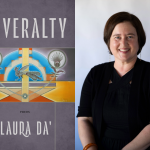
Severalty begins in a garden and moves through ancestral and contemporary hometowns that shimmer between wholeness and severing. In these poems, river currents tick with the intrusion of the clock’s lavish precincts. From powerfully compressed lyrical fragments to pulsing narrative sequences, Severalty shifts perspectives to examine devastation and healing, transience and seasonality, loss and resurrection.
With clear roots in her first two books of poetry, Tributaries and Instruments of the True Measure, this volume joins the author’s poetic trilogy with a deeply personal accounting of history, community, and selfhood. Weaving the past and present into a stunning tapestry, this collection is a powerful testament to Indigenous endurance and creativity, offering readers a deeply insightful and necessary work.
Today, Da’ answers five questions about her work.
Your title, Severalty, is a reference to the Dawes Severalty Act of the late nineteenth century. How does this title (and the related legislation) frame the book?
Allotment is the fundamental act of fragmenting integrity. The Dawes Severalty Act is an agent of genocide enacted against Indigenous nations which attempted to sever the political, familial, and landed bonds of communal life. This time in Shawnee history is still just inside living memory, which is to say that my grandparents, great aunts and uncles, beloved elders who I knew as a very small child, were directly impacted by these policies. This relates to the book and to me as its author by connecting the lived present to the purportedly historical past. As I was creating this book I was writing to an understanding of fragmentation and wholeness that shifted from personal and tribal trauma to an openness to wholeness.
Twelve of the poems in this book have arrows as titles. Can you tell us about the function of these arrows, or how these poems are related?
The twelve poems mentioned are anchored to the concept of time, directionality, and seasonality. Each of these poems is titled by an arrow and each one reaches to a place or sensation that is nestled inside linear time, growing and harvesting time, and fragmented time, but also exists outside these frameworks. The collection begins with the line: Mistaken for a gardener upon my return which offers a preamble for the book’s inquiries concerning resurrection, analogy as a spiritual practice and source of comfort, and the ultimate generosity of the land.
You’ve published two other books with the University of Arizona Press: Instruments of the True Measure and Tributaries. How does Severalty continue, transform, and/or diverge from those projects?
I see Severalty as a final painting of the tryptic. It engages with the past as do the other collections, lives in Shawnee history, culture, language, and people from the inside and from the outside, and reflects personal inquiry through poetry. Each project naturally diverges with my own sensibilities, experiences, and affinities. I hope that readers might enjoy these poems individually and as a collection.
Two of my favorite poems from the book are “Painterly” and “Eye Turned Crow,” which both take up notions of seeing and point-of-view (both in place and time). Can you talk about how Shawnee perspectives shape the language of these poems, or your work in general?
Thanks for your kind words and close reading of these two poems. I appreciate the connection between them as poems that mark a sense of distress by turning to perspective. I wrote Painterly during a difficult period in which I was experiencing complications related to my organ transplant. I was stuck for a long time in the hospital, feeling quite poorly, and I was reading Alberti’s De pictura but struggling to focus. Alberti was exiled from Florence during the renaissance and I too felt a sense of exile that I was writing against in that poem. In Eye Turned Crow, the perspective borrows from a library and considers different acts of genocide and the ways that they are acknowledged or obscured.
What are you working on next?
I’ve been writing poems about places I love. A few can be found on the Seattle Met website.
Laura Da’ is a poet and teacher who studied at the Institute of American Indian Arts. She is the author of Tributaries, an American Book Award winner; Instruments of the True Measure, a Washington State Book Award winner; and Severalty. Da’ is Eastern Shawnee, and she lives in Washington with her family.