The University of Arizona Press


August 19, 2025
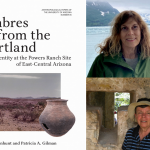
Mimbres Far from the Heartland: Identity at the Powers Ranch Site of East-Central Arizona offers a unique investigation into the complexities of Mimbres identity and social dynamics beyond the traditional Mimbres Valley heartland. Situated at the western edge of the Mimbres region, the Powers Ranch site is a professionally excavated Classic period settlement in Arizona’s Gila River Valley. Through excavation and analysis of architecture and a rich array of artifacts, including ceramic sherds, projectile points, and shell artifacts, authors Mary E. Whisenhunt and Patricia A. Gilman provide a detailed look at the lives of Mimbres people on the periphery.
Today, the authors answer five questions about their work.
What inspired you to write this book?
Gilman: I was interested in the Powers Ranch site because it would help me address one of my research interests—what were the lives of Mimbres people like beyond the Mimbres Valley heartland? It was becoming more apparent to us Mimbres archaeologists that things were different outside the Mimbres Valley, but how and why? Powers Ranch, being located 119 kilometers west of the valley, would help me consider these questions. Although parts of the site were excavated in 1983, the materials were never analyzed, and the excavation was never written up. My students at the University of Oklahoma and I analyzed the ceramics and the projectile points, and so I had a bit of an obligation to write up the site.
Whisenhunt: I was thrilled when Pat asked me to co-author this publication! The Powers Ranch site lies about 5 kilometers north of the area where I did my 2020 dissertation research on precontact settlement patterns in the Gila River Valley between Duncan and York, Arizona. We first visited the site in 2016 and were fascinated by it. Almost all the Classic sites on or near the Gila River in Arizona are on private property, and all have been looted. We’re extraordinarily blessed that the Powers family allowed us access to the property and supported the early investigations on which the book is based. Only one other Mimbres Classic site besides Powers Ranch has been professionally excavated in Arizona’s Gila River Valley, so the data from the Powers Ranch site really filled in a lot of the gaps in our knowledge.
What do you mean when you talk about an “edge community” in archaeology?
Gilman and Whisenhunt: Archaeologists tend to emphasize “core areas” or cultural heartlands where distributions and types of material culture, site layouts, burials, and architecture are strongly patterned. Research focused on the edge communities or regions at the boundaries of these archaeological core areas offers insights into the creation and manipulation of social identity and cultural change. Based on site organization, ceramic types and distributions, and architecture, the Powers Ranch site and several other Mimbres Classic settlements in the Gila River Valley in south-central Arizona represent edge communities of the greater Mimbres cultural region in New Mexico.
What are examples of ceramic items found at the Powers Ranch site in Arizona that helped you connect this site to Mimbres sites in New Mexico?
Gilman and Whisenhunt: We analyzed pottery distributions and designs to determine whether and how those who lived at the Powers Ranch site were affiliated with Mimbres people in the heartland. To represent a Mimbres connection, the painted ceramics in the Classic (CE 1000-1130) parts of the site would have been dominated by Mimbres Classic Black-on-white pottery. We found there were higher proportions of Mimbres pottery at the site than any other kind of painted ceramics, supporting the idea that people living there in the Classic period were affiliated with others in the core Mimbres area. We also found that Classic painted pottery designs at the Powers Ranch site were generally like those in the New Mexico heartland, although there were significant differences in certain design elements. For example, the core area had much higher ratios of pots with figurative designs than those in Arizona’s Gila Valley, and some of the geometric design elements were different. Those differences suggest the Powers Ranch site and the other occupations on the Gila River represent a distinct Western Mimbres identity, but one still affiliated with the Mimbres heartland.
What do you hope readers and researchers take away from this work?
Gilman: I hope that researchers and others interested in Mimbres archaeology will see that people can be fully Mimbres, even though they lived beyond the Mimbres Valley heartland. Their lives were different in that they either chose not to participate in the religion/cosmology that involved the Hero Twins and scarlet macaws, or they were not allowed to participate.
I also hope that readers will see that it is possible to gain insights from analyzing materials that were excavated long ago using different methods than we use today. Publication makes appropriate data available to everyone for thinking about life and lives in the past.
Whisenhunt: I think we know quite a bit about very large Mimbres sites in the core Mimbres area, so I hope this book will be of interest to those who seek to understand Mimbres community life on a smaller scale. And of course, how they were similar or different than others who lived in the Mimbres Valley heartland, and whether the site layout and material culture mirror those further downriver in the Gila River Valley. Like Pat, I hope readers, including other archaeologists, will see the value in analyzing data from sites excavated in the more distant past. My current project focuses on something similar—examining data derived from a Works Progress Administration archaeological excavation from the 1930s.
What is your next project?
Gilman: I am working on three projects right now. My co-authors and I have almost completed a monograph on West Baker, another Mimbres site far beyond the Mimbres Valley that was excavated in 1964 but never analyzed or written up. This site has a water shrine—a pit with layers of turquoise, shell, and other artifacts—a unique feature in Mimbres archaeology.
Other co-authors and I are also working on a monograph for Mogollon Village, a Pit Structure period site (CE 200-1000) in west-central New Mexico. Emil Haury defined the Mogollon Tradition in part using material from his 1933 excavation there, and we are incorporating unpublished data from his work as well as more recent excavations that we did. Mogollon Village is particularly interesting because it appears that one or just a few families lived on the site relatively continuously for several hundred years.
My third project, again with other co-authors, is investigating the presence of scarlet macaws, birds of the tropical rain forests, on southwestern archaeological sites from about CE 950-1400. We suggest that ancient people raised these birds locally and perhaps even bred them, an interpretation far different from the traditional one of trade in these birds from Mesoamerica.
Whisenhunt: I’m working with two co-authors on a book about the Morhiss mortuary site in south Texas. Dating back more than 7,000 years, and with more than 250 recorded burials, it’s one of the largest and oldest hunter-gatherer cemeteries in the U.S. The Works Progress Administration fully excavated it back in the 1930s. Using data derived from original excavation records, radiocarbon dating, stable isotope analysis, and diagnostic lithic material, we’re exploring the evolution of precontact hunter-gatherer dietary and mobility patterns in response to population and environmental pressures.
Mary E. Whisenhunt has conducted archaeological research in the U.S. Southwest since 2014 and has worked at the Center for Archaeological Research at the University of Texas at San Antonio (UTSA) since 2020 and at Statistical Research Inc. (SRI) in Tucson since late 2024. Patricia A. Gilman has done archaeological research in the Mimbres region of New Mexico and Arizona for more than fifty years. One of her research interests is the role of small Mimbres Classic sites beyond the Mimbres Valley.