The University of Arizona Press


August 22, 2025
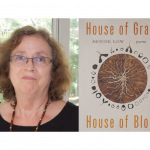
Denise Low recently spoke about her book, House of Grace, House of Blood, with Julie Swarstad Johnson, a guest contributor to Under a Warm Green Linden. Low is a former Kansas Poet Laureate and a founding board member of Indigenous Nations Poets. She currently is a literary co-director for The 222 in Sonoma County, California, and on the advisory board of Write On Door County. She has Northern European and Lenape/Munsee (Delaware) heritage. Johnson is co-editor with Christopher Cokinos of Beyond Earth’s Edge: The Poetry of Spaceflight; and she is Archivist and Outreach Librarian at the University of Arizona Poetry Center.
In 1782, a renegade Pennsylvania militia killed ninety-six pacificist Christian Delawares (Lenapes) in Ohio. Those who escaped, including Indigenous eyewitnesses, relayed their accounts of the atrocity. In House of Grace, House of Blood, Low delves into a critical incident of Indigenous peoples’ experiences. Readers will explore with the poet how trauma persists through hundreds of years, and how these peoples have survived and flourished in the subsequent generations.
Johnson asked Low about her family connections to both sides of the massacre, as well as questions about her research. Below is an excerpt from the interview.
Johnson: As you mention, House of Grace, House of Blood makes extensive use of archival documents. As an archivist myself, I’m always interested in people’s experience with archival materials. Can you describe your experience with archives as you worked on this book? Were you able to see physical items in person or did you access them digitally? Did this have any impact on your writing?
Low: The most important archive was the intangible one of oral tradition—family and tribal. A number of enrolled Delaware elders were generous in sharing unwritten information, which was essential to me personally. And I did not proceed until I heard my uncle affirm our family origins; my brother was also an important source for the memoir. The lacuna in family stories is informative also—what was not said/documented/remembered. Talks with elders was the most impactful of the sources, and the least material.
I appreciate Kevin Young’s discussion of “shadow books” in The Grey Album: Music, Shadows, Lies (2012). These are “books” that were never written because of impediments to black authorship, “removed” books or books with gaps/censored redactions, and lost books—“the oral book of black culture is at times not passed down, at others simply passed over,” Young writes. I appreciate the specific ways these shadow books exist in black United States culture and also, in analogous ways, in Indigenous cultures. Glyphic language of Lenapes is denied legitimacy yet glyph carvings on trees were accurate signposts; rock art is plentiful, and narrative glyphs in basketry, on clan poles, and wampum are all part of a literary cultural legacy.
Read the full interview on the Under a Warm Green Linden website.