 The University of Arizona Press

September 29, 2025
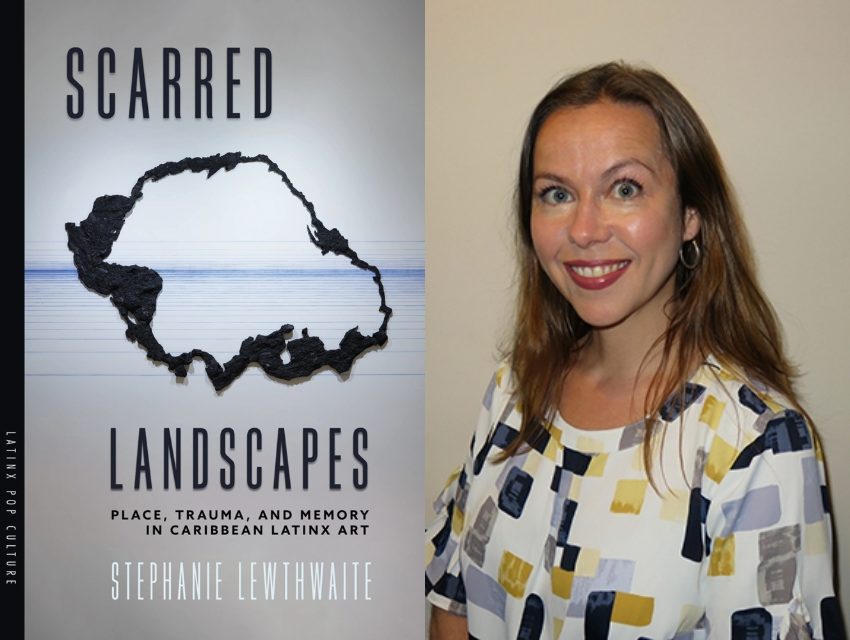
Scarred Landscapes: Place, Trauma, and Memory in Caribbean Latinx Art is a groundbreaking exploration of the rich and complex works of Caribbean Latinx artists. Scholar Stephanie Lewthwaite documents the work of ten influential artists of Cuban, Dominican, and Puerto Rican descent, based in New York City from the 1970s to the present. Through their diverse practices, including painting, printmaking, photography, sculpture, installation, video, and performance art, these artists confront the legacies of colonial trauma and their own experiences of diasporic unbelonging and artworld marginality.
Today, Lewthwaite answers five questions about her work.
What inspired you to write Scarred Landscapes?
I’ve always been fascinated by the relationship between place and memory. My earlier research on Mexican communities and migration in Los Angeles and artistic and cultural exchange in New Mexico led me to consider borderland spaces beyond the U.S. Southwest, namely, the Hispanophone Caribbean and diaspora city of New York, which scholar Melissa Castillo Planas refers to as a “North Atlantic borderlands.” Following the lead of scholars such as Laura E. Pérez, I became interested in parallels between the border theory of Gloria Anzaldúa and the coalitional thought of Cuban-born artist Ana Mendieta, whose work emerged in different geographic contexts but in relation to similar discourses of third-world solidarity and transnational feminism. I began exploring New York as a site of productive exchange between Caribbean Latinx artists with different island and cultural roots who faced old and new traumas in their search for belonging. Teaching students about the diversity of Latinx cultural expression and participating in a memory studies network also led me to write about Caribbean Latinx artists with ties to Cuba, the Dominican Republic and Puerto Rico whose diasporic identities informed what I saw as productive forms of relationality.
Your book puts forth the wonderful concept of “archipelagic memory.” Can you unpack this idea a bit for us?
Scholars have harnessed the idea of the archipelago and archipelagic thought to understand patterns of relationality that inform Caribbean Latinx history and culture. Although centuries of colonialism, imperialism, enslavement, migration, and exile divided the Caribbean and its diaspora communities into nation-bound groups and racial formations, Caribbean Latinx artists have confronted the aftermath of these traumatic histories and their own contemporary unbelonging and marginality by exploring possibilities for solidarity and affirming their multiple diasporic experiences and connections to the rest of the world. The term “archipelagic memory” captures this relationality, and how Caribbean Latinx artists have promoted connectionist sensibilities of different kinds in their work in response to the divisions brought about by trauma: entangling different people, pasts, and places to expose how violence and coloniality resonate in the present and drawing on relational thought to call for justice and solidarity with others in and beyond the Caribbean and New York. In this way, the book frames archipelagic memory as a generative and decolonial form of memory work that imagines other worlds and futures beyond the continuation of trauma in the present.
You talk about work by well-known figures like Ana Mendieta and Coco Fusco but also give space to discussion of lesser-known artists. Could you tell us a bit about one of these lesser-known artists and what drew you to their work?
Following the lead of Latinx art scholars, this book argues that nation-, race-, and class-based hierarchies in society and dominant art worlds lead to the marginalization of some artists over others. Thus, the phrase “lesser-known artist” must be understood in this context and in relation to changes in contemporary art worlds and the academy that have seen some long-established if less visible artists gain increasing recognition in the mainstream as debates about the (mis)representation and erasure of Latinx art have opened up. With respect to younger artists though, I was drawn to the work of Joiri Minaya who views her diasporic experience (Minaya was born in the United States, raised in the Dominican Republic, and trained in Santo Domingo and New York) as a powerful tool for looking across borders and seeking affiliations with others. For example, using performance, photography, sculpture, and installation, Minaya has fashioned a subversive tropical aesthetic that ties the imperial trauma of the Caribbean with that of other archipelagos, such as Hawaiʻi. Minaya’s work shows how archipelagic memory is a vital and ongoing tradition in contemporary Caribbean Latinx art.
Were there any particular stories, images, or archival discoveries that profoundly impacted you during your research for this book?
My correspondence with the Dominican-born artist Freddy Rodríguez really encouraged me to continue researching this book. I position Rodríguez as a foundational figure in Caribbean Latinx art who negotiated various exclusions in U.S. society and mainstream art worlds. One particularly striking image that caught my attention early on was Rodríguez’s use of a disembodied leg belonging to a cimarrón (a maroon or enslaved subject in search of freedom) to symbolize connections between different historical traumas across time and space, his own flight from the D.R., and sense of diasporic un/belonging in N.Y.C. This powerful symbol underscored for me the complexity of memory work in Caribbean Latinx art and how artists such as Rodríguez have had to negotiate multiple worlds, pasts, and presents.
Caribbean Latinx art has a rich and expansive heritage with roots in the Americas as well as ties to different parts of the world. I hope this book will help readers understand this reach and complexity by showing how Caribbean Latinx artists are absolutely vital to narratives of contemporary global art and more inclusive models of justice and belonging that extend beyond territorially bound communities.
What are you working on next?
I continue to work on contemporary Latinx visual culture. I’m in the process of writing a project about Chicanx photography and its relationship with settler colonialism in the Americas, political activism since the 1960s, and debates about border violence, kinship, and decoloniality.
Stephanie Lewthwaite is an associate professor in the Department of American and Canadian Studies at the University of Nottingham. She is the author of Race, Place, and Reform in Mexican Los Angeles, 1890–1940 and A Contested Art: Modernism and Mestizaje in New Mexico. Her interests lie in the field of Latinx visual culture and cultural history.
