The University of Arizona Press

September 16, 2025
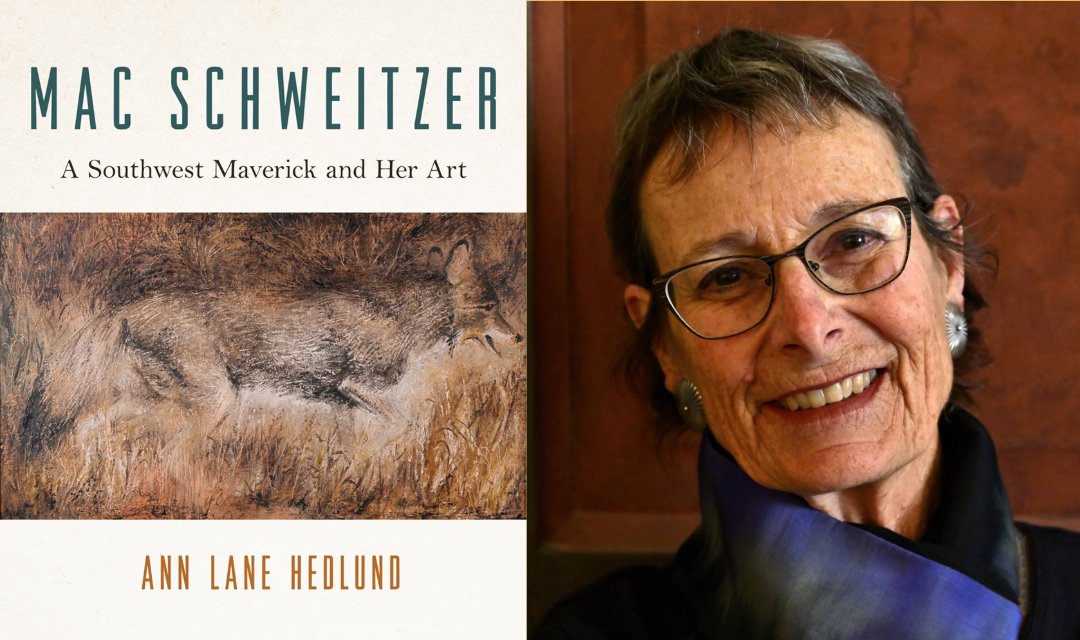
In Tucson during the 1950s, nearly everyone knew, or wanted to know, the southwestern artist Mac Schweitzer. Born Mary Alice Cox in Cleveland, Ohio, in 1921, she grew up a tomboy who adored horses, cowboys, and art. After training at the Cleveland School of Art and marrying, she adopted her maiden initials (M. A. C.) as her artistic name and settled in Tucson in 1946. With a circle of influential friends that included anthropologists, designer-craftsmen, and Native American artists, she joined Tucson’s “Early Moderns,” receiving exhibits, commissions, and awards for her artwork. In Mac Schweitzer: A Southwest Maverick and Her Art, author Ann Lane Hedlund draws from the artist’s letters, photo albums, and published reviews to tell the story of Mac’s creative and adventuresome life. Today, Ann answers five questions about the book.
What first sparked your interest in Mac Schweitzer?
Mac was the mother-in-law I never knew because she died fifteen years before I met her son Kit in 1977. Kit and I married five years later, and our house filled with artworks made by Mac, Kit, his father Jack, and other artists whom we both knew. Family members and friends often focused on the tragedy that Mac died when not quite 41, leaving a toddler and teen-aged son, but few people could recall the variety of works she made, the energy she put into her career, and the awards and honors that she earned. All that was forgotten until I started researching her background through scrapbooks, photo albums, and hundreds of newspaper articles and announcements.
How did Mac fit into the ethos of modernism in Tucson?
Tucson in the 1940s and ‘50s was a lively arts colony, where galleries, festivals, and a nascent museum of art promoted local and regional artists. Arriving in 1946, Mac joined the Tucson Fine Arts Association and showed in several prominent downtown galleries, where she became known as an innovative artist. The modernist movement championed stylized geometric patterning, shifting perspectives, textured materials, and mixed media, among other things. Mac used all these, adding a Southwest twist with her rustic subject matter and distinct coloration. Collectors loved her work, which fit into the modern homes and offices that well-known Arizona architects designed and built at that time.
What was Mac’s process for creating animal paintings while she lived in the Tucson Mountains?
Since high school when she drew caricatures of her teachers and fellow students, Mac was a careful observer of people, places, wildlife, and plants. From the patios and kitchen window of her remote desert bungalow, she watched coyotes, javelina, deer, rabbits, rodents, and many birds up close. She also visited the Arizona-Sonora Desert Museum where she could study the more elusive mountain lions and bobcats. She made quick pencil sketches, working mostly from memory, not from photos. Her drawings and prints capture the animals’ personalities and surroundings, not just their forms. Her paintings bring to life each critter’s character.
How was Mac (an outsider/white woman) welcomed onto northern Arizona’s Indian reservations?
When she started exploring and camping in the Four Corners area, Mac was a single mother whose grade-school-aged son Kit traveled everywhere with her. Together they visited the homes and herding grounds of Hopi and Navajo families, first introduced to them by anthropologist-friends from Tucson. Mac always shared food, art-making supplies, and other goods, while Kit played with the local children. Both mother and son regarded their new friendships as open-hearted, two-way connections. Their friends met them at least halfway, exchanging invitations to attend ceremonial dances and feasts with opportunities to visit Tucson museums, schools, and events. Mac and Kit recognized the privilege to learn about distinct cultures, the importance of privacy and boundaries, and the reciprocal nature of integrating experience into art and life.
What is your next research or writing project?
Well, continuing with that theme of “the privilege to learn about distinct cultures,” I’ve become interested in looking back at my own career as a cultural anthropologist who documented and collaborated with Navajo weavers and other artists. What paths led me to learn about their creative lives? What pitfalls and challenges did I encounter along the way? How was the “arts and crafts scene” when I started, compared with the modern art world today? So many loose ends to follow, so many adventure-filled tales to tell! I don’t yet know whether these musings might result in a single essay, a memoir-esque book, or something in between, but at this stage it’s exciting to look ahead and behind.
****
About the Author
Ann Lane Hedlund is a cultural anthropologist who collaborates with Indigenous weavers and other visual artists to understand creative processes in social contexts. From 1997 to 2013 she served as a curator at Arizona State Museum and professor at University of Arizona, Tucson, where she also directed the nonprofit Center for Tapestry Studies. She is author of Navajo Weaving in the Late Twentieth Century and Gloria F. Ross & Modern Tapestry, among other works.