The University of Arizona Press

October 9, 2025
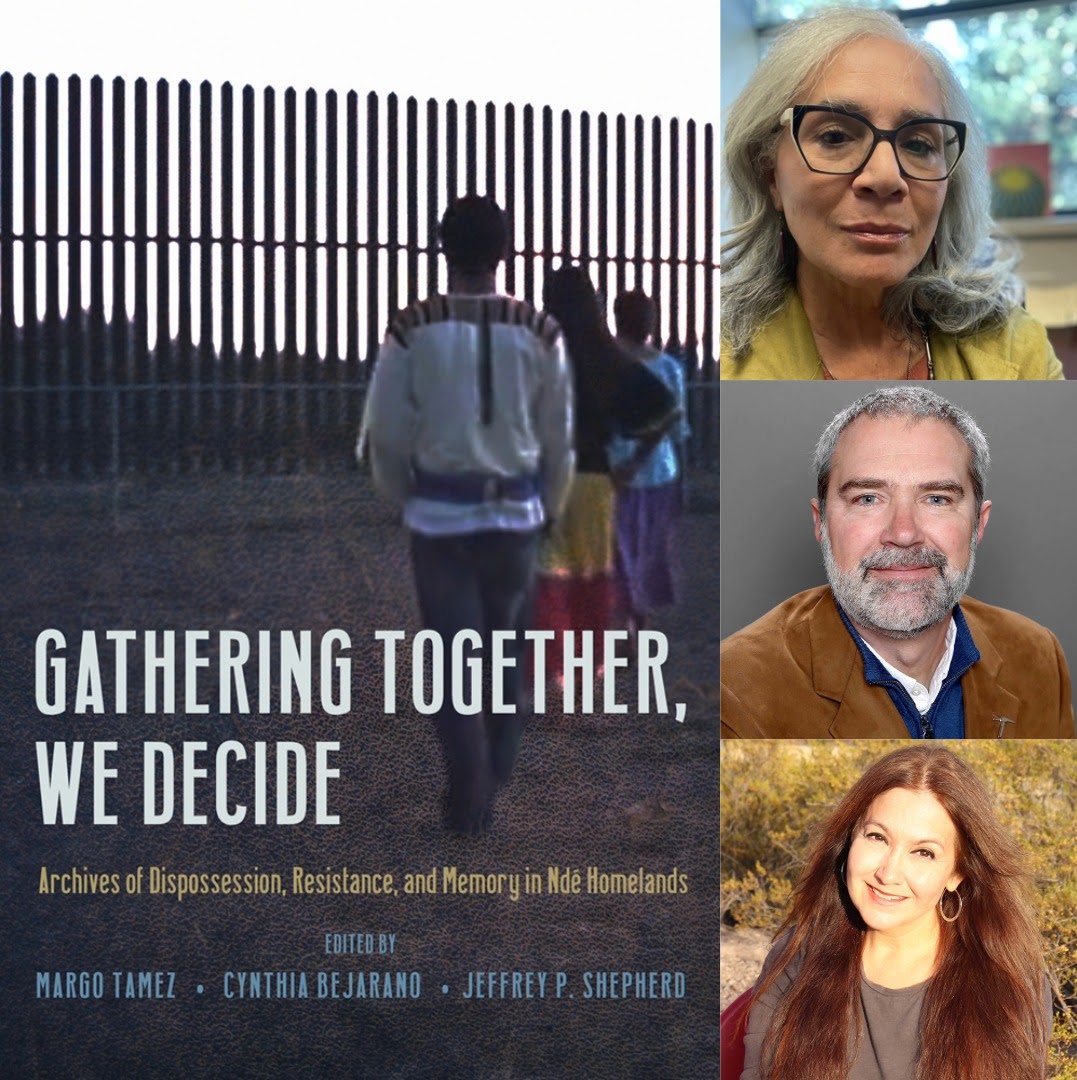
Gathering Together, We Decide: Archives of Dispossession, Resistance, and Memory in Ndé Homelands by Margo Tamez, Cynthia Bejarano, and Jeffrey P. Shepherd is a unique collection that spotlights powerful voices and perspectives from Ndé leaders, Indigenous elders, settler-allies, Native youth, and others associated with the Tamez family, the Ndé defiance, and the larger Indigenous rights movement to document their resistance; expose, confront, and end racism and militarization; and to foreground Indigenous women-led struggles for justice.
In 2007, the Department of Homeland Security began condemnation proceedings on the property of Dr. Eloisa Tamez, a Lipan Apache (Ndé) professor, veteran, and title holder to land in South Texas deeded to her ancestors under the colonial occupation and rule of King Charles III of Spain in 1761, during a time when Indigenous lands were largely taken and exploited by Spanish colonizers. Crown grants of lands to Indigenous peoples afforded them the opportunity to reclaim Indigenous title and control. The federal government wanted Tamez’s land to build a portion of the “border wall” on the U.S.-Mexico border. She refused. In 2008, the Department of Homeland Security sued her, but she countersued based on Aboriginal land rights, Indigenous inherent rights, the land grant from Spain, and human rights. This standoff continued for years, until the U.S. government forced Tamez to forfeit land for the wall. Read an excerpt from the book’s Foreword below.
I’m Eloisa Taméz, and I’m one of the landowners who had the misfortune of being one of those selected to have the border wall built across my land. And I wanna tell you that the land that we’re standing on is a remnant of the San Pedro de Carricitos Land Grant, which was awarded to my family in 1767. At that time, it was over 12,600 acres. I have three acres here, but it is just as special as if it were 12,000 acres. And it’s just as sacred to me and my family as if it were 12,000. The size doesn’t matter; it’s what it represents.
This is the land that—where my father and my grandfather carved a life for us by farming and raising stock so that we would have good nutrition and a good lifestyle. So, in spite of the poverty that we were experiencing, it didn’t seem like poverty to us because we had all the natural foods that were available to us through their efforts. And my father and my grandfather farmed this part of the land grant plus another several acres that went all the way to the river’s edge. So I got the news about the wall that would be constructed across my land on August the 7th, 2007. And apparently the government didn’t have the courage to face me face-to-face, so they had two Border Patrol agents call me at my office.
I’m a professor at the University of Texas in Brownsville, and I was called [by the government] at my [university office] desk. So they got my number. And I was called directly to my extension by them in which they—at that time, there were two of them and they were on speakerphone, and they told me that—they wanted to know what my name was—if I was Eloisa Taméz, and I said, “Yes.” And so then they said, “Well, I am so-and-so from the Border Patrol,” and then the second one introduced himself. And so they told me that they needed to tell me that the land that I owned would be affected by the border wall, had I heard about the border wall.
I said, “Well, yes, I’ve heard about the border wall.” And so they said that they wanted me to agree to sign a—to give them permission to come and do a survey of my land.
And I said, “For what purpose?” They said, “Well, we need to do the survey to determine if the land is appropriate for the building of the wall.” And I said, “And what will that mean?” “Well, we’ll come in and we’ll punch a few holes in your property and then we’ll determine after the analysis what—whether the land is appropriate or not.” And I said, “And you need how much time for that?” “Well, we need at least a year.” And I said, “But you said it was only gonna take you a few hours. Why do you need a year?” And so I said, “Well, you know what? You know, we don’t need to continue this conversation because I don’t do business over the phone. So if you wanna do business with me, you have to come and see me face-to-
face.” And so that’s the way it started.
So it took two more contacts with the same Border Patrol agents, plus some members of the Corps of Engineers, to finally get to the point where they came to see me in my office. Because they would call me on a Saturday evening. More than once. And so I said, “No, you need to come to me and show me the document.” Well, they finally came after contacting [me] more, two or three times. And so, then when I wouldn’t agree to sign the authorization for the initial survey, I then was told that, “Haven’t you heard about eminent domain?” And I said, “Yes, I’ve heard of eminent domain. I know what it is,” and I said, “But I’m still not going to be in favor of this.” So I didn’t sign—I didn’t give them permission to come and do the survey.
Margo Tamez (Ndé) is an associate professor of Indigenous studies in the Community, Culture, and Global Studies Department, Faculty of Arts and Social Sciences, and affiliated in the MFA Creative Writing (Poetry) Program, Faculty of Creative and Critical Studies, at the University of British Columbia in the unceded territory of the Syilx Okanagan People. Cynthia Bejarano is a regents professor and College of Arts and Sciences Stan Fulton Endowed Chair at New Mexico State University. Her research and advocacy focus on embodied border experiences with violence, immigration, migration, and gender-based violence and feminicidios at the U.S.-Mexico border. Jeffrey P. Shepherd is a professor in the Department of History at the University of Texas at El Paso. His research and teaching focuses on Native Peoples of the U.S.-Mexico borderlands and the U.S. Southwest, environmental history, public history, and the history of right-wing extremist movements.