The University of Arizona Press

October 14, 2025
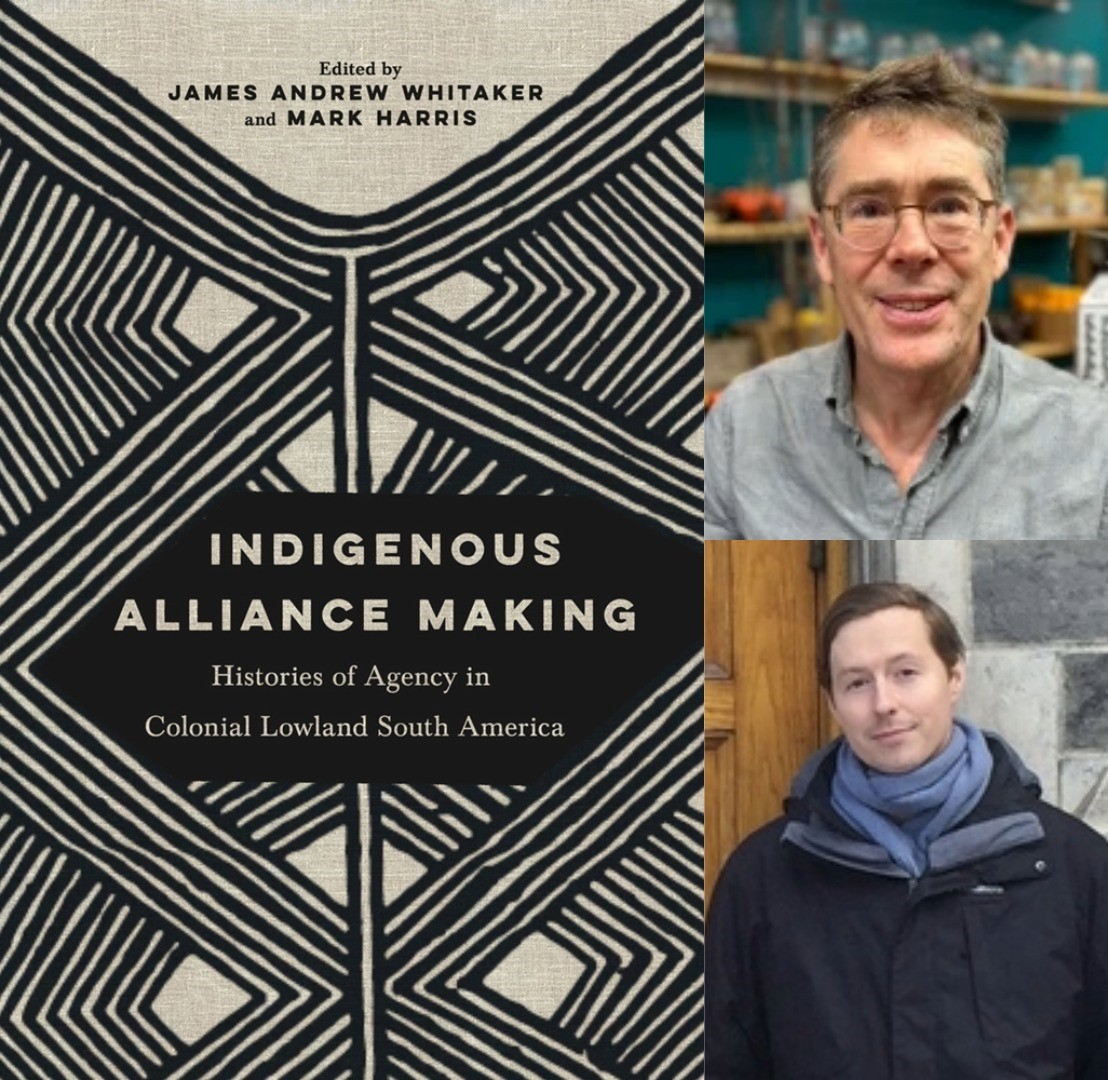
Indigenous Alliance Making by James Andrew Whitaker and Mark Harris brings together historical analyses with anthropological investigations to explore the organizational patterns, goals, and strategies through which Indigenous people have intentionally created various alliances, partnerships, and similar relations with outsiders in lowland South America. Emphasizing class, ethnicity, gender, and race, the chapters bring new dimensions to understanding a vital but understudied region.
During the colonial and postcolonial eras, local people in lowland South America experienced exploitation from outsiders. But as new kinds of societies emerged from engagements between outside and Indigenous communities, Indigenous Amazonians formed strategic alliances to defend livelihoods, territory, and symbolic values, as well as to curb exploitation, predation, and threats.
Through missions, war, and broader conflict, as well as marriage and kinship, local people aimed to maintain control even as personal and collective transformations unfolded. This volume explores the formation of diverse historical relations across regional societies within past and contemporary contexts and contributes to a growing historiographical turn among anthropologists and historians that foregrounds agency in past and present understandings of Indigenous peoples’ engagements with others in lowland South America. Read an excerpt from Chapter 1 below.
António Vieira (1608–97) was a prominent Jesuit missionary known for his work among Indigenous peoples in Brazil. Born in Lisbon, Vieira’s mission work and political negotiations significantly acted within the Portuguese empire and colonies during almost all of the seventeenth century. His writings offer crucial insights into colonial Portuguese strategies and interactions with Indigenous communities. They reflect both the challenges of missionary work and the broader geopolitical and economic motivations behind European colonization.
First published in 1736, Vieira’s Report of Serra de Ibiapaba Mission is a curious text whose trajectory, potential recipients, and true purpose have not yet been sufficiently elucidated.1 This text is historically important as it provides a unique perspective on the relations between the Portuguese and Indigenous communities during a period of intense colonial and religious expansion. The narrative presents a nuanced view of Vieira’s mission, highlighting the resistance and agency of the Indigenous people rather than portraying them as passive recipients of conversion. The report not only documents the geopolitical context of Portuguese and Dutch rivalries but also highlights Vieira’s advocacy within this context for the autonomy of Indigenous peoples, portraying them as active agents rather than passive subjects in the colonial encounter.
Through an analysis of Vieira’s Report, this chapter explores how his missionary activities were aimed at converting the Indigenous population to Catholicism and submission to the Portuguese Crown. It emphasizes Vieira’s view that this process should be conducted with the consent of the Indigenous communities and should respect their sovereignty and freedom. After briefly retracing his biography within the imperial geopolitical context, the chapter analyzes the strategies Vieira employed in his mission in Ibiapaba, the challenges he faced, and the broader implications of his mission within the context of colonial power dynamics. Having had diplomatic experience in Europe before becoming a missionary in Maranhão, Vieira seems to have viewed his experience in Ibiapaba more as a diplomatic mission than as a purely religious one. This provides a new perspective in analyzing his writings about Indigenous peoples.
To understand his ideas requires two contextual pieces of information at the outset. The first is the Portuguese-Dutch global rivalry in the spice trade. The Ibiapaba mission was one episode in the “global struggle” between the Portuguese and Dutch for control of overseas markets (Boxer 1969; Cardoso 2019). The second is the local competition between settlers and clerics for control of Indigenous labor. Located in the frontier region, the Serra de Ibiapaba mission was relevant to the Portuguese Crown for the trade in violet wood and amber, as well as for overland communication between the Brazilian coast and the frontier (known as Maranhão). Vieira therefore believed it was necessary to neutralize Dutch influence in the region. To do so, it was first essential to protect the Indigenous people from the “greed” of the local settlers.
James Andrew Whitaker is an assistant professor of anthropology at the University of Southern Mississippi. He is also an honorary research fellow at the University of St Andrews. His research focuses on historical anthropology, historical ecology, and ontologies in lowland South America. Mark Harris is a professor and head of the School of Philosophical, Historical, and Indigenous Studies at Monash University and an honorary professorial research fellow at the University of St Andrews. His research focuses on the Brazilian Amazon and what makes it a place of global historical and anthropological significance.