The University of Arizona Press

November 11, 2025
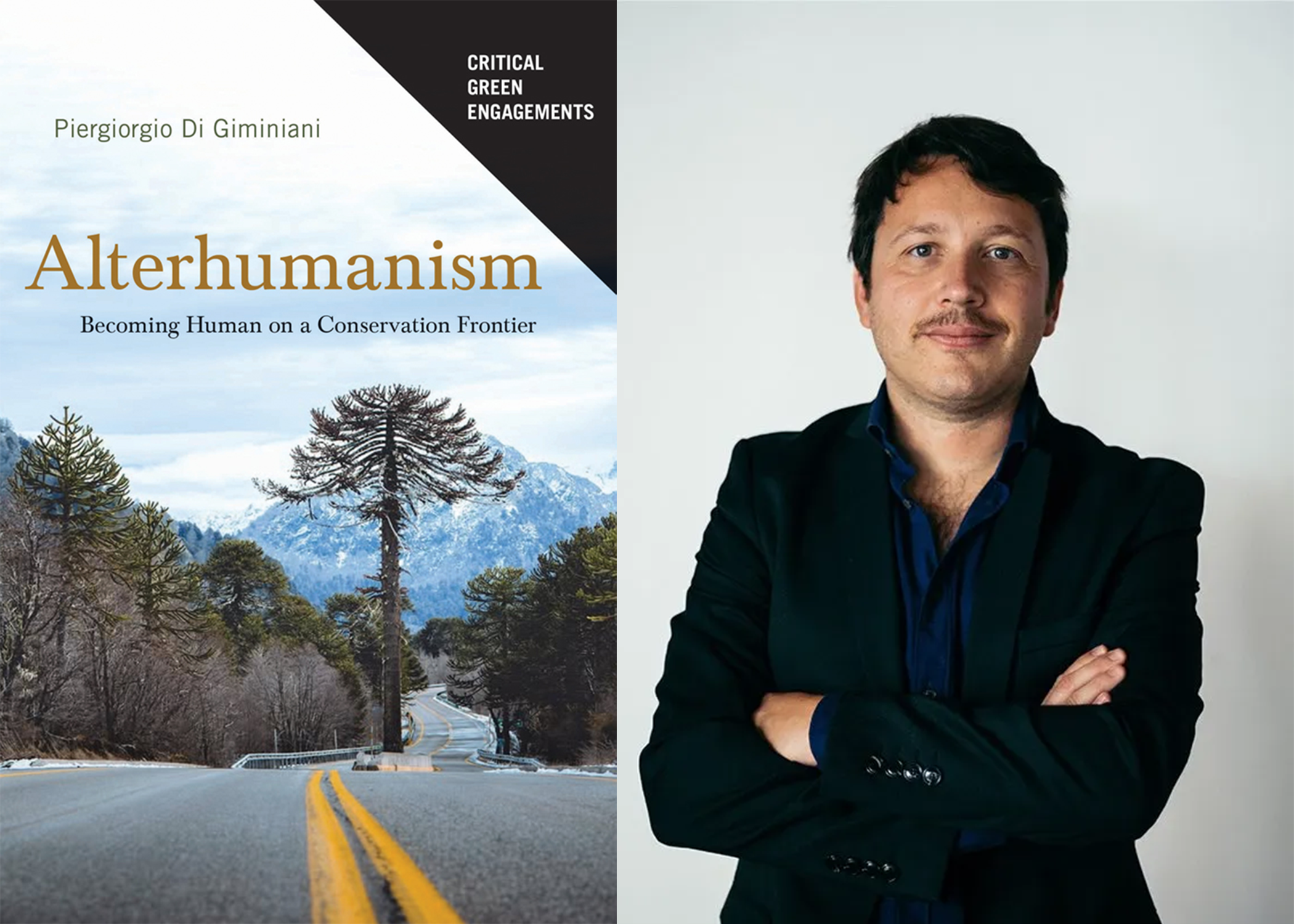
Alterhumanism is a rich, ethnographically grounded perspective on humanity’s evolving relationship with the natural world. Set against the backdrop of southern Chile’s conservation frontier, Piergiorgio Di Giminiani invites us to recognize the centrality of the human condition in the face of an increasingly uncertain world and imagine future forms of coexistence.
Reflecting on more than a decade of ethnographic fieldwork with smallholding settlers, Indigenous Mapuche farmers, environmental activists, entrepreneurs, and conservation scientists, Di Giminiani brings to light how these diverse groups navigate the enduring impacts of settler-caused environmental depletion and their aspirations for new ethics of care. Di Giminiani challenges traditional Western humanism, proposing a more relational and open-ended understanding of humanity shaped by interactions with nonhuman others. Rather than seeking fixed answers, the book explores the fluid and multifaceted nature of becoming human through the lens of conservation politics. By highlighting the entangled, multispecies worlds of southern Chile, Di Giminiani offers a novel approach to understanding the political project of becoming human in the Anthropocene. Read an excerpt from the book’s Introduction below.
Imagine you are riding a bus or perhaps driving down a fast, single-lane road. Trees line both sides, standing in neat rows as you pass. Expansive fields of lush green grass stretch out around you where large herds of cows placidly graze. In the distance, mountains rise, their slopes blanketed by dense forests that reach all the way to their tops. Along the roadside, various signs catch your eye: advertisements for a small grocery store, directions to a nearby lake, or pointers to a small hotel. The houses you pass are charming, singlestory wooden buildings, each surrounded by a fence that encloses a small garden where carefully tended roses bloom in vibrant colors. If it is a summer day, the weather is likely hot and dry. If it is winter, it is cold, possibly foggy, with snow visible on the mountaintops.
After a while, you turn onto a gravel road, and the ride becomes bumpy. The valley here is much narrower than the one you were in before, now surrounded by dense forests. Amid the thick trees, a small but fast-flowing river winds. Soon, you cross it via a wooden bridge, and the road begins to climb steeply, twisting as it goes. A couple of pickup trucks roll by in opposite directions, announced by a dust cloud. You see a couple of people along the road; one is waiting to hop on the bus, while the other is herding a cow. At some point you hear the sound of a motor. You realize the sound is coming from a modest building with a small zinc roof and no walls. Around the building lie large piles of wood and piles of debris. It is likely a small sawmill.
As you continue along the road through the forest, small patches of grassland enclosed by barbed wire begin to appear. Here and there, old tree trunks bleached by time lie scattered across the ground. Wooden, single story houses are tucked away, blending into the landscape so well that they’re frequently hidden from view. Often, a simple wooden gate is the only clue to their presence. Signs occasionally hang beside these gates, marked with words like “Bread” or “Eggs,” suggesting you might find these items for sale at the nearby houses. One sign reads, “Let’s protect life. No to the hydroelectric plant,” while another features a beautifully painted tree alongside the words “Lodging” and “Indigenous Tourism.”
At some point, you run into a larger building, a one-floor wooden structure with a flagpole and a sign at the entrance saying “School.” You see more signs; many of them simply say “For Sale.” As you go up the valley, you realize many houses are surrounded by understory. Everything points to the fact that they were abandoned years earlier. Finally, the road stops at a gate; you’ve reached the last house. There are trails that you can take to walk farther up the hills and into the dense forest, or perhaps, after taking in the surroundings, you decide to turn around and head back toward the main valley. The gentle slope eases up, the open landscape comes back into view, and soon the familiar sights of the larger valley unfold before you once more.
This brief trip might feel familiar to anyone who lives near or has ventured into one of the world’s many temperate forests. What at first might appear to be untouched nature reveals itself as a complex palimpsest of past and present human labor (Mathews 2022, 54). Scattered around these landscapes lie many signs (in some cases, literal ones) that give clues to the many stories of the people who have made these forests their homes. These signs point to interdependent stories of the growth and retreat of forests as well of the human collectivities dwelling around them (see Rival 1993). Images of land abandonment and rewilding are recurrent, but so are hints of the relentless expansion of residential and transportational infrastructures. The enduring effects of deforestation materialize in the irregular patchwork of grassland and forests.
Piergiorgio Di Giminiani is an associate professor in anthropology at the Pontificia Universidad Católica de Chile. He is the author of Sentient Lands: Indigeneity, Property, and Political Imagination in Neoliberal Chile and co-editor of Theorizing Relations in Indigenous South America and The Futures of Reparation in Latin America: Imagination, Translation and Belonging.