The University of Arizona Press


November 19, 2025
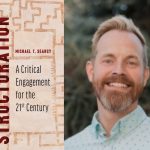
Archaeological Structuration by Michael T. Searcy not only revisits the foundational influence of structuration theory but also introduces new methodologies to study the longue durée, the long-term historical trajectories of ancient societies. Searcy deftly bridges the gap between theoretical frameworks and practical archaeological applications, providing a thorough analysis of how structuration can address real-world problems through the lens of ancient societal transformations. Read an excerpt from the book’s Introduction below.
This book is, in part, the result of an attempt to pin down theoretical trends over the first two decades of the twenty-first century. Doing so has been a challenging pursuit especially as the archaeological literature continues to grow, which makes it difficult to characterize the discipline’s current state. Trying to follow the threads of theory across an ever-expanding literature is much like someone attempting to describe the waves of the ocean while in the water bobbing over each passing wave. Floating at the crest of one, you think you have a good perception of waves to come or waves headed to shore, but the fluid movements are not quite predictable. Only as we look back toward the shore and see a wave crashing to its end or retreating to rejoin the ocean can we understand its trajectory. A full view of the ideas simultaneously developing in any discipline proves difficult if not impossible. Even arriving at this juncture over two decades into the twenty-first century, twenty-twenty hindsight has yet to fully develop for the most recent theoretical movements in archaeology.
Over approximately the past forty years, one wave to have washed over and through archaeology has been practice theory. Originating in sociology, much of its influence on archaeological research and thought is clear on the surface, but some of the undercurrents related to more obscure aspects of this theoretical approach have had profound effects on the discipline. Links can be made to the development of symmetrical archaeology, eventful archaeology, entanglement, agency, and even pragmatic or action archaeology. The primary aim of this text is to present a critical analysis of how some of the fundamental tenets of practice theory have been productively yet incompletely applied to archaeological research.
Of the most consequence in archaeology have been the ideas of sociologist Anthony Giddens related to his work on structuration theory. Following a deep reading of his writings on the topic, I hunted for references to Giddens’s work in archaeological literature working to identify scholars who referenced different aspects of structuration. Throughout this review, it was surprising to note the often singular approach to concepts such as agency, and I also noted how few archaeologists engaged directly with the resource side of structure (i.e., rules and resources). There is a noted lack of development of just how archaeologists have interpreted, and thus incorporated, principles of Giddens’s explanation of resources into archaeological versions of structuration. Indeed, symmetrical archaeology and new materialist archaeologies have begun to unravel and more adequately explain the tangled nature of agents with their environments, things, and other people. But some have critiqued structuration as being a vestige of structural approaches, oversimplifying it as a basic dichotomy between agents and structures. This oversimplification of the concepts, however, negates the complexity of what structures represent and the milieux in which they interact with agents. It also glosses over the intrinsic variables of structures such as rules, resources, and environments or the combination of agentive elements such as access to resources, motivations, or knowledge.
Michael T. Searcy is a professor of anthropology and chair of the Department of Anthropology at Brigham Young University. He is also the director of the New World Archaeological Foundation. Michael has worked in the U.S. Southwest/Northwest Mexico and Guatemala for more than twenty years. He is author of The Life-Giving Stone: Ethnoarchaeology of Maya Metates and co-author of Hinterlands to Cities: The Archaeology of Northwest Mexico and Its Vecinos with Matthew C. Pailes.