The University of Arizona Press

November 25, 2025
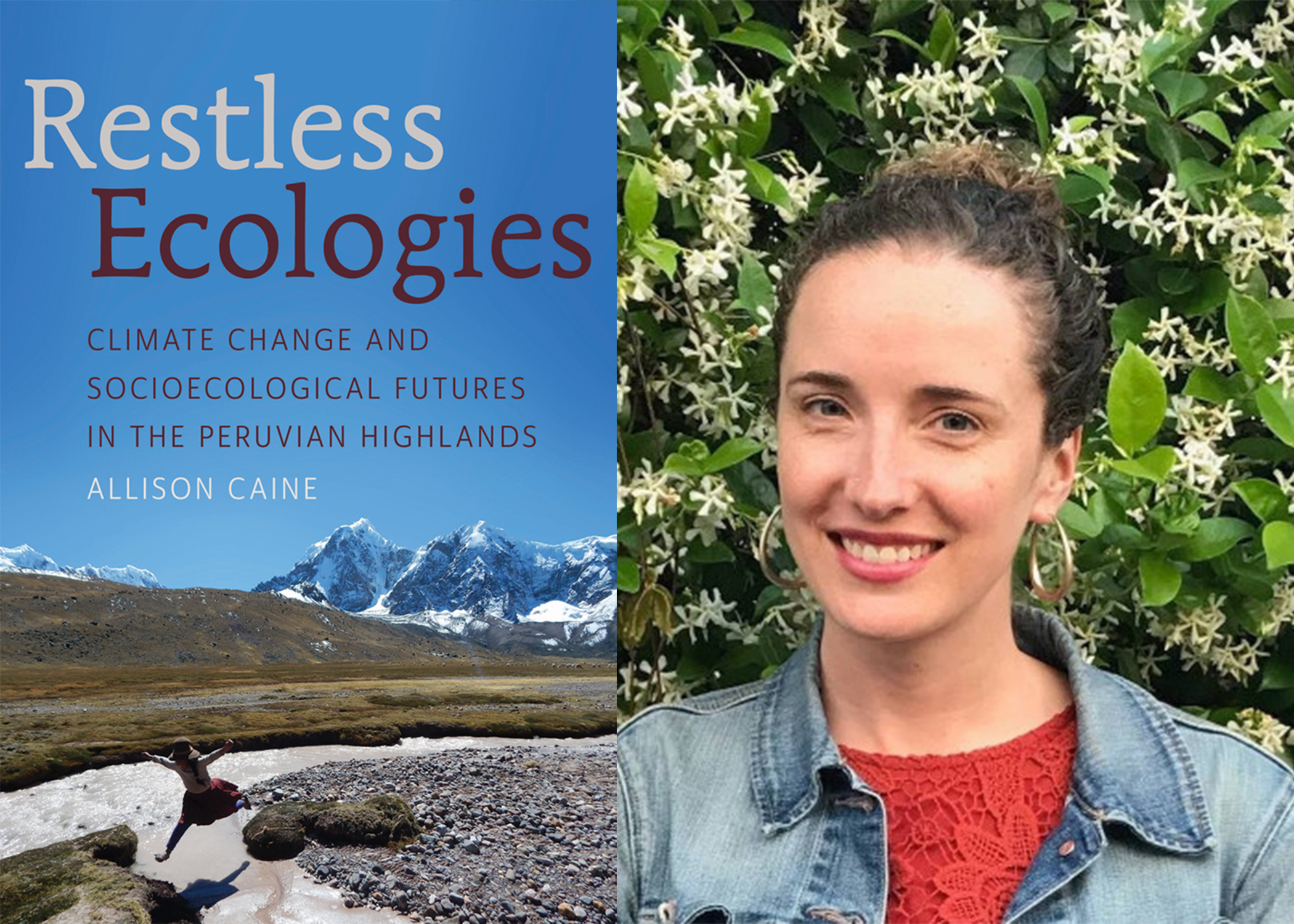
For more than two years, Allison Caine herded alongside the women of the Cordillera Vilcanota, observing them and talking with them about their interactions with their animals, landscapes, and neighbors. In Restless Ecologies: Climate Change and Socioecological Futures in the Peruvian Highlands, Caine emphasizes the importance of Indigenous knowledge and traditional ecological practices and argues that Quechua understandings of restlessness align with and challenge broader theoretical understandings of what it is to be vulnerable in a time of planetary crisis.
Drawing on the Quechua concept of k’ita, or restlessness, Allison Caine explores how herders in the community of Chillca in the Cordillera Vilcanota mountain range of the southeastern Peruvian Andes sense and make sense of changing conditions. Capricious mountains, distracted alpacas, and wayward children deviate from their expected spatial and temporal trajectories. When practices of sociality start to fall apart—when animals no longer listen to herders’ whistles, children no longer visit their parents, and humans no longer communicate with mountains—these failures signal a broader ecological instability that threatens the viability of the herder’s world. Read an excerpt from the book’s Introduction below.
This is a book about the beginnings of fragmentation, specifically the first notes of agitation—of restlessness—as relations between people, animals, and landscapes began to strain and shift. When I arrived in the herding community of Chillca in southeastern Peru in 2015, the rumblings of a larger process of fragmentation were beginning to accelerate. Indeed, in the years after I left, the community would vote to divide their communal pasturelands in the face of increasing conflict over diminishing grasslands and restless animals. This book is, in many ways, the prelude to the breakdown of the commons. But more than that, it is an ethnographic exploration of the attentive forms of attunement, care, and communication through which people both sustain the multispecies assemblages within which they live and notice the first hints of estrangement and detachment in those relationships.
In more concrete terms, this book asks how herders in the community of Chillca sensed and made sense of changing socioecological conditions in the shifting qualities of their interactions with the humans, animals, and landscapes of the Cordillera Vilcanota mountain range of southeastern Peru. Much of this work was undertaken by the women of Chillca, who are the primary pastoralists in the Cordillera Vilcanota and continue to be “stewards of the rangelands” throughout the Andes mountains (Valdivia, Gilles, and Turin 2013). The central theoretical thread of this narrative draws on their utterances and provocations, specifically those shouted at wandering animals: k’ita uywa! Restless animals. In this book, I draw upon the Quechua concept of restlessness (k’ita) to articulate the breakdown of sociality between human and nonhuman social beings, as capricious mountains, distracted alpacas, wayward children, and aging bodies deviated from their expected spatial and temporal trajectories. When practices of sociality began to fall apart in Chillca—when animals no longer listened to the herder’s whistles, humans no longer communicated with mountains, and both bodies and landscapes began to dry out—these failures signaled a broader ecological instability, one that threatened the viability of the herder’s world and their own survival. And the Quechua analytic of restlessness that herders used to describe these changes
both aligned with and challenged prevailing theoretical understandings of what it means to be vulnerable in a time of planetary crisis.
To explore the relationships that hold humans, animals, and landscapes together in the high Andes, I conducted two years of ethnographic and mixed-methods fieldwork (2014–16) in the Cordillera Vilcanota. Between June 2015 and July 2016, I lived in the community of Chillca, a small pastoralist community where people herded their animals in an approximately sixteen-hectare glacial valley system on the southern slopes of the mountain of Ausangate. For one of those years, I herded alongside the women of Chillca, following in their footsteps, observing their interactions with their animals, landscapes, and each other, until eventually I was deemed competent enough to tend a few animals myself. My methods entailed the careful analyses of the “ecology of obligation” of pastoralism (Despret and Meuret 2016, 27)—the multispecies relations of attention, care, affect, and predation—that coalesced in human and animal bodily orientation, communication, recognition, and shared labor in the pasture. While studying the daily practices through which herders and their animals coproduced their lived world, I became especially intrigued by the moments when the work of herding fell apart, and how these moments of frustration and antagonism were interpreted by herders as signals of broader socioecological trouble.
By analyzing climate change from the ground up, this book asks what herders in the high Andes can tell us about climate change in their communities. In the coming chapters, I will suggest that the Quechua con-cept of k’ita provides a compelling articulation of the social and ecological unpredictability that defines the world under a changing climate. Quechua analytics of restlessness both merge with and diverge from recent interpretations of unruly, wild, or feral ecologies. On the one hand, k’ita neatly articulates the confluence of temporal, spatial, and relational qualities that define precarity in a time of climate change. Traces of restlessness are palpable around the globe, as phenomena come untethered from their expected and anticipated positions in time and space, and predictable forms of relationality between beings and entities become increasingly elusive. And yet k’ita also pulls us back from the apocalyptic leanings of wildness, ferality, and unruliness to emphasize the continued practices of relation that endure through disruption.
The central narrative in this book pivots around the life history and experiences of Concepción Rojo Rojo, an alpaca herder and folk singer whose stories and songs provide a touchpoint for the broader discussions around change and continuity, endurance and precarity, and aspirations of improvement that rippled throughout the broader community. This isn’t to suggest that this is her story alone: Concepción would not claim to speak for all herders in Chillca, and indeed there are many voices running throughout this text. Her experience stands not as the definitive story of this time and place but as a guiding line through what is a much larger and more complex story, the details of which will unfold throughout the
ensuing chapters.
Allison Caine is an assistant professor of anthropology at the University of Wyoming with an interest in the environment, rural health, and well-being in the Peruvian Andes and the U.S. Mountain West. Her research in Peru takes a multidisciplinary and collaborative approach to understanding contemporary environmental problems in partnership with international and Indigenous citizen scientists. Her ongoing research program aims to understand diverse experiences of health and aging in changing landscapes in Peru and the United States.