The University of Arizona Press

February 17, 2026
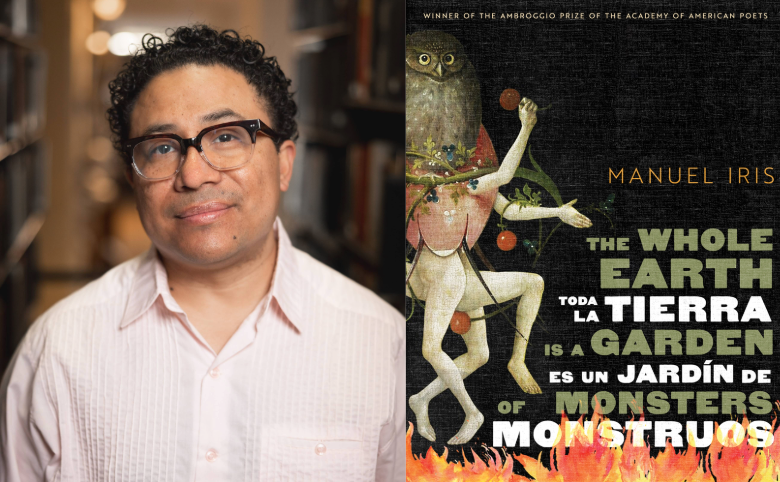
The Whole Earth Is a Garden of Monsters / Toda la tierra es un jardín de monstruos by Manuel Iris intertwines the lives of the northern Renaissance painter Hieronymus Bosch (1450–1516) and an imagined contemporary migrant worker named Juan Coyoc, later known as Juan Domínguez. These two figures run in parallel, mirroring each other across languages, time, and continents. This imaginative, boundary-blurring collection was selected as the winner of the 2025 Ambroggio Prize of the Academy of American Poets.
By comparing and at times intertwining the two poetic narratives of Bosch and Coyoc/Domínguez, the book explores themes of art, migration, narco-violence, family, spirituality, and the idea that every human being represents all humanity at any moment in history. Both Hieronymus Bosch and Juan Domínguez become relatable and intimate figures, part of our own story.
Today, Iris answers five questions about his work.
Your title is a reference to Hieronymus Bosch’s painting, “The Garden of Earthly Delights.” How did you become interested in this painting?
I do not remember how old I was exactly when I was first exposed to a reproduction of The Garden of Earthly Delights. It was maybe an illustration in a book, or a small picture in the pages of an encyclopedia, perhaps. I do know that I was not an adolescent yet, and that those images have haunted me for most of my life. Not only the third panel, the one that represents hell, but the whole painting. I was and still am in awe of how everything in the painting, every creature, seems to be at the same time possible and impossible. I always had the impression that those images were a sort of portrait of humanity, of the human condition. Like any great work of art, this painting is a confession, a shared secret, the footprint of an epiphany. My later love for surrealist art might be the result of Bosch’s influence in my sensibility from an early age.
However, it was only in the last five or six years that I became sort of obsessed with researching Bosch’s life and his complete works.
Can you tell us about the process of translating this book, and working alongside Kevin McHugh who you call your “cotranslator”?
I was born in the Yucatan Peninsula, in Mexico. I became a writer there. During my formative years, I saw that the indigenous poets of the Yucatan, great Mayan poets, were almost all the time their own translators into Spanish. This duality author/translator was and still is the result of a very practical need: if they were to wait for a translator to appear, their work might never be translated, or the publication in Spanish would be seriously delayed or postponed. They became their own translators out of a need to be read in the dominant language of the place they lived.
My situation as a Spanish-speaking poet in the U.S. shares at least one similarity with that of the Mayan poets: if I were to wait for a translator for each one of my books, this very book wouldn’t yet exist. I started translating myself when I decided I wanted to become a U.S. poet who could be read by as many people as possible.
However, I was not aware of the depth of transformation I, as a poet, would experience as a result of becoming my own translator. Now, translating is part of my editing process. What I mean is that sometimes I prefer what is happening in the English version of my poems, and then I go back and revise the Spanish original to match the spirit of the translation. But now, after making two-way changes, which poem is the original one?
My translations of my own poems are not literal, nor too faithful to the original words. They are, however, very faithful to the music and spirit of the poems in Spanish. I allow myself to change things, words, to better fit the feeling of the original poem.
As a translator of my own work, I pursue the spirit of the poems more than I chase linguistic equivalencies. Sometimes I need help sharpening the music of the English poems, and that is where Kevin McHugh comes in. He is the owner of a gifted poetic ear. His sensitivity to the music turning into words and vice versa, is outstanding. He has helped me shape the music (and music is meaning) of the poems in this book, and other books of mine. He is, indeed, a cotranslator of my work. He has served as a guardian of my music when I try to sing English, in a sense.
There are numerous instances of mirroring in this book: Bosch and Juan Coyoc; poems paired with the same title; and even the translation itself, presented first in English and again in Spanish. How do you think about these acts of mirroring and doubling?
One of my constant creative obsessions is the belief that every thing, every body, is a repetition of something else. There is nothing new under the sun. However, at the same time, every face, every object, every experience is unique, original. This duality, for me, affirms our (very temporal, futile) identity and, at the same time, affirms our belonging to the universe, to eternity. I do believe that every single person is a representation of all humankind.
This is maybe why I devised a poetic experiment that emphasizes the similarities between the two seemingly distant characters you mentioned: Hieronymus Bosch and Juan Coyoc (later known as Juan Domínguez), which is an imagined contemporary migrant worker. Their two narrative threads, one rooted in history, the other in fiction, unfold in parallel as “mirror poems”, intersecting or even complementing each other.
This project is the most structurally ambitious I have attempted so far, but that obsession of mine has appeared in my prior poems and books. The mirroring of poems and themes is a direct result of such obsession.
As the former poet laureate of Cincinnati, what were some highlights from your time in that role?
Cincinnati is a generous, artistic city. It is full of poets and creatives of every kind. When I became the city’s poet laureate, I wasn’t really connected to much of the city’s cultural and literary life, but people reached out and included me. I made friends that I will forever hold dear in my heart. Those personal connections are the most important part of my tenure, if I speak from an intimate perspective.
But there was also the public work. I organized poetry readings in non-traditional spaces like laundromats, school kitchens, non-profits, and parking lots. However, the real highlight of my tenure was the result of a struggle: I helped the role survive after the pandemic, when it was in danger of losing support and disappearing. I started the conversations between the city of Cincinnati and the Mercantile Library to sponsor the poet Laureate position together. That, I believe, became my more lasting and important achievement, my gift for this city that has given me so much: securing the existence of Cincinnati’s poet Laureateships for the foreseeable future.
What are you working on now?
I am working on a book that blends poems, essays, and letters. I have no rush.
Manuel Iris is a Mexican-born American poet who has served as poet laureate of Cincinnati, Ohio, writer-in-residence at the Cincinnati and Hamilton County Public Library, and writer-in-residence at Thomas More University. In 2021, he was named a member of the National System of Art Creators of Mexico. Iris is the author of five poetry collections, published in several countries. He has received national and international recognition for his poetic work.