 The University of Arizona Press

February 3, 2026
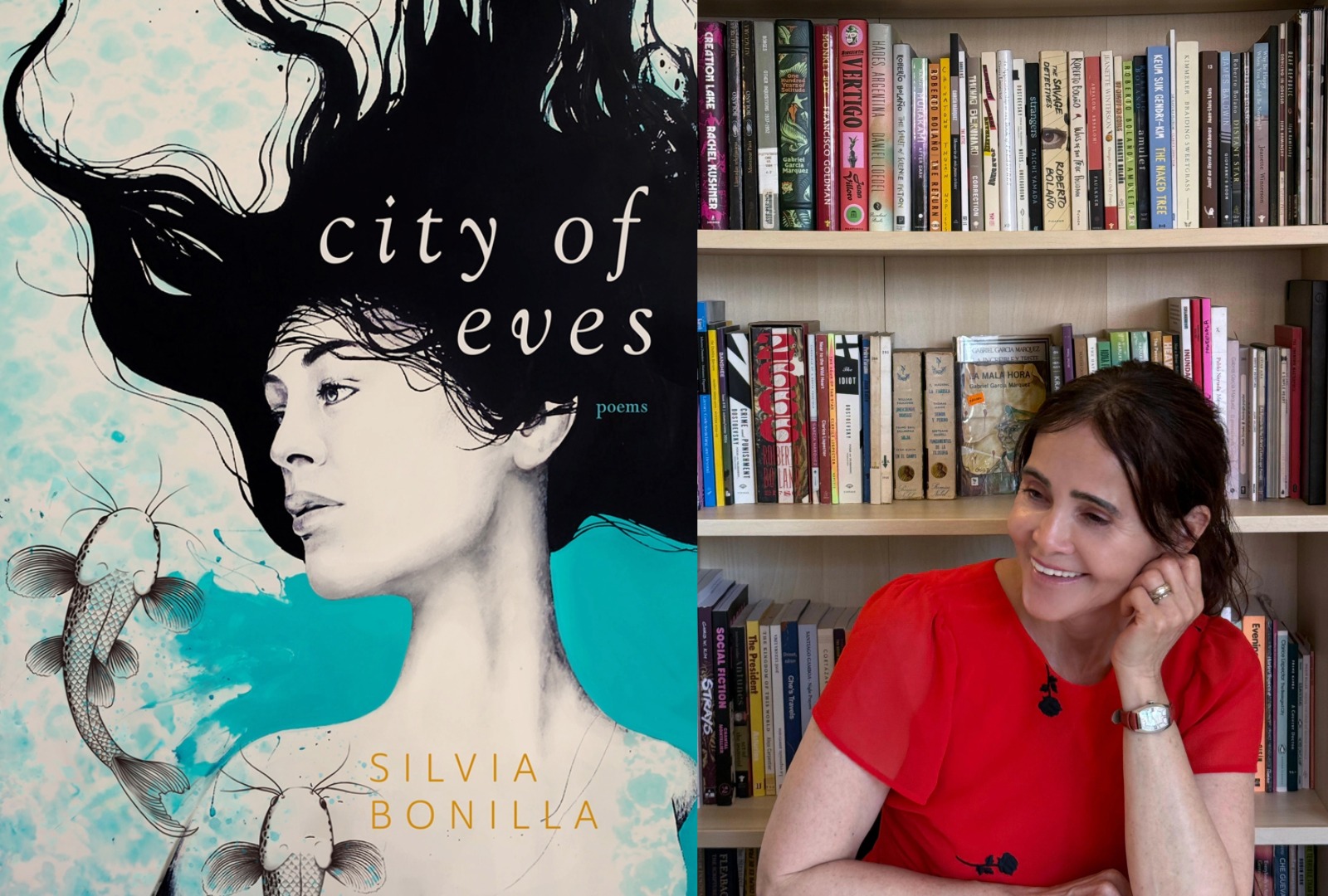
In City of Eves, poet Silvia Bonilla evokes the lives and longing of three young women who suspect the wider world is a ship on the verge of departure—and who are determined not to be stranded on shore. Sonia and her two best friends grow up on the urban coast of Ecuador, sharing cigarettes, school uniforms, and a determination to overcome their circumstances even if the price to pay is exile. Subtle and unsparing, Bonilla’s lyrical poems capture the wild inner horizons and vivid embodiment of youth as it shades into the reflective poignance of maturity marked by disappointment, compromise, and loss. Despite this, it is memories of deep friendship, bonded through shared understanding and aspiration, that lingers. Today, we talk with Bonilla about her latest work.
Some of your poems seem like an archive of girlhood. How do you decide which details—objects, sounds, textures—become part of the record?
I didn’t start with a specific method for deciding which sensory element would become part of the archive of childhood, of girlhood. Some poems were driven by emotional significance, some by cultural significance, and then the details followed.
Immigration narratives are often framed by struggle or loss. How does your poetry resist those narratives and instead create space for joy, complexity, and agency?
I wanted to focus on everyday resilience. The small victories of Sonia and her friends. Make clear their desire for being active agents of their own lives, even though they were victims of circumstance. Emphasizing the joy in their lives, even though there weren’t enough of those happier moments.
Your poem “Women at the Margins” evokes danger, and survival. How do you use poetic imagery to capture the vulnerability and resilience of women navigating borders and systems of power?
I establish a tone of pause in the first stanza that contrasts with the noises of the physical space. There is uncertainty and looming danger. The hyacinths shouting from plastic buckets juxtapose their vibrant beauty, all in the transient context of a bus station. The environment is transactional and dominated by men. The speaker assesses this environment and the stark reality of leaving her daughter behind. With the line “. . . I want you to know/ the first women also walked to trade/ their seeds—made eatable,/ taxable,” I wanted to connect her present-day plight to an ancient legacy of female agency and economic participation. The final image in the poem, “like water that accumulates in a street ditch” is a metaphor for an enduring spirit. A symbol of quiet and humble persistence.
In “Inventory,” the meat locker becomes a haunting metaphor. How do physical spaces and objects help you translate the immigrant experience into something readers can feel viscerally?
The meat locker serves as a chilling and potent metaphor. I wanted to bring to mind the confinement, isolation, and frigidity of immigration. I chose a cold and claustrophobic space, in which something slaughtered is “preserved” before being served for the consumption of others. I wanted readers to feel the journey in their bodies: to feel the cold, to smell the fear and blood.
Your poems evoke strong visual elements almost like painting. Are there particular artists or art movements that influence how you write about memory and imagination?
I believe in the strong interconnection of all of the arts. While there is no particular movement that inspires me more than another, I aim to draw from the strengths of all artistic disciplines. The visual power of a painting, the movement of dance or film, the rhythm of music—all of it is useful to me. I hope to use as many forms of art as I can, to overwhelm the senses.
Silvia Bonilla holds an MFA from the New School. She is the author of the chapbook An Animal Startled by the Mechanism of Life. Her work has been featured in Blackbird, Green Mountains Review, and Cream City Review. She has received support from the Kenyon Review Writer’s Workshop, Sewanee Writer’s Conference, Napa Valley Conference, Community of Writers, the Saltonstall Foundation, and Juniper Institute.
