The University of Arizona Press

March 31, 2026
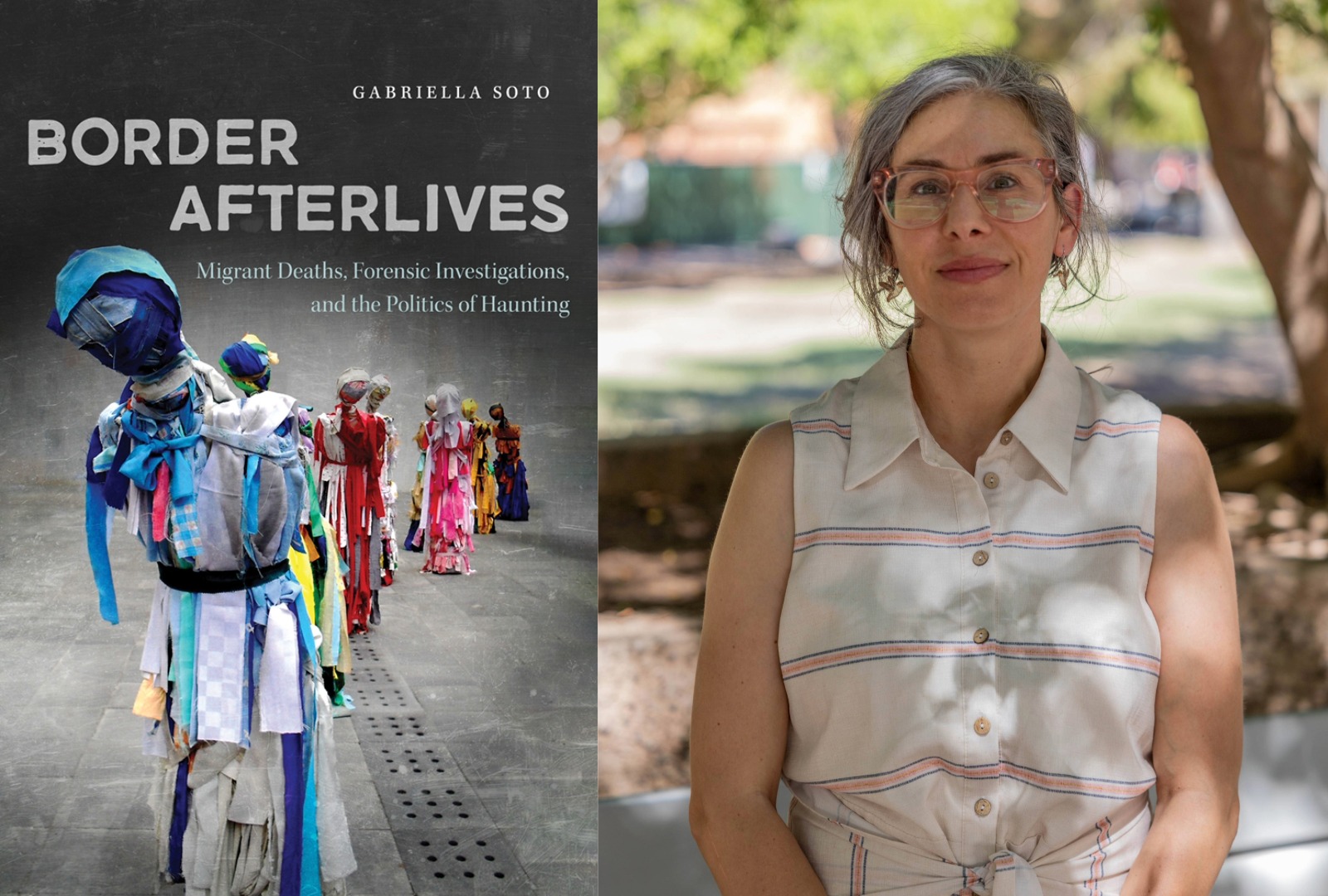
Border Afterlives: Migrant Deaths, Forensic Investigations, and the Politics of Haunting by Gabriella Soto begins with the undocumented individuals who die crossing the U.S.-Mexico border—deaths that are both preventable and politically produced. Drawing on over a decade of ethnographic, participatory, and community-engaged research, author Gabriella Soto examines the postmortem journeys of these migrants through the fragmented infrastructure of medicolegal death investigation in the U.S. Southwest. She reveals how the state’s deterrence-based border policies not only generate death but also fail to provide adequate care for the dead. Soto argues that these deaths should be understood as structural homicides and that the forensic neglect they face is a form of ongoing violence.
Moving between the practical and the philosophical, Soto asks what it means to care for the dead and what society owes to those who die in its name. Through the lens of haunting, she explores how the dead continue to shape the living, not as objects of horror but as moral agents whose presence demands justice. Border Afterlives offers a border-scale comparative account of forensic practices, critiques the limits of “best practices” in under-resourced systems, and calls for a reimagining of forensic humanitarianism grounded in reciprocity and dignity, beyond human rights. This is a book that insists on remembering the dead. Read an excerpt from the book’s Introduction below.
I don’t know them, but sometimes I feel that, because of the intimacy of my knowledge, we verge on a kind of kinship. Their faces are burned into my memory, along with the photos they carried, their belongings, and their hands. I’ve spent so much time thinking about their hands—fingerprints can sometimes be the link that reunites the unnamed dead with their families.
I’ve struggled to tell these stories. But they are not my stories to tell. The official records and interviews I have reviewed associated with death investigations only insinuate intimate knowledge, which is not at all the same as knowing someone—even as I can peer almost voyeuristically into their most vulnerable and private states of final repose. Here, I can only tell you about their afterlives.
I have been studying undocumented migrant border crossing deaths in the U.S. Southwest for over a decade, immersed in research about official and less official processes that determine how their remains are found (often by happenstance), recovered (often without much effort to search the scene for disarticulated bones or belongings), investigated forensically (sometimes haphazardly, often just going through the motions), buried or cremated or returned home. I’ve learned how long so many wait in limbo in between these stages and how often this period of waiting is the result of bureaucratic apathy, constraint, or inefficiency—many times a combination.
I write this book because I want these deaths to haunt you too. I don’t necessarily need you to know the details of what happened in each case. I refuse to draw your attention to bodies as objects of horror. This dehumanizes the dead, and it is the opposite of justice (Goldsmith 2022; Latham et al. 2023; Sontag 2003). In so many ways, the fact that deaths continue to occur along the border is already evidence of injustice, because these deaths are preventable. Instead, I focus on the journeys of deceased migrants through the infrastructure of medicolegal death investigation across the U.S. Southwest. My focus on their postmortem journeys is partially what I mean with the title of this book, “border afterlives.”
The subject of death investigation in the United States takes on particular relevance for the vulnerable population of undocumented people and their families, but it also sheds light on how the United States treats its dead. The notion that we are all equal in death is false (Crossland 2022). The inadequacies of U.S. death investigation and forensic infrastructure mean that racism and social vulnerability experienced in life accompany far too many beyond the grave (cf. Byrne and Sandoval-Cervantes 2022; Rosenblatt 2024).
Following the postmortem itineraries of undocumented people who die in transit in the borderlands reflects what’s going wrong with the treatment of the dead in the United States beyond the border. It is not a border problem that everything seems to be disjointed and dysfunctional, but it is a border-specific issue that deaths of racialized, criminalized, and vulnerable people are concentrated here. It is a border-specific concern that the cases of these particularly vulnerable individuals require special care: It’s harder to identify a person who may lack direct local ties and whose remains have been long exposed to the elements. It’s impossible to identify someone when there is no effort made to do so, as is often the case here.
Gabriella Soto is an associate teaching professor and honors faculty fellow at Arizona State University’s Barrett, the Honors College. She is affiliated faculty with the Binational Migration Institute at the University of Arizona. Soto studies death investigation for undocumented people on the U.S.-Mexico border and the contemporary archaeology of militarized borders. She earned her PhD in anthropology from the University of Arizona and MA in twentieth-century conflict archaeology from the University of Bristol.