The University of Arizona Press

April 20, 2026
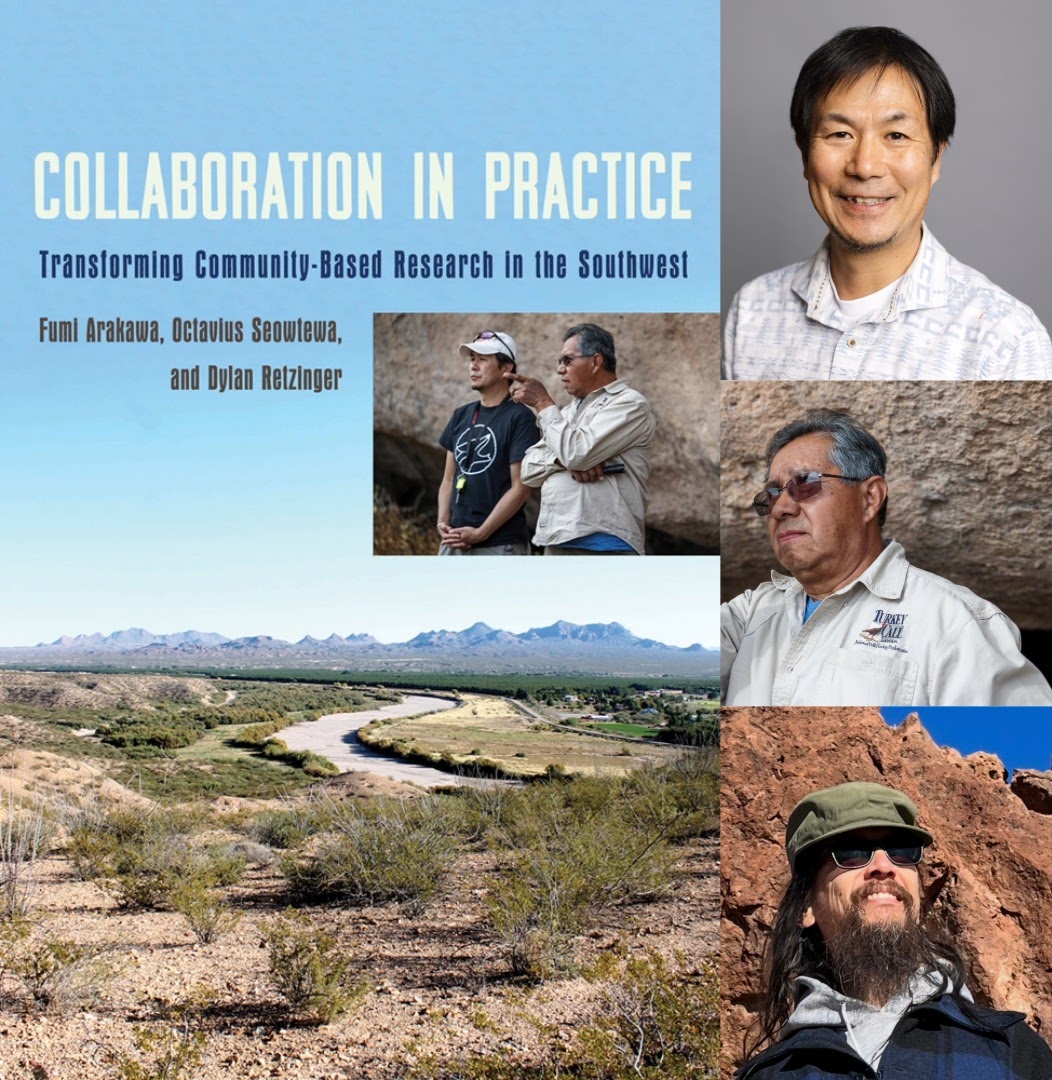
Focusing on the Chavez Cave collections in Las Cruces, New Mexico, Collaboration in Practice: Transforming Community-Based Research in the Southwest by Fumiyasu Arakawa, Octavius Seowtewa, and Dylan Retzinger presents a study of the partnership between New Mexico State University and the Zuni Cultural Resource Advisory Team (ZCRAT). Rather than centering on artifact analysis, the authors emphasize the collaborative process itself—visiting the site, curating an exhibition, and co-authoring this volume—as a model for ethical and respectful research. Ultimately, this work charts a path forward for community-based research that centers Indigenous voices and values. It advocates for an archaeology that is not only more inclusive but also more meaningful to the communities whose histories are being studied. A vital resource for scholars, students, and practitioners, this work seeks to engage in ethical, reciprocal, and culturally grounded research in the Southwest and beyond.
The book situates this collaboration within the broader historical and political context of archaeology and museology. It critically explores how museums and academic institutions can shift from extractive practices to ones that prioritize Indigenous sovereignty, knowledge systems, and cultural continuity. Through personal narratives, historical context, and methodological insights, the authors highlight the challenges and transformative potential of working collaboratively. They show how true collaboration requires humility, mutual respect, and a commitment to shared authority in both research and representation. Read an excerpt from the book’s Foreword below.
A buzzard feather. A drum beater. A wind instrument. A fortunate rock. “This is considered a good omen to find something like this. You take this as a good blessing for you and your family,” comments Octavius Seowtewa, a Zuni elder and Native scholar. A paintbrush. A needle. Bee pod pigment paint or what the Zuni call na:he’le. Medicinal soap. A reed cigarette.
Thousands of years ago, the ancestors of Seowtewa left stories for their descendants at Chavez Cave, located in the Organ Mountains–Desert Peaks (OMDP) National Monument (Figure 0.1). It is regarded as an ancestral home. “[W]hat we are doing [entering the cave],” says Seowtewa, “is asking permission from them [our ancestors] to be here. Once we do the offering and do the smoke and everything like that . . . now we can have an opportunity to talk about this place.”
The aforementioned artifacts, catalog numbers 1976.14.106, 1976.14.39, 1976.14.19, 1967.11.42, 1976.14.97, 1976.14.88, 1976.14.20, 1974.14.100, 1974.14.43, and others, were taken from Chavez Cave by collectors and obtained by the New Mexico State University Museum (hereafter NMSU Museum) in 1974 and 1976. They were wrapped in protective plastic by museum personnel and stored in boxes on shelves in a basement, along with adjacent collections of Native American artifacts (Figure 0.2).
In 1990, Congress passed the Native American Graves Protection and Repatriation Act (NAGPRA). This law required federally funded museums and institutions like the NMSU Museum to return ancestral remains and belongings to lineal descendant groups. NAGPRA has since evolved to regulate how archaeologists treat and study cultural items by mandating deferential consultation with culturally affiliated tribal groups.
These significant legal victories were part of a larger Indigenous-led movement, later turned academic, to “decolonize” and challenge how the cultural heritage and stories of Native American people have been
displayed and told by non-Indigenous scholars and institutions without consent or consultation. The actualization of NAGPRA regulations and decolonial theory presented a variety of challenges; institutions had to do an inventory and return sensitive artifacts (in some cases tens of thousands of years old) to lineal descendant groups that had since migrated and/or been relocated by the U.S. government; archaeologists had to rethink the theory and practice of studying Native American culture as a collaborative and culturally sensitive practice; and Indigenous nation and scholars had to learn how to work with non-Indigenous institutions and scholars that were historically instruments of colonialism.
Fumi Arakawa is an associate professor of anthropology and the associate director of research at the Indiana University Museum of Archaeology and Anthropology. Before joining Indiana University Bloomington, he served as director of the University Museum and professor of anthropology at New Mexico State University. In 2022, he published Correlative Archaeology, which introduced a new theoretical framework for interpreting archaeological data from multiple perspectives.
Octavius Seowtewa is the head medicine man for the Newekwe/Galazy medicine society and also a member of the Eagle Down medicine society. He is a supervisor for the Zuni Cultural Resources Advisory Team (ZCRAT). Seowtewa has been involved with numerous museum projects not only in the United States but also in Japan and the Netherlands. He has reviewed an innumerable amount of Zuni cultural remains at museums for more than twenty years.
Dylan Retzinger is an associate professor at New Mexico State University (NMSU). He earned a bachelor of arts in anthropology with a minor in Native American studies from Humboldt State University. He earned an MFA in creative writing with an emphasis in poetry and PhD in rhetoric and professional communication with a minor in anthropology from NMSU.