The University of Arizona Press

April 27, 2026
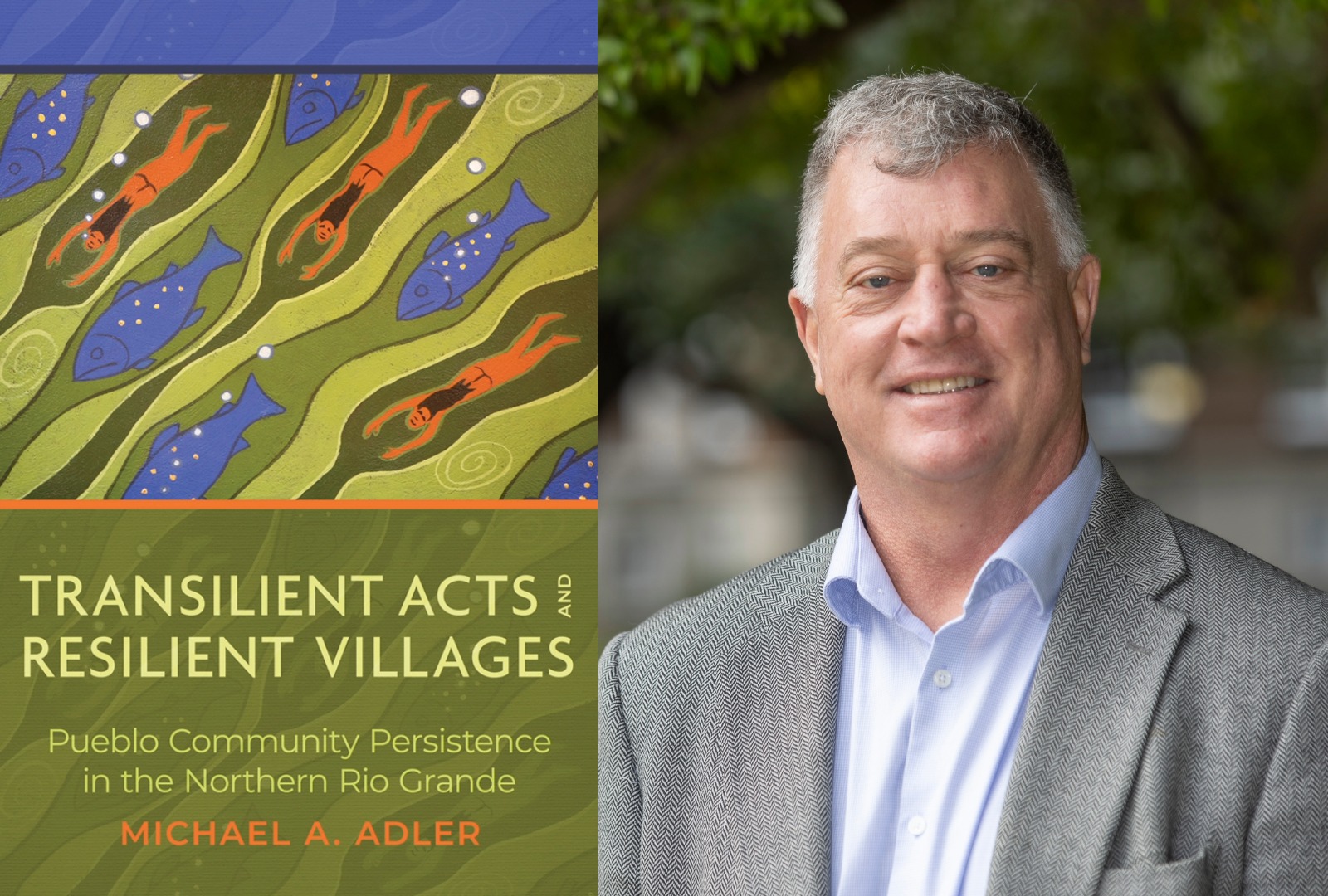
Grounded in decades of collaborative research with Pueblo communities, Transilient Acts and Resilient Villages: Pueblo Community Persistence in the Northern Rio Grande by Michael A. Adler is a vital contribution to southwestern archaeology. It offers a compelling model for how archaeology can respectfully engage with descendant communities and provides essential insights for scholars, students, and community members seeking to understand the complexities of cultural persistence in the face of change.
A powerful rethinking of resilience through the lens of Pueblo history, this work reveals how Tiwa communities in the Northern Rio Grande used culturally intentional strategies to adapt, transform, and endure across a millennium of change. Anthropologist Michael A. Adler introduces the concept of transilience—culturally intentional acts that address existential threats and enable transformation—as a framework for interpreting the long-term persistence of Tiwa communities. Focusing on the Tiwa-speaking communities of Taos, Picuris, and Pot Creek Pueblos, Adler shows how social and ritual organization, architectural change, and sacred geographies were mobilized in response to disruption. He challenges conventional resilience theory, which emphasizes systemic stability, instead centering Indigenous agency, mobility, and sacred practice as key to understanding cultural endurance. Read an excerpt from the book’s Introduction below.
Like all long-lived communities, the story of Picuris Pueblo is complex, interwoven with their specific locality and interactions with other groups in the region, and massively impacted after European colonization of the northern Southwest beginning in the late sixteenth century. Prior to contact, Picuris was one of the major waystations for peoples, goods, and identities flowing out from the Pueblo world into the Southern Plains, part of the Plains-Pueblo Interaction System (Kelley 1984; Spielmann 1991a, 1991b). Agricultural goods, many likely grown on the landesque agricultural complexes around Picuris, were exchanged for all manner of materials from the plains, including bison meat, hides, and stone tool material from the Alibates quarries near Amarillo, Texas. Remains of all these exchange relationships show up in significant amounts in the archaeological assemblages recovered at Picuris Pueblo in the 1960s and 1970s, largely by Herbert Dick and his students (Adler and Dick 1999). The reference in the oral tradition above to “going east where there wasn’t enough water” likely refers to this period of extensive exchange with groups on the Southern Plains. It also may refer to another significant event in Picuris’ history, their nearly complete move from Picuris to live with Apachean groups in southwestern Kansas, at or near the location known today as Quartelejo (also Cuartelejo). Following the failed Pueblo Revolt of 1696, in which Picuris has a significant role, the Picuris people moved north to avoid the ensuing retribution from the Spanish. According to oral tradition, a few villagers remained at Picuris to watch over the settlement (Richard Mermejo, personal communication, 2021), but all the women and children, accompanied by warriors, headed north to live with their longtime trade and marriage partners, the Apache, in what is now Scott County, Kansas. Along the way, the Spanish soldiery caught up with the last of the migrants, and captured 82 women and children, all of whom were sold into servitude after being taken back to New Mexico. The Picuris returned to their longtime home in 1706, squired back at the insistence of Juan de Ulibarri, who was sent to Quartelejo to “free” the “enslaved” Picuris from their hosts (Schroeder 1974). By the beginning of the eighteenth century, the Picuris numbered around 300 people. During the seventeenth century CE, 80%–90% of the considerable population at Picuris Pueblo was lost. Colonization, loss of land base, disease, enslavement, and religious persecution, all the ingredients of what Levene (1999) has aptly called “creeping genocide,” the slow erosion of population, autonomy, health, and well-being in a populace.
I present this condensed history of Picuris Pueblo to pose a question that guides much of this present work. Specifically, given the durability of the Picuris community throughout their immensely difficult and traumatic history, is this not a perfect case study in cultural resilience? This is an important question that requires consideration of just what we mean by “resilience.” Entire subfields of study in ecology, psychology, and social-environmental research have colonized the concept of resilience. In its classic form, resilience is the capacity for a system to experience a perturbation, shock, or similar challenge to its systemic continuity and integrity, and still be able to return to a similar system state of function (Holling 1973). The ancestral and contemporary Native American peoples of the American Southwest have provided a small cottage industry in resilience studies, for the very simple reason that their cultural, social, ceremonial, linguistic, and technological continuities have been widely documented, dated, measured, and plumbed for insights into the durability of these communities. Objectives of these resilience studies into Pueblo community persistence have been to better understand how, as with cases of great travail and challenge experienced by Picuris Pueblo, resilience has been the outcome of these community journeys. This work will also delve into some of the quandaries surrounding “resilience thinking,” requiring close study and critique. I argue throughout this work that for there to be any responsible and useful assessment of a community’s history as an example of resilience, several things need attention. First, while there has been a long, durable concept of cultural identity in a community such as Picuris, we also need to also attend to what has been lost, stolen, or forgotten during the past millennium. What actually is resilient from the standpoint of systemic integrity and system identity? Second, what strategies, beliefs, understandings, and acts have the Picuris people and other Pueblo communities employed to endure the “perturbations” that have been both internal and external to the communities over these centuries of purported resilience? In other words, resilience is a possible outcome of long histories of loss, transition, and accommodation. Finally, what strategies fostered this endurance, and how can our understanding of this durability benefit the ongoing challenges we contend with in the face of environmental degradation, technological change, and social change?
Michael A. Adler is an associate professor in the anthropology department at Southern Methodist University. He received his academic training in archaeology at Princeton University and the University of Michigan. He collaborates with Pueblo communities in the American Southwest to understand their complex ancestries, concepts of cultural identity, and how communities create that complicated concept called “the past.”