The University of Arizona Press

May 5, 2026
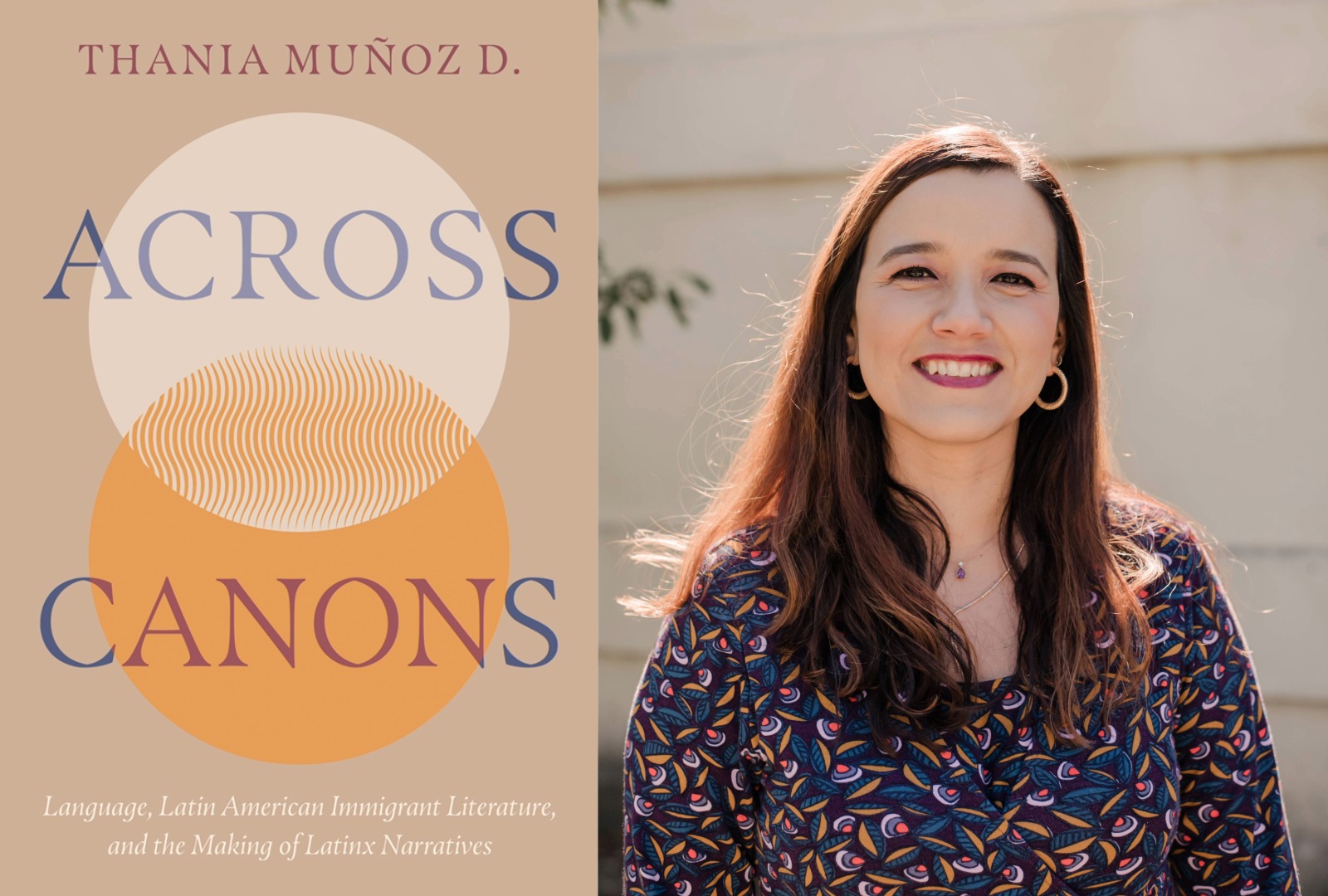
Excavating narrative memories, Across Canons: Language, Latin American Immigrant Literature, and the Making of Latinx Narratives by Thania Muñoz D. examines literary allusions to a classic Latin American canon that resurface in the work of Latin American writers who live and work in the United States. The immigrant literature of Edmundo Paz Soldán, Alberto Fuguet, and Cristina Rivera Garza from the late 1990s and early 2000s provides an important glimpse into representations of Latin America’s relationship with the United States and how immigration has shaped it. This book highlights the benefits of comparative, interdisciplinary interpretations that allow readers and scholars to grapple with the realities of a multilingual Latin American–origin literary present and future of the United States.
Author Thania Muñoz D. looks at immigrant experiences impacted by a prism of social and political factors, including free trade agreements, drug trafficking, political violence, massive foreign debt, and economic dependency. The author examines why these writers refuse to identify as immigrants and reject stereotypical portrayals. Throughout, Muñoz D. makes the case for a new field within Latinx literature: Latin American immigrant writing in Spanish. She explains why this type of literary work is critical across Latin American, Latinx, and U.S. literature. Read an excerpt from the book’s Introduction below.
I owe my love for literature to my experience as a public high school student in Southern California. As a recent immigrant from Mexico (Jalisco) in the late 1990s, I was placed in bilingual education for the first months after my arrival—until California’s Proposition 227 (passed in 1998) eliminated bilingual education in public schools. As the school struggled to place all immigrant non-English speakers in “regular” classes, they were quick to put Latin American immigrant students in Advanced Placement (AP) Spanish courses to provide us with a safe place—even though not all of us spoke or wrote “advanced” Spanish. In those courses, I read the Latin American and Hispanic literary canon our teachers assigned. Although most of us were recent immigrants, we did not read any immigrant stories or Latinx narratives. I learned about Jorge Luis Borges’s (Argentina) labyrinths and Miguel de Unamuno’s (Spain) obsession with death, but we read nothing of Cherríe Moraga’s, Gloria Anzaldúa’s, Tomás Rivera’s, or Oscar “Zeta” Acosta’s literature about being an immigrant or being Chicana/e/o in the United States. The Hispanic canon fed my intellectual curiosity but did not help me ease into my new identity as an immigrant, Chicana, and Latina, as the latter authors might have. The present book is a response to the conventional Spanish-language canon in the United States, which is mostly classified as Latin American or Hispanic in school curricula, university courses, and literary anthologies.
In Across Canons: Language, Latin American Immigrant Literature, and the Making of Latinx Narratives (hereafter Across Canons), language is an essential question in bridging the conversation between Latin American and Latinx literary studies in the United States. Latinx studies are often framed in terms of history, generations, and proficiency, as if Spanish-language literature were written in the past and belonged to “others”: immigrants, our parents, nostalgia—those who are not quite Latinx yet. In Latin American literary studies in the United States, Spanish is framed as “our language,” our identity, our nation, although these conversations often leave out our Indigenous languages. Hispanic studies, modern languages programs, and English departments in U.S. institutions, to name a few examples, replicate this division due to the historical racialization of Spanish in the United States. In this context, Across Canons shows why Spanish-language literature has struggled to find a “home” in the United States. By using a comparative approach to Latin American and Latinx literary studies, taking immigrant literature by Edmundo Paz Soldán (Bolivia), Alberto Fuguet (Chile), and Cristina Rivera Garza (México) as examples, I show how the Latin American literary canon fails in some ways to narrate the immigrant experience in the United States. I argue that Latinx literary studies help bridge this gap by considering the role of language and immigration in this field. In Across Canons, I nonetheless underscore how these fields struggle with multilingualism due to our diverse histories of belonging in the United States. I am in dialogue with these struggles via a fundamental question: How to narrate? What does it look like to narrate in Spanish contemporary immigrant experiences? How do past literary canons shape these narratives? How and why should we read these Spanish texts as Latinx and Latin American? And finally, why does this matter for Latinx and Latin American literary studies?
The how is also at the center of my own writing in this book. As I have shared, my interest in narratives of immigration originated in my own experience as an immigrant, student, and reader of literature. As a 1.5-generation Mexican immigrant, I wanted to read immigrant literature in my own language, but canonical discourses about Latin American identity were replicated even in my public Southern California high school classes. After high school, the question of language became part of my own academic research on immigration and Latin American and Latinx literature. I was continuously asked by peers and professors: Is your research on Latin American immigrant literature in Spanish or in English? Are you looking at immigrant literature from the perspective of Latin American or Latinx studies? In Across Canons, I seek to answer these questions using a comparative and interdisciplinary approach. I argue that Spanish-language immigrant literature, although intrinsically hemispheric, examines the perspectives of immigrants living (or once living) in the United States and the role of language in Latin American and Latinx studies.
Thania Muñoz D. is an immigrant educator, translator, poet, and scholar. Her writing and translations have appeared in Copihue, Acentos Review, Circumference, Fence, Firmament, La Bloga, Catedral Tomada, MARLAS, the Latin American Literary Review, and others. She immigrated in 1998 to Southern California from Jalisco, México, and since 2015 has lived in Maryland. She is an associate professor of Latinx and Latin American literature, director of the MA Program in Intercultural Communication at UMBC, and the managing editor and founder of Latin@ Literatures.