The University of Arizona Press

May 12 , 2026
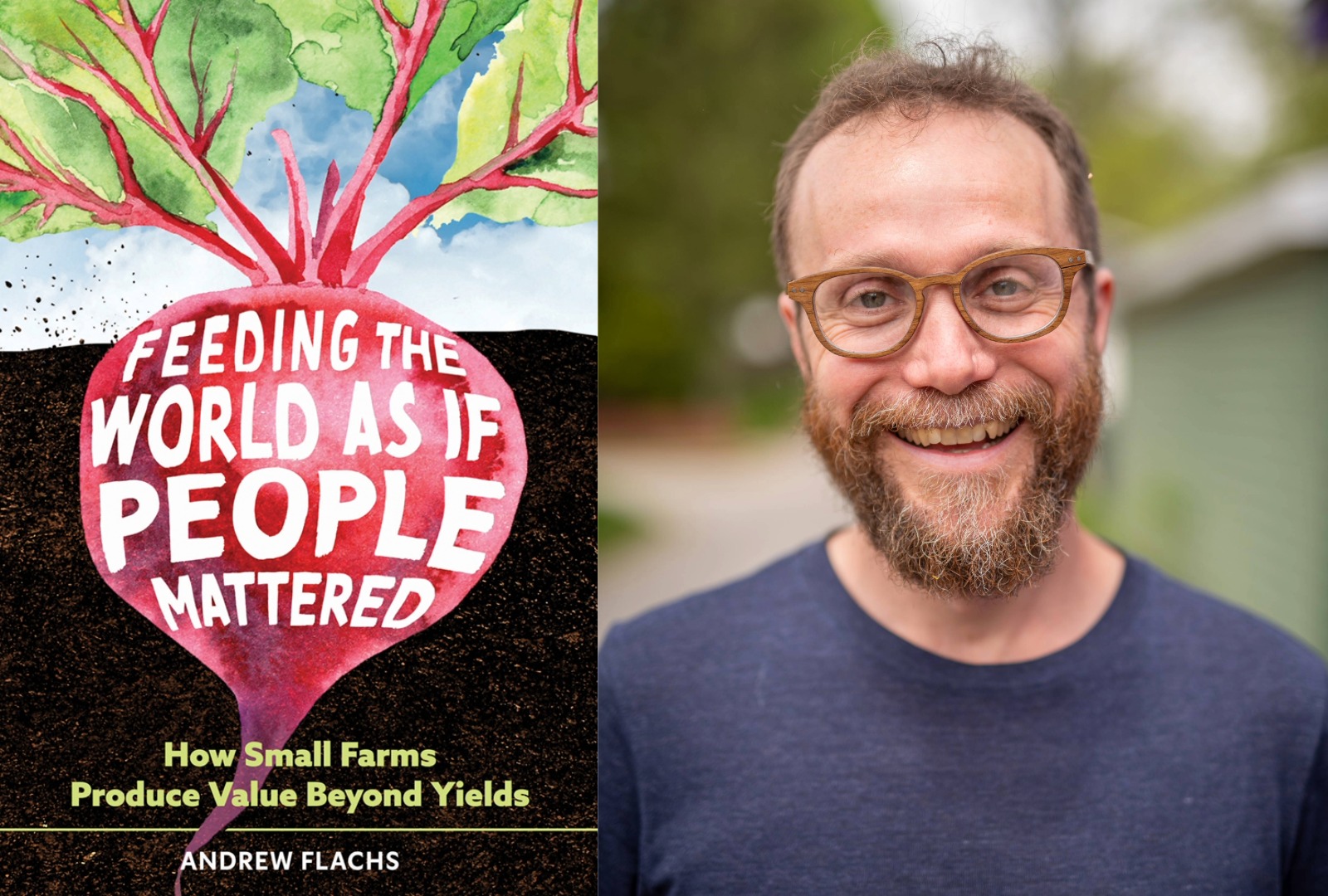
Backyard gardens flush with cucumbers, tomatoes, and peppers where bees buzz and chickens scratch. Beyond, a forest filled with blackberries and jewelweed. Inspired by childhood memories of his grandmother’s overflowing backyard garden, author Andrew Flachs has embarked on a multi-continent, decades-long look at agriculture and its value.
The dominant view of agriculture has focused only on what we produce. It sees value in terms of capital gains or yield efficiency, masking how our global food system produces tremendous amounts of food commodities while failing to feed people, support rural communities, or enhance ecological well-being. Feeding the World as if People Mattered: How Small Farms Produce Value Beyond Yields asks us to look more deeply and more humanely at what we perceive to be most valuable in our agricultural systems. Today, Andrew Flachs answers five questions about his research for the book.
What do you mean when you say “social reproduction,” and how do small small-scale gardens and farms support this?
Social reproduction is a shorthand for describing all the work that goes into creating society: our culture, identity, or the ways that we learn to interact with one another. If production describes what we do in our economy, then social reproduction is everything that goes into making it possible for us to have an economy in the first place. I like to imagine an iceberg (or for a more agrarian metaphor, a beet): if wages and capital and commodities are the visible parts of the economy, then there is a vast layer of work beneath the surface that makes it all possible. Small farms and gardens are great places to explore social reproduction, because this divide between production and reproduction is especially silly when you look at farming: farms are homes, not just production sites; farmers are consumers as well as producers; work you do today literally creates the landscape, shaping what sort of work is possible tomorrow; and farms themselves transcend the human because they are teeming with all sorts of life. Nobody can go to work if they are not ready or able to do their job, but a farmer can’t go to work on a farm if that particular landscape cannot continually sustain life. Creating those conditions takes work from humans, other living beings, and natural processes. This comparative approach allows me to sidestep the typical, misleading question people ask about the future of food: “how do we produce enough food?” Instead, I ask the more important question: “how do we produce enough farms?”
How do farmers and gardeners talk about values such as autonomy, dignity, care, and joy, and how do these values influence practical decisions about seeds, labor, and technology?
This question reminds me of an interview with a Midwest apple farmer who told me that he wasn’t allowed in the farm store anymore because he gave too many apples away—a part-time teacher, he loved the idea of introducing people to new flavors. In turn, this influenced the apples he planted, the insects who came for the apple flowers, the birds who came for the insects, and the artists and entrepreneurs who came to paint landscapes, grow lavender, or sell honey to his community. On this small scale, it’s especially easy to see the biological and social consequences of this sort of creativity. Bigger picture, many of the decisions that I cover in this book from India to Bosnia to the American Midwest are focused around making sure that someone in the family can keep farming. When organic coffee farmers in South India invest in coffee groves that do not turn a profit for years, they are also staking a long-term claim on land that they can pass on to their kids. With that claim, it is much harder for a mining speculator to take their land. Similarly rural Bosnian gardeners maintain small orchards and vegetable allotments even when they only work as migrant laborers for most of the year. The garden helps to ensure that there is a home to return to. This value becomes more visible when we focus on agriculture’s potential for reproduction, not just production alone.
What do we lose, culturally and ecologically, when agriculture is reduced to yields and profits alone?
Agricultural researchers, myself included, have collected detailed descriptions of which seeds farmers plant and what sorts of returns they receive on that investment in the form of profits and yields. My last book, Cultivating Knowledge, was based on hundreds of farm surveys with cotton farmers in South India. But, the backs and margins of those surveys were covered with intimate stories about everything else that was going on in farmers lives that impacted how they were able to get to work in the first place. Because it can’t neatly cleave off its social reproduction, a farm is not a business like any other. Small-scale family farming involves plenty of business, but most of them are not a capitalist enterprise in the strictest sense. The neat divisions of capitalism—where some people own things, decide things, and control investment, and others earn wages, follow orders, and own only their time and energy—do not apply well to farms. We hear all the time that we should run institutions like businesses to make them more efficient: universities, philanthropic organizations, and, of course, the government. But, most businesses fail. If we want to ensure sustainability and security in the food system, we’re going to need a different model. Agriculture is a living landscape that involves people, plants, animals, microbes, soils, waterways, and all kinds of other activity. For many farmers, this work is not just an economic cost-benefit analysis. In India, it offers a political claim on land; in Bosnia, it is a religious fulfillment to ensure that the vital forces of the world continue even when humans invite our own disasters; in the United States, it is an opportunity to work for meaning or repair. In focusing just on a narrow snapshot of their productivity, we miss the real value that these spaces reproduce over the long term.
How do historical plantation logics still show up in modern agriculture and rural communities today?
Plantations and factories create ecologies and economies that externalize social reproduction: the work of recreating our world. By paying for as little of that work as possible, a very small number of powerful people learned to create big profits for themselves. In turn, this economy produced an ecology that was hostile to any life that cannot be commodified. In the colonial capitalism that emerged from Europe after the 1400s, nature in the colonies existed to be captured, controlled, commodified, and sent back to the industrial core. Centering value in private property and wages, this new way of thinking about the economy made the work of women, colonized people, and nature invisible—even as that work made the engines of industry and colonial rule possible. This bait and switch led to the creation of the plantation, a system of extracting profit from soil by radically simplifying how people worked, what they grew, and how they cared for the land. Plantations offered the first assembly lines and economies of scale, all in the interest of producing more and paying people less for it. In this way, plantations are much more like mines than they are like farms, which must continually reproduce the conditions of life in order to be viable. Through this economic system, plantations enacted a new kind of ecology: commodity monoculture. Colonial plantation crops like sugarcane, tobacco, cotton, indigo, or opium were not foods but products to be sold. If those divisions of labor and motives for production on the plantation sound familiar, it’s because they were retooled for factories in the 19th and 20th centuries. However, since land had been more thoroughly colonized by that point, industrial farm interests had to find new and profitable frontiers in genetics, agricultural processing, and inputs like fertilizers and pesticides instead. And, the effects of this, do not stop at the field’s edge. By the mid-20th century, a clear agrarian pattern emerged in the United States: farm towns with large, corporate ownership following industrial models had half as many small businesses and a much lower volume of local retail trade. Infrastructure from sidewalks to electricity to roads fell into disrepair, parks and schools closed, and newspapers that would report on this problem shuttered. This loss cascaded into lower tax bases, less purchasing power, and fewer independent businesses to employ a middle class. This resulting context for rural communities is not some inherent flaw in rural culture, whatever that means, but with the concentration of power in farm spaces. Many rural communities are faced with an unpleasant choice: on the one hand, they may not wish to defend industrial hog producers, chicken producers, or strawberry conglomerates, about whom they hold complex feelings regarding the long-term impact of economic and ecological destabilization. On the other hand, they fear losing opportunities to farm and stay in place altogether amid the withdrawal of economic possibility and political will for change.
You suggest that it is “expensive to feed the world as if people mattered” because it requires investing in care, community, and ecology. What would it take—politically or socially—to make this kind of agriculture possible at scale?
The 21st century of consolidation has created a rural oligarchy that blocks many possibilities for justice and thwarts opportunities for alternative futures through diverse economies. We need a new vocabulary to fight back. In this book, I suggest that we should look to s farms to learn how to optimize stability and autonomy, think with social reproduction to account for the full range of relationships between people, and learn to see the landscape as the physical manifestation of the political economy. Because the scale of the problem is global, there is not going to be an individual solution, like a better choice at the grocery store or a new garden, that can solve it. And, the farmers I profile in India, Bosnia, and the United States have very different agrarian histories. Instead, I suggest that we look to better institutions, regional solidarity, and the exploration of a very human thing: helping life grow. This is not something that any individual achieves alone. It’s not about an individual growing a garden, but rather the possibilities that emerge when lots of us can grow gardens together. To grow is to grow with others. This transformation in what we value requires us to embrace an expansive view of farm life and farm work so as to understand how social and ecological relationships create each other, for better or worse. We don’t need more food; we need more farms. Against an estimated $13 trillion dollar cost in terms of degraded land, polluted water, choked air, and unpaid wages that we, the eating public, pay, we can’t afford not to recognize the profound time and energy that people around the world spend for small farms and gardens. In this book, I show how land reforms help to secure land rights for small farmers against consolidation, while regional buying programs help to pay a diverse set of farmers to manage a diversified ecology that feeds institutions like schools and food hubs. In our twenty-first century of climate change, rising authoritarianism, and widening inequality, gardens and small farms have a major role in strengthening solidarity and cooperation at the community level to help nourish life on earth.
About the author:
Andrew Flachs is an associate professor of anthropology at Purdue University, a father of two children, and a semi-retired musician. His writing on sustainable farming has appeared in scientific venues including American Anthropologist, the Journal of Peasant Studies, and the Journal of Ethnobiology, as well as in public-facing venues like The Conversation, Salon, and National Geographic Magazine. His 2019 book Cultivating Knowledge discussed genetically modified and organic cotton farming in India.