The University of Arizona Press

August 26, 2026
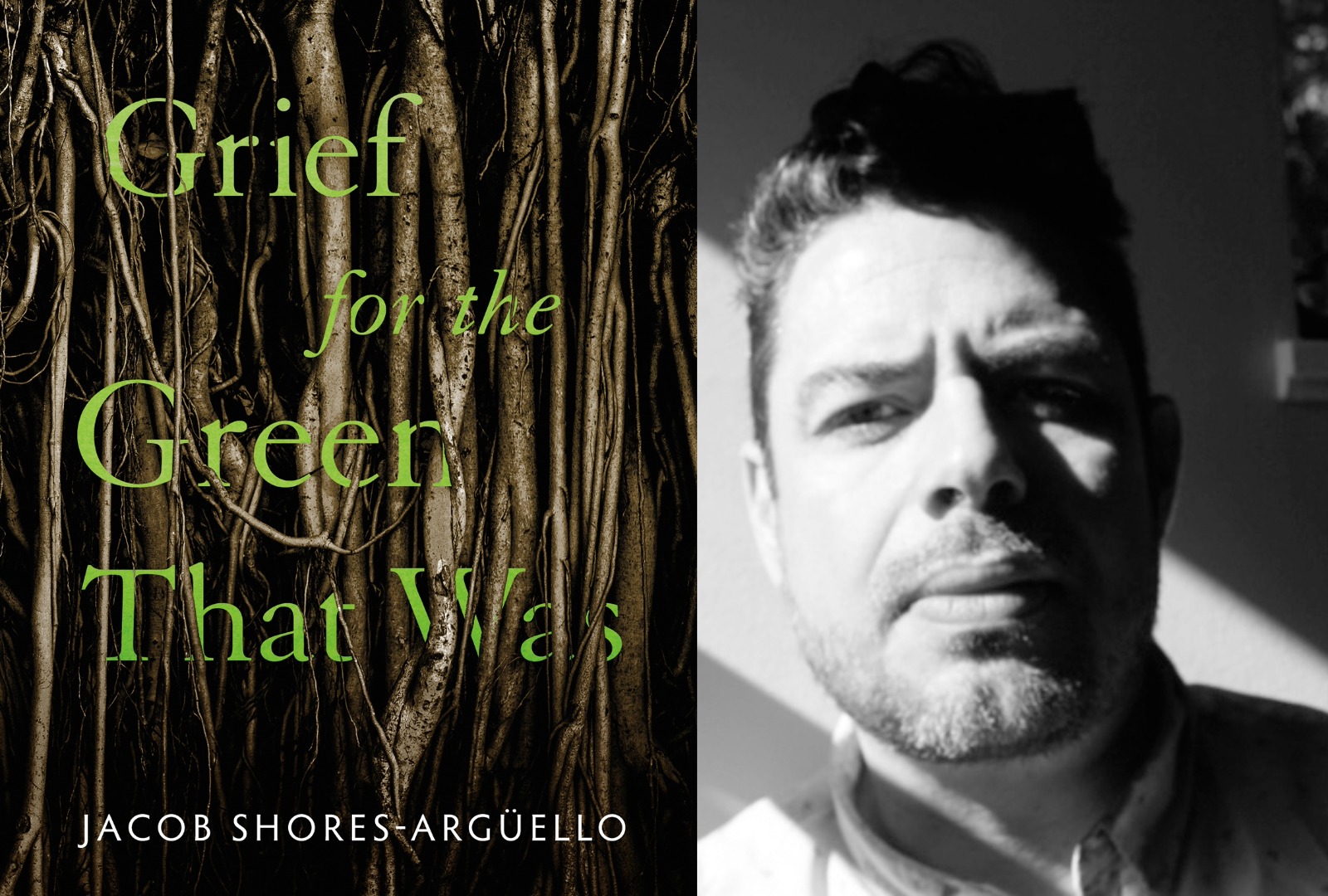
Moving tenderly across memory, continents, and literary forms, Jacob Shores-Argüello’s tightly woven cross-genre collection, Grief for the Green That Was, evolves a private family bereavement into an exploration of collective ecological grief. Following the death of his mother, the speaker navigates between his Costa Rican heritage and his Oklahoma upbringing, eventually arriving at something like healing on the banks of New Zealand’s Whanganui River—the first river in the world granted legal personhood.
A book about what we inherit and what we leave behind, both in families and in landscapes, Shores-Argüello examines how climate change affects not just the physical world but also our emotional and spiritual relationships to place.
Today, we share a special interview with the author, getting his insights on the grief we share in the face of climate change, the nature of personhood (or the personhood of nature), and resisting emotional numbness through formal play.
The title of your book speaks to the many aspects of grief you explore: grief as a form of memory, longing, place, love. Did your relationship to grief change in the writing of this book?
The idea of this book is that it takes personal griefs, something I’ve written about extensively before, and uses them as a platform to speak to the grief we all share. In this case, our communal grief of climate change. More and more, it feels like we are getting wiser in our ways of understanding our individual losses, but we rarely know what to do when the loss is at a different scale, sometimes so wide that we have trouble comprehending it.
This book is a first step for me in understanding the need to recast the way I think of community, the way I think of nature. For instance, this book looks at the town in Costa Rica where my mother is from alongside its idea of giving citizenship to pollinators—birds, bees, and trees. It also looks at the idea of extended family while exploring the recognition of legal personhood for the Whanganui River in Aotearoa New Zealand.
Are there other poets (or artists in any genre) whose work on grief, elegy, loss, or environment you see this book in conversation with?
Perhaps Craig Santos Perez’s From Unincorporated Territory [åmot]. My book isn’t as visually experimental as that one is. But I think they both lean on weaving together different forms and materials in order to hold complexity.
Robert Macfarlane’s Is a River Alive? would be good for those interested in the ideas of the rights of nature. That one doesn’t focus on Aotearoa New Zealand specifically, and so it might be a good complement for this book.
I think readers will be interested in the book’s structure, organized into sections that move from the first, to second, to third person. Can you talk about this incremental shift in perspective?
The book moves from first person, to second person, to third person, and back again to first person—now plural. As the book itself is concerned with ideas of personhood, this seemed like a natural fit for its structure.
Each shift let me think through what the “I” means in the face of loss, what it means to step outside of self with that “you,” and how stories usually told in third person might be the best way to remember our connection with both family and the land. And finally, it ends with the hope that comes when disparate selves can come together as a “we.”
The section “Cuando Tienen Frío (Second Person)” unfolds in Aotearoa New Zealand in the unexpected form of a Choose-Your-Own-Adventure narrative. What appealed to you about this form?
I like to put games in my books when I can. I’ve been numbed by my own grief and I know readers can feel this too. And so I wanted them to flip around the pages. I wanted to offer play as variation. One of the lessons I’ve learned is that it is often hard to understand something big without counterpointing it with something smaller.
Of course, the choose-your-own-adventure has a natural multiplicity built into it. More than one thing can be true. That can be a powerful idea in the face of realities that seem so stark.
What are you working on now?
I’ve been working on this project for years. Eventually, I realized that I was making two books. Grief for the Green that Was is the cross-genre part, it looks through the lens of overlap—between poetry, short stories, and the choose-your-own adventure style memoir.
My next project is a continuation of some of the ideas I’ve mentioned. Hopefully, the sustained length of the novel will offer a different canvas for these ideas to continue to breathe. It is a complementary book, one that explores the roots of citizenship itself while adding a throughline that follows the idea of Blue Zones, those places in the world where people live exceptionally long, healthy lives.
Jacob Shores-Argüello is a Costa Rican American poet and prose writer. His second book, Paraíso, was selected for the inaugural CantoMundo Poetry Prize. He is a 2018–19 Hodder Fellow at Princeton University, a Lannan Literary Fellows for Poetry, and a 2024–25 Rome Prize in Literature winner. His poetry and fiction appear in the New Yorker, Poetry Magazine, the Academy of American Poets’ Poem-a-Day, and the Oxford American, among others. His work examines borders—between geologies, cultures, and languages—between humanity and the natural world.