The University of Arizona Press

September 24, 2026
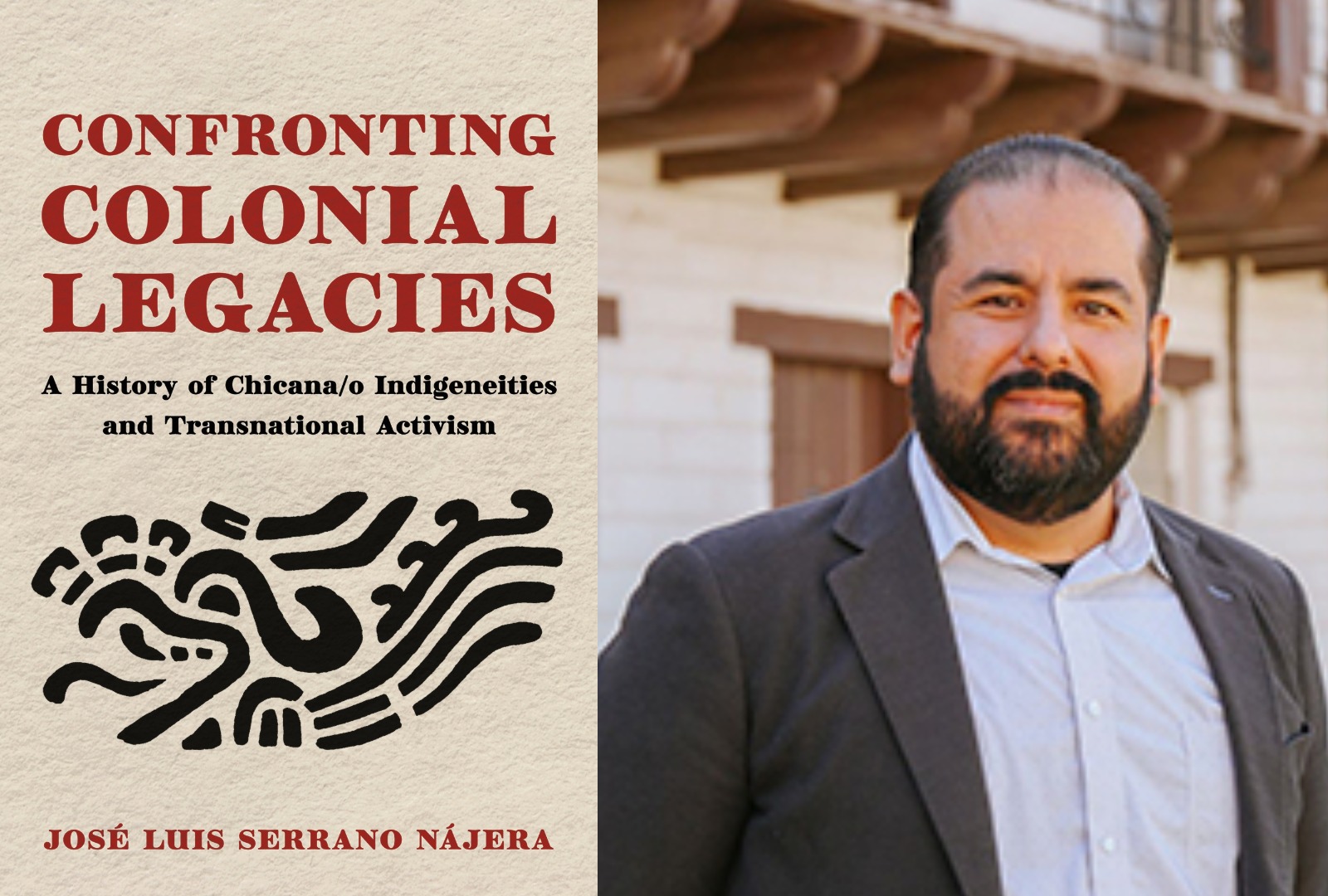
Confronting Colonial Legacies: A History of Chicana/o Indigeneities and Transnational Activism by José Luis Serrano Nájera offers a groundbreaking account of how Chicana/o activists have engaged in sustained efforts to reclaim Indigenous identity through political struggle, cultural expression, and transnational solidarity. Drawing on extensive archival research, Serrano Nájera demonstrates how Chicana/o indigeneity has contributed to broader Indigenous rights movements, including efforts that culminated in the 2007 United Nations Declaration on the Rights of Indigenous Peoples. This work highlights the intercontinental dimensions of Chicana/o activism and offers a vital source for scholars and students in Chicana/o studies, Indigenous studies, ethnic studies, history, and political science. Confronting Colonial Legacies is a compelling call to rethink the politics of identity, sovereignty, and solidarity across the Americas.
Author José Luis Serrano Nájera takes an in-depth look at the history of Chicana/o indigeneity, starting with the Chicana/o Movement of the 1960s and 1970s and through twenty-first century transnational activism and solidarity movements. Serrano Nájera reveals how claims to indigeneity were rooted in reciprocal relationships with Indigenous communities and driven by a shared commitment to decolonization. Through chapters on visual and performing arts, ceremony, education, and grassroots organizing, this book challenges reductive narratives of cultural appropriation and instead foregrounds the complex and historically grounded nature of Chicana/o indigeneity. Read an excerpt from the book’s Introduction below.
Twentieth-and early twenty-first-century Indigenous peoples’ social movements that demand recognition of cultural and political rights have special resonance in the United States and México. These North American countries have large populations of Indigenous peoples and people of Indigenous descent who have impacted the histories of these national societies. Moreover, Indigenous peoples’ cultural vitalities are a significant part of contemporary North American social relations. The United States and México also share a history in which Indigenous peoples have suffered genocide, discrimination, and violations of their civil and human rights, while paradoxically Indigenous cultural symbolisms are mythologized. The context for this paradox has its origins in the seventeenth and eighteenth centuries as colonial officials celebrated the grandiose accomplishments of pre-Columbian civilizations in patronizing tones, while at the same time validating conquest and colonization of the Americas. The consequence of this line of thought in the Americas had disastrous effects on the political, social, and economic survival of Indigenous peoples in what would become México and the United States.
Although decrees of kings, queens, popes, and viceroys have long since faded in the Americas, the consequences of colonization continue to suppress the self-determination of Indigenous peoples. The founding of nation-states and ideals of freedom influenced by liberalism and republicanism have further entrenched false truths regarding the superiority of Western civilization. Furthermore, in both the United States and México, racist policies hostile to the cultural traditions of Indigenous peoples have been instituted in efforts to force assimilation to promote and further modernity as well as create a laboring class. In this long historic context, twenty-first-century Indigenous peoples’ social movements address the right to autonomously define Indigenous cultural trajectory and in sum demand respect for Indigenous human rights in ways that demand decolonization and synthesize the historical and modern in unique expressions. These movements bring to bear the consequences of five centuries of unjust Western political, social, and economic rule over Indigenous peoples in the Americas. These social movements address the need to challenge the dominance of Western thought in the governing policies of the Americas and point us toward a future in which historic injustices are rectified and notions of superiority are abolished. Indigenous peoples’ social movements seek the decolonization of the Americas in both the policies of nation-states and the hearts and minds of all their citizens.
Indigenous social movements in the Americas have multiple sources, but in regard to Mexican Americans, my focus considers Chicana/o Indigeneities of particular importance to decolonization efforts because of their density, scope, breadth, and spatial location. The purpose of this book is to trace significant cultural and political expressions of Chicana/o Indigeneity from its origins in 1960s and 1970s Chicana and Chicano Movement (CCM) cultural ideas, demands for civil rights, and interethnic activism to twenty-first-century transnational efforts to combat neoliberal economies and pursue decolonization. In doing so, this book reveals that Chicana/o Indigeneity resulted from political struggle within the contexts of Chicana/o and Indigenous coalitional decolonial activism that resulted in complex projects of historical recovery.
Given the coalitional context of Chicana/o Indigeneity, as both political thought and historical recovery, my study answers the following question: How are Chicana/o assertions of Indigeneity intrinsically parallel and related to Chicana/o participation in transnational and decolonial Indigenous struggles for human and civil rights during the twentieth and twenty-first centuries? These struggles for human and civil rights involve collaborative political, cultural, educational struggles for Indigenous peoples’ rights to self-determined assertions of identity and decoloniality from local to international levels. As such, the underlying premises for my investigation of Chicana/o Indigeneities are the following sub questions: (1) How has Chicana/o and Indigenous collaborative activism since the 1960s and across borders contributed to alignment in political goals and thought about civil rights, Native sovereignty, and international decolonization?; (2) How do twentieth and twenty-first-century Chicana/o cultural assertions of Indigeneities in the Southwestern United States, in the form of cultural revival and expression as well as religious ceremony, demonstrate the centrality of Indigeneity among Chicanas and Chicanos developing historical consciousness and attempting to self-determine decolonial cultural and social trajectories?; (3) How do these cultural expressions highlight both the feasibility of Indigeneity as a path toward decolonization and the difficulty of taking inventory of historical consciousness and circumstance in the context of the longue durée of Western colonialism?; (4) How did Chicana/o Indigenous political and cultural struggles inspire the creation of educational programs and schools to teach youth to develop critiques of the legacies of colonialism while at the same time creating a space to dismantle the epistemic hegemony of Western civilization and reappraise Indigenous thought and culture?; (5) How did participation in transnational Indigenous advocacy networks since the 1980s redefine Chicana/o understandings of localized control of community politics, respect for Indigenous peoples’ rights, and diverse iterations of decolonial self-determination?; and finally, (6) How does involvement in transnational Indigenous advocacy networks impact localized Chicana/o efforts to combat neoliberal political economies?
José Luis Serrano Nájera is an assistant professor of Chicana and Chicano studies at the University of New Mexico. His publications, which can be found in the Regeneración Tlacuilolli: UCLA Raza Studies Journal and UCLA Historical Journal, have focused on advocacies, social movements, and armed insurrections countering colonial and imperial powers in the United States and México during the modern era. He is also co-chief editor of Regeneración: A Xicanacimiento Studies Journal.