 The University of Arizona Press

September 29, 2026
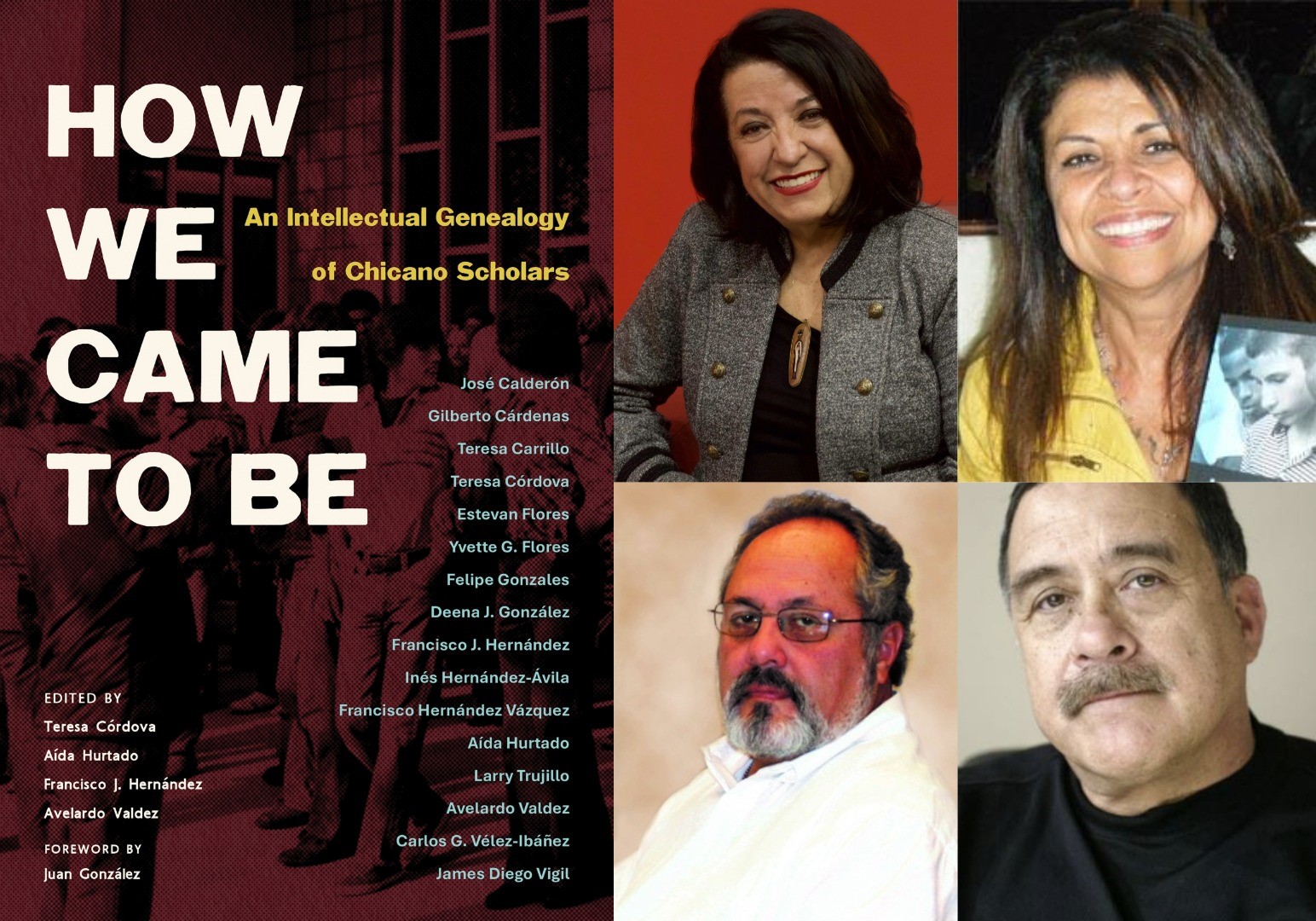
How We Came to Be: An Intellectual Genealogy of Chicano Scholars edited by Teresa Córdova, Aída Hurtado, Francisco J. Hernández, and Avelardo Valdez is both a scholarly archive and a call to action, preserving the legacy of those who built Chicano studies and inspiring future generations to continue the work of transformation within and beyond the academy.
This work chronicles the lives and legacies of Chicana and Chicano scholars whose formative experiences in the Chicano Movement shaped the development of Chicano studies and transformed higher education. Originating from the Reuniónes de Colegas—gatherings of veteran scholars reflecting on their shared histories—the volume features sixteen essays organized into five thematic sections that explore the intersections of activism, scholarship, and institutional change.
The contributors document how grassroots organizing evolved into academic inquiry, leading to the creation of departments, student support systems, and policy reforms that advanced equity and representation in universities. Essays address how community-engaged research influenced urban planning, health advocacy, and cultural production, while also highlighting Indigenous and transnational epistemologies that redefined theoretical frameworks in Chicano studies. The volume concludes with reflections on academic leadership and the breaking of barriers by Chicana scholars in higher education administration. Read an excerpt from the book’s Chapter 1, “Crossing Borders: From Immigrant to Activist Scholar,” below.
In this xenophobic climate, as our immigrant communities are blamed and scapegoated for the state of the economy, it is more important than ever to critically recover our history and the role that Chicano and Chicana studies have played in opening the doors of higher education to thousands who are still on the front lines fighting historical oppression. It is vitally important to recover the spirit and intentions of visions, such as those espoused by El Plan de Santa Bárbara, that presented strategies for tackling the root causes of our systemic and structural inequalities. As part of recovering our history, to be passed on to our future generations, it is important to tell the stories of immigrants who overcame the obstacles of racism, sexism, homophobia, and classism to use learning, teaching, research, and organizing in the interests of our communities. It is in this context, as an immigrant brought to the United States by grandparents who were farmworkers all their lives, that I share my story and the role that Chicano and Chicana studies played in a transformation of consciousness and practice that continues to define who I am.
Select moments in my life have influenced who I am and made possible the role that Chicano and Chicana studies played in my development. Whenever the hills of education got too steep and the obstacles seemed impossible to surmount, I always remembered the resilience of my parents in overcoming poverty and exclusion. Born in Madera, Chihuahua, Mexico, I was brought to the United States at the age of seven by grandparents who never learned English and were farmworkers all their lives. Although other Mexican children from our barrio dropped out of school due to language barriers, I was fortunate in having a schoolteacher in the first grade who stayed after school and taught me English. Subsequently, my struggles with learning English and growing up in a poor immigrant farmworker family became the foundation of language, labor, and immigrant rights issues that I passionately championed in my organizing, teaching, and research activities in our communities and in the fields of Chicano/Chicana studies and sociology. Although I attended Northeastern Junior College in Sterling, Colorado, on a track scholarship, the influences from Chicano and Chicana studies did not fully take hold until I was admitted to the University of Colorado (CU) in 1968.
Mexican Origin and Chicano Identity
My understanding of growing up in a Mexican-origin, non-English speaking farmworker family was framed in my junior year at CU during a Chicano/a studies presentation by Professor Salvador “Huevo” Ramirez. Professor Ramirez used relatable stories to highlight the conditions of farmworkers, including why these workers were stratified into the lowest levels of the economic system and why our families lacked such necessities as indoor plumbing and heat. These stories were connected to my lived experience and showed how we, as students, could use our education to help change those conditions. This growing consciousness led me to run for and get elected to the position of CU student body vice president in 1969. During this time, I was influenced by the examples of farmworker organizers Magdaleno Avila, Jerry Ryan, and Lupe Briseno, who were leading community-based strikes and boycotts in support of farmworkers in Colorado. I also met leaders such as Ricardo Falcon and Freddie Trujillo, who emphasized learning about the Chicano people’s resistance and making the necessary connection between classroom knowledge and organizing to address injustices in our Chicano communities.
It was through these connections and the organizing efforts of the United Mexican American Students (UMAS) organization that I was first exposed to El Plan de Santa Bárbara, which was composed at a conference in April 1969. El Plan called for organizing community-based recruitment, expanding curriculum, and building Chicano/Chicana studies programs and departments. The document also called for the development of Chicano studies in the interests of our Chicano and Chicana communities, whereby students, faculty, and staff would collaborate with community organizations in taking up key issues and using academic resources to change the conditions in our communities.
Putting El Plan into practice in 1970, I joined other students in confronting the racist policies of Joe Coors, who as owner of the Coors Beer Company and member of the UC Board of Regents voted against any programs that would increase the school’s number of students of color. In exposing how few Chicano and Chicana students attended UC, we raised the contradiction that we comprised a disproportionate part of the 50 percent people of color dying on the front lines in Vietnam. I joined UMAS in demanding funds to develop summer programs to prepare Chicano and Chicana students for college. When Joe Coors took the position that we should not develop programs for unqualified students, as vice president of the student government, I supported and stood with demonstrations that ultimately resulted in programs that graduated some of the first Chicano and Chicana students from UC who went on to become teachers, lawyers, doctors, social workers, and political leaders.
Teresa Córdova is director of the Great Cities Institute at UIC and professor of urban planning and policy. She collaborates with communities and policymakers to translate research into action, shaping equitable urban development policy and community development practice.
Aída Hurtado, UC Santa Barbara Distinguished Professor and Luis Leal Endowed Chair, researches intersectional feminisms, Latino/a/x identity, and media representations. She has authored several influential books, received notable awards, and spoke at the 2017 and 2018 Women’s March.
Francisco J. Hernández, a history of education expert, has served as vice chancellor for students at multiple universities. He advises the UC Chicanx/Latinx Alumni Association and the NROC Project, and he holds various board positions.
Avelardo Valdez, USC emeritus professor and former Fulbright Scholar, researches substance abuse, violence, and health among high-risk minorities. He has been the recipient of NIH grants, has chaired the National Hispanic Science Network Association, and has served on the National Academy of Sciences Committee on Causes and Consequences of Incarceration.
