The University of Arizona Press

September 15, 2026
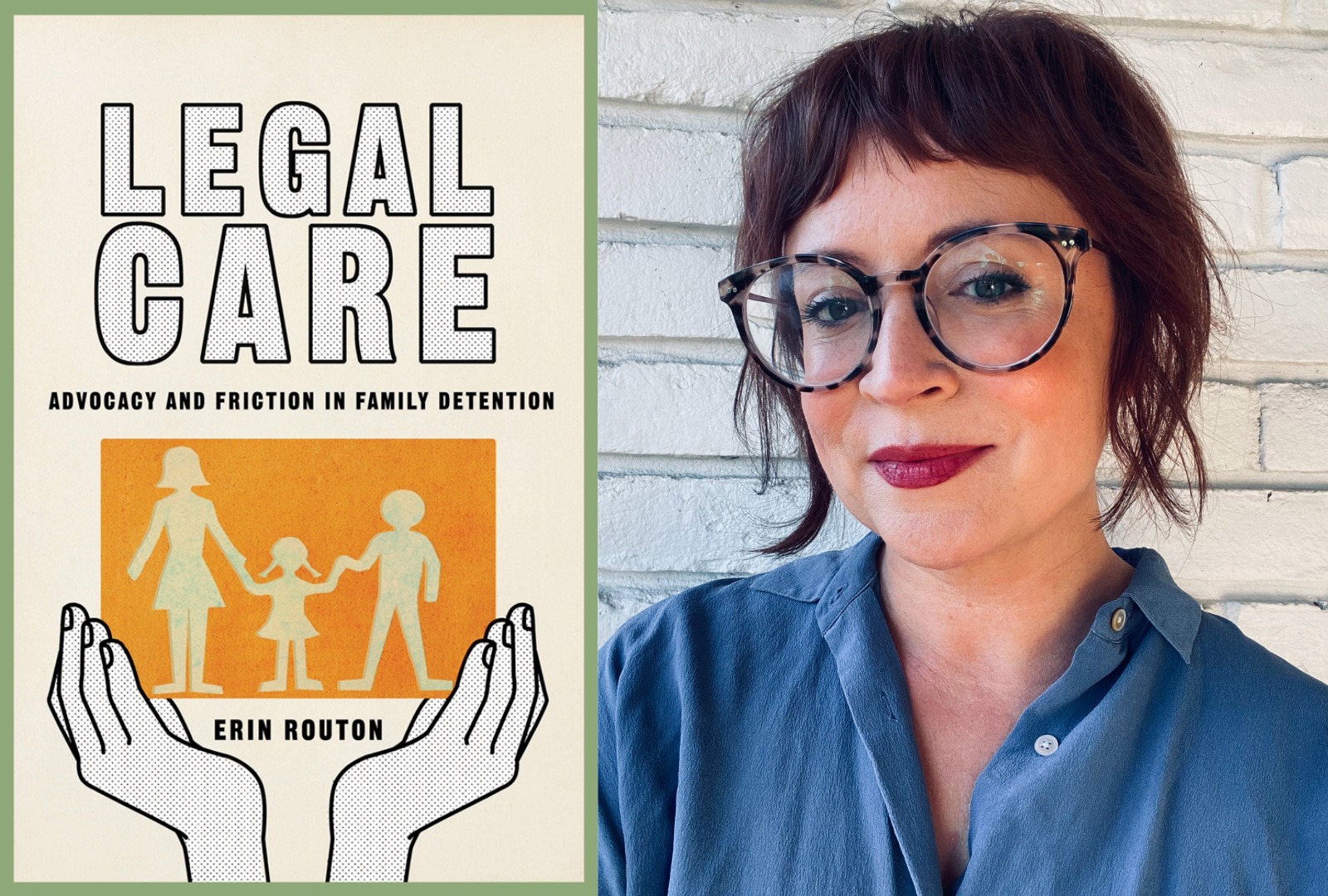
Timely, urgent, and deeply humane, Legal Care: Advocacy and Friction in Family Detention speaks to scholars and practitioners across anthropology, law and society, migration studies, and carceral justice. Eric Routon’s accessible and evocative writing invites readers to reconsider activism and advocacy, offering new language for understanding resistance and solidarity in the face of institutional violence. This book is essential reading for anyone committed to justice, care, and the future of immigration policy in the United States.
In Legal Care, anthropologist Erin Routon explores the operations of these facilities through the unique perspectives of volunteer legal advocates. Routon offers a compelling ethnographic account of the hidden labor and emotional resilience of those advocates. Through the lens of “legal care,” Routon reframes legal aid as a form of caregiving, revealing how these advocates resist the structural and legal violence of family detention while supporting asylum-seeking parents and children. Drawing on immersive fieldwork and firsthand narratives, the book exposes the human cost of administrative incarceration and the quiet power of care in spaces designed to exclude. Read an excerpt from the book’s Introduction below.
The middle of nowhere is how just about everyone describes places like this. By that, they usually mean there aren’t any big malls, no tall buildings, far too much dirt. It’s full of sights like wooden fenceposts stringing together limp barbed wire and swaths of open land dotted by fading billboards with ominous religious pronouncements. It’s too bright during the day, too dark at night, and traffic is determined by loose cattle and wide, unhurried farm machinery. I grew up in a place like this, and in the late summer of 2015, I find myself making my way through terrain that strangely reminds me of home.
Driving down a lonely dirt road, I lean into the steering wheel and squint to see the silver metal gate past a slight turn. They said to keep an eye out because there wouldn’t be a sign. The dust kicks up in cream-colored clouds behind me, and the sun is starting to slip below the distant horizon, turning the sky to its usual vibrant, dusky hues. I think I’m lost. They had told us the road would come right after the detention center, but I never saw the center, just a wide paved path leading off beyond some small hill. I’m already sweating, partially because it’s August in South Texas, but I’m also nervous. The next day will be my first day in an immigrant detention center, and the same distracting thoughts keep running through my head: What am I doing here? I’m not a lawyer, so I don’t really know how to help people with their legal cases. Why would they even want my help? I feel the chunky bits of the road knock the floorboards under my feet, kicking my mind back to the present concern.
I see what looks like the right spot, so I get out to drag the gate open just enough for me to pass through. I drive slowly along a narrow sandy road shrouded with cacti and mesquite trees until coming upon a white, one-story ranch-style home. There’s a row of sparkling clean rental cars with out-of-state plates parked along the side. I rumble over the cattle guard at the entrance and park next to the others. I walk past a rusted barbecue to a back door by the covered patio carrying a tote bag with my notebook and stacks of orientation paperwork, a six pack of Shiner beer in hand. The door swings open, and I’m enthusiastically welcomed by a group I will come to know well in the coming years, though the faces will change. I will also come to know this particular house, known by many who pass through this little town as “the ranch,” eventually thinking of it as a kind of home, and the people who pass through it as an unexpected kind of kin.
What follows is a story of liminal space, of a “nowhere” place caught somewhere in the middle, and the people within it that, in many different ways, find themselves similarly caught. Even the place and people at this story’s center find themselves at a crossroads. Called a baby jail by some, a migrant family detention center by others, and a residential facility by an influential few, it’s all the same place. The people are “legal assistants” or “legal advocates” on paper and “warriors” among compañerxs. In my view, they are also caregivers, and this is a story about why I believe this to be so.
Erin Routon is an assistant professor of anthropology at the University of Houston in Houston, Texas. She also teaches advanced social scientific writing for Harvard Extension School. Her research, activism, and teaching center social justice causes related to immigration and incarceration, particularly in the United States and Latin America. She is a member of the Abolitionist Anthropology Working Group and has worked as a volunteer with various immigrant advocacy organizations and projects across the United States.