The University of Arizona Press

September 17, 2026
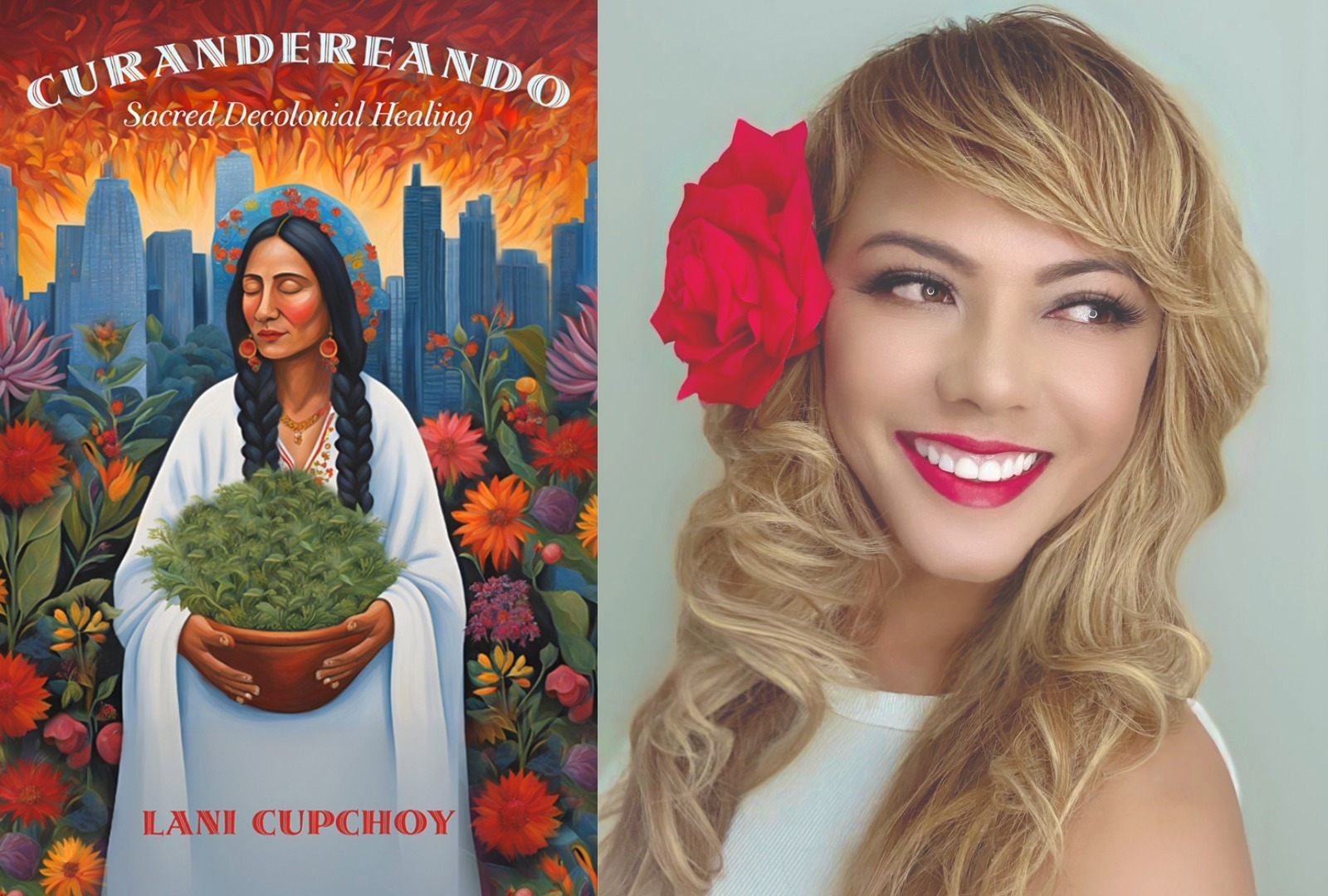
Curandereando: Sacred Decolonial Healing reclaims curanderismo as a living and revolutionary practice of ancestral wisdom, resilience, and renewal. Blending poetry, Spanglish storytelling, oral histories, and testimonios, this hybrid work illuminates healing as both a sacred tradition and a decolonial act of resistance.
Lani Cupchoy traces curanderismo’s survival under colonial oppression, its adaptations across diasporas, and its vital role in addressing contemporary struggles for ecological balance, cultural survival, and social justice. By centering diverse healers and community voices, it resists folkloric portrayals and instead presents curanderismo as an evolving practice deeply relevant to today’s crises.
Today, we share a special interview with the author, who discusses the meaning of “curandereando,” the history of curanderas, and how the past intersects with the living future of curandera healing.
Tell us about your title, Curandereando.
Curandereando is about healing in motion. I wanted a title that made curanderismo active because, to me, it is not simply a tradition we study or a set of practices someone performs. It is a way of being, relating, caring, remembering, and moving through the world.
I also wanted to demystify curanderismo. When people hear words like curandera or curandero, they sometimes imagine a shaman, a mystic, or even a witch. Curanderismo can certainly include deeply spiritual and ceremonial practices, but it takes many forms. Healing can happen through plant medicine, prayer, limpias, healing circles, altars, meditation, mindfulness, intention, preventative care, or simply knowing how to care for someone. It can be physical, emotional, spiritual, communal—or all of these at once. At its heart, curanderismo recognizes that our well-being is connected to our relationships with ourselves, one another, the earth, and spirit.
Many people may recognize aspects of that philosophy in their own lives. Perhaps they grow herbs, meditate, pray for someone, gather in community, pay attention to their wellness, or still use a remedy taught to them by a parent or grandparent. That does not mean every wellness practice is curanderismo; curanderismo has particular cultural histories and ancestral lineages. But it does remind us that healing does not only happen in extraordinary or mysterious spaces. It can happen in ceremony, and it can happen around the kitchen table.
That is curandereando: healing as something living, something we do. As I write in the book, it is “a way of being. A way of life.”
Your book traces curanderismo through time, describing precolonial curanderas and their persecution during the Spanish Inquisition. How did colonization affect the work of curanderas?
One thing I hope readers take away from the book is that the association between curanderas and witchcraft did not emerge in a vacuum. Colonization helped create it.
Long before European colonization, healers held tremendous knowledge about plants, birth, the body, spirit, land, and community. Colonial authorities often recast Indigenous and African-descended healing practices as superstition, heresy, or witchcraft. Healers were persecuted, ceremonies were suppressed, and ways of knowing that did not conform to Catholic orthodoxy were demonized. Yet there was an incredible contradiction: the same colonial society that condemned curanderas could still depend upon their knowledge and remedies when people became ill.
What fascinates me just as much as that persecution, however, is how curanderas responded. They adapted. A prayer might take on Catholic language while preserving older meanings. An Indigenous deity might appear through the image of a saint. A ceremony might move from a public space into the privacy of a home. Knowledge could be carried quietly through families from one generation to the next. I do not think we should automatically interpret those changes as assimilation. In many instances, adaptation was a strategy of survival and resistance.
Colonization also changed how people understood the spiritual dimensions of healing. Curanderismo is grounded in connection—to the earth, to community, to ancestors, to spirit, and, for some, to a Creator. These relationships can take many forms and do not belong to any single religious tradition. Prayer, intention, ceremony, plant medicine, and relationships with the natural world may exist alongside one another as parts of a much more holistic understanding of healing. Over generations, practitioners have carried these relationships forward in ways shaped by their families, communities, histories, and lived experiences.
So when someone encounters the stereotype of the curandera as a “witch,” I want them to ask: Who taught us to see her that way? Behind that stereotype may have been a healer, a midwife, a caretaker, a keeper of plant knowledge, or a community member carrying practices people had relied upon for generations.
Colonization changed curanderismo, but it did not erase it. The fact that these traditions continue today is itself an extraordinary story of survival.
In the preface to your book, you write that your practice of curanderismo is “rooted in the wisdom of my abuela curanderas, yet continually shaped by the teachings of countless healers from across the world.” Can you tell us about one or two of the people who have influenced you the most?
The healers who have influenced me most are the women closest to me: my mother and my abuelas.
Each carried her own gifts and her own ways of healing. Some of that healing happened quietly within the family—through plants, food, prayer, touch, intention, and knowing how to care for someone. Other practices extended outward into the community. What I understand now is that they did not have to announce themselves as healers before they healed. This knowledge was simply woven into everyday life.
One of my earliest memories is from when I was about two years old. I fell from my bicycle and injured my knee badly enough that it became swollen and difficult to walk on. My mother went into our backyard, gathered aloe vera, arnica, and other herbs she knew, heated them, and gently placed the mixture on my knee. By the next morning, the swelling had subsided and I was walking again.
What I love about that memory is that as a child, I did not think anything unusual had happened. I did not think, My mother is practicing curanderismo. I thought, this is what mothers do.
Only much later did I understand what I had witnessed: knowledge of plants, the body, healing, and care that had traveled across generations. My mother may not have called herself a curandera, but, as I write in the book, “her hands carried the same wisdom passed down through generations.”
In many ways, studying curanderismo did not introduce me to healing. It gave me language for something the women in my family had already taught me. That realization has profoundly shaped both my practice and my scholarship.
Importantly, you identify many “New-Gen” healers and describe their current work. What excites you the most about these approaches?
What excites me most about New-Gen healers is that they remind us that a living tradition is allowed to evolve.
Sometimes we romanticize ancestral practices by imagining that they are only authentic if they remain exactly as they were generations ago. But curanderismo itself tells us otherwise. It survived precisely because people adapted, carried knowledge into new environments, and responded to the needs of their communities.
We see that happening again today. Contemporary healers are cultivating medicinal plants in urban environments, transforming everyday spaces into places of healing, connecting diasporic communities through digital platforms, and bringing healing practices into conversations about migration, environmental justice, activism, and decolonization. Queer and gender-expansive curanderes are also creating and reclaiming practices that make space for identities, chosen families, and communities whose spiritual lives have not always been recognized.
What I find exciting is the question underneath all of these approaches: What does healing require from us now?
That question allows us to honor ancestral knowledge without freezing it in the past. New-Gen healers are not simply preserving traditions; they are in relationship with them. They are asking how inherited knowledge can respond to contemporary bodies, communities, environments, and realities.
Curanderismo has roots, but it also has movement. That is how living traditions survive.
What are you working on now?
I have two forthcoming books, so it has been an exciting and very busy period. Although the projects may initially seem quite different, I see a thread connecting all three books: How does knowledge survive across generations, and what do families and communities do to carry it forward?
My forthcoming academic book, Urban Aloha: Hawaiian Diaspora, Identity, and Belonging in Los Angeles, from the University of Nevada Press, turns toward my Hawaiian ancestry and examines how Hawaiian communities in Los Angeles have created belonging and sustained cultural identity through foodways, festivals, family, oral histories, and other forms of cultural memory. The project is deeply personal to me. My father migrated from Hawaiʻi to Los Angeles and created a sense of Hawaiianness in our home through everything from ʻukulele and hula to the plumeria and ti plants in our yard and the foods we ate together. The book examines what I call a “transgenerational imaginary”—the ways cultural knowledge moves across generations, being preserved but also reimagined as communities adapt to new places.
My other forthcoming book, Abuela Medicine, from FlowerSong Press, brings questions of ancestral knowledge even closer to home. It follows five generations of women in my family and the different forms of healing knowledge they carried. Through family stories, memoir, poetry, photographs, and more than forty-five remedios, I explore how knowledge can move from one generation to another through gardens, food, herbs, prayer, spiritual practice, storytelling, and everyday acts of care.
I also want to be clear that I do not see Curandereando—or any of these books—as the final word on these subjects. Curandereando highlights particular people, practices, histories, and moments. There are countless others. There are healers whose stories have never been documented, family knowledge that has never entered an archive, regional traditions that deserve far greater attention, and communities whose experiences still need to be recorded.
We need more of these stories now more than ever. So I think of Curandereando as a contribution and an opening rather than a final word. My forthcoming books take some of the questions that have long shaped my work—about memory, inheritance, cultural knowledge, and what communities carry forward—in very different directions. There will always be more histories to recover, more elders to listen to, more stories to document, and more knowledge to carry forward. No single book can tell the whole story—and that is precisely why we need many more of them.
Lani Cupchoy is a public historian, storyteller, artivista, and filmmaker of Chicana, Afro-indígena, Kanaka Maoli, and Chinese heritage. She is an assistant professor of Chicana/o and Latina/o studies at California State University, Los Angeles, specializing in public history, ethnic studies, and Indigenous knowledge. Founder of Pinkjade Creations, she uses film, music, and digital media to amplify testimonios and cultural resilience. Her work bridges scholarship, ancestral healing traditions, and community-engaged storytelling.