The University of Arizona Press

October 13, 2026
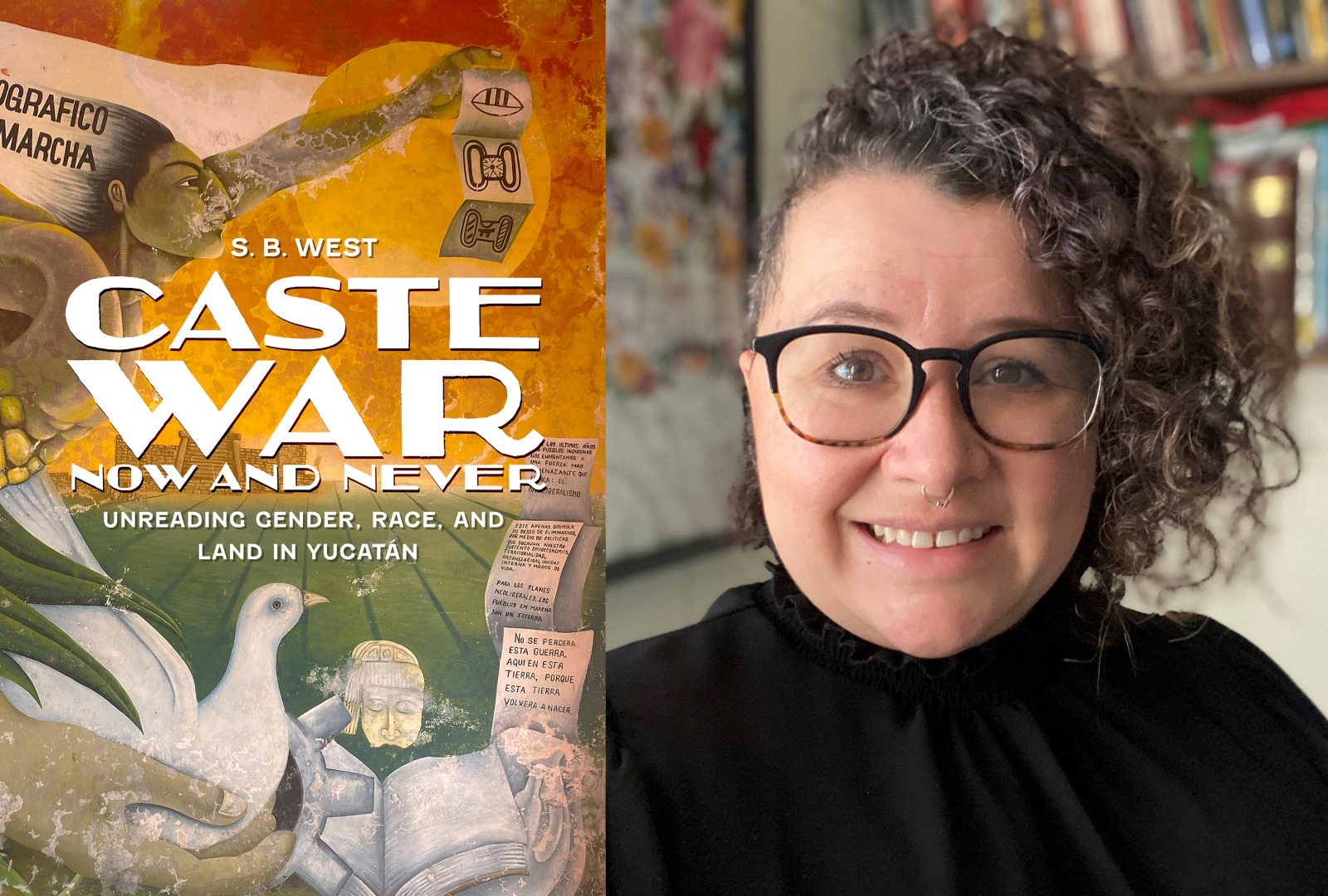
In Caste War Now and Never: Unreading Gender, Race, and Land in Yucatán, scholar S.B. West considers Yucatán’s nineteenth-century Caste War, the longest and most violent Indigenous uprising of the Western Hemisphere, to argue that it actually never occurred. Instead, West writes that the violent events grouped under the “Caste War” label must be understood through alternative frameworks that resist the emergent logics of race war and include related regulatory matrices like gender and land. Through this lens, the Caste War emerges as a discursive construct rooted in an anti-Indigenous archive that served the political interests of a frustrated regional elite during the rise of liberalism and nationhood. West argues that Caste War discourse unfolds as a technology that mobilized and legitimized genocidal actions against racialized rebels and inspired assimilation into hegemonic political and social structures.
In the second half of the book, West looks at the Caste War to engage its contemporary polysemic nature through close readings of Yucatec Maya texts, stories, and other forms of knowledge production. These sources reframe the Caste War as an important part of a framework of resistance that defies colonial time and reclaims narrative control of its events. Caste War Now and Never captures how Maya communities understand the conflict as ongoing and demonstrates that although the Caste War never occurred as such, it continues to endure presently. Read an excerpt from the book’s Chapter 1 below.
In 1847, seven indios were arrested in the town of Chichimilá, Yucatán, on the grounds of plotting a race war to exterminate the blancos (whites). Drunk on too much aguardiente, rebel leader Manuel Antonio Ay was apprehended one night for conspiring with other indios, which resulted in the discovery of a letter that announced Cecilio Chi’s violent plans for a great indio insurrection. Nineteenth-century regional historian Eligio Ancona marked this incident as one of the first revelations of “la gran sublevación que debía estallar próximamente” (the great uprising that would soon erupt). This great race war would “sacar á la raza blanca de la confianza imperturbable en que vivía en el cráter mismo del volcán” (expel the white race from the imperturbable confidence they enjoyed even while living in the very crater of the volcano). And so began the fifty-year period of peninsula-wide violence between white factions and indio rebels—an era known as the Guerra de Castas, or the Caste War. According to the newspapers, historiographies, and literary narratives of the period, rebel leaders Jacinto Pat of Tihosuco, Cecilio Chi of Tepich, and Manuel Antonio Ay of Chichimilá, among others, led their indio troops against Yucateco- owned haciendas and settlements, killing all the blancos they could find. Reports generated by the victims and their representatives tell tales of rebels taking white men’s wives to be kept as concubines; of houses and possessions burned and pillaged; of entire towns of white families— including the women and children—murdered, their bodies left to decay in the aftermath. Accounts circulated of boys ruthlessly executed before their mothers and sisters, their hearts cut out, their blood drunk; of women and daughters raped, their lifeless bodies left to rot aside the mutilated corpses of their family members.
In this hemisphere’s largest and longest Indigenous uprising, violence spilled outward from Yucatán’s southeastern regions—sugar mills, ranchos, towns, and cities were razed in the war’s path. As Terry Rugeley surmises, “property damage for the years 1840– 76 defies calculation.” In all, it was reported that more than half of Yucatán’s population either fell victim to the violence or fled the peninsula; casualties are estimated between 250,000 and 360,000 throughout the fifty-five years of the war. An estimated 78 percent of those casualties and migrations occurred between 1846 and 1861. Yucatecos rapidly began to realize the depth of the crisis, and they dared to imagine the previously unthinkable—the establishment of Maya hegemony. As white reinforcements began to pour into the greater Tihosuco area to suppress the uprising, a militarized Maya independent state called Chan Santa Cruz formed in the 1850s, encompassing a large portion of what is now the state of Quintana Roo. Chan Santa Cruz was recognized as a de facto independent country by the British government, a reflection of intimate economic and political ties between the rebel state and British Honduras (Belize). While an invasion by Porfirio Díaz’s troops in 1901 is often cited as the official “end” of the Caste War, some historians account for the decades of fighting that occurred after that end point, including the oft- cited “last battle” of Dzulá in 1933 or the continued maintenance of Chan Santa Cruz by community members like Norberto Yeh as late as 1959.
Yet there is a polysemic quality to the Caste War that often goes unaccounted for. If we turn to the nineteenth-century epistolary accounts that Caste War rebel leadership left behind, it becomes clear that for the rebels, the war’s goal was not one of racial antagonism— if it was being conceptualized as such, it was because “the whites began it.” Rebel leaders repeatedly state that the rebellion emerged as a reaction to liberal antagonisms and the loss of life accrued because of political violence. They highlight that the violent rebel responses to these oppressions were only pursued after exhausting all other possibilities. Similarly, we can turn to Chan Santa Cruz to observe that, of its many internal conflicts, some were created or fueled by outside attempts to divide the group through “peace-making” treaties or other tactics. Similar actions are documented against two other resistance groups—the icaichés and los pacíficos—including the use of criminalization and physical violence to stifle these movements. What these perspectives elucidate is that those exercising hegemonic control over Yucatán were deeply engaged in nation-building tactics grounded in the lofty charges of order and progress, as was the case in other (Latin) American geopolitical and national spaces. This grounding is undeniably rooted in whiteness, or the systematic hierarchical prioritization of Eurocentric ways of living and world-building. Given this framing, it becomes clear that the instances of race wars—and the facile ways this concept frames the Caste War—are not happenstance. Such narratives peaked during the implementation of modernity, which mobilized myriad forms of hegemonic violence that suppressed bodies, knowledges, and ways of being that did not fit into the temporal, economic, and political structure encoded through whiteness. Thus, this study maintains that when “race war” is evoked, it is to index an imagined collision between two racialized factions made to occupy certain positions through an ontologized racial identity. While I give more texture to race war and caste war through this text, the rebel epistolary accounts referenced above demonstrate how the conditions of liberalism, nation-building, and capitalism affected and redefined many social categories within the peninsula if we assume this understanding of race war.
S. B. West is an associate professor of instruction in the Gender and Sexuality Studies Program at Northwestern University and also affiliate faculty in Spanish and Portuguese and Native American and Indigenous Studies. West’s scholarship focuses on Latin American literatures and cultures, abolition, and transfeminist theory. They have published work in South Atlantic Quarterly, Hispanófila, and the Latin Americanist.