 The University of Arizona Press

With the arrival of the summer months, we welcome a slower pace in Tucson: shorter lines at your favorite restaurant, fewer emails in your inbox, and perhaps some extra time to dig into a good book while cicadas buzz outside.
At the University of Arizona Press, we find that this annual summer slowdown is the perfect moment to revisit some of the incredible titles in our backlist (i.e., books from our previous seasons, sometimes going back many, many years), in particular those that are now available in paperback.
And while we’re excited about the books we’re going to publish soon, we think it’s always worth taking the time to revisit a few remarkable books from our backlist. After all, as those old song lyrics go, “Make new friends, but keep the old!” Check out the roundup of books now in paperback below.
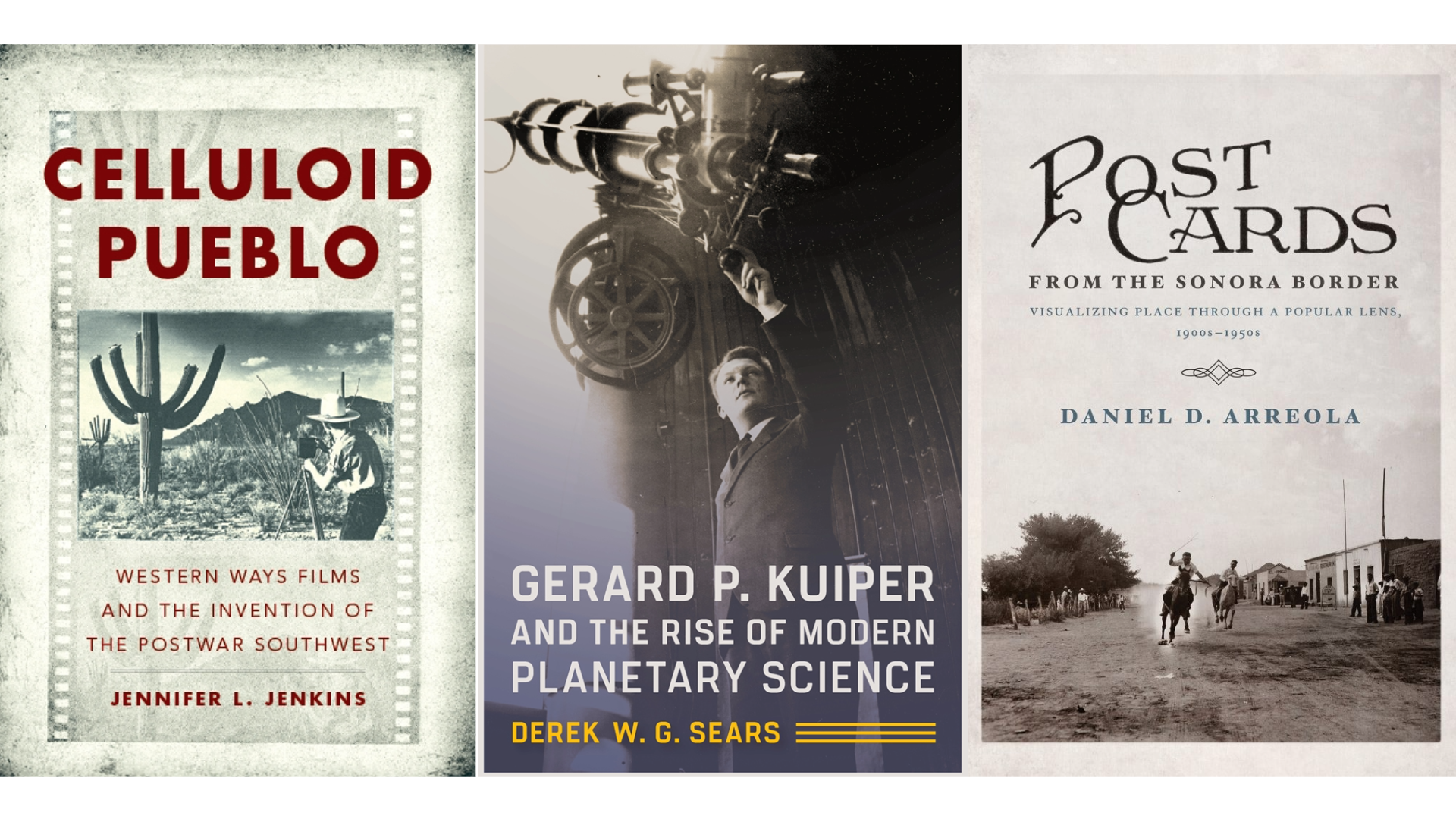
Postcards from the Sonora Border: Visualizing Place Through a Popular Lens, 1900s–1950s

Young men ride horses on a dusty main road through town. Cars and gas stations gradually intrude on the land, and, years later, curiosity shops and cantinas change the face of Mexican border towns south of Arizona. Between 1900 and the late 1950s, Mexican border towns came of age both as centers of commerce and as tourist destinations. Postcards from the Sonora Border reveals how images—in this case the iconic postcard—shape the way we experience and think about place.
Making use of his personal collection of historic images, Daniel D. Arreola captures the evolution of Sonoran border towns, creating a sense of visual “time travel” for the reader. Supported by maps and visual imagery, the author shares the geographical and historical story of five unique border towns—Agua Prieta, Naco, Nogales, Sonoyta, and San Luis Río Colorado.
Postcards from the Sonora Border introduces us to these important towns and provides individual stories about each, using the postcards as markers. No one postcard view tells the complete story—rather, the sense of place emerges image by image as the author pulls readers through the collection as an assembled view. Arreola reveals how often the same locations and landmarks of a town were photographed as postcard images generation after generation, giving a long and dynamic view of the inhabitants through time. Arranged chronologically, Arreola’s postcards allow us to discover the changing perceptions of place in the borderlands of Sonora, Mexico.
Gerard P. Kuiper and the Rise of Modern Planetary Science

Astronomer Gerard P. Kuiper ignored the traditional boundaries of his subject. Using telescopes and the laboratory, he made the solar system a familiar, intriguing place. “It is not astronomy,” complained his colleagues, and they were right. Kuiper had created a new discipline we now call planetary science.
Kuiper was an acclaimed astronomer of binary stars and white dwarfs when he accidentally discovered that Titan, the massive moon of Saturn, had an atmosphere. This turned our understanding of planetary atmospheres on its head, and it set Kuiper on a path of staggering discoveries: Pluto was not a planet, planets around other stars were common, some asteroids were primary while some were just fragments of bigger asteroids, some moons were primary and some were captured asteroids or comets, the atmosphere of Mars was carbon dioxide, and there were two new moons in the sky, one orbiting Uranus and one orbiting Neptune.
He produced a monumental photographic atlas of the Moon at a time when men were landing on our nearest neighbor, and he played an important part in that effort. He also created some of the world’s major observatories in Hawai‘i and Chile. However, most remarkable was that the keys to his success sprang from his wartime activities, which led him to new techniques. This would change everything.
Derek W. G. Sears shows a brilliant but at times unpopular man who attracted as much dislike as acclaim. This in-depth history includes some of the twentieth century’s most intriguing scientists, from Harold Urey to Carl Sagan, who worked with—and sometimes against—the father of modern planetary science. Now, as NASA and other space agencies explore the solar system, they take with them many of the ideas and concepts first described by Gerard P. Kuiper.
Gardening at the Margins: Convivial Labor, Community, and Resistance
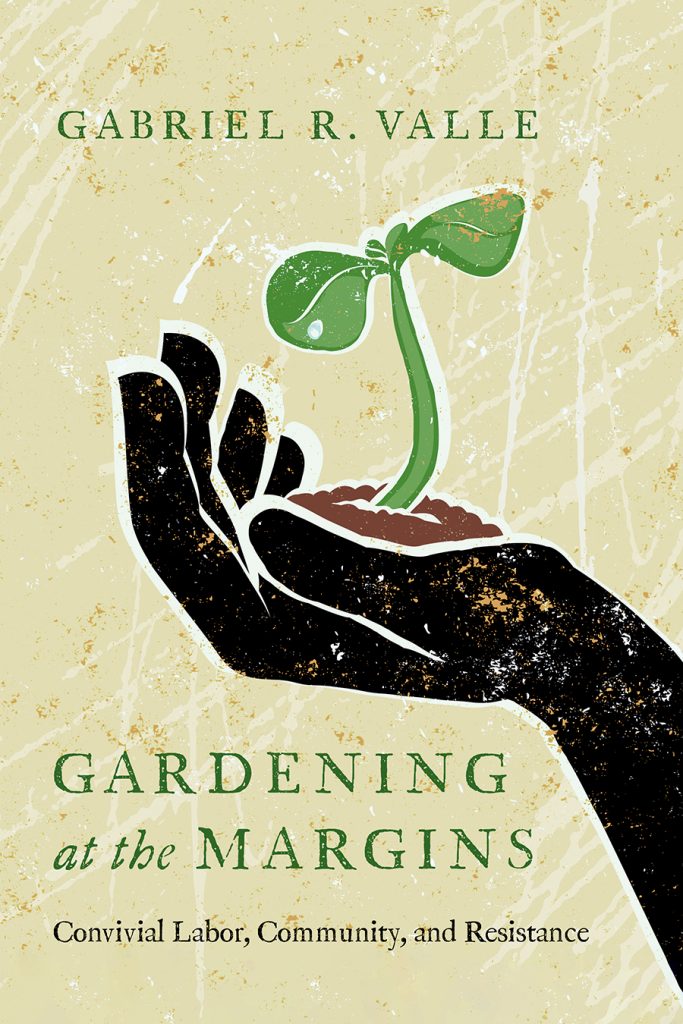
Gardening at the Margins tells the remarkable story of a diverse group of neighbors working together to grow food and community in the Santa Clara Valley in California. Based on four years of deeply engaged ethnographic field research via a Participatory Action Research project with the people and ecosystems of La Mesa Verde home garden program, Gabriel R. Valle develops a theory of convivial labor to describe how the acts of care among the diverse gardeners—through growing, preparing, and eating food in one of the most income unequal places in the country—are powerful, complex acts of resistance.
Participants in La Mesa Verde home garden program engage in the practices of growing and sharing food to envision and continuously work to enact alternative food systems that connect people to their food and communities. They are building on ancestral knowledge, as well as learning new forms of farming, gardening, and healing through convivial acts of sharing.
The individuals featured in the book are imagining and building alternative worlds and futures amid the very real challenges they embody and endure. Climate change, for example, is forcing thousands of migrants to urban areas, which means recent immigrants’ traditional environmental, nutritional, and healing knowledge will continue to be threatened by the pervasiveness of modernity and the homogenization of global capitalism. Moreover, once rural people migrate to urban areas, their ability to retain traditional foodways will remain difficult without spaces of autonomy. The stories in this book reveal how people create the physical space to grow food and the political space to enact autonomy to revive and restore agroecological knowledge needed for an uncertain future.
Celluloid Pueblo: Western Ways Films and the Invention of the Postwar Southwest

The five Cs of Arizona—copper, cattle, cotton, citrus, and climate—formed the basis of the state’s livelihood and a readymade roster of subjects for films. With an eye on the developing national appetite for all things western, Charles and Lucile Herbert founded Western Ways Features in 1936 to document the landscape, regional development, and diverse cultures of Arizona, the U.S. Southwest, and northern Mexico.
Celluloid Pueblo tells the story of Western Ways Features and its role in the invention of the Southwest of the imagination. Active during a thirty-year period of profound growth and transformation, the Herberts created a dynamic visual record of the region, and their archival films now serve as a time capsule of the Sunbelt in the mid-twentieth century. Drawing upon a ten-year career with Fox, Western Ways owner-operator Charles Herbert brought a newshound’s sensibility and acute skill at in-camera editing to his southwestern subjects. The Western Ways films provided counternarratives to Hollywood representations of the West and established the regional identity of Tucson and the borderlands.
Jennifer L. Jenkins’s broad-sweeping book examines the Herberts’ work on some of the first sound films in the Arizona borderlands and their ongoing promotion of the Southwest. The book covers the filmic representation of Native and Mexican lifeways, Anglo ranching and leisure, Mexican missions and tourism, and postwar borderlands prosperity and progressivism. The story of Western Ways closely follows the boom-and-bust arc of the midcentury Southwest and the constantly evolving representations of an exotic—but safe and domesticated—frontier.
Translation and Epistemicide: Racialization of Languages in the Americas

Translation has facilitated colonialism from the fifteenth century to the present day. Epistemicide, which involves destroying, marginalizing, or banishing Indigenous, subaltern, and counter-hegemonic knowledges, is one result. In the Americas, it is a racializing process. But in the hands of subaltern translators and interpreters, translation has also been used as a decolonial method.
Author Joshua Martin Price gives an account of translation-as-epistemicide in the Americas, drawing on a range of examples from the early colonial period to the War on Terror. The first chapters demonstrate four distinct operations of epistemicide: the commensuration of worlds, the epistemic marginalization of subaltern translators and the knowledge they produce, the criminalization of translators and interpreters, and translation as piracy or extractivism. The second part of the book outlines decolonial translation strategies, including an epistemic posture the author calls “bewilderment.”
Translation and Epistemicide tracks how through the centuries translation practices have enabled colonialism and resulted in epistemicide, or the destruction of Indigenous and subaltern knowledge.
