 The University of Arizona Press


November 17, 2025
The University of Arizona Press is attending the 2025 American Anthropological Association meeting in New Orleans this week! Find us at booth #101 to browse our latest anthropology titles and meet with our Senior Editor, Allyson Carter.
If you can’t attend this year, or if you need an extra copy of a book you discover at our booth, we’ve got you covered: use AZAAA25 for 40% off all books, with free shipping on orders over $60.
Are you an author or editor? Do you have a project that would be a great fit for The University of Arizona Press? To learn more about publishing with us, click here.
New & Featured Anthropology Titles

In Indigenizing Japan, archaeologist Joe E. Watkins provides a comprehensive look at the rich history and cultural resilience of the Ainu, the Indigenous people of Hokkaido, Japan, tracing their journey from ancient times to their contemporary struggles for recognition. Watkins’s insightful analysis highlights the Ainu’s enduring spirit and their resurgence as part of the global Indigenous movement. Key events such as the 1997 Nibutani Dam case and the 2007 recognition of the Ainu as Japan’s Indigenous people are explored in depth, showcasing the Ainu’s ongoing fight for cultural preservation and self-determination. By situating the Ainu’s experiences within broader global colonial histories, Indigenizing Japan underscores the shared struggles and resilience of Indigenous communities worldwide.

Flows of Violence offers a profound ethnographic exploration of the intricate relationship between violence and water infrastructure in one of Colombia’s most marginalized cities. This groundbreaking work engages with the concept of “infrastructural violence,” revealing how the Colombian state’s neglect and inadequate provision of water services perpetuate inequality and suffering among Buenaventura’s residents. Through extensive fieldwork, Felipe Fernández provides rich empirical data and firsthand accounts that bring to light the daily struggles and resilience of the city’s inhabitants. This timely contribution underscores the urgent need for equitable infrastructure development and social justice, making it a pivotal text for understanding urban poverty and state dynamics in Latin America and beyond.

In the high Andean grasslands 4,500 meters above sea level, Quechua alpaca herders live on the edges of glaciers that have retreated more rapidly in the past fifty years than at any point in the previous six millennia. Women are the primary herders, and their specialized knowledge and skill is vital to the ability of high-elevation communities to survive in changing climatic conditions. In the past decade, however, these herders and their animals have traversed a rapidly shifting terrain. In Restless Ecologies, Allison Caine draws on the Quechua concept of k’ita, or restlessness, to explore how herders in the community of Chillca in the Cordillera Vilcanota mountain range of the southeastern Peruvian Andes sense and make sense of changing conditions.
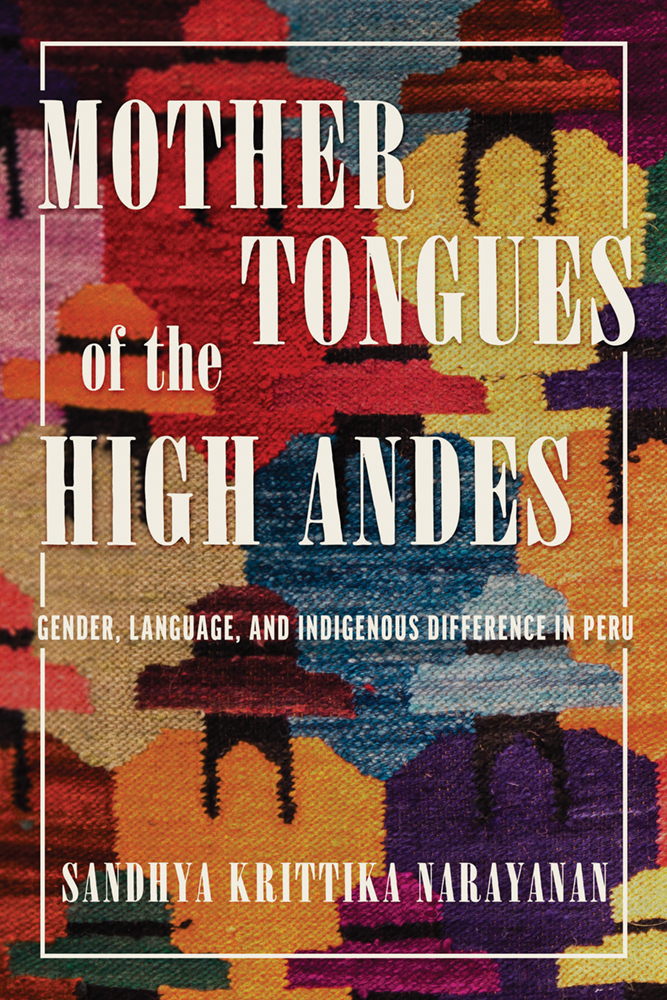
What does it mean to be a Quechua or Aymara speaker today in Puno, the capital of the Peruvian altiplano? What does it mean to be an Indigenous ethnic Quechua or Aymara individual? Mother Tongues of the High Andes opens with these questions, exploring what Quechua and Aymara languages and identities mean for Indigenous puneños as they navigate their past and present. Anthropologist Sandhya Krittika Narayanan argues that understanding inter-Indigenous linguistic and social differences involves examining Indigenous gender roles, responsibilities, and linguistic practices, particularly those of Indigenous puneña women. She shows how these practices have contributed to the maintenance of Indigenous multilingualism and continuity in local modes of understanding Indigenous identity and difference.
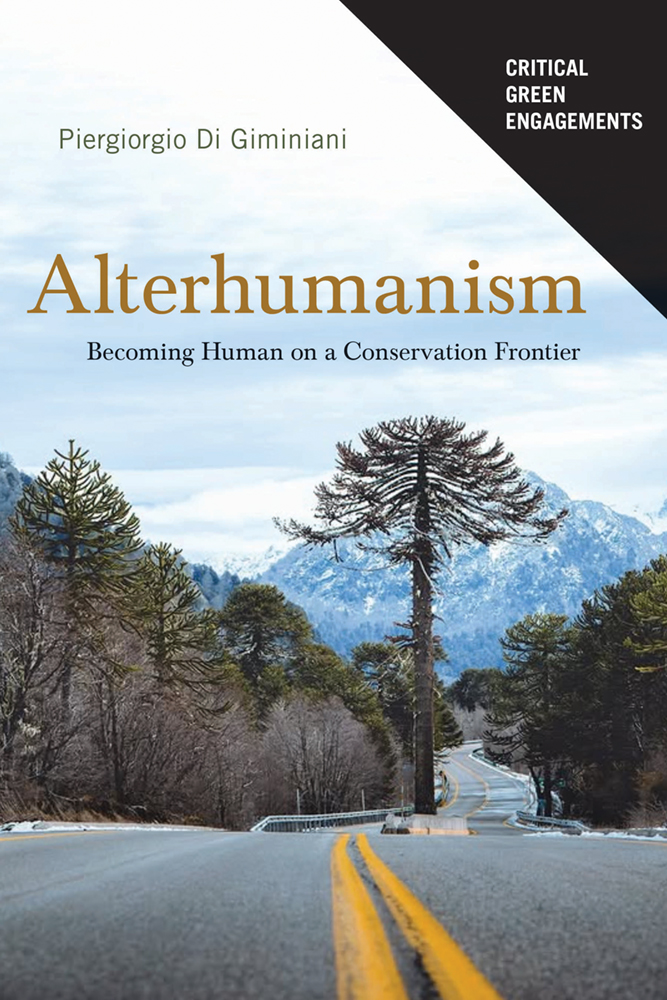
What does it mean to be human in the Anthropocene? Set against the backdrop of southern Chile’s conservation frontier, Piergiorgio Di Giminiani’s Alterhumanism invites us to recognize the centrality of the human condition in the face of an increasingly uncertain world and imagine future forms of coexistence. Reflecting on more than a decade of ethnographic fieldwork with smallholding settlers, Indigenous Mapuche farmers, environmental activists, entrepreneurs, and conservation scientists, Di Giminiani brings to light how these diverse groups navigate the enduring impacts of settler-caused environmental depletion and their aspirations for new ethics of care.

As permafrost in Siberia continues to melt and the steppe in the Gobi turns to desert, people in Mongolia are faced with overlapping climate crises. Some nomadic herders describe climate change as the end of a world. They are quick to add that the world has ended before for Indigenous people in North Asia, as waves of colonialism have left the steppe with a complicated web of apocalypses. A Song for the Horses by Kip Hutchins examines cases in which people respond to the pressures of climate change by drawing on cultural heritage to foster social resiliency. At the intersection of music, environment, and posthumanism, A Song for the Horses shows how Mongolian musicians use cultural traditions to imagine and build toward alternative futures beyond climate change and neoliberalism.
Featured Series
Critical Issues in Indigenous Studies anchors intellectual work within an Indigenous framework that reflects Native-centered concerns and objectives. Series titles expand and deepen discussions about Indigenous people beyond nation-state boundaries, and complicate existing notions of Indigenous identity. The series editors are especially interested in works that analyze colonization, land dispossession, and oppression while foregrounding Indigenous peoples’ resistance to these processes.
Global Change/Global Health is a series for scholarly monographs that treat global change and human health as interconnected phenomena. The goals of the series are to advance scholarship across the social and health sciences, contribute to public debates, and inform public policies about the human dimensions of global change.
Biodiversity in small spaces is a series that provides short, to-the-point books that re-examine the conservation of biodiversity in small places and focus on the interplay of memory, identity, and affect in determining what matters, and thus what stays, thereby shaping the fabric of biodiversity in the present and, ultimately, the future. The authors will cover, in an accessible way, the range of marginalities, subjectivities, and chronologies, from indigenous farmers nurturing, defending, or repatriating their traditional crop varieties to college towns re-embedding food production and consumption into the social fabric of their communities.
Critical Green Engagements is a series that critically engages with the growing global advocacy of the “green economy” model for environmental stewardship and puts forth alternatives to discourses that dominate “green” practices. The series explores how different advocates, bystanders, and opponents engage with the changes envisaged by policy directives and environmental visions. It also examines which forms of social movements emerge from these ideologies and how social movement actors connect. The series showcases the rigorous, high-quality research and writing emerging in response to these transformations and channels the energies and skills of an international collection of leading environmental scholars.
Native Peoples of the Americas is an ambitious series whose scope ranges from North to South America and includes Middle America and the Caribbean. Each volume takes unique methodological approaches—archaeological, ethnographic, ecological, and/or ethno-historical—to frame cultural regions. Volumes cover select theoretical approaches that link regions, such as Native responses to conquest and the imposition of authority, environmental degradation, loss of Native lands, and the appropriation of Native knowledge and cosmologies. These books illuminate the strategies that Native Peoples have employed to maintain both their autonomies and identities. The series encourages the participation of Native, well-established, and emerging scholars as authors, contributors, and editors for the books.
For questions or to submit a proposal to any of these series, please contact Allyson Carter at ACarter@uapress.arizona.edu.
