 The University of Arizona Press

Mexican Americans in a Dallas Barrio
Ebooks (Open Access)
Read Online
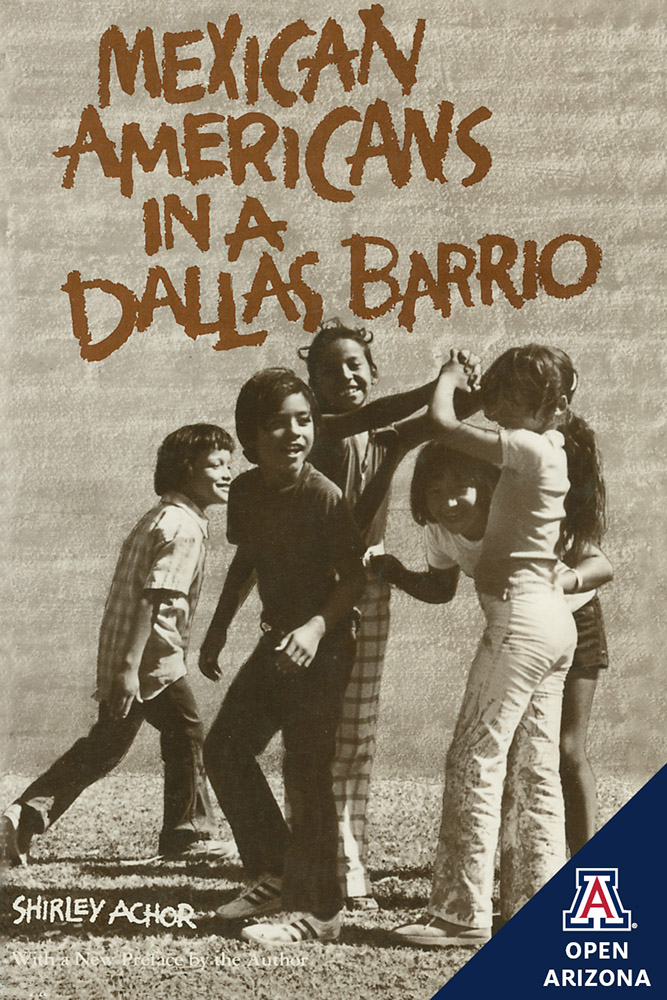
This book vividly describes day-to-day barrio life in Dallas. Achor’s portrayal of the residents challenges stereotypes of traditional Mexican American culture and southwestern barrio life.
“A very perceptive, authoritative, and compact description of a Dallas Mexican American community.”—Dallas Morning News
“[A] significant contribution to contemporary Chicano studies . . . reveal[ing] new dimensions of the Chicano experience. . . . Achor’s ethnography stands as a major challenge to the negative view of the Chicano barrio as an urban village dominated by the culture of poverty.”—American Anthropologist
“The book is not only readable, compassionate, accurate, and careful; it is also a good ethnography.”—International Migration Review
“Contributes careful ethnographic and survey research toward constructing a theory of ethnic stratification in the United States.”—Contemporary Sociology
“A promising and interesting contribution. . . . The author’s descriptive accounts provide important and telling insights about the barrio’s life cycle, linking it to institutions, change, and adaption.”—Aztlán
“Contains a wealth of information concerning the relationships between the residents of the ‘barrio’ and the larger Dallas society, including important data regarding housing conditions, the world of work, and the general sociocultural matrix.”—Southwestern Historical Quarterly
“[A] significant contribution to contemporary Chicano studies . . . reveal[ing] new dimensions of the Chicano experience. . . . Achor’s ethnography stands as a major challenge to the negative view of the Chicano barrio as an urban village dominated by the culture of poverty.”—American Anthropologist
“The book is not only readable, compassionate, accurate, and careful; it is also a good ethnography.”—International Migration Review
“Contributes careful ethnographic and survey research toward constructing a theory of ethnic stratification in the United States.”—Contemporary Sociology
“A promising and interesting contribution. . . . The author’s descriptive accounts provide important and telling insights about the barrio’s life cycle, linking it to institutions, change, and adaption.”—Aztlán
“Contains a wealth of information concerning the relationships between the residents of the ‘barrio’ and the larger Dallas society, including important data regarding housing conditions, the world of work, and the general sociocultural matrix.”—Southwestern Historical Quarterly
222 Pages
6 x 9
Published: December 2018Ebooks (OA) ISBN: 9780816538782