“Woven from the Center” Celebration, Basketry Showcase and Basket Weaver Expo

Date: Saturday, March 23, 2024

Time: 10 a.m to 2 p.m., AZT

Where: Front Lawn, Arizona State Museum, University of Arizona, 1013 E. University Blvd, Tucson

Celebrate the publication of Woven from the Center: Native Basketry in the Southwest, by Diane Dittemore, at the Arizona State Museum.  Basket weavers from around the region, many highlighted in the book, will be showing and selling their wares as part of the Basketry Showcase and Basket Weaver Expo. In addition, the book will be available for purchase and signing by the author. Visitors may also go inside the museum to see the exhibit, “Woven Through Time: American Treasures of Native Basketry and Fiber Art,” curated by Dittemore.

About the book:

Woven from the Center presents breathtaking basketry from some of the greatest weavers in the Southwest. Each sandal and mat fragment, each bowl and jar, every water bottle and whimsy is infused with layers of aesthetic, cultural, and historical meanings. This book offers stunning photos and descriptions of woven works from Tohono O’odham, Akimel O’odham, Hopi, Western Apache, Yavapai, Navajo, Pai, Paiute, New Mexico Pueblo, Eastern Apache, Seri, Yaqui, Mayo, and Tarahumara communities. This richly illustrated volume stands on its own as a definitive look at basketry of the Greater Southwest, including northern Mexico.

Author Lucianne Lavin Speaks at Southbury Library

When: February 6, 2024

Time: 1 p.m., EST

Where: Southbury Public Library, 100 Poverty Rd., Southbury, CT

Registration recommended: Register for event here

Lucianne Lavin will speak on Our Hidden Landscapes edited by Lucianne Lavin and Elaine Thomas at the Southbury Connecticut Library. The event is co-sponsored by the Library and the Southbury Land Trust. Lavin will talk about built stone cultural features. The idea of Native Americans designing stone structures that represent sacred landscapes is fairly new to some Northeastern researchers, as it was historically–and erroneously—thought that local Indigenous peoples did not build in stone and all such structures were the result of European-American farming activities. Some of it is, but some of it is not.

This event is free to attend and open to all. Register here.

About the book:

Native American authors provide perspectives on the cultural meaning and significance of ceremonial stone landscapes and their characteristics, while professional archaeologists and anthropologists provide a variety of approaches for better understanding, protecting, and preserving them. The chapters present overwhelming evidence in the form of oral tradition, historic documentation, ethnographies, and archaeological research that these important sites created and used by Indigenous peoples are deserving of protection.

This work enables archaeologists, historians, conservationists, foresters, and members of the general public to recognize these important ritual sites.

Michael Chiago Speaks at Amerind Museum

Date: Saturday, February 17, 2024

Time: 11 a.m., AZT

Where: Amerind Museum, 2100 N. Amerind Road, Dragoon, AZ

Amerind Museum hosts an artist gallery talk and reception with Michael Chiago. Amerind celebrates its latest exhibit: Tohono O’odham Himdag in Brush and Lens: Paintings of Michael Chiago and Photography of Bernard Siquieros. “Himdag” refers to the Tohono O’odham way of life. Painter Michael Chiago is a prolific artist who has created thousands of original works over a career spanning decades. In color and line, Michael celebrates O’odham himdag. Photographer Bernard Siquieros was a passionate educator of O’odham himdag with a long and diverse career. Through it all–Bernard carried a camera, capturing O’odham himdag in moments of everyday life and in moments of celebration. In brush and lens, these two men chronicle the great strength of the Tohono O’odham community, honoring their rich heritage and working together for brighter tomorrows.

Learn more about himdag in the book: Michael Chiago: O’odham Lifeways Through Art, by Michael Chiago, Sr. and Amadeo M Rea.

About the book:

Michael Chiago: O’odham Lifeways Through Art offers an artistic depiction of O’odham lifeways through the paintings of internationally acclaimed O’odham artist Michael Chiago Sr. Ethnobiologist Amadeo M. Rea collaborated with the artist to describe the paintings in accompanying text, making this unique book a vital resource for cultural understanding and preservation. A joint effort in seeing, this work explores how the artist sees and interprets his culture through his art.

A wide array of Chiago’s paintings are represented in this book, illustrating past and present Akimel O’odham and Tohono O’odham culture. The paintings show the lives and traditions of O’odham people from both the artist’s parents’ and grandparents’ generations and today. The paintings demonstrate the colonial Spanish, Mexican, and Anglo-American influences on O’odham culture throughout the decades, and the text explains how wells and windmills, schools, border walls, and nonnative crops have brought about significant change in O’odham life.


Steven LeBlanc Speaks on Chaco, Mimbres, and Paquime at the University of Arizona

Date: Wednesday, March 6, 2024

Time: 3 – 4  p.m., AZT

Where: ENR2 Rm S107, University of Arizona, 1064 E. Lowell St., Tucson

Steven LeBlanc, retired director of collections, Peabody Museum/Harvard University, will present his slides on “Chaco, Mimbres and Paquime: A New Synthesis,” in person on the University of Arizona campus. The event is sponsored by the Arizona State Museum and is free and open to the public. LeBlanc’s presentation is based on the forthcoming book that he co-authored with Roger Anyon,  Ancient Communities in the Mimbres Valley, Continuity and Change from AD 750 to 1350. Attendees will receive a discount code to pre-order this book.

Chaco Canyon and Paquime (Casas Grandes) are both world heritage sites. Between them lies the unique Mimbres culture. For over 50 years the relationships between them have produced many theories, but little consensus. Recent information strongly suggests that the terminal dates for Chaco and Mimbres ca. AD1130 are very near the initial date for the founding of Paquime, thus changing how they might have been related. A new synthesis provides insights into the links between these three cultures.

About the book:

In the Mimbres Valley of southwestern New Mexico, archaeologists have been working for decades to meticulously excavate archaeological sites. Expanding beyond studies that focus on a single pueblo, this volume represents the final report on the excavations of the Mimbres Foundation. It brings together data from a range of pithouse and pueblo sites of different sizes and histories in diverse locations—to refine the current understandings of Mimbres region archaeology in the context of the Greater Southwest.


“Our Hidden Landscapes” in Virtual History Lecture Series

When: January 23, 2024

Time: 2 p.m., EST

Where: Register for Zoom

Our Hidden Landscapes edited by Lucianne Lavin and Elaine Thomas will be featured in a virtual history lecture series sponsored by Avon Historical Society and Avon Free Public Library. Lucianne Lavin will talk about built stone cultural features. The idea of Native Americans designing stone structures that represent sacred landscapes is fairly new to some Northeastern researchers, as it was historically–and erroneously—thought that local Indigenous peoples did not build in stone and all such structures were the result of European-American farming activities. Some of it is, but some of it is not.

To receive the Zoom link, register here.

About the book:

Native American authors provide perspectives on the cultural meaning and significance of ceremonial stone landscapes and their characteristics, while professional archaeologists and anthropologists provide a variety of approaches for better understanding, protecting, and preserving them. The chapters present overwhelming evidence in the form of oral tradition, historic documentation, ethnographies, and archaeological research that these important sites created and used by Indigenous peoples are deserving of protection.

This work enables archaeologists, historians, conservationists, foresters, and members of the general public to recognize these important ritual sites.

Celebrating “Light As Light”: A Poetry Reading by Simon J. Ortiz

Date: Tuesday, January 30, 2024

Time: 6:00 – 8:00 p.m., AZT

Where:  University of Arizona Libraries, Special Collections Reading Room, 1510 E. University Blvd.

Free to attend: Reserve your space here (NOTE: As of 1/24/2024, registration has reached maximum capacity. Please contact exhibits@uapress.arizona.edu for more information.)

Join us to celebrate Simon J. Ortiz’s first collection of poems in 20 years: Light As Light. Ortiz will read from his latest book, followed by a conversation with poet and University of Arizona Regents Professor Ofelia Zepeda. The event is free and open to the public, but seating is limited. Reserve your space here. A book signing and reception will take place with books available for purchase. The event is sponsored by The University of Arizona Press, the University Libraries Special Collections, and the University of Arizona Poetry Center.

About the book:

Light As Light is acclaimed poet Simon J. Ortiz’s first collection in twenty years. The poems in this volume celebrate the wonders and joy of love in the present while also looking back with both humorous and serious reflections on youth and the stories, scenes, people, and places that shape a person’s life. Light As Light brims with giddy, wistful long-distance love poems that offer a dialogue between the speaker and his beloved. Written in Ortiz’s signature conversational style, this volume claims poetry for everyday life as the poems find the speaker on a morning run, burnt out from academic responsibilities, missing his beloved, reflecting on sobriety, walking the dog, and pondering the act of poem making. The collection also includes prayer poems written for the speaker’s son; poems that retell traditional Acoma stories and history; and poems that engage environmental, political, and social justice issues—making for a well-rounded collection that blends the playful and the profound.

Simon J. Ortiz (Acoma Pueblo) is a poet, fiction writer, essayist, and storyteller, and a retired Regents Professor of English and American Indian Studies at Arizona State University. Ortiz is the author of Out There Somewhere, Men on the Moon: Collected Short Stories, After and Before the Lightning, Woven Stone, and from Sand Creek. He is also the editor of Beyond the Reach of Time and Change: Native American Reflections on the Frank A. Rinehart Photograph Collection and Speaking for the Generations: Native Writers on Writing, as well as the author of the children’s book, The Good Rainbow Road. In 1982, Ortiz won a Pushcart Prize for from Sand Creek. He is also the recipient of the Lila Wallace Reader’s Digest Writer’s Award, the New Mexico Humanities Council Humanitarian Award, the National Endowment for the Arts Discovery Award, and a National Endowment for the Arts Fellowship, and he was an Honored Poet at the 1981 White House Salute to Poetry. In 1993, he received a Lifetime Achievement Award from the Returning the Gift Festival of Native Writers (the Wordcraft Circle of Native Writers and Storytellers) and the Native Writers’ Circle of the Americas.

Becerra and Yetman Speak at Cactus & Succulent Society

When: Thursday, February 1, 2024

Time: 7 p.m., doors open at 6 p.m.

Where: Sky Islands Public High School, 6000 E. 14th St., Tucson (location map)

Judith Becerra and David Yetman will show slides from their new book,  Elephant Trees, Copales, and Cuajiotes, A Natural History of Bursera at the Tucson Cactus and Succulent Society meeting. The authors will go behind the scenes into their travel and research adventures for this book. The meeting is free and open to the public; the Society will give away door prizes and free plants. The book will be available for purchase (credit or debit cards only), and authors will be available to sign copies of their book.

About the book:

Predominantly native to the U.S. Southwest, Mexico, and the Caribbean, the various species of Bursera have been prized throughout history for their distinctive aromas, medicinal properties, workable wood, and attractive appearance. Despite its extensive past and current use as incense in religious ceremonies, and its resourceful antiseptic ability to treat a range of maladies, no comprehensive book exists on this vital yet overlooked plant. Highlighting bursera’s importance and impact within the desert Southwest and Mexico, this volume will be the first book to describe the ecology, evolution, ethnobotany, and peculiar chemistry of the many species of Bursera.

In the United States, Bursera is represented by the short, contorted, and aromatic elephant tree of the hot Sonoran Desert and the stately and colorful gumbo limbo of southern Florida, while in the torrid lowlands of southern Mexico, the engines of evolution have produced forests dominated by dozens of species of Bursera, each with a peculiar ecological slot.

Author William L. Bird at Tucson Modernism Week

Date: Saturday, November 11, 2023

Time: 10  – 11 a.m.

Where: Rincon Congregational Church, 122 N Craycroft Rd, Tucson, AZ

Tickets: $10, available at the Tucson Historic Preservation Foundation website

William L. Bird, author of In the Arms of the Saguaros, interprets the rise of modernism through postcard images of Tucson, offering a fascinating journey through time as he explores the transformation of the city. In his talk, “Every Day I Walk These Streets: The Curt Teich Postcard and the Coming of Modern Tucson,” Bird embarks on a visual and historical adventure, tracing the evolution of Tucson from its early days to the vibrant, modern 20th century city.

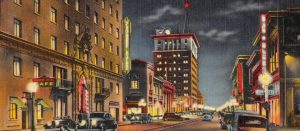
1940s postcard of downtown Tucson

Tucson postcards, not surprisingly, also featured saguaros. Bird’s latest book, In the Arms of the Saguaros shows how, from the botanical explorers of the nineteenth century to the tourism boosters in our own time, saguaros and their images have fulfilled attention-getting needs and expectations. Through text and lavish images, this book explores the saguaro’s growth into a western icon from the early days of the American railroad to the years bracketing World War II, when Sun Belt boosterism hit its zenith and proponents of tourism succeed in moving the saguaro to the center of the promotional frame. 

William L. Bird Jr. is a curator emeritus of the National Museum of American History, Smithsonian Institution. His interests lie at the intersection of politics, popular culture, and the history of visual display.  

Josie Méndez-Negrete at San José City College

Date: Thursday, October 26, 2023

Time: 12 – 1 p.m., PST

Where:  Student Center, San José City College, 2100 Moorpark Ave., San José, CA

Josie Méndez-Negrete, author of Activist Leaders of San José, California: En sus propias voces, will speak at “Paths of Activism and Leadership: Chicana/Latino Stories of San José.” Josie Méndez-Negrete is a professor emerita of Mexican American studies in the Department of Bilingual-Bicultural Studies, the Mexican American Studies Program, and the College of Education and Human Development at the University of Texas at San Antonio.She will talk about activists Sofia Mendoza, Mike Garcia, Jack Brito, Cecilia Arroyo, Ernestina Garcia, Josie Torralba Romero, Anthony R. Soto, Jose & Clare Villa, and Esther Medina.

About the book:

The community of San José, California, is a national model for social justice and community activism. This legacy has been hard earned. In the twentieth century, the activists of the city’s Mexican American community fought for equality in education and pay, better conditions in the workplace, better health care, and much more.

Sociologist and activist Josie Méndez-Negrete has returned to her hometown to document and record the stories of those who made contributions to the cultural and civic life of San José. Through interview excerpts, biographical and historical information, and analysis, Méndez-Negrete shows the contributions of this singular community throughout the twentieth century and the diversity of motivations across the generations.

Alma García at Guadalupe Cultural Arts Center in San Antonio

Date: Friday, November 10, 2023

Time: 6:00 – 8:00 p.m., CST

Where: Guadalupe Cultural Arts Center Latino Bookstore, 1300 Guadalupe St, San Antonio, TX

Alma García will discuss her debut novel, All That Rises, as part of the Texas Author Series at the Guadalupe Cultural Arts Center in San Antonio. The event is free and open to the public. A book signing and reception will take place with books available for purchase.

About the book:

All That Rises is a story of families and conflict in El Paso, Texas. In this novel, mysteries are unraveled, odd alliances are forged, and the boundaries between lives blur in destiny-changing ways—all in a place where the physical border between two countries is as palpable as it is porous, and the legacies of history are never far away. There are no easy solutions to the issues the characters face in this story, and their various realities—as undocumented workers, Border Patrol agents, the American supervisor of a Mexican factory employing an impoverished workforce—never play out against a black-and-white moral canvas. Instead, they are complex human beings with sometimes messy lives who struggle to create a place for themselves in a part of the world like no other, even as they are forced to confront the lives they have made.

For Authors

The University of Arizona Press publishes the work of leading scholars from around the globe. Learn more about submitting a proposal, preparing your final manuscript, and publication.

Inquire

Requests

The University of Arizona Press is proud to share our books with readers, booksellers, media, librarians, scholars, and instructors. Join our email Newsletter. Request reprint licenses, information on subsidiary rights and translations, accessibility files, review copies, and desk and exam copies.

Request

Support the Press

Support a premier publisher of academic, regional, and literary works. We are committed to sharing past, present, and future works that reflect the special strengths of the University of Arizona and support its land-grant mission.

Give