Natasha Varner on Tucson’s Settler History in “Electric Literature”

February 19, 2024

In an essay for Electric Literature, Natasha Varner explores her ancestral ties and Tucson’s settler history from The Castle Apartments, a landmark developed in 1906. Varner’s research sends her to a time when the city was riddled with disease, shedding light on the role the building had in Indigenous dispossession:

“None of the ads mentioned that this health-seeker haven was being built atop Tohono O’odham land, atop Yoeme land. That while Tucson signified a chance at survival to some, its original inhabitants were being forced into ever-dwindling reservations bordering its city limits.”

Read the Essay

About La Raza Cosmética: Beauty, Identity, and Settler Colonialism in Postrevolutionary Mexico:

In the decades following the Mexican Revolution, nation builders, artists, and intellectuals manufactured ideologies that continue to give shape to popular understandings of indigeneity and mestizaje today. Postrevolutionary identity tropes emerged as part of broader efforts to reunify the nation and solve pressing social concerns, including what was posited in the racist rhetoric of the time as the “Indian problem.” Through a complex alchemy of appropriation and erasure, indigeneity was idealized as a relic of the past while mestizaje was positioned as the race of the future. This period of identity formation coincided with a boom in technology that introduced a sudden proliferation of images on the streets and in homes: there were more photographs in newspapers, movie houses cropped up across the country, and printing houses mass-produced calendar art and postcards. La Raza Cosmética traces postrevolutionary identity ideals and debates as they were dispersed to the greater public through emerging visual culture.

***

Natasha Varner is a writer and historian whose work focuses on race, identity, and settler colonialism in Mexico and the United States. She is the recipient of the 2017 Lewis Hanke postdoctoral research award presented by the Conference on Latin American History. In addition to traditional academic pursuits, she is a public scholar who has written for Public Radio International and Jacobin, among other outlets.

Jesús Rosales featured on Arizona Public Media

February 14, 2024

Jesús Rosales was interviewed on Arizona Public Media about the book he co-edited with Vanessa Fonseca-Chávez: La Plonqui: The Literary Life and Work of Margarita Cota-Cárdenas. The video also features an interview with Margarita Cota-Cárdenas at her 82nd birthday celebration. Cota-Cárdenas was a pioneer in Chicano Studies: the first courses she taught in Chicano literature were in Spanish at Arizona State University. Watch the full video here.

In the interview, Rosales said, “Margarita is part of the Chicano movement writers from the sixties and seventies. I believe she is a pioneer in the sense that she was one of the first writers who introduced courses also at the university level of Chicano writers. She wrote most of her stuff in Spanish and in Spanglish. It was a really challenging writing for her and for the readers as well.”

About the book:

Celebrating more than forty years of creative writing by Chicana author Margarita Cota-Cárdenas, this volume includes critical essays, reflections, interviews, and previously unpublished writing by the author herself to document the lifelong craft and legacy of a pioneering writer in the field.

Nicknamed “La Plonky” by her family after a made-up childhood song, Cota-Cárdenas grew up in California, taught almost exclusively in Arizona, and produced five major works (two novels and three books of poetry) that offer an expansive literary production spanning from the 1960s to today. Her perspectives on Chicana identity, the Chicanx movement, and the sociopolitical climate of Arizona and the larger U.S.-Mexico border region represent a significant contribution to the larger body of Chicanx literature. Additionally, the volume explores her perspectives on issues of gender, sexuality, and identity related to the Chicanx experience over time.

2023 Southwest Book Award Winners

January 24, 2024

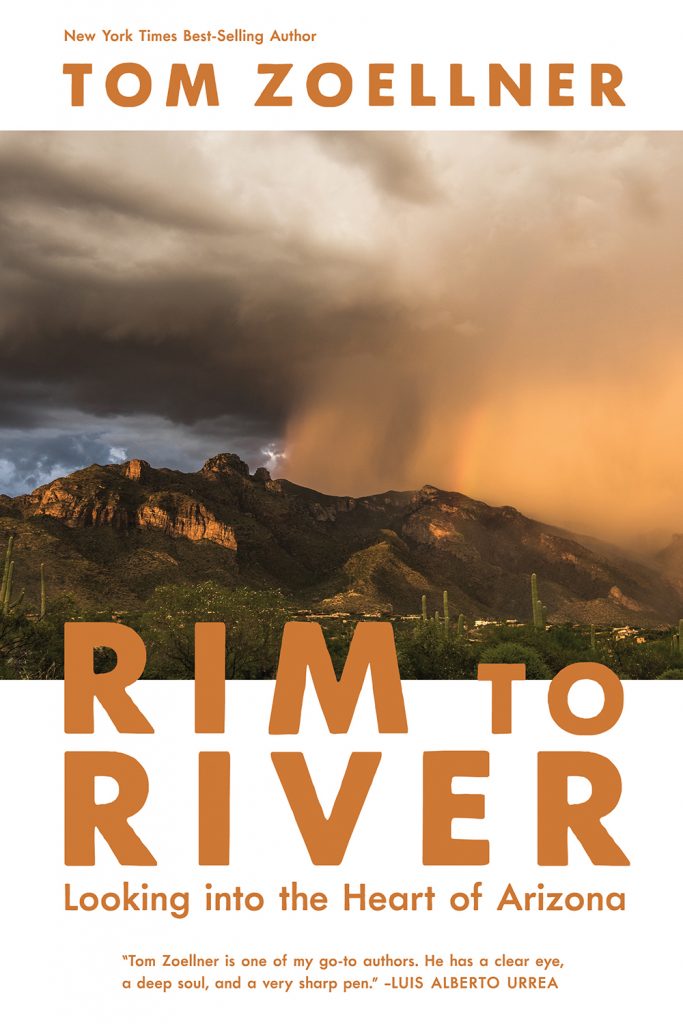
We are thrilled to announce that two of our books were recently selected as 2023 Southwest Book Award winners! Nuclear Nuevo México by Myrriah Gómez and Rim to River: Looking into the Heart of Arizona by Tom Zoellner have both been selected by the Border Regional Library Association, along with four other books. See the full list of 2023 winning titles at the BRLA website.

The Border Regional Library Association (BRLA) “is an organization founded in 1966 for the promotion of library service and librarianship in the El Paso/Las Cruces/Juárez Metroplex. Current membership includes over 100 Librarians, Paraprofessionals, Media Specialists, Library Friends and Trustees from all types of libraries in the Tri-State area of Trans-Pecos Texas, Southern New Mexico and Northern Chihuahua.”

About the books:

Contrary to previous works that suppress Nuevomexicana/o presence throughout U.S. nuclear history, Nuclear Nuevo México focuses on recovering the voices and stories that have been lost or ignored in the telling of this history. By recuperating these narratives, Myrriah Gómez tells a new story of New Mexico, one in which the nuclear history is not separate from the collective colonial history of Nuevo México but instead demonstrates how earlier eras of settler colonialism laid the foundation for nuclear colonialism in New Mexico.

Gómez examines the experiences of Nuevomexicanas/os who have been impacted by the nuclear industrial complex, both the weapons industry and the commercial industry. Gómez argues that Los Alamos was created as a racist project that targeted poor and working-class Nuevomexicana/o farming families, along with their Pueblo neighbors, to create a nuclear empire. The resulting imperialism has left a legacy of disease and distress throughout New Mexico that continues today.

Tom Zoellner walked across the length of Arizona to come to terms with his home state. But the trip revealed more mountains behind the mountains.

Rim to River is the story of this extraordinary journey through redrock country, down canyons, up mesas, and across desert plains to the obscure valley in Mexico that gave the state its enigmatic name. The trek is interspersed with incisive essays that pick apart the distinctive cultural landscape of Arizona: the wine-colored pinnacles and complex spirituality of Navajoland, the mind-numbing stucco suburbs, desperate border crossings, legislative skullduggery, extreme politics, billion-dollar copper ventures, dehydrating rivers, retirement kingdoms, old-time foodways, ghosts of old wars, honky-tonk dreamers, murder mysteries, and magical Grand Canyon reveries.

Congratulations, Myrriah and Tom!

January 9, 2024

In Woven from the Center: Native Basketry in the Southwest, author Diane Dittemore presents breathtaking basketry from some of the greatest weavers in the Southwest. Today, Dittemore has provided us with field notes and insights into her work.

My first encounter with Southwestern basketry was a Tohono O’odham basket I grew up with, one my grandmother Minnie Harper kept on her dresser and used to hold letters. I never thought to ask her where she got it, but it likely dates to the 1920s when she was living in Trinidad, Colorado.

Tohono O’odham “letter holder” basket of my grandmother’s (left) and two Comcaac (Seri) baskets collected in 1977 while conducting fieldwork in Desemboque, Sonora.

I began serious study of Native art in graduate school for anthropology and museum studies at the University of Denver beginning in 1975. The Native American Arts and Industries class instructor was Richard Conn, renowned Curator of Indian Art at the Denver Art Museum. The Native Arts floor at DAM was our classroom, my first “fieldwork” site, albeit in a domesticated space largely absent images of the people responsible for the works displayed. For the class, we were tasked with drawing selected pottery, basketry, weavings, and beadwork on display. This was an excellent means of studying Native cultural arts, although my artistic skills were and still are wanting! In a foreshadowing of my eventual professional life’s work, I rendered a Pima (Akimel O’odham) jar.

Drawing from class assignment to draw Native arts on display at Denver Art Museum

In 1977, I conducted my first actual fieldwork in Mexico for a master’s thesis researching one-stringed fiddles made by Comcaac (Seri) of Sonora’s west coast.  My thesis topic ended up a comparison of Seri and Western Apache fiddles. While concentrating on musical traditions and conducting fieldwork in the Comcaac village of Desemboque, I also purchased several baskets and learned from weavers about materials, technology, and cultural contexts.

My field partner, Seth Schindler, who was researching for his PhD dissertation on Comcaac material culture, later became my husband. Nothing like having a first date consist of weeks on end camped on the beach, sharing a tent much to the disapproval of a few Comcaac women.

I began work as curator of the ethnology collections at the Arizona State Museum in 1979. Included in these collections are over 4000 examples of basketry from all over the world but primarily from the American Southwest and Northwest Mexico. This collection offers limitless opportunities for museum-based research. 

Diane (on ladder) with former Curator of Collections, Jan Bell, in old basket storeroom, c. 1980. Photographer, Helga Teiwes.
A very pregnant Diane (left) discussing basket she is purchasing for ASM with trading post operator Joyce Montgomery at Peridot Trading Post, San Carlos Apache Reservation, Arizona, February 23, 1985. Photographer, Helga Teiwes. (ASM 64897) . (Daughter Anna was born May 18, 1985!).

In the 1980s and early 1990s I set out with museum photographer Helga Teiwes to document O’odham and Western Apache basket weavers. We took trips to the Apache reservations of San Carlos and Ft. Apache, and to the Pima (Akimel O’odham) Gila River Indian Community.

Diane with San Carlos Apache basketry matriarch Cecilia Henry, learning about her weaving techniques, April 18-19, 1990. Photographer, Helga Teiwes (ASM c-20843).
Diane discussing basketry materials and techniques with Katherine Brown, San Carlos Apache Reservation, Arizona. April 18-19, 1990.  Photographer, Helga Teiwes (ASM 84090).
Diane taking a close look at a basketry tus, or water bottle, prior to its being coated with piñon pitch to make it water tight, with Minnie Narcisco, Cibecue, Ft. Apache Reservation, Arizona, May 16-17, 1984. Photographer, Helga Teiwes (ASM 64817).

My first publication, in American Indian Art Magazine, focused upon unique Akimel O’odham (Pima) baskets decorated with glass beads. By this time, the weavers at Gila River (of which there were very few) were no longer incorporating beads, so fieldwork was a very limited component of this research.

First basketry publication in Winter 1986 American Indian Art Magazine.

The 1990 fieldwork at the San Carlos Apache Reservation was conducted in part to talk to weavers and other culture bearers about certain eccentric marks on early 20th century coiled basketry, to determine whether they might have special significance. This resulted in a 1998 publication with Museum Conservator Nancy Odegaard, Eccentric Marks on Western Apache Coiled Basketry.

I co-authored another American Indian Art Magazine article, Anonymous Was a Weaver: In Search of Turn-of-the-Century Western Apache/Yavapai Basketry Artists (Summer 1999). At this time there were no Apache or Yavapai weavers still making the gargantuan ollas that were the subject of this article, so the fieldwork involved visiting sister institutions.

In 2010, with ASM’s basketry collection given the designation as an American Treasure through the federal Save America’s Treasures program, planning commenced for a permanent ASM basket exhibit that came to be called Woven through Time: American Treasures of Southwest Native Basketry and Fiber Art. I served as the lead curator for this exhibit, which opened in 2017. We commenced a major initiative to acquire examples of work by contemporary basket weavers, in order to  show visitors to Woven through Time that the millennia-old tradition continues to the present. With museum photographer Jannelle Weakly, we traveled to weavers’ homes, and to galleries and art fairs to purchase baskets and photograph the makers.

Jilli Oyenque, Ohkay Owingeh Pueblo (San Juan) basket weaver holding willow wicker basket Diane purchased for ASM at Santa Fe Indian Market, August 2012. Photographer, Jannelle Weakly (SWIA_2012_p33).

ASM secured the services of AZPM to create a video for the Woven through Time gallery about the continued importance of basketry among Arizona’s Native communities. We recorded weavers from the Salt River Pima-Maricopa Indian Community as they gathered willow and cattail basketry materials.  Of course, the time to collect these materials is in July!  So, on a day in 2016 when the high was expected to be 114 degrees, we met the weavers and video graphed their efforts.

Diane interviewing basket teacher Alice Manuel of Salt River Pima-Maricopa Indian Community for inclusion in a gallery video, July 16, 2016. Photographer, Jannelle Weakly (ASM 2016-325-image287).

I began serious work on the basket book, Woven from the Center during a 2013 sabbatical, envisioning it as a companion to the exhibit Woven through Time: American Treasures of Native Basketry and Fiber Arts.  After numerous delays, involving weathering the scourge of Covid with attendant museum closures and other challenges, I submitted the manuscript in 2022.

A major goal of Woven from the Center: Native Basketry in the Southwest, in addition to sharing the Arizona State Museum’s unparalleled collection of Southwest Native basketry, is to bring the weavers—past and present—out of anonymity and give them full acknowledgment as keepers of traditions that continue to have deep resonance within their respective tribal communities.

***

Diane Dittemore is the Associate Curator of Ethnological Collections at the Arizona State Museum, an anthropology museum at the University of Arizona.  For forty-five years, she has curated, interpreted, and written about ASM’s peerless collection that is focused on historic and contemporary works made by Indigenous people of the American Southwest and Mexico.

Winter is Poetry Season!

December 18, 2023

Celebrate winter with four new collections of poetry from UA Press. We publish two veteran poets, the Ambroggio Prize winner, and one poet’s first collection. May this poetry bring light and warmth to close out 2023, and begin the new year brightly.

Light As Light brims with giddy, wistful long-distance love poems that offer a dialogue between the speaker and his beloved. Simon Ortiz (Acoma Pueblo) writes in conversational style; and this volume claims poetry for everyday life as the poems find the speaker on a morning run, burnt out from academic responsibilities, missing his beloved, reflecting on sobriety, walking the dog, and pondering the act of poem making. Celebrate on January 30, 2024, with Ortiz as he reads and discusses his poetry on the University of Arizona campus. Click here for details.

Kimberly Blaeser, former Wisconsin Poet Laureate and founding director of In-Na-Po, Indigenous Nations Poets, is a writer, photographer, and scholar. In her new collection, Ancient Light, she uses uses lyric, narrative, and concrete poems to give voice to some of the most pressing ecological and social issues of our time. Blaeser’s innovative poems trace pathways of kinship, healing, and renewal. They celebrate the solace of natural spaces through sense-laden geo-poetry and picto-poems.

Ojo en Celo / Eye in Heat, by Margarita Pintado Burgos (Author) and Alejandra Quintana Arocho (Translator), is the Winner of the 2023 Ambroggio Prize of the Academy of American Poets. With devastating clarity, Pintado Burgos’s poems, presented in both Spanish and English, give voice to the world within and beyond sight: the plants, the trees, the birds, the ocean waves, the fruit forgotten in the kitchen, the house’s furniture. Inspired by the poet’s homeland in Puerto Rico, light takes on new dimensions to expose, manipulate, destroy, and nourish.

In his first published collection Yaguareté White, Diego Báez writes in English, Spanish, and Guaraní. The languages encounter each other through the elusive yet potent figure of the jaguar. The son of a Paraguayan father and a mother from Pennsylvania, Baéz grew up in central Illinois as one of the only brown kids on the block—but that didn’t keep him from feeling like a gringo on family visits to Paraguay. Exploring this contradiction as it weaves through experiences of language, self, and place, Baéz revels in showing up the absurdities of empire and chafes at the limits of patrimony, but he always reserves his most trenchant irony for the gaze he turns on himself.

Esther Belin Named Durango’s Poet Laureate

December 7, 2023

The City of Durango, Colorado, named Esther Belin as its first-ever Poet Laureate. She has lived in Durango since 1997, and has published two poetry books: From the Belly of My Beauty and Of Cartography. Belin is also one of the editors of The Diné Reader: An Anthology of Navajo Literature.

High school student Zoe Golden was named the Rising Poet Laureate. Starting January 1, 2024, the Poets Laureate will provide a constant presence of poetry at community events. A poetry column in Durango’s newspaper, The Telegraph, and poetry installations on city buses will contribute to that presence, to “bring the magic of poetry to everyday life,” according to a press release from the Durango Poet Laureate Program.

Durango Public Library Supervisor Daisy Grice said, “We are so excited to see the poets in action starting next year. We think there will be an aura of more poetry around Durango, hopefully fostering a sense of creativity and beauty.”

Congratulations Esther!

Alma García Featured on Texas Standard News Show

November 29, 2023

Alma García was featured on the Texas Standard News Show and spoke about her debut novel, All That Rises. In the interview, she spoke about her inspiration for the book, her personal ties to El Paso and Albuquerque, key themes in her book, and how she makes the story come alive.

The inspiration from the story came from a character that she wrote about in short story 20 years ago, a Mexican-American working class gardener.

“And once I wrote the story and it was published and it had received some attention, I felt like ‘oh, I can’t quite let go of this character. I am interested in spinning a world around him.’ And I already understood that El Paso was sort of the background of where he was in his world. But as I began to spin a world around him, I began to understand that there was something bigger happening here,” she said.

One of the key themes in her book is “that history repeats itself no matter how many times we think humanity has surely learned its lesson,” said García.

Another key theme she would like readers to take away is “the idea of what borders mean in a larger sense. I mean, a border is a place that both divides and joins in. It’s a geopolitical gesture.”

If you would like to listen or read the full interview click here.

About the book:

In the border city of El Paso, Texas, two guardedly neighboring families have plunged headlong into a harrowing week. Rose Marie DuPre, wife and mother, has abandoned her family. On the doorstep of the Gonzales home, long-lost rebel Inez appears. As Rose Marie’s husband, Huck (manager of a maquiladora), and Inez’s brother, Jerry (a college professor), struggle separately with the new shape of their worlds, Lourdes, the Mexican maid who works in both homes, finds herself entangled in the lives of her employers, even as she grapples with a teenage daughter who only has eyes for el otro lado—life, American style.

Elizabeth Henson Essay in “The Brooklyn Rail”

November 10, 2023

Elizabeth Henson, author of Agrarian Revolt in the Sierra of Chihuahua, 1959–1965, writes about the Sojourner Truth Organization in The Brooklyn Rail. In her essay titled “When We Win, We Lose: The Story of a Run-Away Shop,” Henson details a critical event during her years as an activist and member of the Sojourner Truth Organization from the early 1970s to 1983. Similar to her book about the history of revolt and activism in Chihuahua, Mexico, the essay reveals her personal history of activism in the labor movement in Chicago.

She writes:

In the spring of 1976, Val Klink and I formed a legal collective downtown with Kingsley Clarke from the Sojourner Truth Organization (STO), the revolutionary communist group that we were close to. . . . South Chicago was grimy, with blocks of bungalows, menudo on weekends, and a thrift store opposite the bank. It was an espresso-free zone, but the train connected it to Hyde Park and downtown. In segregated Chicago, South Chicago was the one working-class district where Black, Mexican, and white folks lived more or less together. Our clients had real estate problems, contract disputes, and custody battles, a litany of tedious and intractable difficulties, exacerbated by the massive layoffs of the mid-1970s. Many had been employed by local steel mills.

Read the entire essay here.

About Agrarian Revolt in the Sierra of Chihuahua, 1959–1965:

The early 1960s are remembered for the emergence of new radical movements influenced by the Cuban Revolution. One such protest movement rose in the Mexican state of Chihuahua. With large timber companies moving in on the forested sierra highlands, campesinos and rancheros did not sit by as their lands and livelihoods were threatened. Continuing a long history of agrarian movements and local traditions of armed self-defense, they organized and demanded agrarian rights.

Thousands of students joined the campesino protests in long-distance marches, land invasions, and direct actions that transcended political parties and marked the participants’ emergence as political subjects.

Photos from Alma García’s Book Launch in Seattle

November 8, 2023

Alma García, celebrated her debut novel All That Rises at two Seattle bookstores. Although originally from Texas and New Mexico, García now makes her home in the Pacific Northwest. She launched her novel at Secret Garden Books where she used to work as a bookseller. Her “OG” booksellers surprised her at the celebration. Everyone enjoyed music by Jenny&Birch and Los Flacos. Next up, Kristen Millares interviewed García at Elliott Bay Book Company. Seattle is a great town for authors and readers!

If you live in Texas or New Mexico, Alma García is coming your way:

Nov. 10: Guadalupe Cultural Arts Center in San Antonio

Nov. 11: Texas Book Festival in Austin

Nov. 14 Búho Books in Brownsville

Nov. 16 Daniel Chacón Talks with Alma García in El Paso

Nov. 17 Bookworks in Albuquerque

Readers with the book and Alma García reading at Secret Garden Books. Los Flacos and Jenny&Birch brought the book launch rhythm.

At Elliot Bay Book Company, readers celebrated the debut novelist. Kristen Millares (on the right in red) interviewed Alma García, then the author read from All That Rises.

About the book:

In the border city of El Paso, Texas, two guardedly neighboring families have plunged headlong into a harrowing week. Rose Marie DuPre, wife and mother, has abandoned her family. On the doorstep of the Gonzales home, long-lost rebel Inez appears. As Rose Marie’s husband, Huck (manager of a maquiladora), and Inez’s brother, Jerry (a college professor), struggle separately with the new shape of their worlds, Lourdes, the Mexican maid who works in both homes, finds herself entangled in the lives of her employers, even as she grapples with a teenage daughter who only has eyes for el otro lado—life, American style.

When Language Broke Open Makes #SpeakUp List

November 2, 2023

To celebrate University Press Week (November 12-17, 2023), the Association of University Presses created a list of “103 University Press Publications that #SpeakUp”. Selected by member presses to celebrate UP Week 2023, these 103 publications represent the many areas in which university presses and their authors #Speak UP. We are happy to announce that When Language Broke Open: An Anthology of Queer and Trans Black Writers of Latin American Descent, edited by Alan Pelaez Lopez, is on the list.

When Language Broke Open collects the creative offerings of forty-five queer and trans Black writers of Latin American descent who use poetry, prose, and visual art to illustrate Blackness as a geopolitical experience that is always changing. Telling stories of Black Latinidades, this anthology centers the multifaceted realities of the LGBTQ community.

Alan Pelaez Lopez is an Afro-Indigenous poet and installation and adornment artist from Oaxaca, Mexico. Their work attends to the realities of undocumented migrants in the United States, the Black condition in Latin America, and the transgender imagination. Their poetry collection, Intergalactic Travels: poems from a fugitive alien, was a finalist for the 2020 International Latino Book Award. They are an assistant professor at the University of California, Davis.

For Authors

The University of Arizona Press publishes the work of leading scholars from around the globe. Learn more about submitting a proposal, preparing your final manuscript, and publication.

Inquire

Requests

The University of Arizona Press is proud to share our books with readers, booksellers, media, librarians, scholars, and instructors. Join our email Newsletter. Request reprint licenses, information on subsidiary rights and translations, accessibility files, review copies, and desk and exam copies.

Request

Support the Press

Support a premier publisher of academic, regional, and literary works. We are committed to sharing past, present, and future works that reflect the special strengths of the University of Arizona and support its land-grant mission.

Give