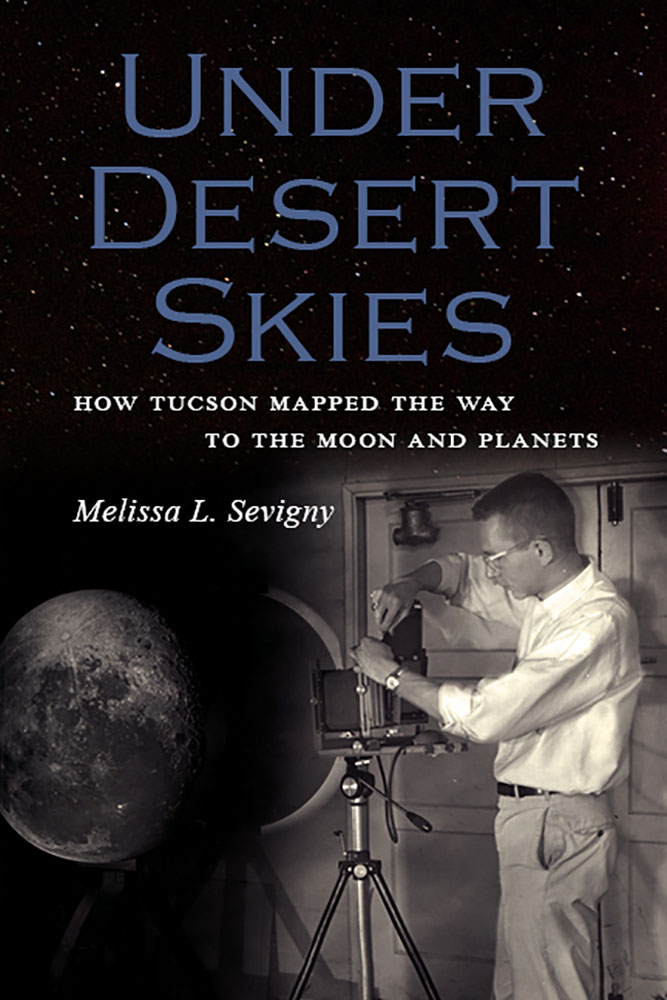
Free E-Book of the Week: Under Desert Skies

July 8, 2020

Since March, we have featured a free e-Book almost every week. For this week’s Free e-Book of the Week, we’re pleased to offer Melissa Sevigny’s Under Desert Skies: How Tucson Mapped the Way to the Moon and Planets for free download.

Under Desert Skies describes how a small lunar- and planetary-focused laboratory at the University of Arizona forged the field of planetary science at a time when few people studied the solar system. Spanning six decades, the book records the stories of the scientists who, with telescopes and spacecraft, transformed single points of lights into worlds that we can see, touch, study, and compare to Earth.

Melissa L. Sevigny grew up in Tucson, Arizona, with a deep love of the geology, ecology, and the clear desert skies of the Southwest. She is a science and technology reporter for KNAU (Arizona Public Radio) in Flagstaff. Minor Planet (15624) Lamberton is named in her honor.

Download Under Desert Skies here using code AZSKY20. Available until 7/16/2020.

“Beyond their awe-inspiring accomplishments, these UA faculty epitomize the ‘inexhaustible sense of wonder’ that Sevigny considers the heart of planetary science.”—The Journal of Arizona History

“Tells the story of how a small corner of Arizona became Earth’s ambassador to space.”—Lunar and Planetary Information Bulletin

Under Desert Skies presents an institutional history of the Lunar and Planetary Laboratory (LPL) at the University of Arizona in Tucson: a key center for planetary sciences today and throughout its sixty-year history.” —Isis Review

More books about space and science

Need Some Summer Reads? We Got You

July 7, 2020

We recently asked several University of Arizona Press authors to recommend a book from the Press that makes for a good read, and beautiful literature. Enjoy!

Bryan Allen Fierro’s Dodger Blue Will Fill Your Soul

We may not have baseball this year (fingers still crossed), but we do have Dodger Blue Will Fill Your Soul. Of course this collection is about more than baseball. Bryan Allen Fierro‘s debut is a series of searing tales set in the barrios of Los Angeles that was rightly recognized as being a testament to all of our shared humanity.

Luis Alberto Urrea, author of In Search of Snow, Wandering Time and Nobody’s Son

Melissa L. Sevigny’s Under Desert Skies: How Tucson Mapped the Way to the Moon and Planets

Summer evenings are for stargazing. And our desert skies make for some of the best seeing anywhere. Just ask any astronomer or backyard telescope enthusiast. You probably know one or two because Tucson is full of them. Chances are you’ve visited Kitt Peak National Observatory or the Mount Lemmon SkyCenter or the Whipple Observatory on Mount Hopkins, just a few of the telescope collections that dot the peaks of our sky islands.

Indeed, Tucson is the astronomy capital of the world. But we also have a long, fascinating history of planetary science. Melissa L. Sevigny’s 2016 book, Under Desert Skies: How Tucson Mapped the Way to the Moon and Planets, tells the stories of how space pioneers like Gerard Kuiper and Ewen Whitaker founded the UA’s Lunar and Planetary Lab (LPL) and made Tucson the epicenter of exploration of our solar system.

Ken Lamberton, author of Chasing Arizona: One Man’s Yearlong Obsession with the Grand Canyon State

Tom Holm’s The Osage Rose

Want to know more about the Tulsa Race Massacre that’s been in the news recently? Tom Holm‘s novel provides a nuanced examination of this event and two others that happened nearly simultaneously: the Osage Oil Murders and Prohibition, through the actions of believable characters. This is the best work in print that addresses these issues which still have consequences nearly a century since they occurred.

Frances Washburn, author of The Red Bird All-Indian Traveling Band

Carmen Giménez Smith’s Milk and Filth

With so little time, I pick cautiously the guests I invite to share my imagination. I want my VIP guests to tingle flesh and zing my body electric. I want them to stop me in my tracks to hear new contrapuntal melodies and to shiver with pleasure as I lick air that wraps anew words and images—actions and thoughts. I want them to peel back that thick glaze coating the surface of my mind. I want them to jumper-cable shock me out of Twitter bubbles and FB echo chambers. I want a lot. Today, I invite Carmen Giménez Smith and her exquisite Milk and Filth to share my soul.

Frederick Luis Aldama, author of Latinx Superheroes in Mainstream Comics

Sara Sue Hoklotubbe’s Sadie Walela Mystery series

I recommend Sara Sue Hoklotubbe‘s award winning Sadie Walela Mystery series. There are precious few Native mystery writers and it is refreshing indeed to read stories authored by writers who know the culture and the territory.

Devon A. Mihesuah, author of The Roads of My Relations

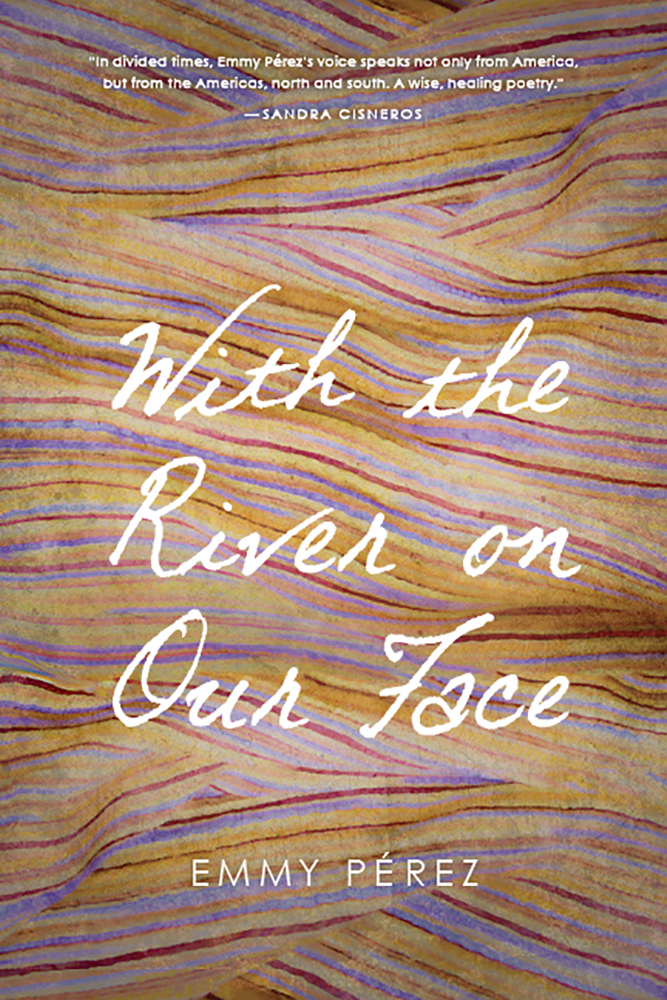
Emmy Pérez’s, With the River on Our Face

Emmy Pérez’s With the River on Our Face, is more than a love letter to the Peoples and ecologies long nourished beyond the cut banks of the Rio Grande. This vital collection is a divining rod. With precise music in her language, Pérez is intentional and patient, and informed. With the River on Our Face is a meditation, border gravity pulling the reader to culturally fertile and voice sustaining, emerald waters. 

Bryan Allen Fierro, author of Dodger Blue Will Fill Your Soul

Six More Open Access Titles Now Available

July 6, 2020

The University of Arizona Press is constantly working toward innovative, forward-thinking ways to connect our scholarship with readers worldwide. We are pleased to announce a new selection of titles in the fields of anthropology, archaeology, border studies, and Latin American studies are now available as open access (OA).

Thanks to financial support from Knowledge Unlatched, we have been able to move an additional six titles to OA format. The titles are available either via link on our website or directly through the OAPEN Foundation.

Now Available as OA:

The Border and Its Bodies
The increasingly militarized U.S.-México border is an intensely physical place, affecting the bodies of all who encounter it. The essays in this volume explore how crossing becomes embodied in individuals on the most basic social unit possible: the human body.
OA Link

Activist Biology
Activist Biology is the story of a group of biologists at the National Museum in Rio de Janeiro who joined the drive to renew the Brazilian nation, claiming as their weapon the voice of their fledgling field. It offers a portrait of science as a creative and transformative pathway. This book will intrigue anyone fascinated by environmental history and Latin American political and social life in the 1920s and 1930s.
OA Link

Before Kukulkán
This volume illuminates human lifeways in the northern Maya lowlands prior to the rise of Chichén Itzá. Using bioarchaeology, mortuary archaeology, and culturally sensitive mainstream archaeology, the authors create an in-depth regional understanding while also laying out broader ways of learning about the Maya past.
OA Link

Big Water
Big Water focuses on the uniquely overlapping character of South America’s Triple Frontier. These essays complicate the frontiers and balance the excessive weight previously given to empires, nations, and territorial expansion. Big Water’s transdisciplinary approach provides a new understanding of how space and society have developed throughout Latin America.
OA Link

Challenging the Dichotomy
Challenging the Dichotomy explores how dichotomies regarding heritage dominate the discussions of ethics, practices, and institutions. Contributing authors underscore the challenge to the old paradigms from multiple forces. The case studies and discourses, both ethnographic and archaeological, arise from a wide variety of regional contexts and cultures.
OA Link

Cooperatives, Grassroots Development, and Social Change
Cooperatives, Grassroots Development, and Social Change presents examples from Paraguay, Brazil, and Colombia, examining what is necessary for smallholder agricultural cooperatives to support holistic community-based development in peasant communities. Reporting on successes and failures of these cooperative efforts, the contributors offer analyses and strategies for supporting collective grassroots interests. Illustrating how poverty and inequality affect rural people, they reveal how cooperative organizations can support grassroots development strategies while negotiating local contexts of inequality amid the broader context of international markets and global competition.
OA Link

Kathryn Conrad: ‘Our work is more important than ever’

June 30, 2020

During the Association of University Presses virtual annual meeting in June 2020, Kathryn Conrad, director of the University of Arizona Press, addressed AUPresses members as outgoing president of its board of directors. Conrad assumed presidency in June 2019. Niko Pfund, president of Oxford University Press USA, has assumed the presidency as Conrad remains on the board a past president.

Conrad’s statement reflects on the past challenges unique to this year, as well as the values that provide a roadmap for all academic presses:

In a normal year, I would take this time to tell you about the work of the Association’s Board of Directors and some of its accomplishments. 

But this is not a normal year. 

On March 15, just days after the World Health Organization had declared COVID-19 a pandemic, the AUPresses Board of Directors convened online for its spring meeting. We spent our first hour together sharing the state of our presses and institutions while shutting down our offices to work from home. I think all of us will remember those strange early days and what would become the first of countless virtual meetings. 

At that March meeting, we approved the Association’s Anti-Racism statement, a document developed over 18 months by the Association’s Diversity and Inclusion Task Force, chaired by Gita Manaktala and Larin McLaughlin, and its first Equity, Justice, and Inclusion Committee, chaired by Gita and Brian Halley. 

The statement recognizes the racist and exploitative practices that have shaped our institutions and our presses. It calls on us to confront the systems—the systems to which we belong–that perpetuate bias, inequalities, and white supremacy. 

Ten weeks later, the murder of George Floyd ignited a global movement for Black lives. In the midst of scrutiny of anti-Black racism in every corner of our society, our industry is called out for its inequity through the #PublishingSoWhite and #PublishingPaidMe hashtags and our own university press community is called out for our failure to support inclusion. It is a time of anger, hurt, and overwhelm. And here we are, at our 2020 Annual Meeting, trying to process all of this in a virtual environment that we will likely be stuck in for some time to come. 

The Association’s Annual Meeting has always been a source of inspiration for me. Last year, inspired by Chris Long’s closing plenary session in Detroit on the transformative power of values-based publishing, I led a deeper dive into our Association’s values with members of the board and staff. 

What do we mean when we say we hold Stewardship, Intellectual Freedom, Integrity, and Diversity and Inclusion as the values we strive to uphold?

The mission of AUPresses is to advance the essential role of this global community of publishers whose mission is to ensure academic excellence and cultivate knowledge. Our values are the principles that guide us–our compass. At an historical moment that feels simultaneously riveting and overwhelming, a compass feels like a good thing to have. 

In our work this year, we recommitted to our values, first developed 5 years ago under the leadership of Barbara Kline Pope and Meredith Babb, and we developed common understanding of their meaning in our everyday work. 

We demonstrate Stewardship through our mindful investment in the development and dissemination of scholarship, respecting the fundamental labor of publishing. We amplify authors’ voices as we work to advance and preserve an inclusive scholarly record. 

We embody Intellectual Freedom by promoting the emergence and evaluation of new theories, and by championing the freedom to think, research, publish, and read. These are the pillars of a democratic society. 

We demonstrate Integrity as leaders in peer review best practices and by earning the trust of our authors, our readers, and our institutions. 

We strive for equity, justice, and inclusion in our practices. And we endeavor to represent the breadth of human knowledge and experience as part of our commitment to Diversity and Inclusion.

Guided by our values and by our strategic plan, updated last year under the leadership of Jennifer Crewe, our association has accomplished much this year in support of our goals of Collaboration, Advocacy, Research, Education, 

We established an Open Access task force, led by Erich van Rijn, to help build collaboration among our members around this increasingly important issue, and we have deepened our engagement with the Coalition for Diversity and Inclusion in Scholarly Communications. We have redoubled our Advocacy efforts with a new Advocacy Committee, led this year by Meredith Babb, and with the Stand UP Award, a new advocacy award, spearheaded by Greg Britton. We supported the expansion of the Lee and Low Diversity Baseline Survey to consider university presses more fully, and we increased our frequency of gathering of sales data from quarterly to monthly to help members navigate this volatile economic time. We have expanded opportunities for members to connect online to share knowledge and best practices. And we will soon launch a Global Presses Partnership Program, spearheaded by Anthony Cond. This program will bring together university presses in the Global South with AUPresses members to expand the knowledge base of our international university press community through the sharing of experience and practical education across borders.

Much of the work of this Association happens in its committees, made up of volunteers from across our membership. I cannot name them all but I would like to extend my deep thanks to the committee chairs and members for their work this year.

Serving as AUPresses president has afforded me a remarkable opportunity to see what our Association is made of. I have seen the dogged determination of our Central Office staff, led by the ever-ready Peter Berkery, who tends to the myriad concerns of members, both individually and collectively, each day. I have seen the fierce support of our members for one another. I have seen the ingenuity of our marketers, who came together in recent months to support the independent bookstores that support us and to rally for the common cause of scholarship. I have seen our stellar Annual Meeting Program Committee, led by Laurie Matheson, turn on a dime to create a virtual meeting that will give our members actionable ideas, professional growth, and opportunities to meet new colleagues. I have seen a community of publishers that believes our collective efforts are greater than the sum of our parts. 

Our work is more important than ever. Thanks to the many volunteers who conducted the work of our Association this year, and thanks to each and every one of our members for the work that you do every day.

Press Receives Major Grant From the National Endowment for the Humanities

June 29, 2020

The University of Arizona Press announces the receipt of a major National Endowment for the Humanities Coronavirus Aid, Relief, and Economic Security Act grant, which provides emergency relief to institutions and organizations working in the humanities. The $90,037 grant provides the Press ongoing support for the publication of humanities scholarship, and acknowledges, in particular, its record publishing books relevant to communities of color.

This CARES Act grant will allow the Press to dramatically increase availability of e-books in Indigenous and Latinx studies, raising the total number of available eBooks to nearly 75 percent of the total list of 1,500 titles in print published by the Press. By making works available for digital delivery, the Press can fulfill its mission regardless of social distancing requirements and help maintain financial viability during the pandemic and beyond.

“We are grateful to the U.S. Congress and the National Endowment for the Humanities for providing us with this opportunity to provide this significant scholarship to a larger audience. Since the onset of the pandemic, the circulation of print books radically decreased while the need for eBooks grew,” said Kathryn Conrad, director of the University of Arizona Press.

The Press’s high-profile list in Indigenous and Latinx studies, emphasizes history, comparative religion, literary criticism, media studies, and gender studies. This scholarship is part of our history of publishing books by, about, and for underrepresented communities in the United States, said Conrad.

For the highly competitive NEH CARES grant category, the Humanities Endowment received more than 2,300 eligible applications from cultural organizations requesting more than $370 million in funding for projects between June and December 2020. Approximately 14 percent of the applicants were funded. The Press is one of four organizations in Arizona to receive this funding.

“These new e-book versions of important works in Indigenous and Latinx scholarship will greatly expand the readership of these books at a time when public interest in these topics is rapidly growing,” said Shan Sutton, dean of University Libraries. “NEH support will ensure that the general public has greater access, while also enabling these books to be more easily integrated into online college courses that are increasing as well.”

About the National Endowment for the Humanities Created in 1965 as an independent federal agency, the National Endowment for the Humanities supports research and learning in history, literature, philosophy, and other areas of the humanities by funding selected, peer-reviewed proposals from around the nation. Additional information about the National Endowment for the Humanities and its grant programs is available at neh.gov.

Free E-Book of the Week: Deception on All Accounts from the Sadie Walela Mystery Series

June 25, 2020

Since March, we have featured a free e-Book almost every week. As we look toward the long weekend coming up, what could be better than tucking into a good mystery?  

For this week’s Free e-Book of the Week, we’re pleased to offer the first of Sara Sue Hoklotubbe’s mystery series, Deception on All Accounts for free download. Set against the backdrop of small-town Oklahoma and its Native culture, Deception on All Accounts draws readers into the real lives of contemporary American Indians as it shines a light on violence, corporate corruption, and prejudice in modern America. As Sadie Walela comes to terms with murder, romance, and her hopes for a career, she finds deception on all accounts.

Deception on All Accounts is the first of four books that feature Sadie. Author Sara Sue Hoklotubbe is a Cherokee tribal citizen. She is the winner of a WILLA Literary Award, Trophy Award for Best Fiction Book by Oklahoma Writers’ Federation, a New Mexico-Arizona Book Award for best mystery/suspense, and a Wordcraft Circle of Native Writers and Storytellers Award for best mystery.. Read ‘Seven Questions with Sara Sue Hoklotubbe’ to learn more.

Download Deception on All Accounts here using code AZSADIE20. Available until 7/6/2020.

“It’s a pleasure to make the acquaintance of Sadie Walela, a banker in northeastern Oklahoma who is thrust into the role of amateur sleuth after a spate of branch robberies leaves several colleagues dead and her career in critical condition. . . . Hoklotubbe paints a believable picture of Indian-white relations in small-town America and crafts a series protagonist as savvy as she is sweet.”—Booklist

“Evenly paced prose, increasingly suspenseful plotting, and the emergence of a strong heroine characterize this promising first mystery.”—Library Journal

Learn more about the series

Mark Nichter’s ‘Global Health’ Now Available in e-Edition

June 23, 2020

We are pleased to announce that anthropologist Mark Nichter’s book Global Health: Why Cultural Perceptions, Social Representations, and Biopolitics Matter is now available in e-Book format, as well as print.

Since its publication in 2008, Global Health has been a key text for understanding health social science research and what this research can contribute to global health and the study of biopolitics. Nichter is Regents’ Professor Emeritus and Professor of Anthropology, Public Health, and Family Medicine at the University of Arizona.

“Nichter has written an accessible text that is both critical and constructive, an inspiration as well as a lesson plan. It should be required reading for anyone considering the relevance of social science in global health.”–Current Anthropology

The June 19, 2020 issue of the American Anthropological Association’s Anthropology News includes an essay by Regents’ Professor Emeritus Mark Nichter. “Engaging the Pandemic: How One Medical Anthropologist Is Boosting Our Capacity to Understand and Contend with COVID-19” (pp. 3–7) explores the practical collaborations a medical anthropologist can contribute during lockdown. Nichter writes, “COVID-19 provides an opportunity to build alliances and momentum for significant health care reform.”

Free E-Book of the Week: Wildfire in the Southwest

June 15, 2020

For more than a week, our community has watched the smoke from the Bighorn Fire float up above the Santa Catalina Mountains, which sit just north of Tucson. As of today, the fire has burned more than 14,000 acres of our beloved Sky Island.

But wildfire has been on the mind of all of us at the Press for several years. Since 2015, we have been publishing the works of fire historian Stephen J. Pyne, who has been illuminating the regional and national history of wildfire in the United States.

For this week’s free e-Book of the Week, we’re drawing attention to Pyne’s To the Last Smoke Series by offering The Southwest for free download from our website. The volume helps to explain the challenges wildland firefighters are facing right now with the Bighorn Fire, and why this is likely to be just one of many burns in the Southwest this summer.

The Southwest is part of the multivolume series describing the nation’s fire scene region by region. The volumes in To the Last Smoke serve as an important punctuation point to Pyne’s 50-year career with wildland fire—both as a firefighter and a fire scholar. These unique surveys of regional pyrogeography are Pyne’s way of “keeping with it to the end,” encompassing the directive from his rookie season to stay with every fire “to the last smoke.”

Download here using code AZFIRE20. Available until 6/25/2020.

“An elegant and informed treatise on the history and evolving nature of wildfire in our arid and rugged landscape.”—Journal of Arizona History

“This is an exceptionally readable work; the analyses of events reflect the interpretation of humans, ecology, and institutions.”—Choice

“An accessible entry point into the kaleidoscopic set of shifting interests that characterize the relationships of fire to the Southwest.”—Southwestern Historical Quarterly

Learn more about the book

AUPresses Statement on Equity and Anti-Racism

June 3, 2020

The Association of University Presses, of which the University of Arizona Press is a member, recently released this statement on equity and anti-racism. This statement was originally proposed and drafted by the organization’s 2017-2018 Diversity & Inclusion Task Force. The Equity, Justice, and Inclusion Committee established in 2019 took the statement through a process of peer review and revision. The AUPresses Board of Directors, of which University of Arizona Press Director Kathryn Conrad currently serves as president, approved the statement in March 2020. 

The Association of University Presses and its members aspire to hold justice, equity, diversity, and inclusion as values that guide our policies, practices, and publications. Upholding these values requires introspection, honesty, and reform of our current practices, the interests they serve, and the people and perspectives they exclude.

Through the work that we publish, university presses have helped to document the histories of institutions in the United States and elsewhere. This scholarship shows that most colleges and universities were built through the exploitation of people of color and established as white and male-only institutions, on land from which indigenous peoples were and continue to be displaced. The racist and exploitative practices that shaped this history remain embedded, even within institutions that work to study and critique that history. Currently, within universities and presses, systems that perpetuate bias, inequalities, and white supremacy go unquestioned and unchecked; in this way, they are perpetuated.

Please go here to read the statement in its entirety.

Free E-Book of the Week: Them Goon Rules

June 3, 2020

For this week’s free e-Book of the Week, we’re drawing attention to our exceptional works in social justice, offering Marquis Bey’s Them Goon Rules for free download from our website.  

A series of essays that reads like a critical memoir, this work queries the function and implications of politicized Blackness, Black feminism, and queerness. Bey binds together his personal experiences with social justice work at the New York–based Audre Lorde Project, growing up in Philly, and rigorous explorations of the iconoclasm of theorists of Black studies and Black feminism. Bey’s voice recalibrates itself, creating a collection that tarries in both academic and nonacademic realms.

Download here using code AZBEY20. Available until 6/10/2020.

“Weaving pop culture, rap, literary analysis, politics, and anger, Bey challenges readers to think of the intersectionality of gender, race, and politics in a different way.”—CHOICE

“Marquis Bey has gifted us with more than a collection of essays about Blackness, feminism, and queerness—it is a tome for and with the ‘ontologically criminalized.’ Bey demonstrates a distinctive radical vulnerability that can only be the result of working in and through a Black queer feminist lens. Unapologetically, this text dances, bends, moves, breaks open and through language—an elaborated nah! There is powerful poetry here asking that we, scholars who believe in freedom, interrogate our own methods and motives again and again. This book is courageous as it dwells, a break in the break. A must-read for any scholar, poet, or (non)human seeking the spectacular possibility of taking flight.” —Kai M. Green, Assistant Professor of Women’s, Gender, and Sexuality Studies at Williams College

“Bey challenges those of us who are committed to Black justice to approach every day with the force of revolution. By refiguring Black freedom-making in this way, we are able not only to ‘steal life back’ from a white fickle normativity but also to enwrap that life in the promise of escape.”—Hashim Pipkin, The Opportunity Network

Them Goon Rules is an exciting collection of essays—brimming with insight, inspiration, love, and rage, the book leads readers through an urgent set of questions about the body, identity, race, place, sex, Blackness, subversion, and gender. Offering what Bey at one point calls a ‘fugitive praxis,’ this book believes in transformation and shows us how it is done! Brilliant!”—Jack Halberstam, author of Trans*: A Quick and Quirky Guide to Gender Variance

Learn more about the book

For Authors

The University of Arizona Press publishes the work of leading scholars from around the globe. Learn more about submitting a proposal, preparing your final manuscript, and publication.
Inquire

Requests

The University of Arizona Press is proud to share our books with readers, booksellers, media, librarians, scholars, and instructors. Join our email Newsletter. Request reprint licenses, information on subsidiary rights and translations, accessibility files, review copies, and desk and exam copies.
Request

Support the Press

Support a premier publisher of academic, regional, and literary works. We are committed to sharing past, present, and future works that reflect the special strengths of the University of Arizona and support its land-grant mission.

Give