If you didn’t have a chance to join in the Virginia G. Piper Center for Creative Writing’s recent book celebration for Alberto Álvaro Ríos’s new picaresque novel, A Good Map of All Things, listen to this interview with KJZZ’s Steve Goldstein on creating art during a pandemic and his new book.
A Good Map tells stories of a Mexican town and its unique inhabitants that feel familiar to all who love and live in Arizona-Sonora borderlands.
From the interview:
You know, I think this particular book is about quiet in its own way, and quiet is not an easily told story. You know, loud — everybody turns toward loud, and we’re living in very loud times. Loud is a magnet. Loud, you know, people are drawn to it. Quiet — that’s a much harder sell. And while I use guise or the setting of the mid-20th century, I think really what I’m trying to write is to the quiet, to the dark side of the moon, if you will — you know, equally there, absolutely there. But getting little attention. And what I’m especially trying to, to make a point of is saying that all of the loud around the border. Well, it’s just loud. The 98% of the rest of people’s lives is this quiet, everyday kind of experience. I was on a panel many years ago with Ursula Le Guin, the great science-fiction writer, and she said something that has always stayed with me. She said, “You know, science fiction,” She said. “It’s, it’s 98% regular, everyday. And 2% on Mars.” And what she was trying to say is the 2% on Mars got all the attention, but it wasn’t accurate to the actual way that we live. And I think in this book, I’m trying to get to the depth of the everyday, which is that 98% of how we actually get through life. And the ’50s happens to be — you know, I was born in the ’50s. That’s when I was growing up. These, the particular adventures, if I can call them that, came from all of the towns that I grew up visiting and spending time in, and that my grandmother and her sisters had been teachers and mercantile workers in these towns. So they were always being talked about and remembered, and they were towns like Rayón and Cucurpe and Ímuris and especially Magdalena, all in the corridor of northern Sonora. And it’s a corridor that’s traditionally been called the Pimería Alta, and it extends from certainly Tucson, you could argue Phoenix — but certainly Tucson all the way to Hermosillo and Guaymas. That corridor, which was a longtime historic trading corridor. That ancientness, that oldness, that old-fashionedness is inherently in the place. And that’s what I’m trying to write to.
When Christopher Cokinos isn’t talking about his love of poetry that celebrates spaceflight, the poet and author shares his interest in space sciences.
The discovery suggests a greater distribution of water on the Moon, an environment that astronomers in centuries past thought might have surface water but Apollo-era science suggested was bone dry. Since then, new laboratory techniques have cracked open previously-unstudied Apollo samples and found water molecules. Meanwhile, missions to the Moon over the past three decades found evidence of lunar water ice in permanently shadowed regions of the Moon, clustered around the poles.
For The Space Review, Cokinos makes an argument for the next NASA lunar mission to head to the moon’s south pole, and not follow in the footsteps of the Apollo missions.
From his report:
In any case, if we can’t get to the pole on Artemis 3, go forward to a new location and don’t return to an Apollo site—not yet. Lunar sustainability can’t indulge in the appearance of expensive nostalgia that could risk turning off shaky public support.
The University of Arizona Press recently announced Rigoberto González’ editorship of its Camino del Sol Series. The award-winning and critically acclaimed series of poetry, fiction, and essays publishes emerging and established voices in Latinx literature, such as Juan Felipe Herrera, Carmen Giménez Smith, Luis Alberto Urrea, Richard Blanco, Alberto Ríos, Pat Mora, Tim Z. Hernandez, Emmy Pérez, and Francisco X. Alarcón.
González is the author of eighteen books of poetry and prose. His awards include Guggenheim, NEA, NYFA, and USA Rolón fellowships, the PEN/Voelcker Award, the American Book Award from the Before Columbus Foundation, the Lenore Marshall Prize from the Academy of American Poets, and the Shelley Memorial Prize from the Poetry Society of America. A critic-at-large for The LA Times and contributing editor for Poets & Writers Magazine, he is currently Distinguished Professor of English and Director of the MFA Program in Creative Writing at Rutgers-Newark, the State University of New Jersey.
“Camino del Sol has been essential to our Latinx literary legacy. For over 25 years this series has provided a home for the stories and voices that amplify, celebrate, and nuance the diverse experiences of our communities,” González said.
“I owe much of my college literary education to the books published by the University of Arizona Press, and in the same spirit of service to all readers, I am honored to continue its mission to seek out and highlight the remarkable work of both seasoned and promising Latinx writers.”
Kathryn Conrad, director of the University of Arizona Press, said González’ editorship and the caliber of the Camino del Sol advisory board furthers the Press’s mission to center Latinx and Indigenous literary voices.
“The University of Arizona Press is one of the first publishers to spotlight Latinx literary voices. We are honored Rigoberto has joined us to grow and care for this important series.”
Camino del Sol was established in 1994 by writer and poet Ray Gonzalez. The Camino del Sol series advisory board includes Francisco Cantú, Sandra Cisneros, Eduardo C. Corral, Jennine Capó Crucet, Angie Cruz, Natalie Diaz, Aracelis Girmay, Ada Limón, Jaime Manrique, Justin Torres, Luis Alberto Urrea, and Helena María Viramontes.
“With a spectacular Advisory Board composed of this country’s most notable talent in American letters, I expect Camino del Sol will maintain its exceptional reputation and to rise into further prominence by reflecting the growth and changes in our cultural and political landscapes,” González said.
Urayoán Noel‘s forthcoming poetry collection Transversal will be the first book under González’ editorship.
From 15 Books From Smaller Presses You Won’t Be Able To Put Down:
A Good Map of All Things by Alberto Álvaro Ríos (University of Arizona Press, out now)
Billed as a “picaresque” novel — a style that typically follows a rogue or antihero and often has some elements of satire — A Good Map is set in the borderlands of Arizona and Sonora. The people in this fictional, small Mexican town are incorrigible gossips, true believers, and utterly charming. This is a book that feels like a classic, with characters who feel like family.
We are thrilled to announce that Aída Hurtado received an honorable mention for the 2020 NWSA Gloria E. Anzaldúa Book Prize for her recent University of Arizona Press title, Intersectional Chicana Feminisms!
The 2020 NWSA Gloria E. Anzaldúa Book Prize offers recognition for groundbreaking monographs in women’s studies that make significant multicultural feminist contributions to women of color/transnational scholarship. The prize honors Gloria Anzaldúa, a valued and long-active member of the National Women’s Studies Association.
Advocating for and demonstrating the importance of an intersectional, multidisciplinary, activist understanding of Chicanas, Intersectional Chicana Feminisms provides a much-needed overview of the key theories, thinkers, and activists that have contributed to Chicana feminisms.
Aída Hurtado is the Luis Leal Endowed Chair and a professor in the Department of Chicana and Chicano Studies at the University of California, Santa Barbara. She is co-author ofChicana/o Identity in a Changing U.S. Society and co-author of Beyond Machismo: Intersectional Latino Masculinities.
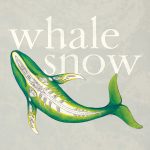
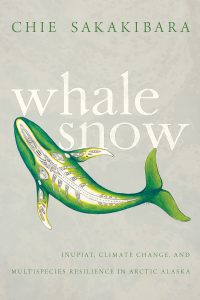
In Whale Snow: Iñupiat, Climate Change, and Multispecies Resilience in Arctic Alaskaauthor Chie Sakakibara uses multispecies ethnography to explore how the relatedness of the Iñupiat of Arctic Alaska and the bowhead whale forms and transforms “the human” through their encounters. Sakakibara shows how people of Arctic Alaska live in the world that intersects with other beings, how these connections came into being, and, most importantly, how such intimate and intense relations help humans survive the challenges of climate change. Today, Chie answers our questions.
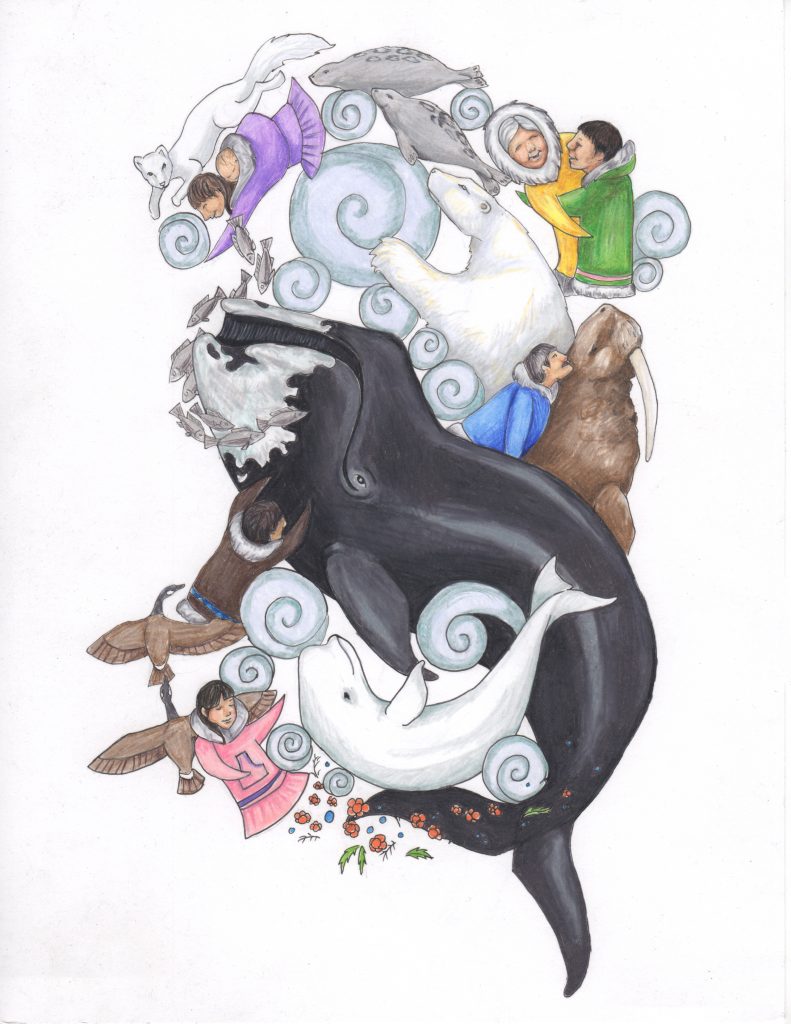
The artwork on the cover of your book is stunning. Please tell us more about the artist Nasuġraq Rainey Hopson.
Nasuġraq Rainey Hopson is an Iñupiaq artist and writer who was born and raised on the North Slope of Alaska. She is someone who I heartily admire for her deep commitment to her community through the promotion of Iñupiaq values, aesthetics, and environmentalism. As a dear friend, mentor, and collaborator, Nasuġraq kindly contributed the cover art, X-ray Whale, along with the original frontispiece and three illustrations included in Whale Snow. Her creations eloquently tell many stories, and they often point to a positive reciprocal relationship that goes across the boundary of humans and nonhuman animals, which gets intensified in our times of global climate change. This dynamism is the subject of Whale Snow.
Nasuġraq calls Anaktuvuk Pass (AKP) home, a beautiful village nestled in the foothills of the Brooks Range, and her days are filled with adventures with her daughter, husband, a small flock of chickens, a variety of types of artistic expression, and writing. She is also known as a groundbreaking Arctic gardening guru, and is the founder of America’s northernmost gardening project called “Gardens in the Arctic,” which has successfully grown fresh produce for her community since 2016. Visit Nasuġraq’s website, Nasuġraq Rainey Hopson: Iñupiaq Artist and Writer, to learn more about her career: https://www.nasugraqhopson.com/.
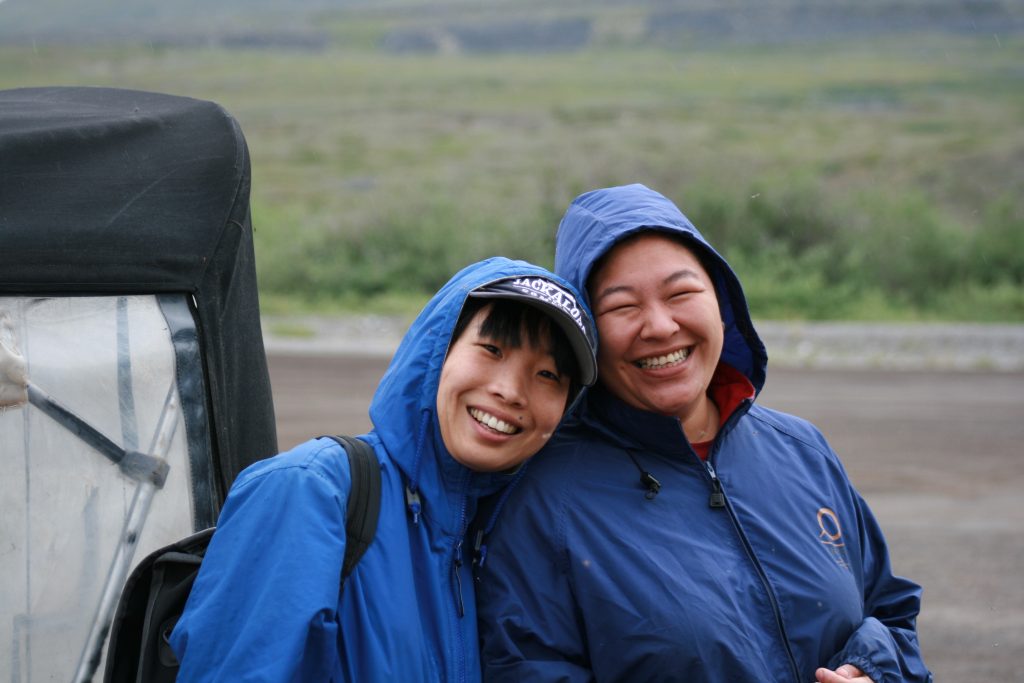
Portrait of Chie Sakakibara and Nasuġraq Rainey Hopson in Anaktuvuk Pass, Alaska. Photo by Aaron A. Fox.
In the Arctic, climate, culture, and human resilience are connected through bowhead whaling. You write that climate change has disrupted this ancient practice. What are some of the implications of this disruption?
In Whale Snow, I explored how Iñupiat live their values in the midst of pervading modernity in relation to colonial encounters and ongoing social and environmental transformations. Each of their social principles is now threatened by myriad ramifications of climate change. For so many times, on so many occasions, and in so many places, I have witnessed how the joy of getting a whale has worked a miracle to transform human lives, experiences, and relations. At the same time, it suggests the costs of not getting any whales. Without the whales, social tensions rise. Without the whales, the meaning and order the whales bring to sustain the community gets diluted—no whale means no harmony and no assurance of community integrity. When the ocean rises, sea ice deteriorates, and the tundra thaws, the devastation of not having any whales is immeasurable, and at times results in social rupture through violence, alcoholism, substance abuse, depression, and unexpected death, just to name a few. This is why whaling remains the central idiom of Iñupiaq well-being and sovereignty. Whaling maintains social health and solidarity as the foundation of survival. This is why the responsibility of the whalers is so immense.
At this time of further uncertainties for subsistence, the temptation of not observing the community norms gets much closer to the surface of their social fabric. At the same time, however, in the face of heightening anxiety and stress, development of interpersonal and interspecies bonds fosters resilience that ultimately strengthens the people. Such resilience can be invigorated through proactive adaptation to change, which leverages tradition and culture in modernity. This process of adaptation often manifests in a form of multispecies reciprocity in Arctic Alaska, which deeply intertwines the humans with humans, humans with animals, and humans with the environment. In the face of heightening anxiety and stress, development of interpersonal and interspecies bonds creates resilience that ultimately sustains the people.
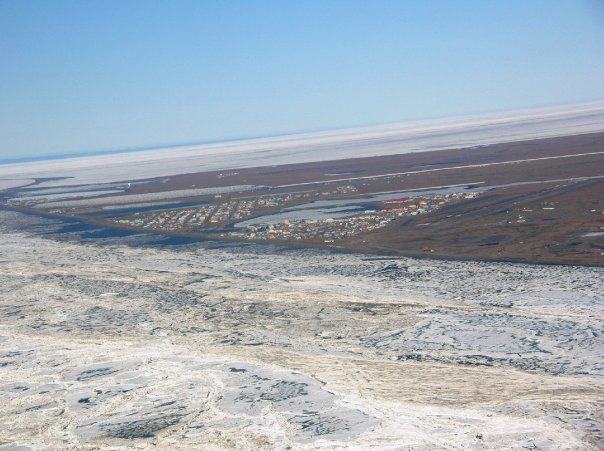
Aerial View of Utqiaġvik, Alaska – Photo by Chie Sakakibara
Global environmental change is all around us. In this time of ecological transition, why is exploring multispecies relatedness important?
As the COVID-19 pandemic and its interspecies origins underscore, we all live in the Anthropocene, an age in which humans and other animals are forced to live in closer proximity, share viruses, and confront new ones. Interspecies entanglements have increased their significance due to accelerating ecological dilemmas. My Iñupiaq mentors and collaborators taught me the importance of interspecies togetherness, or multispecies solidarity. Togetherness cultivates resilience, the capacity of individuals and communities to adapt, recover, and survive challenges and uncertainties. In this context, as Donna Haraway says, we must make kin as we are not the only important actors, and kin-making is a multispecies affair to cultivate resilience and mitigate vulnerability for survival. The Iñupiaq way of life clearly embodies this philosophy. Whale Snow is a journey to unpack such relations to better comprehend further entanglements between humans and nonhuman others as we are increasingly forced to live together.
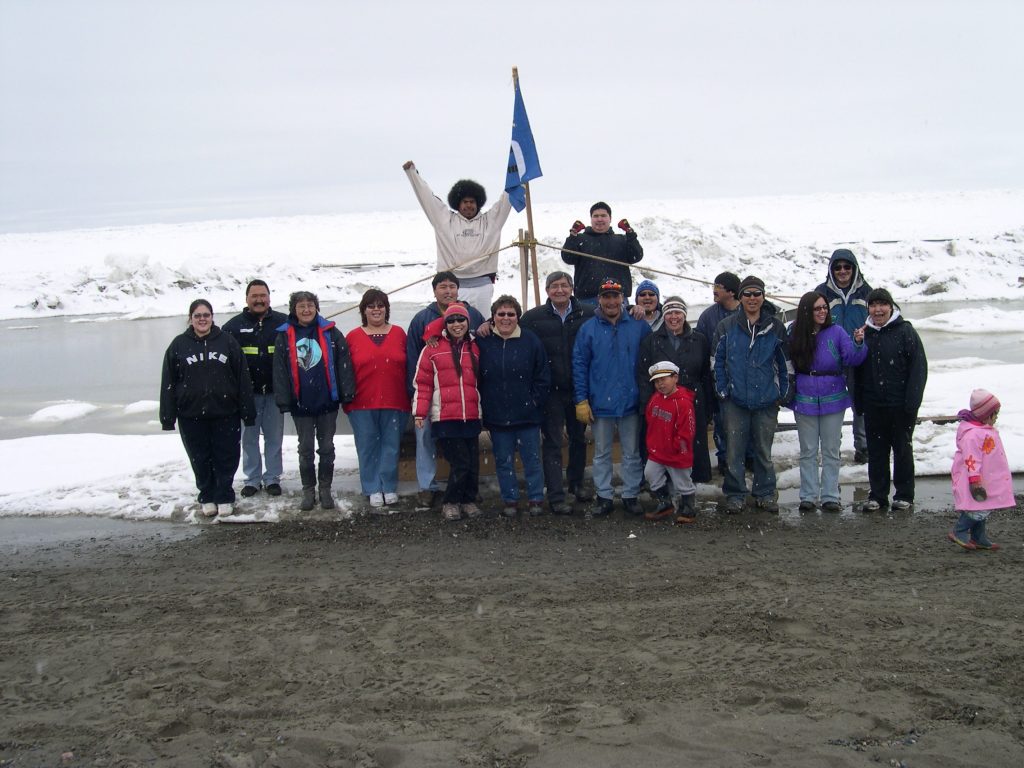
Kaleak Crew, successful whaling crew, celebrates the end of whaling season in Utqiaġvik, Alaska. Photo by Flossie Nageak.
You open the acknowledgements by describing a promise you make to a community member to “not disappear” once you completed your fieldwork. Why was this so important?
Academic researchers in Indigenous communities have a fraught relationship with Indigenous communities with data mining, and this history remains inseparable from the legacy of colonialism and colonization. It was this reputation for outsider extraction that my mentor Martha Aiken was afraid of. She had seen how local knowledge and experience were conveniently extracted, simplified, and plugged into the market economy as medicine, books, popular music, and designs, or when they were instantly turned into private property after being detached from their appropriate cultural contexts. Rarely was a plan to benefit the community part of this enterprise. On my first day in her community as a graduate student, Martha asked me to swear that I would commit myself to cultivate a long-term relationship with her and her community before starting to work on my dissertation research. I agreed to make the commitment. Now, many years later, I am still in the process of earning my place. The process of relationship-building has opened many doors to me that would have otherwise stayed closed; it is obvious but not an exaggeration to say that this study could not have been written without community participation and co-authorship. Martha has since passed away, but as a faculty member at Oberlin College, I continue to share her wisdom with my students to educate future generations of scholars—both Indigenous and non-Indigenous—about the importance of social justice, research ethics, community benefit, collaboration, and reciprocity so the future scholars will never disappear. Whale Snow is a token of my humble reciprocity with Martha and the community that adopted me and considered and cared for me as their own. As a partial fulfillment of Martha’s mandate, I wrote this book to offer insights into the depth of Iñupiaq-whale relations, and especially how they intersect with Iñupiaq struggles to achieve cultural sovereignty through the whaling cycle, and in so doing exhibit resilience in the face of unrelenting impacts of global climate change.
What do you hope people take away from your work?
Indigenous vulnerability to climate change has been discussed extensively in the fields of public policy, political science, anthropology, and geography, but comparatively few studies have actually shed light on the ways in which people emotionally invest themselves in their entanglements with animals and environments to nurture resilience. In contrast, Whale Snow shares powerful and positive stories about Indigenous experiences coping with climate change. As climate change increases environmental and cultural uncertainties, it also intensifies Iñupiaq emotions and relatedness with the bowhead whale to seek out cultural activities that strengthen social identities and a politics of Indigenous sovereignty. In this sense, my narrative departs from studies that emphasize human vulnerability and instead serves as an ethnography of hope cultivated and entangled with interspecies relations.
This book lies at the intersection of my personal life and stories of America’s northernmost Indigenous society. My narrative is steeped in a deep long-term relationship between a culturally adopted Japanese woman in the two Iñupiaq villages and her adoptive family members, relatives, mentors, collaborators, colleagues, friends, and acquaintances. This is the story of the people and the bowhead whale, and at the same time, the story of my own life. My fieldwork has become synonymous with my personal growth and fulfillment as an adopted member of whaling crews through participation in everyday life in contemporary rural Alaska. In many different ways and contexts, my adoptive families and kin taught me that the Iñupiaq-whale relationship is a force of innovation and adaptation that now serves as a way to cope with social stress and the unforeseeable future. In other words, this book was germinated in my own process of becoming an Iñupiaq (meaning “a complete person”) through building a relationship with Iñupiat and their nonhuman kin, and I present this book as a humble offering for the people and whales who are connected through emotive bonds, words, stories, and songs that they have so generously bestowed upon me.
Whale Snow Frontispiece – By Nasuġraq Rainey Hopson.
Chie Sakakibara is an assistant professor of environmental studies at Oberlin College. She was trained in cultural geography, art history, and Indigenous studies. Her work explores human dimensions of global environmental change among Indigenous peoples. Native to Japan, Sakakibara is a proud adoptive member of the Iñupiaq whaling community. Her love of humans and nonhuman animals manifests in her academic work as well as in her life with one human daughter and two canine sons.
All royalties accruing from sale of this publication go to the North Slope Borough Iñupiat History, Language, and Culture Commission.
Hosted by Alexander Heffner, The Open Mind is a series that explores national interests in politics, media, technology, the arts and civic life.
Beyond Earth’s Edge is an anthology that spans from the dawn of the space age to the imagined futures of the universe. The anthology offers a fascinating record of both national mindsets and private perspectives as poets grapple with the promise and peril of U.S. space exploration across decades and into the present.
Border radio is one of our favorite topics at Radio Survivor and on this week’s episode we dig into the history of radio broadcasting on the northern border of Mexico. Scholar Sonia Robles shares the stories of some of the lesser-known, small broadcasters whose histories are often overshadowed by the wild tales of higher power border blaster stations.
“The knowledges in this book come from deep places in our hearts, bodies, and minds and is intended for personal, familial, and community well-being. The writings reflect wisdom passed on through the oral tradition and lived experiences, research applied to our lives, or from our own intuitive creativity. As we learn from each other in a variety of ways, we have gathered reflections and practices in the form of short essays, poetry, visual art, ritual guidelines, and songs. It is wisdom based on the ancient knowledge received from Indigenous and African ancestors who understood their interconnectedness with one another and all life forms, with nature, and with the sacred cosmic forces. We and the contributors to this volume believe that it is time our cultural capital be documented and shared as we carry medicine in reclaiming ancestral teachings, in rethinking imposed religious beliefs, and in learning from diverse spiritual traditions.”
What can poetry teach us about science? Inspired by this question five years ago, Julie Swarstad Johnson embarked on a journey that celebrated spaceflight and poetry at the University of Arizona Poetry Center. In September 2016 Swarstad Johnson, a librarian at the renowned poetry center, organized an exhibit aptly titled “The Poetry of Spaceflight.”
That exhibit inspired the new poetry anthology co-edited by Swarstad Johnson and Christopher Cokinos, Beyond Earth’s Edge: The Poetry of Spaceflight. Recently, Swarstad Johnson recalled the inspiration for the exhibit and the book on the University of Arizona Poetry Center’s blog 1508. She also provides ideas for writing your own poems inspired by spaceflight.
The University of Arizona Press publishes the work of leading scholars from around the globe. Learn more about submitting a proposal, preparing your final manuscript, and publication.
The University of Arizona Press is proud to share our books with readers, booksellers, media, librarians, scholars, and instructors. Join our email Newsletter. Request reprint licenses, information on subsidiary rights and translations, accessibility files, review copies, and desk and exam copies.
Support a premier publisher of academic, regional, and literary works. We are committed to sharing past, present, and future works that reflect the special strengths of the University of Arizona and support its land-grant mission.
 The University of Arizona Press