Ready to Take Your Own Space Poetry Journey?

November 4, 2020

What can poetry teach us about science? Inspired by this question five years ago, Julie Swarstad Johnson embarked on a journey that celebrated spaceflight and poetry at the University of Arizona Poetry Center. In September 2016 Swarstad Johnson, a librarian at the renowned poetry center, organized an exhibit aptly titled “The Poetry of Spaceflight.”

That exhibit inspired the new poetry anthology co-edited by Swarstad Johnson and Christopher Cokinos, Beyond Earth’s Edge: The Poetry of Spaceflight. Recently, Swarstad Johnson recalled the inspiration for the exhibit and the book on the University of Arizona Poetry Center’s blog 1508. She also provides ideas for writing your own poems inspired by spaceflight.

Read Swarstad Johnson’s post and writing prompts.

Beyond Earth’s Edge Inspires a Celebrity Space Poetry Jam

October 29, 2020

If your deep Start Trek nerdom had you fantasizing about the Doctor from Star Trek: Voyager reading you some Pablo Neruda, you can thank Beyond Earth’s Edge: The Poetry of Spaceflight.

The poetry anthology, recently published by the University of Arizona Press, was featured on Planetary Radio, the Planetary Society’s weekly podcast brilliantly hosted by Mat Kaplan.

Beyond’s editors Julie Swarstad Johnson and Christopher Cokinos joined the podcast in what was truly a space-nerd delight with Picardo, of Star Trek: Voyager fame and a Planetary Society board member, reading a Pablo Neruda poem, as well as Bill Nye, Sasha Sagan, astronauts Nicole Stott and Leland Melvin, and others, all reading poems featured in the anthology celebrating poetry and outer space.

Listen to the podcast here, and revel further in the podcast and anthology getting some love from Daily Star Trek News–yes, Beyond Earth’s Edge is on the Federation’s radar! Read about it here. ?

‘Beyond Earth’s Edge’ Co-Editor Celebrates Cosmic Life in LA Times’ Op-Ed

October 20, 2020

Christopher Cokinos, co-editor of Beyond Earth’s Edge: The Poetry of Spaceflight, reveled in science’s recent discovered of phospine in the clouds of Venus, a sign that may signal life in a recent Op-Ed published by the Los Angeles Times.

From the op-ed:

“It means that life arose more than once in our backwater solar system. It means that life is common, and its tenacity is cosmic. For me, that puts our struggles in a grand context. Not by way of diminishing the hard work of problem-solving that faces us. Rather, the possibility that swaths of airborne microbes are going about their business in the skies above Venus reminds me that life finds a way. We can find our way too.”

Read the entire op-ed here.

Beyond Earth’s Edge, co-edited by Cokinos and Julie Swarstad Johnson (Editor), Christopher Cokinos, is a trailblazing anthology of poetry that spans from the dawn of the space age to the imagined futures of the universe. The anthology offers a fascinating record of both national mindsets and private perspectives as poets grapple with the promise and peril of U.S. space exploration across decades and into the present.

Anne García-Romero Featured on New Books Network Podcast

September 15, 2020

University of Arizona Press author Anne García-Romero was featured on a recent episode of the New Books Network podcast for her book, The Fornes Frame.

“In The Fornes Frame: Contemporary Latina Playwrights and the Legacy of Maria Irene Fornes (University of Arizona Press, 2016) playwright and theatre scholar Anne García-Romero traces the career and legacy of Maria Irene Fornes.

Fornes was one of the most significant American playwrights of the twentieth century, and her legacy is evident in the dozens of playwrights she mentored over the course of her long career. García-Romero shows how her unique pedagogy and her example as a successful Latina experimental playwright continue to inspire playwrights like Caridad Svich, Cusi Cram, Elaine Romero, Quiara Alegría Hudes, and Karen Zacarías.”

Listen to the podcast and read more here.

Frederick Luis Aldama Featured on New Books Network Podcast

September 15, 2020

University of Arizona Press author Frederick Luis Aldama was featured on a recent episode of the New Books Network podcast to discuss his new volume, which he co-edited with Arturo J. Aldama, Decolonizing Latinx Masculinities.

“In this episode we sit down with Frederick Luis Aldama, Distinguished University Professor at the Ohio State University and co-editor of Decolonizing Latinx Masculinities (University of Arizona Press), to discuss some of the cutting-edge research in this new edited volume.

This rich collection of work from eighteen contributors approaches the topic of masculinities from a diversity of perspectives and methodologies. With special emphasis on the plurality of Latinx masculinities, the essays reveal the divergent manifestations of masculinity across a broad spectrum including politics, social movements, literature, media, popular culture, personal experience, and other analytical angles. The pernicious effect of stereotypes and toxic Latinx masculinity is laid bare throughout the text in chapters that challenge the derogatory performances and reification of machismo in mainstream U.S. culture and society.”

Listen to the podcast and read more here.

Gloria E. Anzaldúa Reads Uncollected and Unpublished Poems in 1991 Recording

August 14, 2020

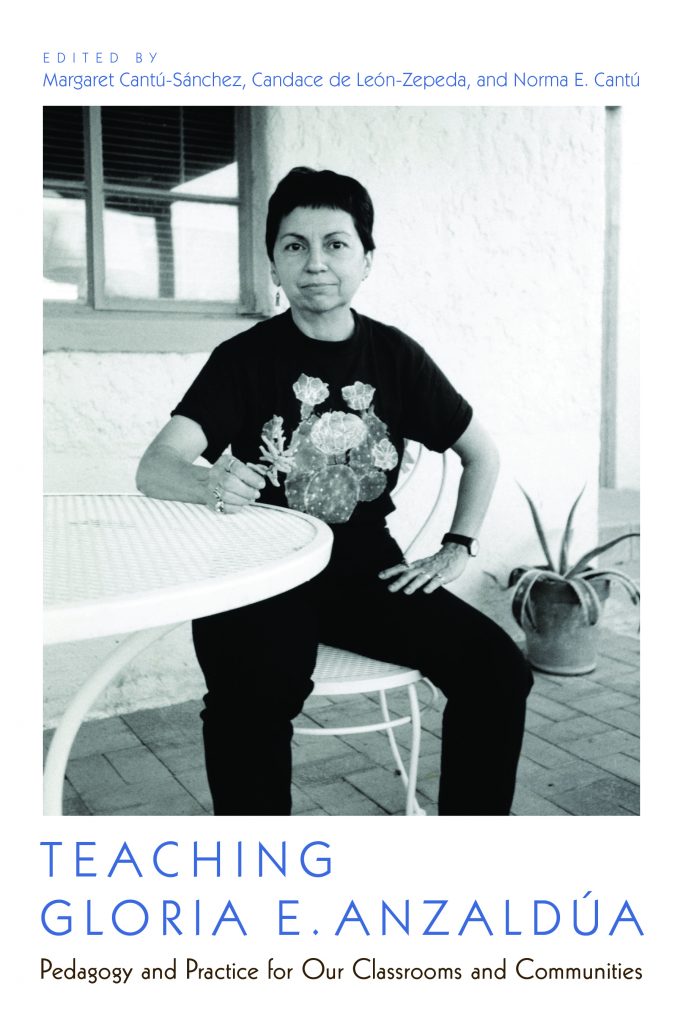
We are so thrilled to share a new volume with you, Teaching Gloria E. Anzaldúa, this season! We thought this reading from Gloria herself was incredible, so we wanted to share it with you. This reading is available thanks to voca, the University of Arizona Poetry Center’s online audiovisual archive of more than 1,000 recordings of poets reading their work during visits to the Center between 1963 and today. Listen here.

Gloria Evangelina Anzaldúa—theorist, Chicana, feminist—famously called on scholars to do work that matters. This pronouncement was a rallying call, inspiring scholars across disciplines to become scholar-activists and to channel their intellectual energy and labor toward the betterment of society. Scholars and activists alike have encountered and expanded on these pathbreaking theories and concepts first introduced by Anzaldúa in Borderlands/La frontera and other texts.

Teaching Gloria E. Anzaldúa is a pragmatic and inspiring offering of how to apply Anzaldúa’s ideas to the classroom and in the community rather than simply discussing them as theory. The book gathers nineteen essays by scholars, activists, teachers, and professors who share how their first-hand use of Anzaldúa’s theories in their classrooms and community environments.

Urayoán Noel Featured on the Poetry Centered Podcast

August 13, 2020

Poetry Centered features curated selections from voca, the University of Arizona Poetry Center’s online audiovisual archive of more than 1,000 recordings of poets reading their work during visits to the Center between 1963 and today. In each episode, a guest poet introduces three poems from voca, sharing their insights about the remarkable performances recorded in our archive. Each episode concludes with the guest poet reading a poem of their own. Our inaugural season includes episodes hosted by Hanif Abdurraqib, Alison Hawthorne Deming, Ada Limón, Urayoán Noel, Maggie Smith, and TC Tolbert.

In this episode, Urayoán Noel introduces recordings of Ai engaging with war through necessary fury (“The Root Eater”), Lehua M. Taitano composing a lifeline to communities living with the legacies of colonialism (“A Love Letter to the Chamoru People in the Twenty-first Century”), Ofelia Zepeda on the untranslatability of song (“Ñeñe’i Ha-ṣa:gid / In the Midst of Songs”), and a fable of radical imagination by Gloria E. Anzaldúa (“Nepantla”). Noel ends the episode with his poem “Molecular Modular,” built around open-ended questions considering virality and modes of community.

Urayoán Noel is the author of Buzzing Hemisphere/ Rumor Hemisférico, a playful and irreverent mash-up of voices and poetic traditions from across the Americas, which imagines an alternative to the monolingualism of the U.S. literary and political landscape, and proposes a geo-neuro-political performance attuned to damaged or marginalized forms of knowledge, perception, and identity. Urayoán Noel has been a fellow of CantoMundo and the Ford Foundation, and he is currently the poetry editor of NACLA Report on the Americas. Born in San Juan, Puerto Rico, Noel lives in the Bronx and is an assistant professor of English and Spanish at New York University.

Keep an eye out on our website for a forthcoming collection from Urayoán Noel!

Charles Bowden’s Blue Desert Featured in Harper’s Magazine

7/24/2020

In the August 2020 issue of Harper’s Magazine, Wes Enzinna writes an essay on Charles Bowden that praises, criticizes, and recognizes Bowden as a shrewd predictor of the current chaos surrounding the United States borderlands. Below, read an excerpt from the essay which pertains to our book Blue Desert, originally published in 1986 and recently re-released with a new forward by Fransciso Cantú in 2018.

“For all his cynicism, Bowden’s response to this crisis was never a desire to strengthen the border, but rather to destroy it. ‘There aren’t any Mexican stars or American stars,’ he once said in a radio profile, as he hiked with the correspondent through the Buenos Aires wildlife refuge in southern Arizona, a popular route for migrants sneaking into the United States. ‘It’s like a great biological unity with a meat cleaver of law cutting it in half.’ His work was an attempt to heal this cleavage, and to remind us how our hunger, pollution, and violence connected us all, especially in the Sonoran and Chihuahuan Deserts, where nature was a stingy mother and death ruled over everything. ‘We are becoming more and more aware that our civilization destroys the foundations that support it by devouring the earth and the things of the earth,’ he wrote in Blue Desert. ‘But we don’t have the courage to back away, to stop, to restrain ourselves. I know I don’t.’

Like the beasts and criminals he admired, Bowden was a complicated, contradictory creature. He loved dogs, dirt, wine, worms, Cadillacs, cacti. He held backyard parties to watch summer cereus flowers bloom at midnight, and owned scores of guns but was reluctant to shoot them lest they scare the birds. In Most Alarming, a priest named Gary Paul Nabhan reports that the last time he saw Bowden the surly old tough guy was weeping for a cottonwood tree that had died. Bowden’s teeth were falling out. He was poor and owned little more than a laptop, a Le Creuset pot, a sleeping bag, a Honda Fit, and a pair of binoculars. If in life he sometimes failed to be a decent man, in his writing he tried to be a better animal. ‘The whippoorwill’s name reflects the sounds we hear it make,’ he once wrote in a letter to a friend.”

Read the entire essay here.

Published in 1986, Blue Desert was Charles Bowden’s third book-length work and takes place almost entirely in Arizona, revealing Bowden’s growing and intense preoccupation with the state and what it represented as a symbol of America’s “New West.” In a thoughtful new foreword, Francisco Cantú writes, “In Blue Desert, we follow Bowden in the processes of becoming. We see the version of Bowden that he would likely most want us to remember—someone who did their best to be an honest witness, someone who was haunted by modernity and his place in it, someone who grappled with his demons by gazing deeply into the desert.”

Charles Bowden (1945–2014) was the author of many acclaimed books about the American Southwest and U.S.-Mexico border issues. He was a contributing editor for GQ, Harper’s, Esquire, and Mother Jones. His honors include a PEN First Amendment Award and the Lannan Literary Award for Nonfiction.

Escape the News with University Press Books

May 1, 2020

The university press community has compiled an “Escape the News” reading list! The escape theme was interpreted broadly: submissions range from music history and poetry, graphic novels, photography and illustrated books, short stories, novels, memoirs, and natural history. There is also an international flavor to the list—especially in the areas of creative literature, fiction, poetry, and fine arts—indicating the global nature of the university press community. The goal for the list is to offer readers a way to entertain and inform in a time when reading allows us a portal to other worlds, when we can’t quite get there in person.

Our book picks for this “Escape the News” reading list are Kafka in a Skirt by Daniel Chacón and Ladies of the Canyons by Lesley Poling-Kempes.

“Daniel Chacón’s collection of stories challenges convention and resolution, offering us thought-provoking insights into our current (and oftentimes surreal) political climate. Kafka in a Skirt breaks new ground in the art of social commentary that highlights the strangeness of our human condition and the follies of the skewed perceptions we maintain of ourselves, our neighbors, and the troubled world we live in.”—Rigoberto González

Poling-Kempes has done an admirable job scouring archives for these women, who have been largely left out of the historical record of the West. It’s a kind of prequel to our common history of the Southwest, peopled by women with long skirts and cinched waists in the desert heat, riding cowboy style, trying to do right by the land they all loved.”—Los Angeles Times

Discover more books from this reading list here.

Smithsonian Magazine Selects Sugarcane and Rum for Their Weekly Reading Series

April 30, 2020

We are thrilled that Sugarcane and Rum was selected for the latest installment of Smithsonian magazine’s “Books of the Week” series!

Here’s what Smithsonian had to say about Sugarcane and Rum:

Gust and MathewsSugarcane and Rum looks beyond the Yucatán Peninsula’s reputation as an idyllic getaway spot to expose the harsh conditions faced by its 19th-century Maya laborers.

Hacienda owners implemented punitive economic systems where workers became deeply indebted to their bosses, only to see their freedoms curtailed as a result. At the same time, the authors note, these men and women enjoyed a certain level of autonomy as an indispensable source of labor come harvest time.

‘What this history shows,’ according to the book’s introduction, ‘is that sugarcane and rum are produced on a massive scale to satisfy the consumptive needs of the colonizers, which only compounds its exploitative nature as the products became available to the middle and working class.’

Meilan Solly for Smithsonian magazine

Read the full list of book recommendations here.

For Authors

The University of Arizona Press publishes the work of leading scholars from around the globe. Learn more about submitting a proposal, preparing your final manuscript, and publication.

Inquire

Requests

The University of Arizona Press is proud to share our books with readers, booksellers, media, librarians, scholars, and instructors. Join our email Newsletter. Request reprint licenses, information on subsidiary rights and translations, accessibility files, review copies, and desk and exam copies.

Request

Support the Press

Support a premier publisher of academic, regional, and literary works. We are committed to sharing past, present, and future works that reflect the special strengths of the University of Arizona and support its land-grant mission.

Give