Abalone Mountain Press Podcast interviewed Esther Belin, co-editor of The Diné Reader: An Anthology of Navajo Literature, published by the University of Arizona Press. Also interviewed were Byron Aspaas, Nia Francisco and Laura Tohe. Together they discussed what it is like growing up on the Navajo Reservation, writing poems in Navajo, and hopes for The Diné Reader.
Belin is one of four editors of this powerful new anthology of Navajo literature with a range of contributors including Shonto Begay, Sherwin Bitsui, Luci Tapahonso, Laura Tohe, and many others.
The Archaeology of Refuge and Recourse explores the dual practices of refuge and recourse among Indigenous peoples of California. From the eighteenth to the twentieth century, Indigenous Coast Miwok communities in California persisted throughout multiple waves of colonial intrusion. But to what ends?
Applying theories of place and landscape, social memory, and mobility to the analysis of six archaeological sites, Tsim D. Schneider argues for a new direction in the archaeology of colonialism. This book offers insight about the critical and ongoing relationships Indigenous people maintained to their homelands despite colonization and systematic destruction of their cultural sites.
Watch Tsim Schneider introduce his new book below.
Tsim D. Schneider is a citizen of the Federated Indians of Graton Rancheria and an assistant professor of anthropology at the University of California, Santa Cruz. His archaeological and historical research investigates the lives and decision making of Indigenous peoples contending with colonialism. Schneider is co-editor ofIndigenous Landscapes and Spanish Missions: New Perspectives from Archaeology and Ethnohistory, and his research appears in such high-caliber journals as American Anthropologist, American Antiquity, and American Indian Quarterly.
On The Joys of Binge Reading podcast, Jenny Wheeler recently interviewed University of Arizona Press author Sara Sue Hoklotubbe on writing and her book, Betrayal at the Buffalo Ranch, the fourth in Hoklotubbe’s Sadie Walela mystery series.
“She recounts how a book that started out being about how women got a bad rap in banking turned into a bank robbery mystery. And she recalls the day she got stopped at Heathrow for having an American Indian name, believe it or not.”
In a special opinion piece for the Arizona Republic Stephen Pyne writes that Fires in the West–and the world, for that matter, is not a problem solved with a once-and-done project:
“Places that historically had fire are having more and nastier outbreaks. Places without routine fire are experiencing it. An equal reality is that we need more landscape fire to dampen fuels and enhance ecological integrity. All in all, too much bad fire, too little good.”
Stephen J. Pyne is an emeritus professor at Arizona State University. Best known for his research into the history of fire, he is the author of Between Two Fires and To The Last Smoke, along with several other works on fire. He has also written a suite of studies that orbit around the concept of three ages of discovery: The Ice: A Journey to Antarctica; How the Canyon Became Grand; Voyager: Exploration, Space, and the Third Great Age of Discovery; and The Great Ages of Discovery.
University of Arizona Press author Carwil Bjork-James was recently featured on a Media Indigena podcast episode entitled “Bolivia for Beginners.”
Imagine what it would be like to live in a country where roughly half the population is Indigenous, said to be the highest such proportion in all of South America. Imagine too that, for over a decade, your president was himself Indigenous. Well, in Bolivia, that’s been the reality—and a fascinating one at that. A reality we delve into further with a special guest who’s written extensively about the ways in which Indigenous-led social movements have dramatically and fundamentally altered the mainstream political landscape.
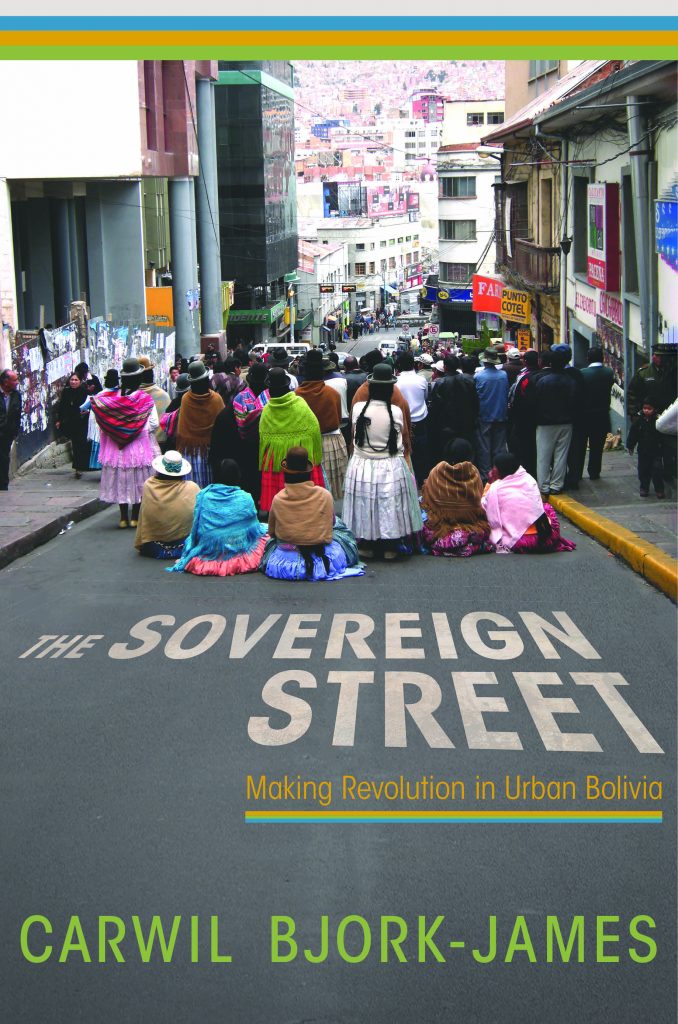
Recently, University of Arizona Press author Carwil Bjork-James presented a talk on Andean extraction at the American Association of Geographers meeting. Taking the streets of Cochabamba, Sucre, and La Paz as its vantage point, Carwil’s new book The Sovereign Street offers a rare look at political revolution as it happens. It documents a critical period in Latin American history, when protests made headlines worldwide, where a generation of pro-globalization policies were called into question, and where the indigenous majority stepped into government power for the first time in five centuries
“As part of an extended panel on the Corporation on at the American Association of Geographers meeting, I presented the following talk on Concession blocks, spiraling pits, and wily start-ups: Spatialities of Andean extractivism (AAG members only). The talk is a deep dive in the technologies and policies that connect open-pit mining w/ speculative capital, built around Sumitomo Corporation’s San Cristobal mine in Potosí, Bolivia and Bear Creek Mining’s failed Santa Ana silver mine project in Puno, Peru.”— Carwil Bjork-James
Carwil Bjork-James is an assistant professor of anthropology at Vanderbilt University. His research, both ethnographic and historical, concerns disruptive protest, grassroots autonomy, state violence, and indigenous collective rights in Bolivia.
In a new essay published this week on the History News Network, Steve Pyne explains the link between last months Mars landing by Perseverance and the Great Ages of Discovery, which he details in his new book. Here’s a brief excerpt from the essay:
“There is a lot to marvel at Perseverance’s February 18 landing on Mars, beyond robotic exploration as an extreme sport. Only half of attempted missions to Mars have succeeded, and the sheer technical audacity that stuck Perseverance’s landing is guaranteed to dazzle. But America’s latest endeavor joins two other missions from civilizations re-emerging as global actors after centuries of exploring quietude. Perhaps more deeply, Perseverance’s first-contact photo, a shadow selfie, raises questions about the very nature of discovery and the character of an explorer.”
Jon Lee Anderson, author of Che: A Revolutionary Life, offers four books that reveal a Havana beyond the clichés. One of the books he chose is Miller’s Cuba, Hot and Cold, about which Anderson writes, “If you had to pick one great introduction to Havana, it’d be this slender, readable work. It hits all the touchstones of history, art and literature with a healthy sense of humor—and you can finish it in an hour and a half.”
Since his first visit to the island thirty years ago, Miller has shown us the real people of Havana and the countryside, the Castros and their government, and the protesters and their rigor. His first book on Cuba, Trading with the Enemy, brought readers into the “Special Period,” Fidel’s name for the country’s period of economic free fall. Cuba, Hot and Cold brings us up to date, providing intimate and authentic glimpses of day-to-day life.
Tom Miller has been writing about Latin America and the American Southwest for more than four decades. His articles have appeared in outlets including the New York Times, Smithsonian, LIFE, Rolling Stone, and Natural History. He is affiliated with the University of Arizona’s Center for Latin American Studies, and at a 2008 ceremony, the City of Quito proclaimed Miller Un Huésped Ilustre (An Illustrious Guest).
Horsefly Dress author Heather Cahoon was interviewed for Poetry Northwest by Shriram Sivaramakrishnan. Below, read an excerpt from this thoughtful interview and find a link to read the entire discussion.
Shriram Sivaramakrishnan: I would like to kickstart our discussion with the first thing that caught my attention when I was reading your book: the use of Salish words. In your recent reading for The University of Arizona Press, you spoke about weaving Salish into your poems as an act of reclaiming, among other things, the land. It reminded me of a quote by Maurice Merleau-Ponty (I came across it while reading Maggie Nelson’s Bluets), “words do not look like the things they designate.” In the same reading, you also mentioned that you do not speak Salish. Given that your poems are firmly situated in the realities of the land, its people, and their tradition, how does language inform your creative practice?
Heather Cahoon: My poems are definitely rooted in place and reflective of my personal relationships with the landscape, people, flora, and fauna where I live. In terms of how language, specifically my use of Salish, informs my creative practice, I would start by noting that the level of Salish that appears in Horsefly Dress roughly mirrors my speaking ability. Growing up, everyone learns a handful of words and in college I took Salish from one of our elders but I certainly never came close to being fluent. As a result, my decision to include Salish in my poems was very intentional and serves a sort of dual purpose. On a basic level it connects me to my community and reaffirms those ties but it also calls attention, at least momentarily, to American Indians generally and, by extension, the settler colonial history of America. This is why I say that the use of Salish is an act of reclaiming space, not only as a presence on the physical lands where Salish-speaking people have been living for thousands of years, but the non-physical landscapes as well, including the broader American psyche and the mainstream narratives that have largely omitted tribal people.
Horsefly Dress is a meditation on the experience and beauty of suffering, questioning its triggers and ultimate purpose through the lens of historical and contemporary interactions and complications of Séliš, Qĺispé, and Christian beliefs. Heather Cahoon’s collection explores dark truths about the world through first-person experiences, as well as the experiences of her family and larger tribal community. As a member of the Confederated Salish and Kootenai Tribes, Cahoon crafts poems that recount traditional stories and confront Coyote’s transformation of the world, including his decision to leave certain evils present, such as cruelty, greed, hunger, and death.
Heather Cahoon, PhD, earned her MFA in poetry from the University of Montana, where she was the Richard Hugo Scholar. She has received a Potlatch Fund Native Arts Grant and Montana Arts Council Artist Innovation Award. Her chapbook, Elk Thirst, won the Merriam-Frontier Prize. She is an assistant professor of Native American studies at the University of Montana. She is from the Flathead Reservation and is a member of the Confederated Salish and Kootenai Tribes.
For Authors
The University of Arizona Press publishes the work of leading scholars from around the globe. Learn more about submitting a proposal, preparing your final manuscript, and publication.
The University of Arizona Press is proud to share our books with readers, booksellers, media, librarians, scholars, and instructors. Join our email Newsletter. Request reprint licenses, information on subsidiary rights and translations, accessibility files, review copies, and desk and exam copies.
Support a premier publisher of academic, regional, and literary works. We are committed to sharing past, present, and future works that reflect the special strengths of the University of Arizona and support its land-grant mission.