In a new essay published this week on the History News Network, Steve Pyne explains the link between last months Mars landing by Perseverance and the Great Ages of Discovery, which he details in his new book. Here’s a brief excerpt from the essay:
“There is a lot to marvel at Perseverance’s February 18 landing on Mars, beyond robotic exploration as an extreme sport. Only half of attempted missions to Mars have succeeded, and the sheer technical audacity that stuck Perseverance’s landing is guaranteed to dazzle. But America’s latest endeavor joins two other missions from civilizations re-emerging as global actors after centuries of exploring quietude. Perhaps more deeply, Perseverance’s first-contact photo, a shadow selfie, raises questions about the very nature of discovery and the character of an explorer.”
Jon Lee Anderson, author of Che: A Revolutionary Life, offers four books that reveal a Havana beyond the clichés. One of the books he chose is Miller’s Cuba, Hot and Cold, about which Anderson writes, “If you had to pick one great introduction to Havana, it’d be this slender, readable work. It hits all the touchstones of history, art and literature with a healthy sense of humor—and you can finish it in an hour and a half.”
Since his first visit to the island thirty years ago, Miller has shown us the real people of Havana and the countryside, the Castros and their government, and the protesters and their rigor. His first book on Cuba, Trading with the Enemy, brought readers into the “Special Period,” Fidel’s name for the country’s period of economic free fall. Cuba, Hot and Cold brings us up to date, providing intimate and authentic glimpses of day-to-day life.
Tom Miller has been writing about Latin America and the American Southwest for more than four decades. His articles have appeared in outlets including the New York Times, Smithsonian, LIFE, Rolling Stone, and Natural History. He is affiliated with the University of Arizona’s Center for Latin American Studies, and at a 2008 ceremony, the City of Quito proclaimed Miller Un Huésped Ilustre (An Illustrious Guest).
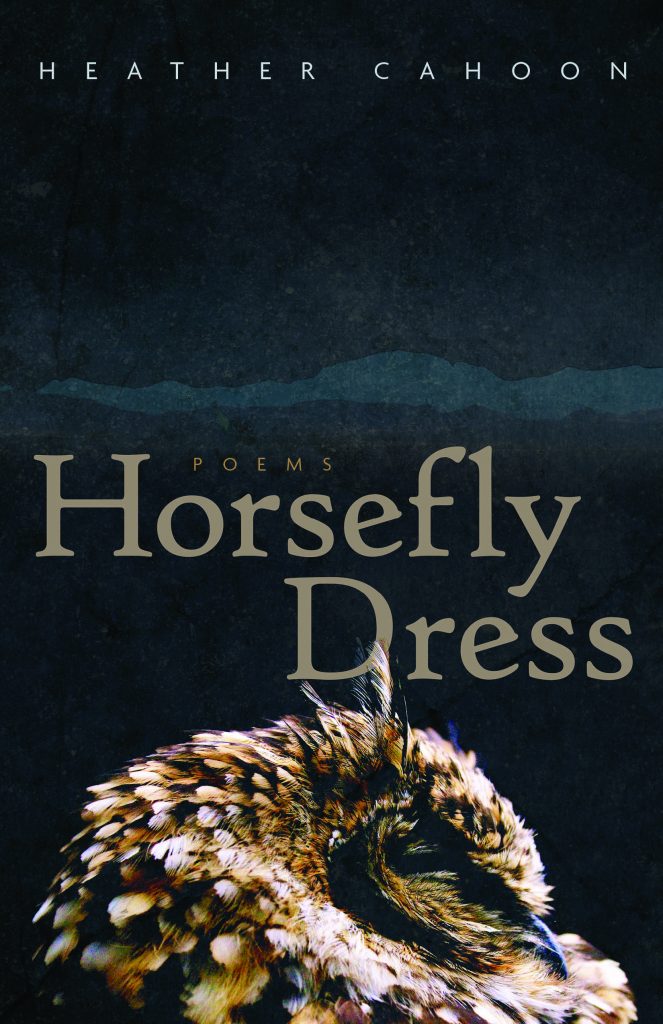
Horsefly Dress author Heather Cahoon was interviewed for Poetry Northwest by Shriram Sivaramakrishnan. Below, read an excerpt from this thoughtful interview and find a link to read the entire discussion.
Shriram Sivaramakrishnan: I would like to kickstart our discussion with the first thing that caught my attention when I was reading your book: the use of Salish words. In your recent reading for The University of Arizona Press, you spoke about weaving Salish into your poems as an act of reclaiming, among other things, the land. It reminded me of a quote by Maurice Merleau-Ponty (I came across it while reading Maggie Nelson’s Bluets), “words do not look like the things they designate.” In the same reading, you also mentioned that you do not speak Salish. Given that your poems are firmly situated in the realities of the land, its people, and their tradition, how does language inform your creative practice?
Heather Cahoon: My poems are definitely rooted in place and reflective of my personal relationships with the landscape, people, flora, and fauna where I live. In terms of how language, specifically my use of Salish, informs my creative practice, I would start by noting that the level of Salish that appears in Horsefly Dress roughly mirrors my speaking ability. Growing up, everyone learns a handful of words and in college I took Salish from one of our elders but I certainly never came close to being fluent. As a result, my decision to include Salish in my poems was very intentional and serves a sort of dual purpose. On a basic level it connects me to my community and reaffirms those ties but it also calls attention, at least momentarily, to American Indians generally and, by extension, the settler colonial history of America. This is why I say that the use of Salish is an act of reclaiming space, not only as a presence on the physical lands where Salish-speaking people have been living for thousands of years, but the non-physical landscapes as well, including the broader American psyche and the mainstream narratives that have largely omitted tribal people.
Horsefly Dress is a meditation on the experience and beauty of suffering, questioning its triggers and ultimate purpose through the lens of historical and contemporary interactions and complications of Séliš, Qĺispé, and Christian beliefs. Heather Cahoon’s collection explores dark truths about the world through first-person experiences, as well as the experiences of her family and larger tribal community. As a member of the Confederated Salish and Kootenai Tribes, Cahoon crafts poems that recount traditional stories and confront Coyote’s transformation of the world, including his decision to leave certain evils present, such as cruelty, greed, hunger, and death.
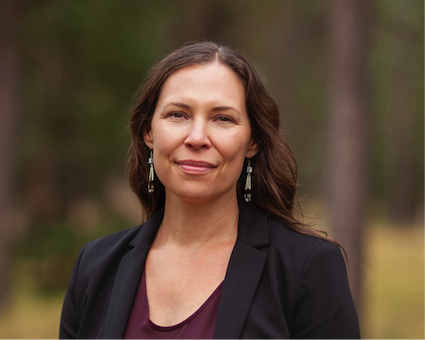
Heather Cahoon, PhD, earned her MFA in poetry from the University of Montana, where she was the Richard Hugo Scholar. She has received a Potlatch Fund Native Arts Grant and Montana Arts Council Artist Innovation Award. Her chapbook, Elk Thirst, won the Merriam-Frontier Prize. She is an assistant professor of Native American studies at the University of Montana. She is from the Flathead Reservation and is a member of the Confederated Salish and Kootenai Tribes.
In the interview, García expanded on the themes of the book:
“The essays in our book,” García continued, “bring in new historical actors to the movement that had earlier been excluded and, secondly, the book attempts to nationalize the movement in that it made Chicanos and other Latinos for the first time into national political actors and laid the foundation for today’s recognized Latino political power. It is not excluding or downplaying earlier histories of the movement but rather expanding them.”
“Over the past 40 years, I have witnessed the reclamation of Indigenous identities and spiritual practices among many Xicanx and Latinx peoples as well as an uplifting of our African ancestries, often referred to as “the third root.” Foundational to these reclamations is the embracement of non-Western epistemologies. We have come to understand our deep interconnectivity with all of humanity as well as plant and animal life and the natural forces of the universe. So we understand that how we live our lives impacts all others and that we must live with a consciousness of balance, reciprocity, respect and gratitude. We must honor the spirits in all life forms and not consider humans to be superior. We must take care of the planet and in turn the planet will take care of us. We must also maintain our relationships with our deceased ancestors (known and unknown) who have walked this earthly journey before us “as death brings another kind of wisdom that they want to share with us.” The ancestors gain the power to continue to guide and protect us.”
Mark McLemore, host and producer of Arizona Public Media’s Arizona Spotlight, recently interviewed Christopher Cokinos and Julie Swarstad Johnson, co-editors of Beyond Earth’s Edge: The Poetry of Spaceflight.
Beyond Earth’s Edge is a trailblazing anthology of poetry that vividly captures the violence of blastoff, the wonders seen by Hubble, and the trajectories of exploration to Mars and beyond through a wide array of lyric celebrations, somber meditations, accessible narratives, concrete poems, and new forms of science fiction. Included are diverse perspectives from poets such as Robert Hayden, Rae Armantrout, N. Scott Momaday, Adrienne Rich, Tracy K. Smith, Ray Bradbury, May Swenson, Pablo Neruda, and many other engaging poetic voices.
In the 2020 year in review issue of the Wall Street Journal, author Stephen Pyne explains why 2020 brought a better understanding of the causes of wildfires and what needs to be done. He writes:
“Surely the dominant story of 2020 will be the coronavirus pandemic and the economic upheaval and political fallout it caused. But the enduring images of the year may well be of another contagion—the fires that splashed across the globe and the havoc they wrought where humanity’s and nature’s economies met.
The fires seemed everywhere, partly because of extensive media coverage—fires are visually graphic and guaranteed to grab attention. But this wasn’t hype. The fires were real. Many occurred in the usual places—like California, African savannas and Australia—that are built to burn, though this time they came with performance enhancers. Few of such fires were individually unprecedented, but they were so many they swarmed, and they came in serial outbreaks. In their ensemble they qualify as epic.”
The desert inspires wonder. Attending to history, culture, science, and spirit, The Nature of Desert Naturecelebrates the bounty and the significance of desert places.
When Christopher Cokinos isn’t talking about his love of poetry that celebrates spaceflight, the poet and author shares his interest in space sciences.
The discovery suggests a greater distribution of water on the Moon, an environment that astronomers in centuries past thought might have surface water but Apollo-era science suggested was bone dry. Since then, new laboratory techniques have cracked open previously-unstudied Apollo samples and found water molecules. Meanwhile, missions to the Moon over the past three decades found evidence of lunar water ice in permanently shadowed regions of the Moon, clustered around the poles.
For The Space Review, Cokinos makes an argument for the next NASA lunar mission to head to the moon’s south pole, and not follow in the footsteps of the Apollo missions.
From his report:
In any case, if we can’t get to the pole on Artemis 3, go forward to a new location and don’t return to an Apollo site—not yet. Lunar sustainability can’t indulge in the appearance of expensive nostalgia that could risk turning off shaky public support.
From 15 Books From Smaller Presses You Won’t Be Able To Put Down:
A Good Map of All Things by Alberto Álvaro Ríos (University of Arizona Press, out now)
Billed as a “picaresque” novel — a style that typically follows a rogue or antihero and often has some elements of satire — A Good Map is set in the borderlands of Arizona and Sonora. The people in this fictional, small Mexican town are incorrigible gossips, true believers, and utterly charming. This is a book that feels like a classic, with characters who feel like family.
The University of Arizona Press publishes the work of leading scholars from around the globe. Learn more about submitting a proposal, preparing your final manuscript, and publication.
The University of Arizona Press is proud to share our books with readers, booksellers, media, librarians, scholars, and instructors. Join our email Newsletter. Request reprint licenses, information on subsidiary rights and translations, accessibility files, review copies, and desk and exam copies.
Support a premier publisher of academic, regional, and literary works. We are committed to sharing past, present, and future works that reflect the special strengths of the University of Arizona and support its land-grant mission.
 The University of Arizona Press