Celebrating the People of the Press: Abby Mogollon

July 24, 2019

People of the Press is back this week! Inspired by the Association of University Presses celebration of the people of AUPresses, we would also like to celebrate our dedicated publishing professionals throughout our 60th anniversary year.

Today, we’re featuring our Marketing Manager, Abby Mogollon.

Hello Abby, what do you do for the Press?

I am the Marketing Manager for the University of Arizona Press. With a three-person marketing team, we have an all-hands-on-deck approach to our marketing and communications. It takes everyone doing their part. I have a wide variety of duties, from guiding our overall marketing strategy to overseeing our website and metadata. I work on book covers and jackets with our designer, coordinate with our sales reps across the country, and much more. All in support of helping our authors share this vital scholarship! My favorite work is when I get to spend time at an exhibit or book festival, hand-selling our books and meeting authors and customers.

How long have you worked at UA Press?

I just reached my tenth anniversary!

The University of Arizona Press is committed to helping contribute to an informed society and enlightening readers. What’s one thing you’ve learned from your work?

I feel like every day I’m learning something new in this job. Whether it’s new ways to market our books or new ways to think about the world, thanks to our author’s scholarship. I feel so lucky to have a job where every day I’m learning something new. Perhaps the one thing I’ve learned is to just keep learning and being ready to change.

What would people be surprised to learn about your work?

So much of book publishing is invisible. It takes a great partnership between the press and the author to spread the word about a book, and a lot of thought and planning is happing behind the scenes. For example, for every review a book receives, there were probably ten or even twenty pitches to outlets. I think people may also be surprised to learn how much thought goes into those quotes on the back of a book. We call them blurbs and think carefully about who we request them from, and the authors who provide blurbs spend a significant amount of time with a work to come up with those two sentences that appear on the back of a book. It’s a real craft. With the advent of digital marketing and metadata, the traditional channels for sharing and publishing information has gotten exponentially more interesting and complex.

Tucson has a thriving literary and scholarly community. What’s one of your favorite spots to hear authors, find a good book, or just curl up and read?

I really love hearing authors talk about their work or present their poetry. I’m incredibly grateful to Antigone Books and the UA Poetry Center for the opportunities they provide to connect authors and audiences. I also love the University of Arizona Bookstore’s selection of books. Whether it’s a preview of authors coming to the Tucson Festival of Books or the new University of Arizona Press books, they are a tremendous asset to our community. For reading, I just love hunkering down on the couch with a book, and my dog Petal curled up next to me. That’s the best kind of afternoon.

Gerard P. Kuiper’s Lunar Contributions

July 16, 2019

In Gerard P. Kuiper and the Rise of Modern Planetary Science, Derek W. G. Sears crafts an in-depth history of some of the twentieth century’s most interesting scientists, from Harold Urey to Carl Sagan, who worked with the father of modern planetary science. Now, as NASA and other space agencies explore the solar system, they take with them many of the ideas and concepts first described by Gerard P. Kuiper. In celebration of the fiftieth anniversary of the Apollo 11 moon landing, keep reading for a glimpse into Kuiper and the University of Arizona’s involvement in this exciting period of American history.

“It was the most extraordinary time, one that is hard to imagine many decades later. In 1961, when President John Kennedy made the commitment to land a man on the Moon by 1970, rockets were exploding on the launch pad… Eight years later, highly sophisticated, complex, large, manned spacecraft would touch down on the surface of the Moon within feet of their intended landing site. It took a lot of small steps, a lot of dedication, and a lot of stress to make it happen. Astronauts died in the effort. To Gerard Kuiper and his small group of lunar specialists in Tucson, the task was to produce maps and interpretations of the lunar surface and help with decisions concerning landing sites.”

“America’s decision to land a man on the Moon affected Kuiper in two ways. It led to the construction of a new building in Tucson, eventually to become the Kuiper Space Sciences Building… It also led to a series of robotic missions to the Moon. The science team led by Kuiper, who were amid publishing three atlases of the Moon, would be obvious candidates to participate in these programs.

The American robotic precursors for humans to land on the Moon consisted of three programs. The Ranger program was to be a series of spacecraft that would crash into the Moon and take close-up images as they did. The Lunar Orbiter program was to be a series of spacecraft that would, as their name implied, orbit the Moon and take photographs of the surface. Third, and the most sophisticated of the three programs, was to be the Surveyor program that would consist of robots that landed on the Moon.

Kuiper became involved in the Ranger and Surveyor programs in 1961 when he was asked to serve on committees advising the Jet Propulsion Laboratory (JPL) in Pasadena, California, who were managing these programs… In 1961, Rangers 1 and 2 failed on launch. Rangers 3 and 5 missed the Moon. Ranger 4 hit the Moon but failed to return any data. In 1963 the project was reorganized, and Kuiper was asked to be the chief experimenter with a science team of Urey, Shoemaker, Whitaker, and Ray Heacock, a JPL engineer.”

“Four redesigned spacecraft were prepared, each with six TV cameras. At Kuiper’s suggestion, the TV system was tested in mock lunar landscapes at Goldstone Station in the Mojave Desert. Camera operations were carried out by Ralph Baker, who later joined the Optical Sciences Center in Tucson. The science team, especially Whitaker, played an important role in determining the impact sites for Ranger and the approach angles. Ranger 6 was another failure, but Ranger 7 was a spectacular success. It crashed just south of the Copernicus crater in a region now known, at Kuiper’s suggestion, as Mare Cognitum.”

“Kuiper arranged for LPL [Lunar and Planetary Laboratory] to make loose-leaf albums from the Ranger 7 prints, which required a local company, Ray Manley Commercial Photography, to make fifty thousand prints. In the rapid-fire days leading up to the Apollo landings, things moved fast. Ranger 8 hit Mare Tranquilitatis in February 1965, and Ranger 9 crashed near the Alphonsus crater a month later. Both were completely successful.”

“Never had the LPL attracted such attention. With this success came attempts by the NASA centers and JPL to recruit LPL scientists. Whitaker was approached JPL, Kuiper was invited to take a position at NASA headquarters in Washington, D.C., and both Gehrels and Kuiper were invited to move to the Manned Spacecraft Center in Houston. Kuiper took great pleasure in recounting the details to President Harvill.”

Derek W.G. Sears was a professor at the University of Arkansas for thirty years and is now a senior research scientist at NASA. He has published widely on meteorites, lunar samples, asteroids, and the history of planetary science.

Celebrating the People of the Press: Scott DeHerrera

July 9, 2019

People of the Press is back this week! Inspired by the Association of University Presses celebration of the people of AUPresses, we would also like to celebrate our dedicated publishing professionals throughout our 60th anniversary year.

Today, we’re featuring our Assistant Editor, Scott DeHerrera.

Hi Scott, what you do for the Press?

I am responsible for acquiring titles in poetry and fiction for the Press’s two award-winning literary series, Sun Tracks and Camino del Sol. I also work closely with our Senior Editor, Dr. Allyson Carter, to bring in new titles in anthropology, Indigenous studies, archaeology, environmental science, and space science.

How long have you been working at UA Press?

10 years this June!

The University of Arizona Press is committed to helping contribute to an informed society and enlightening readers. What’s one interesting thing you’ve learned from your work?

In this era of smart phones and social media and technological overload, it’s easy to become jaded and begin to think people no longer have the attention spans required for reading more than 280 characters at a time; however, working in this position has taught me that is indeed not the case – people are reading now more than ever!

What would people be surprised to learn about your work?

I think people would be surprised to know how small our staff is given how many great titles we publish each year.

Tucson has a thriving literary and scholarly community. What’s one of your favorite spots to hear authors, find a good book, or just kick back and read?

Ever since I was a kid, Bookman’s has always been one of my favorite places to spend an afternoon.

Paula López Caballero and Ariadna Acevedo-Rodrigo Featured on New Books Network Podcast

June 27, 2019

University of Arizona authors, Paula López Caballero and Ariadna Acevedo-Rodrigo, were featured on a recent episode of New Books Network podcast do discuss their new book, Beyond Alterity.

“What happens when scholars approach the category of “indigenous” without presupposing its otherness? Edited by Paula López Caballero and Ariadna Acevedo-Rodrigo, Beyond Alterity: Destabilizing the Indigenous Other in Mexico (University of Arizona Press, 2018) is an interdisciplinary collection of essays that take such an approach to studying indigenous communities and the concept of indigeneity. As the editors explain in the podcast, the indigenous subject has been often assumed to be defined by difference, so scholars tend to overlook the existence of practices, ideas, and politics that do not align with preconceived, essentialized ideas about indigenous alterity. This book examines, on the one hand, the range of lived experiences within indigenous communities, and on the other, the ongoing construction of the category of “indigenous.” Its first section uncovers ways in which indigenous communities’ practices and politics were more similar to than distinct from those of their nonindigenous counterparts. In the podcast, Acevedo-Rodrigo discusses her chapter on the role of Spanish-language schools in indigenous towns during the Porfiriato. The second section explores the changing, debated meanings of “the indigenous” in Mexico in various fields of scientific inquiry. López Caballero synthesizes her findings on anthropological debates on what constituted the indigenous in the 1940s. The editors also make reference to the other contributions to this edited volume on topics from property rights to genomic research.”

Listen to the podcast and read more here.

Celebrating the People of the Press: Amanda Krause

June 27, 2019

Inspired by the Association of University Presses celebration of the people of AUPresses, we would also like to celebrate our dedicated publishing professionals throughout our 60th anniversary year!

This week, we’re featuring our Editorial, Design, and Production Manager, Amanda Krause.

What do you do at the Press, Amanda?

I help shepherd books through the Editorial, Design, and Production process, answering author queries; working with freelance copyeditors, proofreaders, and indexers and print vendors; maintaining our house style guide; and managing the schedules for book production to make sure books are published (and reprinted) on time.

How long have you worked at UA Press?

Six and a half years.

The University of Arizona Press is committed to helping contribute to an informed society and enlightening readers. What’s one thing you’ve learned from your work?

I feel like I am constantly absorbing knowledge from our authors and from our location at the University of Arizona Main Library, but perhaps my favorite piece of oddly specific trivia I’ve learned is that “on” is the correct usage when talking about national forests (as in “work on the national forest” rather than “work in the national parks”) — according to our author Ted Catton, this harkens back to the Forest Service’s early days when their primary role was managing grazing lands; you say “on the forest” just as you say “on the range”.

What would people be surprised to learn about your work?

Despite my role in editorial, I actually spend very little of my work day reading — because my role is so focused on project managing and finding and correcting specific errors in the text, I rarely have an opportunity to read our books cover to cover for work (though I do enjoy reading them for fun!).

Tucson has a thriving literary and scholarly community. What’s one of your favorite spots to hear authors, find a good book, or just curl up and read?

I am a huge fan of both Bookman’s and Antigone.

Kathryn Conrad Begins Term as President of AUPresses

June 26, 2019

Kathryn Conrad, director of the University of Arizona Press, assumed the presidency of the Association of University Presses (AUPresses) on June 12, 2019, during the Association’s Annual Meeting. Conrad was preceded by Jennifer Crewe, associate provost and director of Columbia University Press.

In her inaugural address, Conrad commended university presses for working “to advance scholarship, to preserve cultural heritage, and to build the scholarly record.” Read Conrad’s full remarks.

Conrad began her publishing career as an editorial assistant for both Algonquin Books of Chapel Hill and Houghton-Mifflin’s Best American Short Stories, an editor for River Styx—a literary magazine based in St. Louis—and a typesetter. She joined the marketing department of the University of Missouri Press in 1989, where she worked as advertising manager, promotion manager, and finally assistant marketing manager. She moved to Tucson in 1995 as the marketing and sales manager of the University of Arizona Press and served as its interim director, while continuing in her marketing and sales duties, for four years before her appointment as director in 2012.

The leader of a university press that reports to its university’s library—as do 20 percent of the Association’s member presses—Conrad speaks and writes frequently on the synergies that academic libraries and scholarly presses share. In addition, she earned a master’s degree in information and library sciences (MALIS) from the University of Arizona last year.

Conrad has advanced the work of the AUPresses community in many volunteer capacities. She served on the Association’s Board of Directors from 2002-2005 and also for three, multi-year terms on the Marketing Committee, including a stint as its chair. She has been a member and chair of the Library Relations Committee and has served on the Nominating and Program Committees and the University Press Week Task Force.

As a longtime leader within the Association, President Conrad offered her special thanks at the Detroit conference to all volunteers who will lead and serve AUPresses committees this year, including a new Equity, Justice, and Inclusion Committee.

She also welcomed all newcomers to the conference and profession. “The university press of the future may not look like the university press of today, but it will keep quality and expertise at its core,” she concluded. “I have a lot left to learn about publishing, and I expect to learn it from you. You are the future of AUPresses.”

About the 2019-2020 AUPresses Board of Directors

Other AUPresses leadership changes for 2019-2020 include:

  • Treasurer Jean Kim, Stanford University, took office, as Robbie Dircks, University of North Carolina Press, wrapped up his 2018-2019 term.
  • Niko Pfund, president of Oxford University Press USA, was chosen as President-Elect.
  • Alice Ennis, chief financial officer of University of Illinois Press, was named Treasurer-Elect.
  • New board members began three-year terms: Mary C. Francis, editorial director of the University of Michigan Press/Michigan Publishing, and Lara Mainville, director of the University of Ottawa Press.
  • Past president Nicole Mitchell, director of the University of Washington Press; past treasurer Nadine Buckland, finance manager of University of West Indies Press; John Donatich, director of Yale University Press; and Donna Shear, director of the University of Nebraska Press concluded their terms on the board as the Association thanked them for their dedicated service.

About the Association

The Association of University Presses is an organization of 150+ international nonprofit scholarly publishers. Since 1937, the Association of University Presses has advanced the essential role of a global community of publishers whose mission is to ensure academic excellence and cultivate knowledge. The Association holds integrity, diversity, stewardship, and intellectual freedom as core values. AUPresses members are active across many scholarly disciplines, including the humanities, arts, and sciences, publish significant regional and literary work, and are innovators in the world of digital publishing.

Sale on All Sun Tracks Titles

June 24, 2019

We are so thankful that Joy Harjo’s appointment as U.S. Poet Laureate will bring attention to Native artists. We’ve been publishing Native writers in Sun Tracks for nearly 30 years. We’re offering a 45% discount on all Sun Tracks titles through the end of June. Use discount code SUNTRACKS19 on our website.

Joy Harjo Named U.S. Poet Laureate

June 19, 2019

Joy Harjo (Mvskoke/Creek), an internationally known poet, writer, and musician, was named the 23rd poet laureate by the Library of Congress. The University of Arizona Press is the proud publisher of two books by Harjo:

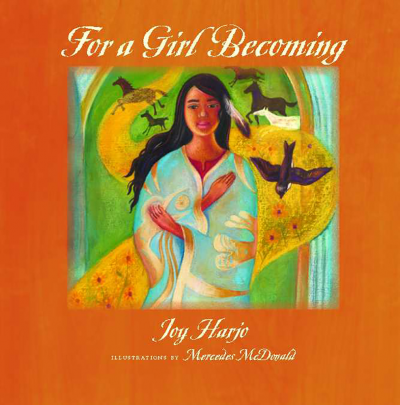
For a Girl Becoming
With its rich, symbolic artwork and captivating language, For a Girl Becoming is the perfect gift to recognize a birth, graduation, or any other significant moment in a young woman’s life. Not only for children, this lively and touching story speaks to that part in each of us who still stands at the door of becoming.

Part of our award-winning Sun Tracks series, For A Girl Becoming is the winner of several awards. Launched in 1971, Sun Tracks was one of the first publishing programs to focus exclusively on the creative works of Native writers. The series includes more than eighty volumes of poetry, prose, art, and photography by such distinguished artists, including Joy Harjo.

Secrets from the Center of the World
This is Navajo country, a land of mysterious and delicate beauty. “Stephen Strom’s photographs lead you to that place,” writes Joy Harjo. “The camera eye becomes a space you can move through into the powerful landscapes that he photographs. The horizon may shift and change all around you, but underneath it is the heart with which we move.” Harjo’s prose poems accompany these images, interpreting each photograph as a story that evokes the spirit of the Earth. Images and words harmonize to evoke the mysteries of what the Navajo call the center of the world.

Here’s the announcement of Harjo’s appointment on NPR: https://www.npr.org/2019/06/19/733727917/joy-harjo-becomes-the-first-native-american-u-s-poet-laureate

Here’s a link to The University of Arizona’s Poetry Center, where Harjo read from her work in 2016. https://poetry.arizona.edu/blog/vocalisms-2-joy-harjo

Above: Literary legends Allison Hedge Coke and Joy Harjo.

Celebrating UA Press: Past, Present, and Future

June 12, 2019

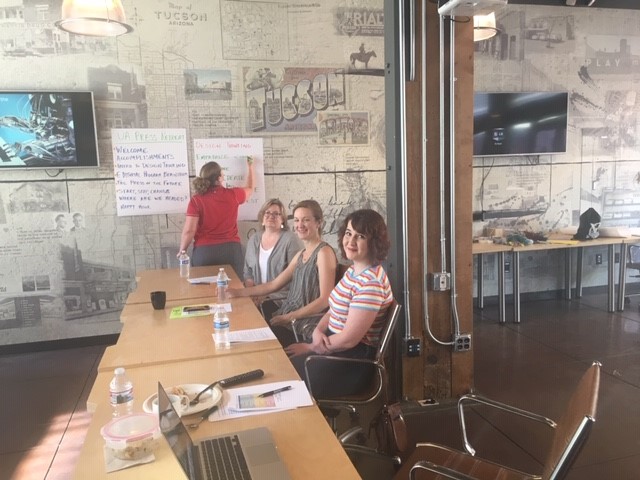
This week, our university press colleagues are gathering in Detroit for the annual Association of University Presses meeting where they are celebrating publishing successes and learning from each other about the important work of scholarly publishing. Just last week, the University of Arizona Press staff came together for its own celebration and brainstorming session.

Our hard-working staff of eleven put a pause on author meetings, copy editing, e-book making, and marketing to brainstorm and discuss the University of Arizona Press of the future.

It seems like the right moment.

This year marks sixty years of publishing in the Sonoran Desert. We are enjoying looking back and celebrating our growth and evolution into one of the premier scholarly presses in the Southwest. With sixty years of authors, editors, directors, advisory board member, peer reviewers, designers, booksellers, and, best of all, readers, there is so very much to be grateful for and celebrate.

Last week, we gathered in downtown Tucson for a day-long retreat, applying design-thinking practices to reflect and brainstorm around ideas of the UA Press of the future. The entire staff wholly and fully engaged in thoughtful and creative thinking. We asked ourselves provocative “what ifs.” Grounded in our mission to share scholarly communications and research, we proposed possible and even daring solutions that could continue to march that mission forward well into the future.

Every staff member is genuinely committed to continuing our growth and evolution. We are devoted to the legacies left to us by all who have worked for and supported the Press in the past.

After the retreat, our facilitator Shannon Jones wrote, “Watching you work as a dedicated, fun team was inspiring. Thank you for everything you are doing to make the Press such a valuable part of the UA and our community.”

To the University of Arizona Press past, present, and future, we celebrate your spirit, passion, commitment, and sense of community. Onward.

For Authors

The University of Arizona Press publishes the work of leading scholars from around the globe. Learn more about submitting a proposal, preparing your final manuscript, and publication.

Inquire

Requests

The University of Arizona Press is proud to share our books with readers, booksellers, media, librarians, scholars, and instructors. Join our email Newsletter. Request reprint licenses, information on subsidiary rights and translations, accessibility files, review copies, and desk and exam copies.

Request

Support the Press

Support a premier publisher of academic, regional, and literary works. We are committed to sharing past, present, and future works that reflect the special strengths of the University of Arizona and support its land-grant mission.

Give