Rosa’s Einstein is a Latinx retelling of the Brother’s Grimm’s Snow-White and Rose-Red, reevaluating border, identity, and immigration narratives through the unlikely amalgamation of physics and fairy tale. Using details both from Einstein’s known life and from quantum physics, Jennifer Givhan crafts a circus-like landscape of childhood trauma and survival.
Below, read an excerpt from a review of Rosa’s Einsteinin the Adroit Journal, written by poet and essayist Allison Bird Treacy.
Every culture has traditional stories, and every family has its lore. We depend on these narratives to make meaning, but there are times in our lives when we call on those stories with a greater desperation, particularly when faced with tragedy. This is the state of affairs in Jennifer Givhan’s new poetry collection, Rosa’s Einstein; disaster looms in the air in the form of the atomic bomb, but also in the form of more intimate losses. What’s truly magical about this collection is how Givhan brings the science underlying nuclear technology into the magical world of myth and fairytale. What her approach uncovers is their mutual uncertainty, what Albert Einstein might have called “spooky action at a distance”— a phrase he used to describe that which is real, but unbelievable. In Rosa’s Einstein, what’s imagined is more believable, more present in many ways. than what we name reality.
To enter the strange alchemy of Rosa’s Einstein, we could start in any number of places, but perhaps the most useful place to begin is with Los Alamos, with the Trinity Project and the invention of the atomic bomb. Its violence haunts these pages, and in “Field Trip: Lieserl Blanketed in Fallout, or Nieve,” Rosa, Givhan’s reinvention of Rose Red and Lieserl, Einstein’s missing daughter, venture into the mythos of that day:
At the nuclear museum we watched the Trinity test
the day the sun rose twice:

Nieve appeared in the mushroom cloud
above our rancho.

That's what I called her. I renamed her
Nieve, my Good sister, favored one.

Sometimes, we pretend the extra limbs
are here to comfort us, snow-white

branches growing from our sheets
like snowflake arms in sixfold radial symmetry.

Nothing's so fragile, so perfectly shaped, as melting.
Jennifer Givhan is an NEA Fellowship recipient and author of three previous collections of poetry. She teaches English at Western New Mexico University.
Northern Arizona University is rolling out a bachelor’s degree that focuses on criminal justice on tribal lands. The Indian Country Criminal Justice degree will look into the unique laws and institutions on tribal lands. Karen Jarratt-Snider, an associate professor and chair of the applied Indigenous studies department, says her department and the department of criminology and criminal justice created the degree together. She said it will combine existing courses from Indigenous studies, including federal tribal law, criminal jurisdictions and sovereignty, with the criminal justice curriculum…. read more
Karen Jarratt-Snider and Marianne O. Nielsen are the editors of the University of Arizona Press’s Indigenous Justice series, which focuses on issues of social and criminal justice, law, and environmental justice as they impact Indigenous North America (with occasional references to other Indigenous nations).
The series is intended for undergraduate and graduate students of Native American, American Indian, Alaskan Native, and Indigenous peoples’ justice issues; human rights, criminal justice and legal scholars; criminal justice and environmental professionals; and Indigenous community leaders.
With millions of acres burning in the Arctic, Amazon, and between California to the Gran Canaria, fire seems to be everywhere. Stephen Pyne recently posted a thoughtful essay on History News Network,from the George Washington University. Here’s a brief excerpt:
Winter Isn’t Coming. Prepare for the Pyrocene
by Steve Pyne
Millions of acres are burning in the Arctic, thousands of fires blaze in the Amazon, and with seemingly endless flareups in between, from California to Gran Canaria–fire seems everywhere, and everywhere dangerous and destabilizing. With a worsening climate, the fires dappling Earth from the tropics to the tundra appear as the pilot flames of an advancing apocalypse. To some commentators, so dire, so unprecedented are the forecast changes that they argue we have no language or narrative...read more.
Stephen Pyne is an emeritus professor at Arizona State University. He is the author of more than 30 books, mostly on wildland fire and its history but also dealing with the history of places and exploration, including The Ice, How the Canyon Became Grand, and Voyager. Most recently, he has surveyed the American fire scene with a narrative, Between Two Fires: A Fire History of Contemporary America, and a suite of regional reconnaissances, To the Last Smoke, all published by the University of Arizona Press.
In their new UA Press volume,Black Girl Magic Beyond the Hashtag, Julia S. Jordan-Zachery and Duchess Harris have compiled essays which dive deeply into twenty-first century acts of self-definition, especially that of Black femmes, girls, and women.Black Girl Magic Beyond the Hashtag shows how Black girls and women foster community, counter invisibility, engage in restorative acts, and create spaces for freedom. Intersectional and interdisciplinary, the contributions in this volume bridge generations and collectively push the boundaries of Black feminist thought.
“Jamila Woods, in her song “Blk Girl Soldier” (2016), sings of BlackGirlMagic. But what does it mean when we, self-identified Black femmes, girls, and women, invoke BlackGirlMagic? The term BlackGirlMagic is used across age, class, education, and other social identity markers. But it begs the question, what is BlackGirlMagic? Why do black femmes, girls, and women feel the need to consider themselves magical? What are we haunted by that is soliciting a response that asserts Black girls and women are magical? What ontological and epistemological questions does BlackGirlMagic pose? How does use of the term magic subvert Western thought that is grounded in positivism, rationalization, and empiricism? These are the questions that serve as the wellspring of this edited collection.
“Since introduced by Thompson in 2013, the term #BlackGirlMagic has been used widely, and it has become part of the lexicon of digital Blackness. To some extent, it has also become commodified (for example, by the selling of T-shirts and other merchandise). While the notion of BlackGirlMagic spreads in cyberspace and other places, the question remains: How is BlackGirlMagic experienced offline? The chapters that comprise this volume address this question. They move us beyond social media’s visual representations by offering analyses of the lived experiences of Black femmes, girls, and women, and how they negotiate the politics of invisibility through intracommunication methodologies in their efforts to arrive at self-definition and self-valuation and restoration. The chapters herein speak to how Black girls and women foster community, counter invisibility, engage in restorative acts, and create spaces for freedom. In essence, they show how Black femmes, girls, and women practice #BlackGirlMagic.
What the collection shows is that the labor required for success is not magical. It is real, and this labor can— and almost always does— exact a cost from those who might appear magical.
“By considering #BlackGirlMagic as an idea and an ideography, we are better positioned to understand how Black femmes, girls, and women perform magic. What the collection shows is that the labor required for success is not magical. It is real, and this labor can— and almost always does—exact a cost from those who might appear magical.
Deploying various qualitative approaches to unmask the essence of Black femmes’, girls’, and women’s perseverance against oppressive structures, the chapters in this volume paint a picture of the magic used by Black femmes, girls, and women. As they fight for recognition, and as they persevere against oppressive structures, the chapters show how the magic displayed in digital spaces such as Twitter is a combination of joy, pain, hope, fulfillment, anger, disillusionment, fatigue, and a commitment to justice and freedom. The term invokes how Black femmes, girls, and women live on the margins while also being insiders. It simultaneously emphasizes cultural specificity and difference, oppression and liberation. In a sense, #BlackGirlMagic is a mixture of the objective and the subjective. Additionally, it is both a discourse and performance. #BlackGirlMagic can be read as a political, cultural, and historical interpretation of Black femmes’, girls’, and women’s lives in relation, directly and indirectly, to Western philosophic thought. If read in this manner, #BlackGirlMagic is a form of resistance. The assertion of #BlackGirlMagic seeks to establish truth, order, and reality as understood from Black femmes’, girls’, and women’s perspectives.
Black girls and women are humans. That’s all we are. And it would be a magical feeling to be treated like human beings— who can’t fly, can’t bounce off the ground, can’t block bullets, who very much can feel pain, who very much can die.
Linda Chavers, 2016
“There is a pressing question that remains: Is #BlackGirlMagic an effective strategy of dissent from the dominant and oppressive structures faced by Black femmes, girls, and women? Some read #BlackGirlMagic as inclusive, as it does not rely on a prototypical Black femme, girl, or woman. But does it address the otherness faced by Black femmes, girls, and women across time and space? If so, how? We need to think through the limitations of #BlackGirlMagic as a cultural and political response to oppression faced by Black femmes, girls, and women. Not all Black women agree with this concept. Linda Chavers, trained at New York University and Harvard, wrote in Elle that Black girls aren’t magical, they are human (2016). Based on this analysis, we have to critically analyze which bodies are allowed to be centered in #BlackGirlMagic and how, for example, class, sexuality, and able-bodiedness influence such. Yes, #BlackGirlMagic serves to create ‘space for women [femmes and girls] of color to create and survive’ (Johnson and Nuñez 2015, 48). But who is allowed into that space? And who is not?T
The various themes that link the chapters that make up this edited volume bring us a little closer to answering these questions. As a collection, the chapters show how Black femmes, girls, and women choose to “gaze back” at neoliberalism and multiple, interlocking structures of oppression.
Julia S. Jordan-Zachery is a professor and chair in the Africana Studies Department at University of North Carolina at Charlotte. Her interdisciplinary research focuses on African American women and public policy. Jordan-Zachery currently serves as the president of the Association for Ethnic Studies.
_______________________________________
Duchess Harris is a professor of American studies at Macalester College. She is a scholar of contemporary African American history and political theory. She is the curator of the Duchess Harris Collection, which has more than sixty books written for third through twelfth graders.
Black Girl Magic Beyond the Hashtag belongs to the Feminist Wire Book Series. The Feminist Wire Books: Connecting Feminisms, Race, and Social Justice is a new series from The Feminist Wire (TFW) and the University of Arizona Press that presents a cultural bridge between the digital and printing worlds. These timely, critical books will contribute to feminist scholarship, pedagogy, and praxis in the twenty-first century.
University of Arizona Press author, Farid Matuk, is today’s featured poet on Poets.org. You can find his featured poem here.
Poem-a-day is the only digital series publishing new, previously unpublished work by today’s poets each weekday morning. This free series reaches 450,000+ readers daily.
Read Matuk’s most recent collection, The Real Horse, to immerse yourself in a text that Cathy Park Hong described as “tender, difficult, wondrous, and wise”.
People of the Press is back this week! Inspired by the Association of University Presses celebration of the people of AUPresses, we would also like to celebrate our dedicated publishing professionals throughout our 60th anniversary year.
I sometimes joke that my job as Director is to attend meetings and sign my name. But what I love most is finding partnerships with colleagues on campus and in the community.
How long have you worked at the UA Press?
Almost 25 years! So much has changed in that time about the way we disseminate scholarship and connect with readers that it never gets old.
The University of Arizona Press is committed to helping contribute to an informed society and enlightening readers. What’s one thing you’ve learned from your work?
That university press publishing attracts the most talented, dedicated, generous, passionate, community-minded professionals you can imagine.
What would people be surprised to learn about your work?
I think people would be surprised at the amount of labor it takes to make a book. Research has shown that the average cost of publishing and disseminating a high-quality peer-reviewed monograph ranges from $30,000 to $50,000. Most of that is in staff time— and it doesn’t even include the cost of print copies. But I think they would be equally surprised to know that on most days, that work feels like a privilege. We get to share the stories and scholarship of incredibly talented writers and experts and help them have an impact on the world.
Tucson has a thriving literary and scholarly community. What’s one of your favorite spots to hear authors, find a good book, or just curl up and read?
Nothing beats the Tucson Festival of Books for renewing one’s own excitement about books, authors, and this incredible literary community we live in. But for sitting down with a great book, I’ll take the back porch during a Tucson monsoon.
A sustained address to the poet’s daughter, The Real Horse takes its cues from the child’s unapologetic disregard for things as they are, calling forth the adult world as accountable for its flaws and as an occasion for imagining otherwise. Farid Matuk‘s interrogations of form cut a path through the tangle of a daughter’s position as a natural-born female citizen of the “First World” and of the poet’s position as a once-undocumented immigrant of mixed ethnicity. These luminously multifaceted poem sequences cast their lot with the lyric voice, trusting it to hold a space where we might follow the child’s ongoing revolution against the patrimony of selfhood and citizenship.
In the following excerpt, author Hilary Plum and poet Zach Savich dive deeply into The Real Horse, and discuss their thoughts and questions which arise from the text. You can find this review and discussion on West Branch, a thrice-yearly magazine of poetry, fiction, essays, and reviews.
“A hero’s pretty feet on her legs white hose skin exposed in sumptuous folds bound as freight on the back of this real horse running into its own outline.”
The questions of authenticity, representation (whose, of whom?), and legibility (to whom? saying what?) are the weighty and beautiful burden of this book, entangled ever with the cruel realities and constructions of race (the phrase “white enough” accumulates in devastating refrain). The couplet quoted above describes the stage actor Adah Menken (1835-1868), whose racial identity was a source of speculation and her own self-invention. Matuk considers her famous role as the “Cossack hero, Ivan Mazeppa”: “Each night on stage she covered her skin, though not her shape, in a pinkish white body stocking to play the culminating scene in which Mazeppa is stripped nude and bound, against a scrolling panorama, to a runaway horse.” There’s a real horse and fake nudity and flamboyantly performed race, of unknown “authenticity”; there’s a fake land in real motion. There are flesh and presence and life in their quickness, elusive amid inescapable representation and discursive force. Performances (Menken’s act; Homelands truest graffiti) may overflow the constraints of their stages, may claim sites of resistance, of “freedom, neither public nor private,” at least for a scrolling moment.
“Where does opposition go after it frames our beautiful camaraderie?” Matuk asks in a letter to his daughter that prefaces the book. “You show me that even if the outlines of our circumstance burn without consequence, we can tend at once to the plain moment and to material things and to the projections they bear.” Both things and the “projections they bear”; both the real horse and its outline. This book forms hope somewhere between reality and representation, in the quick movement of that opposition’s going, the horizon it’s heading toward. Read more.
Poet Farid Matuk
Farid Matuk is the author of the poetry collections This Isa Nice Neighborhood and The Real Horse. Born in Peru to a Syrian mother and Peruvian father, Matuk lived in the U.S. variously as an undocumented person, a “legal” resident, and a “naturalized” citizen. Matuk’s work has been recognized most recently with a New Works grant from the Headlands Center for the Arts and a Holloway Visiting Professorship at University of California, Berkeley.
Author Sergio Troncoso shared an op-ed on CNN todayabout his hometown El Paso and his parents’ hometown Juárez, Chihuahua.
(CNN)–I am and always will be the proud son of Mexican immigrants from El Paso. My parents came from Juárez, Chihuahua, to the United States in the 1950’s, newlyweds with on a few dollars in their pickets. In the east side of the neighborhood of Ysleta, they built an adobe house that at first… Read more.
People of the Press is back this week! Inspired by the Association of University Presses celebration of the people of AUPresses, we would also like to celebrate our dedicated publishing professionals throughout our 60th anniversary year.
Today, we’re featuring our Art Director, Leigh McDonald.
Hello Leigh, what do you do for the Press?
I am the Art Director for the UA Press. My role includes a wide variety of production and design work, including book cover design, typesetting and interior book design, and art management. I also work with our printers to choose formats and materials and get the books made.
How long have you worked at the UA Press?
A very lucky thirteen years!
The University of Arizona Press is committed to helping contribute to an informed society and enlightening readers. What’s one thing you’ve learned from your work?
One of my favorite things about working at the Press is that I get to learn a little bit about the wide variety of important scholarship we publish. Aside from staying current on the hottest topics in Anthropology or Border Studies, probably the best thing I have learned—and keep learning!—is what’s happening in the art world related to all these different disciplines. Whether I’m being introduced to an up-and-coming young Native painter or rediscovering some fascinating vintage Space art, our books keep me learning every day.
What would people be surprised to learn about your work?
Everybody loves books, but not many people think about the work that goes into them behind the scenes! Everything you see when you pick up a book, from the choice of paper stock and color to the font, margins, image placement…everything but the content was a decision made by someone like me.
Tucson has a thriving literary and scholarly community. What’s one of your favorite spots to hear authors, find a good book, or just curl up and read?
I do most of my book purchasing at either Bookmans or Antigone,
but to just curl up and read there’s nothing like enjoying the shade of a tree
in a nearby park.
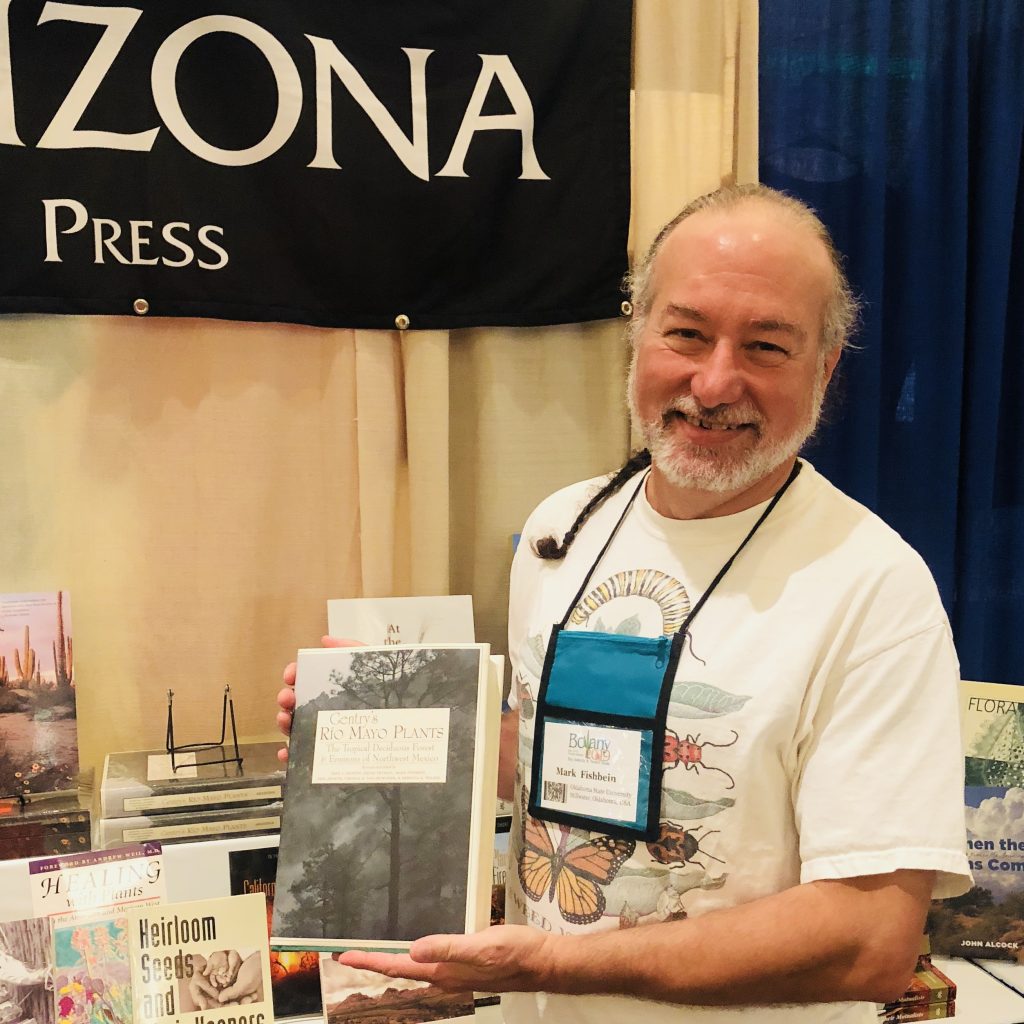
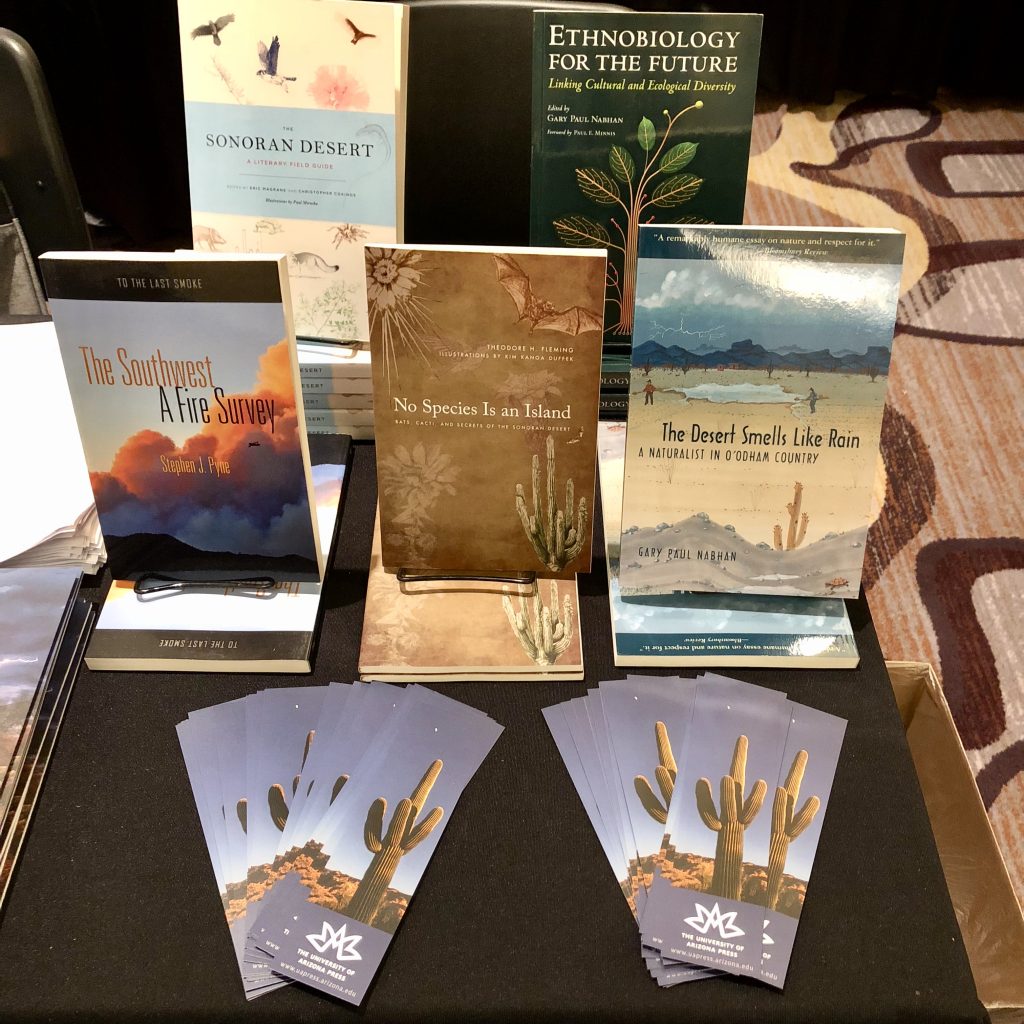
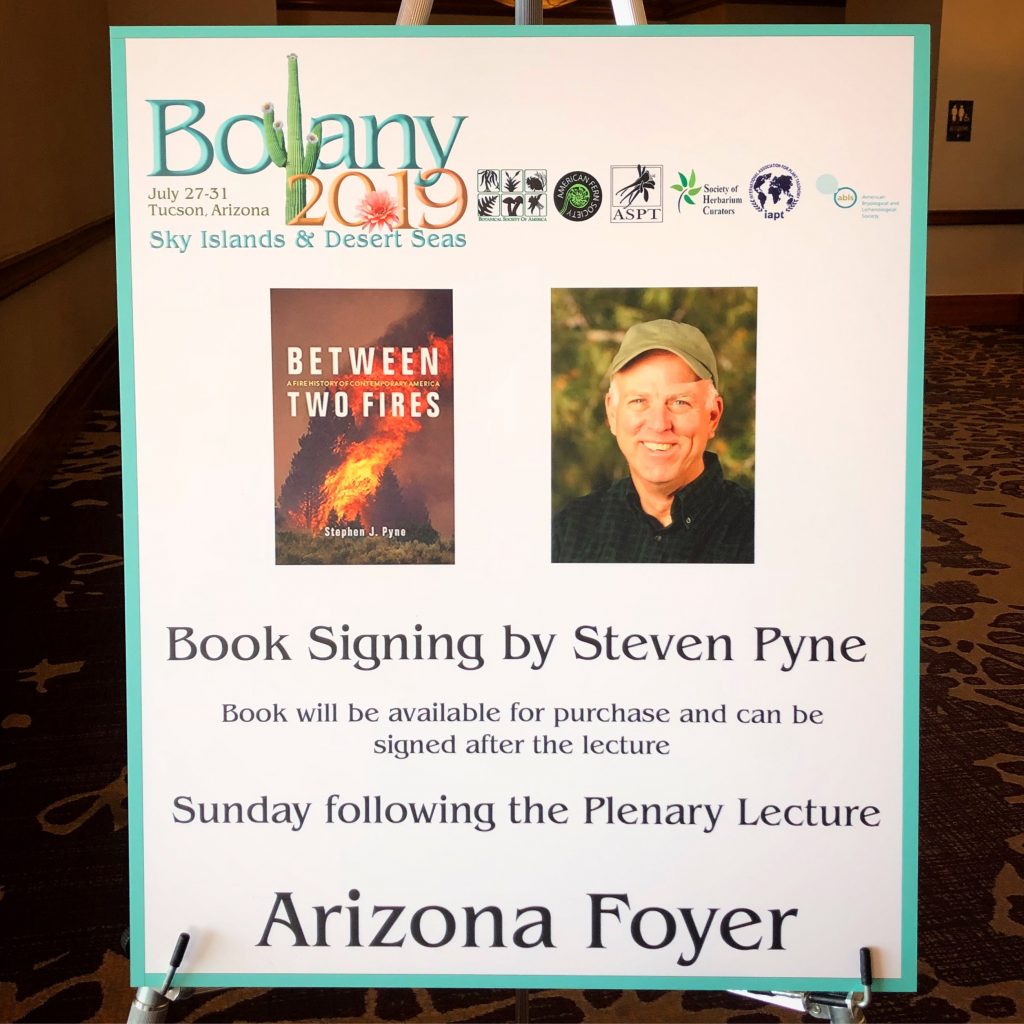
This week, we attended the 2019 Botany Conference in Tucson. We had a wonderful time meeting botanists and plant enthusiasts from far and wide, and sharing our books on the Sonoran desert and other regions. We were also thrilled that one of our authors, Stephen Pyne, was the plenary speaker for the conference and spent an evening signing his UA Press books, such as Between Two Fires. Thank you to all of the Botany 2019 attendees for visiting our beautiful desert home and stopping by the UA Press booth to look at our books!
The University of Arizona Press publishes the work of leading scholars from around the globe. Learn more about submitting a proposal, preparing your final manuscript, and publication.
The University of Arizona Press is proud to share our books with readers, booksellers, media, librarians, scholars, and instructors. Join our email Newsletter. Request reprint licenses, information on subsidiary rights and translations, accessibility files, review copies, and desk and exam copies.
Support a premier publisher of academic, regional, and literary works. We are committed to sharing past, present, and future works that reflect the special strengths of the University of Arizona and support its land-grant mission.
 The University of Arizona Press