Stephen Pyne’s Op-Ed in The Los Angeles Times Warns of a Wildfire Contagion

August 25, 2020

Stephen Pyne’s Op-Ed in The Los Angeles Times addresses the current wildfire explosion in California and across the globe in recent times, offering a warning of the very fire-inflicted future ahead of us.

“The big payoff against contagion comes from systemic preparations. Emergency medicine can cope with a coronavirus surge only if other work flattens the curve of infection. Emergency firefighting can cope with outbreaks on the scale of California’s only if we address that fraction of climate, fuels and ignitions that remain within our reach.

We can eliminate obvious points of contact, such as powerline failures during Santa Ana and Diablo winds. We must tend to landscapes with pre-existing conditions — drained by drought, covered in feral fuels, buffeted by high winds — that can push mundane outbreaks toward lethal outcomes. We must promote community fire-wellness programs and practice routine watchfulness to reduce vulnerability.”

Read the entire piece here.
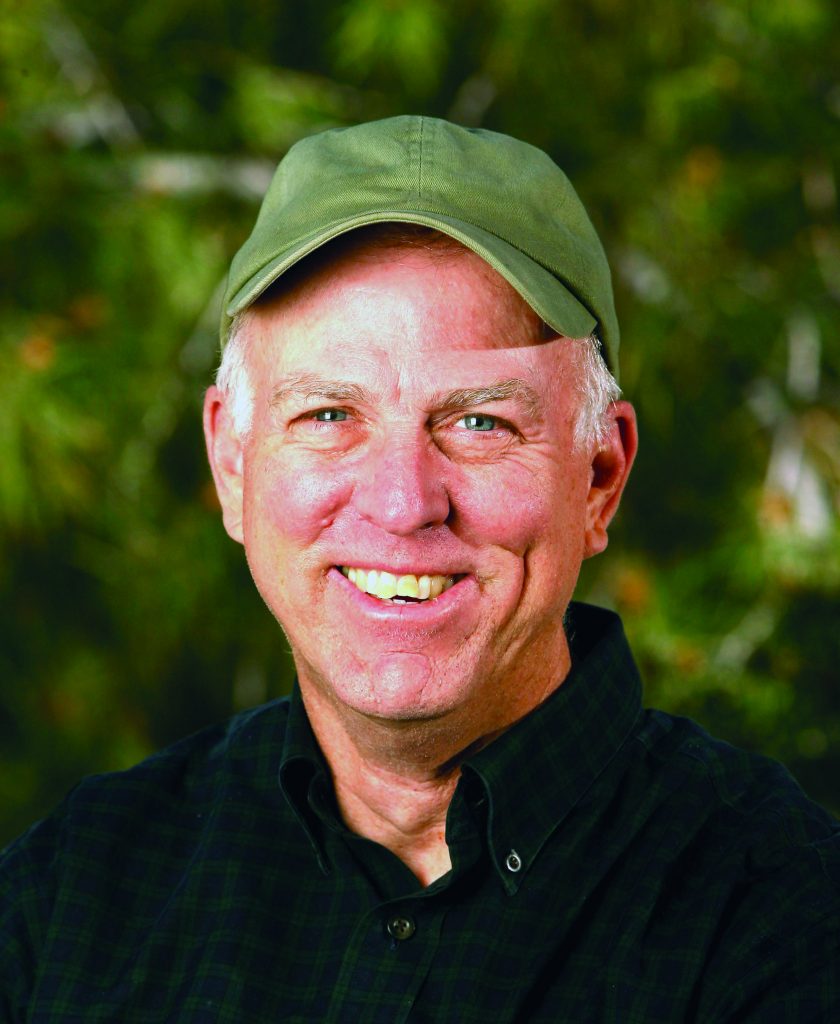
Stephen J. Pyne is an emeritus professor at Arizona State University. He is the author of more than 30 books, mostly on wildland fire and its history but also dealing with the history of places and exploration.
_________________________________

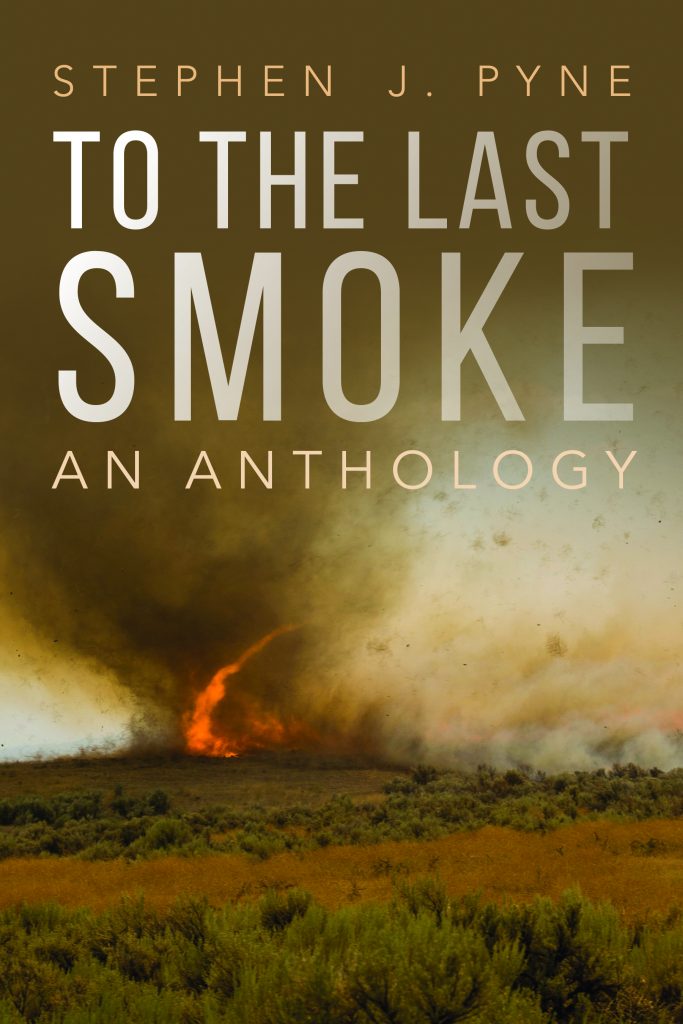
Pyne’s latest volume with the University of Arizona Press is To the Last Smoke, which offers a unique and sweeping view of the nation’s fire scene by distilling observations on Florida, California, the Northern Rockies, the Great Plains, the Southwest, the Interior West, the Northeast, Alaska, the oak woodlands, and the Pacific Northwest into a single, readable volume. The anthology functions as a color-commentary companion to the play-by-play narrative offered in Pyne’s Between Two Fires: A Fire History of Contemporary America. The series is Pyne’s way of “keeping with it to the end,” encompassing the directive from his rookie season to stay with every fire “to the last smoke.”
See the Conversation: Beaule and Douglass Discuss ‘Global Spanish Empire’

August 20, 2020

On August 15, more than 200 peopled tuned in to watch editors Christine Beaule and John G. Douglass discuss their edited volume The Global Spanish Empire: Five Hundred Years of Place Making and Pluralism, a free virtual lecture offered by the Amerind Foundation.

Watch the video.

The Global Spanish Empire tackles broad questions about indigenous cultural persistence, pluralism, and place making using a global comparative perspective grounded in the shared experience of Spanish colonialism. Through an expansive range of essays that look at Africa, the Americas, Asia, the Caribbean and the Pacific, this volume brings often-neglected regions into conversation.

Viewers of the virtual conversation will learn about several key topics in the book, including the role of place-making in Spanish colonialism, the role of pluralism in the colonial experiment, and gain new understanding of Indigenous-Spanish interactions. Beaule and Douglass also explain how their Amerind Studies in Anthropology series book (published by the University of Arizona Press) came together.

To see upcoming Amerind events, please visit the foundation’s website.

Meditación Fronteriza Nominated as a Finalist for the International Latino Book Award

August 20, 2020

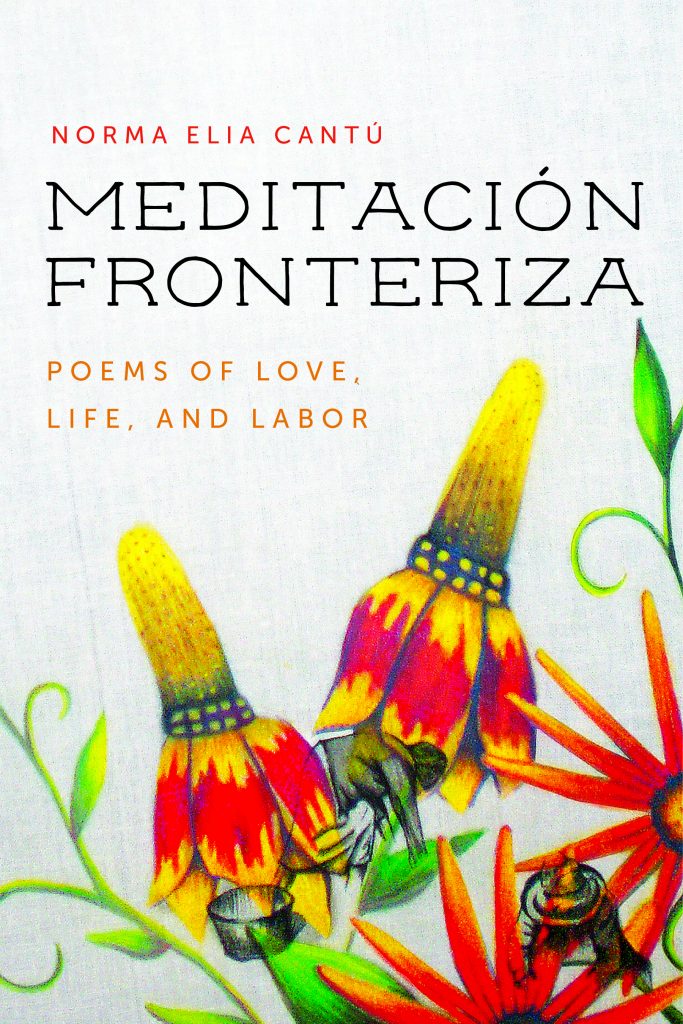
We are thrilled to announce that Meditación Fronteriza by Norma Elia Cantú is a finalist for the International Latino Book Awards Juan Felipe Herrera Poetry Book section! At the Virtual Awards Ceremony on September 12, the first, second, and honorable mention will be announced. The virtual and free program starts with entertainment at 2:30pm Pacific Time and the ceremony begins at 3:00 pm Pacific Time. Visit the International Latino Book Awards website for more details.

“Again, healer, teacher, foremother Norma Cantú stitches together the art of documentation. Here, she weaves together mediations on the literal/spiritual/intellectual/metaphorical borderlands. A gathering of love poems carving a space to grieve and to celebrate, these poems honor the land, the people in it, and women’s bodies in bloom and in decay in all the places we exist and in all our forms—algebra teachers and poets and pecan shellers and lovers. Like the tendrils of a vine, each poem sprouts its own delicate truth.”—Laurie Ann Guerrero

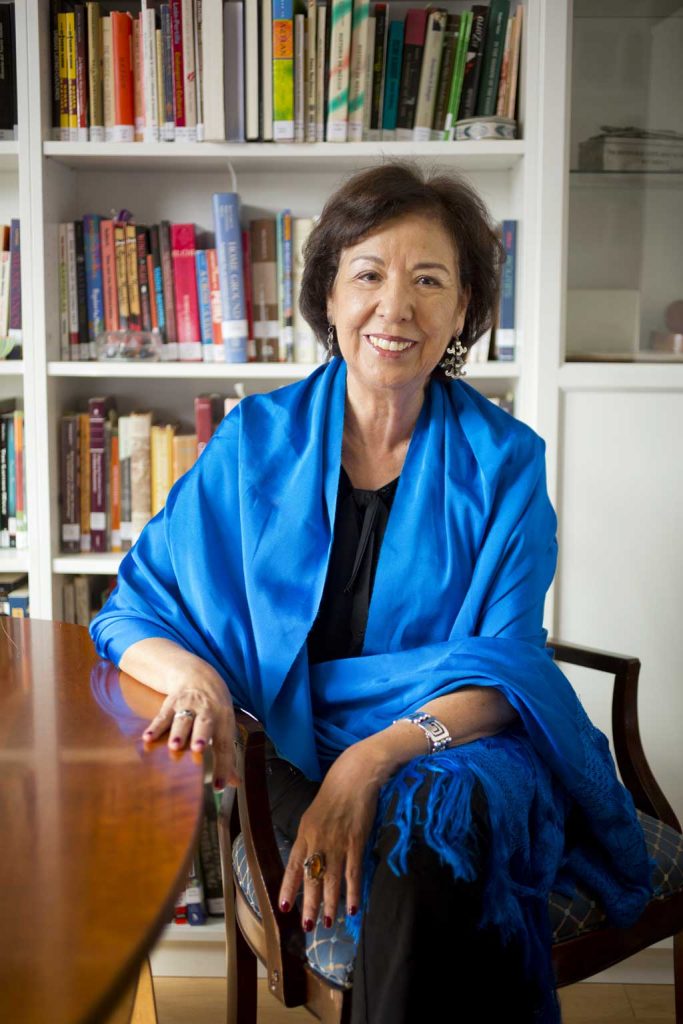
Norma E. Cantú is a scholar-activist who currently serves as the Norine R. and T. Frank Murchison Professor of the Humanities at Trinity University. She is founder and director of the Society for the Study of Gloria Anzaldúa. She has published fiction, poetry, and personal essays in a number of venues.

Congratulations on this wonderful news, Norma!

Gloria E. Anzaldúa Reads Uncollected and Unpublished Poems in 1991 Recording

August 14, 2020

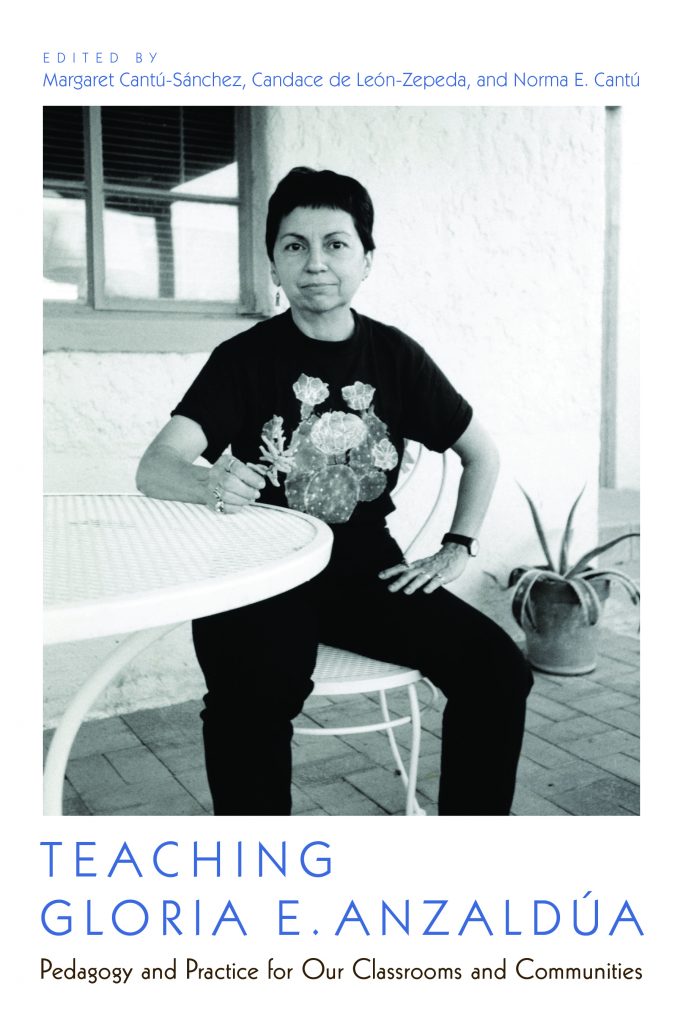
We are so thrilled to share a new volume with you, Teaching Gloria E. Anzaldúa, this season! We thought this reading from Gloria herself was incredible, so we wanted to share it with you. This reading is available thanks to voca, the University of Arizona Poetry Center’s online audiovisual archive of more than 1,000 recordings of poets reading their work during visits to the Center between 1963 and today. Listen here.

Gloria Evangelina Anzaldúa—theorist, Chicana, feminist—famously called on scholars to do work that matters. This pronouncement was a rallying call, inspiring scholars across disciplines to become scholar-activists and to channel their intellectual energy and labor toward the betterment of society. Scholars and activists alike have encountered and expanded on these pathbreaking theories and concepts first introduced by Anzaldúa in Borderlands/La frontera and other texts.

Teaching Gloria E. Anzaldúa is a pragmatic and inspiring offering of how to apply Anzaldúa’s ideas to the classroom and in the community rather than simply discussing them as theory. The book gathers nineteen essays by scholars, activists, teachers, and professors who share how their first-hand use of Anzaldúa’s theories in their classrooms and community environments.

Urayoán Noel Featured on the Poetry Centered Podcast

August 13, 2020

Poetry Centered features curated selections from voca, the University of Arizona Poetry Center’s online audiovisual archive of more than 1,000 recordings of poets reading their work during visits to the Center between 1963 and today. In each episode, a guest poet introduces three poems from voca, sharing their insights about the remarkable performances recorded in our archive. Each episode concludes with the guest poet reading a poem of their own. Our inaugural season includes episodes hosted by Hanif Abdurraqib, Alison Hawthorne Deming, Ada Limón, Urayoán Noel, Maggie Smith, and TC Tolbert.

In this episode, Urayoán Noel introduces recordings of Ai engaging with war through necessary fury (“The Root Eater”), Lehua M. Taitano composing a lifeline to communities living with the legacies of colonialism (“A Love Letter to the Chamoru People in the Twenty-first Century”), Ofelia Zepeda on the untranslatability of song (“Ñeñe’i Ha-ṣa:gid / In the Midst of Songs”), and a fable of radical imagination by Gloria E. Anzaldúa (“Nepantla”). Noel ends the episode with his poem “Molecular Modular,” built around open-ended questions considering virality and modes of community.

Urayoán Noel is the author of Buzzing Hemisphere/ Rumor Hemisférico, a playful and irreverent mash-up of voices and poetic traditions from across the Americas, which imagines an alternative to the monolingualism of the U.S. literary and political landscape, and proposes a geo-neuro-political performance attuned to damaged or marginalized forms of knowledge, perception, and identity. Urayoán Noel has been a fellow of CantoMundo and the Ford Foundation, and he is currently the poetry editor of NACLA Report on the Americas. Born in San Juan, Puerto Rico, Noel lives in the Bronx and is an assistant professor of English and Spanish at New York University.

Keep an eye out on our website for a forthcoming collection from Urayoán Noel!

Fred Arroyo and Daniel Chacón Share Their Work And Writing Life

Aug. 14, 2020

We recently brought authors Fred Arroyo and Daniel Chacón together for an online event that turned into a creative writing and philosophy cocktail. In other words, it was super cool.

Arroyo and Chacón also read excerpts from their recent University of Arizona Press books — Sown in Earth and Kafka in a Skirt.

Arroyo, in Sown in Earth, recounts his youth through beautiful lyrical prose to humanize and immortalize the hushed lives of men like his father, honoring their struggle and claiming their impact on the writers and artists they raised. Chacón’s Kafka, his first book with the Press, is a short-story collection set in El Paso and other Latinx-dominant urban spaces disregarding boundaries and transporting readers into a world merely parallel to our own.

We are grateful to the authors for their time.

Bundle Sale: 20% Off Print Books & the E-Book Free

August 13, 2020

Now through the end of the month, we’re offering a bundle sale perfect for stocking up for the semester! We are offering 20% off titles, plus you can add the e-Book free with code AZBUNDLE in our shopping cart.

Every print book is available at 20% off with this code, but unfortunately not all University of Arizona Press books are available in e-Book format. To find out how you can help us digitize more of our backlist, please visit our Support page.

Reel Latinxs Nominated as a Finalist for the International Latino Book Award

August 20, 2020

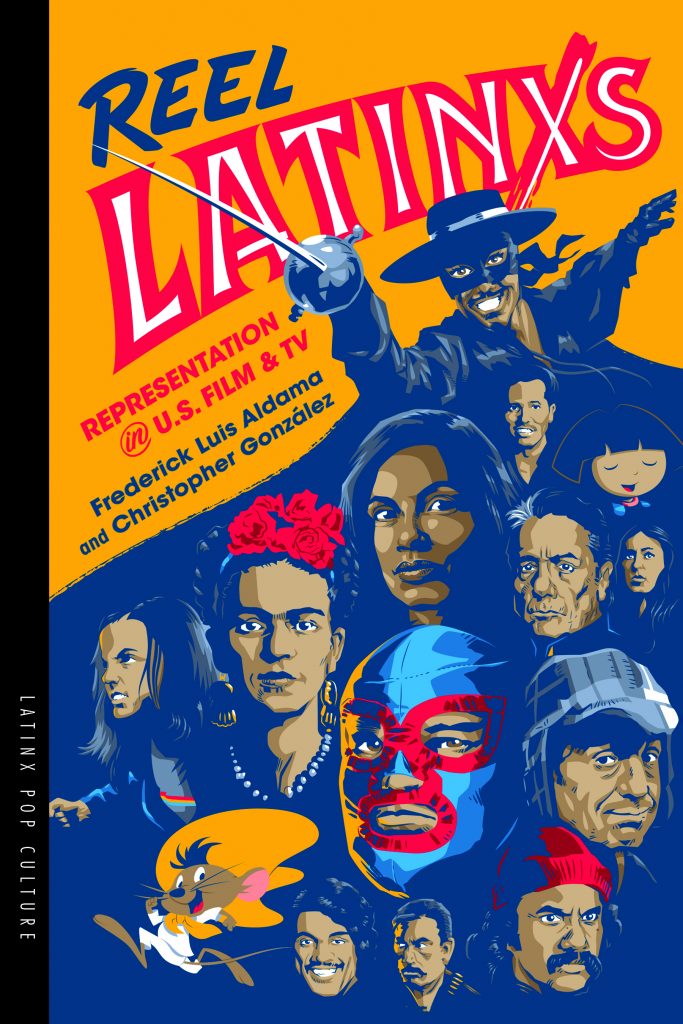
We are thrilled to announce that Reel Latinxs by Frederick Luis Aldama and Christopher González is a finalist for the International Latino Book Awards Best Nonfiction— Multi-Author section! At the Virtual Awards Ceremony on September 12, the first, second, and honorable mention will be announced. The virtual and free program starts with entertainment at 2:30pm Pacific Time and the ceremony begins at 3:00 pm Pacific Time. Visit the International Latino Book Awards website for more details.

In Reel Latinxs, Aldama and González blaze new paths through Latinx cultural phenomena that disrupt stereotypes, breathing complexity into real Latinx subjectivities and experiences. In this grand sleuthing sweep of Latinx representation in mainstream TV and film that continues to shape the imagination of U.S. society, these two Latinx pop culture authorities call us all to scholarly action.

Frederick Luis Aldama is University Distinguished Professor, Arts & Humanities Distinguished Professor of English, University Distinguished Scholar, and Alumni Distinguished Teacher at The Ohio State University. He is the 2018 recipient of the Rodica C. Botoman Award for Distinguished Teaching and Mentoring and the Susan M. Hartmann Mentoring and Leadership Award. He is the award-winning author, co-author, and editor of more than forty books. He is editor and co-editor of eight academic press book series as well as editor of Latinographix, a trade press series that publishes Latinx graphic fiction and nonfiction.

Christopher González is an associate professor of English and director of the Latinx Cultural Center at Utah State University in Logan, Utah.

Congratulations, Frederick and Christopher!

Alberto Álvaro Ríos Talks Poetry, Fiction, And Border Life In Recent Interview

August 7, 2020

In a recent interview with the SanTan Sun News, Arizona Poet Laureate Alberto Álvaro Ríos talks about poetry, and his new book with the University of Arizona Press:

A Good Map of All Things” has a similar theme and the story takes place just south of the border, in northern Sonora.

“It’s a compendium of all the small towns that I grew up either visiting or hearing about or my great aunts lived in,” he said. “There is no one main character; the town itself is the character. Everybody comes in and they tell their story, creating again their own community. There’s no one way to describe their community. Everybody has their version.”

Rios values the lifelong experience that makes us singular as authors and poets. 

“We each, every one of us as human beings, have an innately particular story to tell,” he said.

Read the entire interview here.

Fonseca-Chávez On NPR Urges Reflection On Southwest Colonial History

August 6, 2020

University of Arizona Press author Vanessa Fonseca-Chávez was recently on NPR affiliate KJZZ discussing the Confederate monument removals and the monuments recently removed in New Mexico of Spanish conquistador Juan de Oñate:

… it’s complicated because the issue with the Oñate statues is that they were met with protests from the moment that they were going up. And the larger argument that I make with that is the funding that’s attached to these almost are always people of, you know, people that want to celebrate this legacy. People that are from a different sort of socioeconomic status. Even the statue in El Paso, for example, which is the largest equestrian statue in the world, this was put up after the one that went up in Alcalde, New Mexico, after the one that went up in Albuquerque. And so it’s sort of just interesting to think about, you know, if the argument is that these statues really celebrate our history, how many statues do you want? And are you willing to listen to detractors or folks that feel differently about that history. If you’re not willing to listen to that, but you’re also part of the socioeconomic class that can make it happen, then that’s where sort of the power imbalance happens when you’re really talking about whether or not this is OK.

Fonseca-Chávez’s new book, Colonial Legacies in Chicana/o Literature and Culture, exposes the ways in which colonialism is expressed in the literary and cultural production of the U.S. Southwest, a region that has experienced at least two distinct colonial periods since the sixteenth century.

To listen or read the full interview with Fonseca-Chávez, go here.

For Authors

The University of Arizona Press publishes the work of leading scholars from around the globe. Learn more about submitting a proposal, preparing your final manuscript, and publication.

Inquire

Requests

The University of Arizona Press is proud to share our books with readers, booksellers, media, librarians, scholars, and instructors. Join our email Newsletter. Request reprint licenses, information on subsidiary rights and translations, accessibility files, review copies, and desk and exam copies.

Request

Support the Press

Support a premier publisher of academic, regional, and literary works. We are committed to sharing past, present, and future works that reflect the special strengths of the University of Arizona and support its land-grant mission.

Give