April 11, 2023

We were thrilled to see so many authors and volume editors stop by our booth at the Society of American Archaeology meeting in Portland earlier this month. If you weren’t able to stop by, there’s still time to order our archaeology titles. For 30% off and free shipping in the continental U.S. use discount code AZSAA23 at checkout in our website shopping cart. The discount ends 5/5/23.

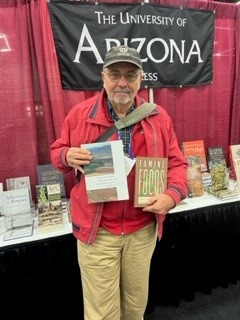
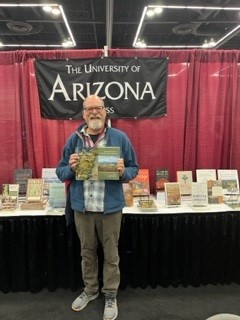
Author Paul Minnis with his works The Neighbors of Casas Grandes and Famine Foods.
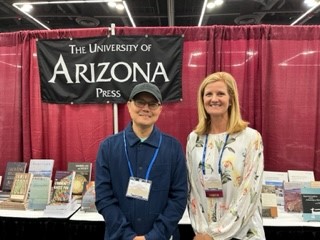
Stephen Acabado, co-author of Indigenous Archaeology in the Philippines, and Allyson Carter, Senior Editor
John G. Douglass with his works The Global Spanish Empire and Forging Communities in Colonial Alta California
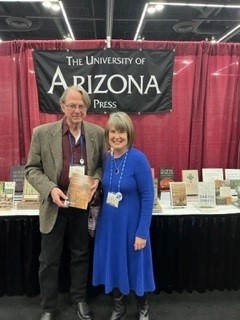
Randal H. McGuire, co-editor of The Border and Its Bodies, and Ruth M. Van Dyke, editor of Practicing Materiality
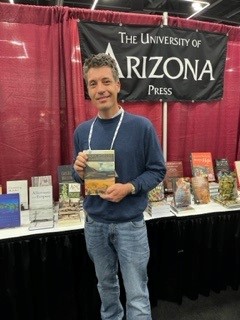
Samuel Duwe, author of Tewa Worlds and co-editor of Continuous Path
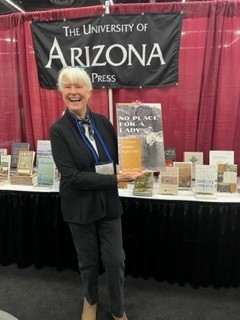
Shelby Tisdale, author of the forthcoming work No Place for a Lady
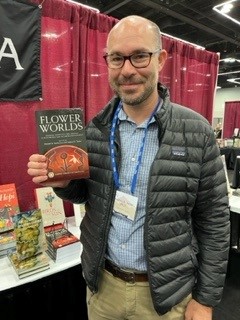
Andrew Turner co-editor of Flower Worlds
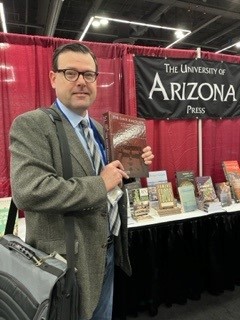
Patrick D. Lyons, editor of The Davis Ranch Site
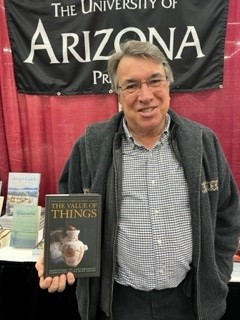
Thomas H. Guderjan, co-editor of The Value of Things
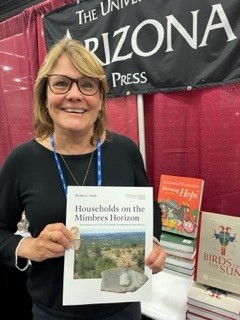
Barbara J. Roth with her new work Households on the Mimbres Horizon
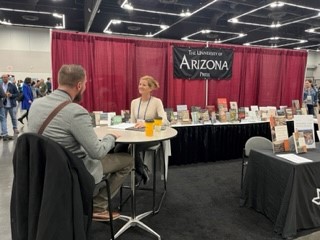
Allyson Carter, senior editor, meets with authors. If you have publishing questions about your archaeology manuscript, email her at acarter@uapress.arizona.edu.

UA Press earns three PubWest design awards

February 8, 2023

Congratulations to The University of Arizona Press Editorial Production and Design team: Amanda Krause, Leigh McDonald, and Sara Thaxton! Because of their amazing creativity and dedication to excellence, the team received three awards for book design at The Publishers Association of the West’s (PubWest) 2023 conference.

UA Press designers dominated the podium in the category of Short Stories/Poetry/Anthologies. Raven’s Echo by Robert David Hoffmann, won gold. Cardinal in My Window with a Mask on Its Beak, by Carlos Aguasaco won silver.

And just in time for the Tucson Gem and Mineral Show, the beautiful full-color Mineralogy of Arizona, Fourth Edition, by Raymond W. Grant, Ron Gibbs, Harvey Jong, Jan Rasmussen, and Stanley Keith, won silver in the Reference Book category.

PubWest is a national trade organization of publishers and of associated publishing-related members. The association presents annual design awards for book design, book cover design, and graphic novel design.

Ask UP & Ask the University of Arizona Press

September 15, 2022

We’re thrilled to announce that this fall the University of Arizona Press is hosting the Association of University Presses popular site Ask UP. The site is a resource for authors looking to learn more about scholarly publishing, university presses, and the publishing process in general. Hosted each quarter by a different member of the AUP community, the University of Arizona Press looks forward to answering your questions!

In addition to an “Ask A Question” feature, the site also includes resources related to teaching, promotion, copyright and intellectual property, and preparing materials for publication. It also provides links to describe the life cycle of a book, from the perspective of a variety of university presses.

Learn more about Ask Up here.

Arizona Crossroads Series Launch

September 12, 2022

Below, find a recording of the Arizona Crossroads series launch. Arizona Crossroads explores the history of peoples and cultures, events and struggles, ideas and practices in the place we know today as Arizona. Open to any topic within any time period of Arizona history, the series will publish scholarship that is cutting-edge and innovative, yet generally accessible and readable to an educated general audience. We are open to a variety of book formats: monographs, multi-authored works, and edited collections, as well as broader more synthetic works. Interdisciplinary projects that engage the past are encouraged.

Learn more about Arizona Crossroads here.

Learn more about the Arizona Historical Society here.

Many thanks to David Turpie, Vice President of Education, Exhibitions, and Publications at the Arizona Historical Society; Kristen Buckles, Editor-in-Chief at the University of Arizona Press; and the Arizona Crossroads series editors: Katherine G. Morrissey, Eric V. Meeks, and Anita Huizar-Hernández for joining us for this discussion!

New Lit Hub Series Features Two University of Arizona Press Titles

August 11, 2022

A new Lit Hub series by Diana Arterian features books currently on poet Tatiana Luboviski-Acosta’s night stand, which happens to include two University of Arizona Press titles, Decolonizing Latinx Masculinities co-edited by our Latinx Pop Culture series editors Frederick Luis Aldama and Arturo J. Aldama, and Rewriting the Chicano Movement: New Histories of Mexican American Activism in the Civil Rights Era co-edited by Mario T. García and Ellen McCracken.

On Decolonizing:

Considering the attention Luboviski-Acosta gives to gender in their work, it’s not surprising there are multiple texts that address it directly in their pile. This edited collection considers more specifically the cultural impacts of capitalism in conjunction with Latinx masculinity (what’s been fed to us on television and film for decades, what pops up on social media). Beyond this, however, some of the contributors explore the nourishing and “healing masculinities,” including queer Latinx rodeos, food, music, and more.

On Rewriting:

As the title suggests, this collection of essays attempts to give further nuance to the most powerful civil rights work enacted by Mexican Americans up until that time in the United States. “The essays in this volume broaden traditional views of the Chicano Movement that are too narrow and monolithic,” as the book’s description states. Also known as “El Movimiento,” the Chicano Movement involved thousands of activists fighting for civil rights denied them since the end of the Mexican-American War in 1848, and claiming Chicano identity as one of empowerment. The contributors to this collection give insight into the many varied members and methods of activism otherwise left out of the history books.

Read the entire story here.

This is Tucson Summer Reading Challenge Includes Four University of Arizona Press Books

July 25, 2022

Big thanks to the Arizona Daily Star‘s This is Tucson for including four University of Arizona Press books and authors in its summer reading challenge.

Press books featured:

When It Rains: Tohono O’odham and Pima Poetry edited by Ofelia Zepeda, “When it was first released in 1982, ‘When It Rains’ was one of the earliest published literary works in the O’odham language. Speakers from across generations shared poems that showcased the aesthetic of the written word and aimed to spread interest in reading and writing in O’odham. The poems capture brief moments of beauty, the loving bond between family members, and a deep appreciation of Tohono O’odham culture and traditions, as well as reverent feelings about the landscape and wildlife native to the Southwest. A motif of rain and water is woven throughout the poetry in ‘When It Rains,’ tying in the collection’s title to the importance of this life-giving and sustaining resource to the Tohono O’odham people. With the poems in both O’odham and English, the volume serves as an important reminder of the beauty and changeability of the O’odham language.”

The Desert Smells Like Rain: A Naturalist in O’odham Country by Gary Paul Nabhan, “This year marks the book’s 40th anniversary. On Aug. 30, the University of Arizona Press will publish a special 40th anniversary edition of the book, complete with a new introduction by Nabhan dedicated to the O’odham people who changed his life.”

Sowing the Seeds of Change: The Story of the Community Food Bank of Southern Arizona, by Seth Schindler, “This is the story of a remarkable organization’s sustained, compassionate response to a problem of staggering proportions: there are about 35 million food-insecure people in America today. The numbers are no less shocking in Southern Arizona: one in six residents, and one in four children, are food insecure. How can this be in the richest country in the world? This book explores that paradox and the innovative solutions that one organization has developed to create a healthier, more secure tomorrow for the less fortunate among us. The Community Food Bank of Southern Arizona (CFB) is one of the oldest and most respected food banks in America. It is a widely recognized leader not simply in providing hunger relief but in attacking the root causes of hunger and poverty through community development, education, and advocacy.”

Natural Landmarks of Arizona by David Yetman, “Natural Landmarks of Arizona celebrates the vast geological past of Arizona’s natural monuments through the eyes of a celebrated storyteller who has called Arizona home for most of his life. David Yetman shows us how Arizona’s most iconic landmarks were formed millions of years ago and sheds light on the more recent histories of these landmarks as well. These peaks and ranges offer striking intrusions into the Arizona horizon, giving our southwestern state some of the most memorable views, hikes, climbs and bike rides anywhere in the world. They orient us,  locate us, and they are steadfast through generations.”

To read the entire challenge, go here.

Farina King and Tai Edwards Receive 2022 AUPresses Stand UP Award

July 19, 2022

At last month’s Association of University Press (AUPresses) annual meeting, historians Farina King and Tai Edwards received the prestigious Stand UP Award for their work in defense of the University Press of Kansas.

The Stand UP Award honors those who through their words and actions have done extraordinary work to support, defend, and celebrate the university press community. The award is intended to recognize advocates who stand up from within the communities that presses work with, speak to, and serve.

King (Diné) is an associate professor of history at Northeastern State University in Tahlequah, Oklahoma, and the author of The Earth Memory Compass: Diné Landscapes and Education in the Twentieth Century (University Press of Kansas, 2018) and coauthor of Returning Home: Diné Creative Works from the Intermountain Indian School (University of Arizona Press, 2021).

Edwards is an associate professor of history and directs the Kansas Studies Institute at Johnson County Community College in Overland Park, Kansas, and is the author of Osage Women and Empire: Gender and Power (University Press of Kansas, 2018) as well as articles that have appeared in Kansas History and the Journal of American History.

Edwards and King were recognized for their powerful advocacy last year in support of the University Press of Kansas (UPK), a consortial press founded in 1946 and guided by a Board of Trustees comprised of the provosts of its six parent universities. Early in 2021, in light of budgetary impacts of the COVID-19 pandemic, this board initiated an independent review to propose direction for UPK’s future, including a consideration of closure. Specialists in Indigenous history who each had published their first books with UPK, Edwards and King sprang into action to advocate in tandem for this imperiled press, successfully rallying others through grassroots efforts and promoting the work of university presses in general.

“By keeping the challenges faced by UPK in national context, these two scholars helped many in our community have valuable conversations on our home campuses about the significance of institutional support for the important work that we do,” said Stand UP Award nominators Kelly Chrisman Jacques, UPK’s managing director, and Kathryn Conrad, director of the University of Arizona Press.

Read the complete announcement.

University of Arizona Press Announces New Series: Arizona Crossroads

July 18, 2022

The University of Arizona Press is thrilled to announce Arizona Crossroads, a new series celebrating Arizona’s history in partnership with the Arizona Historical Society. For more info on the series, please visit the series page here.

Throughout its history, Arizona has long served as a crossroads between Native peoples, settler colonists, and immigrants from around the world. It has been a contested site among peoples, nations, and empires; it is also a place where events, decisions, and struggles have had far-reaching consequences beyond its shifting borders. As the series title suggests, series editors Anita Huizar-Hernández, Eric V. Meeks, and Katherine G. Morrissey, welcome books that deepen our understanding of Arizona as a diverse crossroads and meeting ground within broad national and transnational contexts, whether topical, thematic or geographic (the region, the nation, the borderlands).

Open to any topic within any time period of Arizona history, the series will publish scholarship that is cutting-edge and innovative, yet generally accessible and readable to an educated general audience. We are open to a variety of book formats: monographs, multi-authored works, and edited collections as well as broader more synthetic works. Interdisciplinary projects that engage the past are encouraged.

Series editors:

Anita Huizar-Hernández is Associate Professor of Spanish in the School of International Letters and Cultures at Arizona State University. She is a literary critic whose teaching and research focus on the literatures and cultures of the U.S.-Mexico borderlands with a particular emphasis on the Arizona borderlands. Her book, Forging Arizona: A History of the Peralta Land Grant and Racial Identity in the West (Rutgers 2019), examines a nineteenth-century land grant scheme in which a con artist falsified archives around the world to steal part of the Arizona and New Mexico Territories. Other publications include articles in the Journal of Arizona History, MELUS (Multi-Ethnic Literatures of the United States), SAIL (Studies in American Indian Literatures), and English Language Notes. Her current book project investigates the early-twentieth century writings of Mexican Catholic political exiles in the United States. She is also engaged in multiple digital public-facing projects centered in Arizona, including “Reporting on Race and Ethnicity in the Borderlands (1882-1924): A Data-Driven Digital Storytelling Hub” and “DETAINED: Voices from the Migrant Incarceration System.”

Eric V. Meeks is Professor of History at Northern Arizona University. His research and teaching focus primarily on the history of the US-Mexico borderlands and race and ethnicity in North America. His book, Border Citizens: The Making of Indians, Mexicans, and Anglos in Arizona, examines how racial classifications and identities of the diverse indigenous, mestizo, and Euro-American residents of Arizona’s borderlands evolved as the region was politically and economically incorporated into the United States. A new updated edition was published by University of Texas Press in 2020. Other publications include articles in the Journal of Arizona History, Western Historical Quarterly, Journal of the Southwest and the Latin American Research Review. His current book project is a history of the US-Mexico borderlands from the late eighteenth century to the present, under contract with Yale University Press in cooperation with the Clements Center for Southwest Studies at Southern Methodist University.

Katherine G. Morrissey is Department Head and Associate Professor of History at the University of Arizona. Her research and teaching focus on cultural, environmental, borderlands/Southwest and North American West history. Her books include Mental Territories: Mapping the Inland Empire and two co-edited books with the University of Arizona Press, Border Spaces: Visualizing the U.S.-Mexico Frontera, with John-Michael H. Warner and Picturing Arizona: The Photographic Record of the 1930s, with Kirsten Jensen. Publications also include book chapters as well as articles in the Journal of Arizona History, Pacific Historical Review, Global Environment, and Frontiers: A Journal of Women Studies. Her current book project, Visual Legacies: Reimagining the US/Mexico Borderlands, traces efforts to mark and visually represent the meanings of the border through the long 20th century. She is co-PI for the “Reporting on Race and Ethnicity in the Borderlands (1882-1924)” digital project.

To learn more, register for our virtual series launch on Friday, September 9, 2022, 12:30 p.m. For event info, go here. For questions or to submit a proposal, please contact University of Arizona Press Editor-in-Chief Kristen Buckles, kbuckles@uapress.arizona.edu.

Southwest Books of the Year 2022 Recognize University of Arizona Press Titles

February 11, 2022

Thank you to Pima County Public Library’s Southwest Books of the Year for once again choosing new titles from the University of Arizona Press: The Diné Reader: An Anthology of Navajo Literature, Becoming Hopi: A History, and Natural Landmarks of Arizona.

The Southwest Books of the Year are chosen by a panel of reviewers who examine new books focused on Southwest subjects or by Southwest authors. Pima County Public Library has published Southwest Books of the Year for more than four decades, helping us celebrate the best of literature, nonfiction, and regional books.

From Gregory McNamee on The Diné Reader:

… The editors of this splendid collection of Diné writing proceed in that spirit. Their pages are full of delights and surprises, beginning with excerpts from Blackhorse Mitchell’s Miracle Hill, which appeared a year before N. Scott Momaday’s House Made of Dawn, the novel credited with starting the modern Native literary renaissance. Many roads here lead to Luci Tapahonso, an inspiration to generations of Diné poets; the editors’ literary genealogies (with Esther Belin citing Nia Francisco as the first Diné writer she read) and interviews with writers lend special value to the collection. The Diné Reader belongs in every collection of Native American letters, and every Native literature deserves an anthology so thoughtful and well constructed.

Bruce Dinges chose Becoming Hopi:

The product of fifteen years of collaborative research among archaeologists, anthropologists, and tribal consultants conducted under the auspices of the Hopi Cultural Preservation Office, Becoming Hopi describes the dynamic evolution of society and culture from scattered precontact villages to large, complex, stable communities intimately connected to the land. Hopi resiliency, the authors convincingly argue, is a testament to the people’s adaptability to constant change and the expression of a lifeway that is always in the process of becoming. Appendices include site descriptions and maps, clan migration routes, and radiocarbon dates. To their credit, the contributors avoid academic jargon in an effort to make their conclusions accessible to a broad Native and non- Native audience. Fact-filled and lavishly illustrated, this landmark study sets an exemplary standard for future tribal histories.

Gregory McNamee chose Natural Landmarks of Arizona:

Arizona has a lot of mountains—3,928 of them, in fact, with nary a horizon without at least a peak or two. David Yetman, intrepid explorer and host of In the Americas, writes that he came to Arizona as a child from flatland New Jersey and, with brief sojourns here and there, has never left it, at least in part because of his fascination with our state’s geography and geology. In this compendium, he runs the mountainous gamut from Agathla, with its “touch of Mount Doom,” to Yarnell Hill, a good place to scope out the Harquahalas, which harbor the same geological sequence that can be seen in the Grand Canyon and which constitute “perhaps the Sonoran Desert’s most impressively purely desert range.” Geology is a notoriously difficult subject to write about, but Yetman—something of a landmark himself—handles it with skill and flair. Lovers of mountains, whether as things to climb or to behold, will delight in traveling alongside him.

Elizabeth Wilder Named Assistant Editor at University of Arizona Press

January 27, 2022

Elizabeth Wilder was recently named assistant editor in the University of Arizona Press’s Acquisitions Department. Wilder first joined the Press in April 2020 as editorial assistant.

As assistant editor, Wilder oversees the Press’s two award-winning literary series, Camino del Sol and Sun Tracks, the annual Ambroggio Prize, and supports the lists of the University of Arizona Press Editor-in-Chief Kristen Buckles. She holds a PhD in English from Stanford University.

For Authors

The University of Arizona Press publishes the work of leading scholars from around the globe. Learn more about submitting a proposal, preparing your final manuscript, and publication.

Inquire

Requests

The University of Arizona Press is proud to share our books with readers, booksellers, media, librarians, scholars, and instructors. Join our email Newsletter. Request reprint licenses, information on subsidiary rights and translations, accessibility files, review copies, and desk and exam copies.

Request

Support the Press

Support a premier publisher of academic, regional, and literary works. We are committed to sharing past, present, and future works that reflect the special strengths of the University of Arizona and support its land-grant mission.

Give