Five Questions with Reyes Ramirez

February 24, 2022

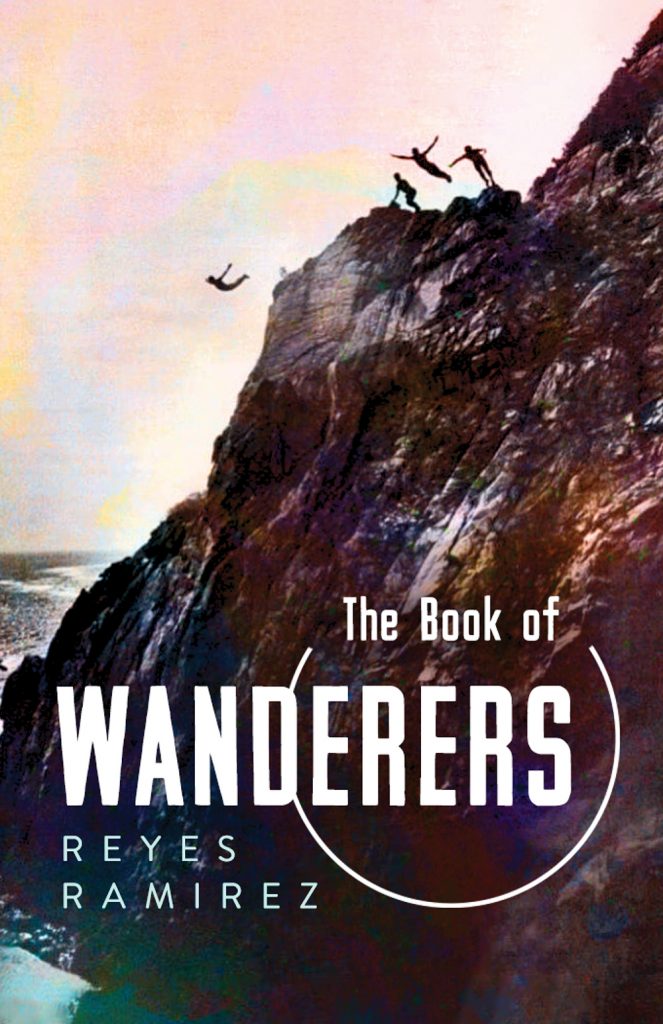
In Reyes Ramirez’s dynamic short story collection’s new lineages of Mexican and Salvadoran diasporas traverse life in Houston, across borders, and even on Mars. Themes of wandering weave throughout each story, bringing feelings of unease and liberation as characters navigate cultural, physical, and psychological separation and loss from one generation to the next in a tumultuous nation. The Book of Wanderers deeply explores Houston, a Gulf Coast metropolis that incorporates Southern, Western, and Southwestern identities near the borderlands with a connection to the cosmos. As such, each story becomes increasingly further removed from our lived reality, engaging numerous genres from emotionally touching realist fiction to action-packed speculative fiction, as well as hallucinatory realism, magical realism, noir, and science fiction.

Here are five questions from Reyes Ramirez on Houston, writing, and, of course, The Book of Wanderers:

Houston is home to The Book of Wanderers. Is there an otherworldly vibe in this Texas city we don’t know about?

Houston is one of the most diverse, if not the most diverse, cities in America; that along with being the fourth largest city in America in the crux of Southern, Southwestern, Western, and Borderlands identities along the Gulf Coast, you encounter some unique things that couldn’t exist anywhere else just by sheer probability, size, and historical precedence. You could drive down a street with a health clinic, an ice cream shop, a nail salon, a video store, a payday loan service, a bar, and a gun store next to each other and across the street have a row of restaurants from different nations, ethnicities, and combinations thereof that would make the United Nations blush. Meanwhile, a car with golden rims the size of a five-year-old child just cut you off and a horse stares at you from its trailer. It’s a blue city in a red state, meaning the person in the Prius you just parked next to blasting a chopped and screwed version of a new pop song, the one with a decal of an anime character and one of those equality bumper stickers, could be strapped with a .38 special revolver so you have to be careful since it’s 96 degrees as a hurricane makes landfall and the potable water you both came for is almost gone. I hope The Book of Wanderers captures as much of that as possible.

What influences do you turn to in your writing?

I love to draw from different sources, whether it be films, books, or personal experience, to inform my writing and individual projects. For example, anime was super influential to me growing up; the story “The Latinx Paradox within Joaquín Salvatierra” is heavily inspired by Gundam Wing and Neon Genesis Evangelion with their mecha suits and the use of young people to pilot them. This, in turn, is mixed with my exploration of scientific research that found Latinxs “live longer than Caucasians,” and my family’s history as being children during war. Roberto Bolaño’s 2666, Jean-Luc Goddard’s 2 or 3 Things I Know About Her, Laura Esquivel’s Like Water for Chocolate, historical research, and my own experiences cleaning houses and buildings with my mom growing up were some influences on and references for “The Many Lives and Times of Aransa de la Cruz.” Just all the things, really.

The Book of Wanderers and its characters are so cinematic. Is that something you’d like to see happen with these people, creatures and lives—have them on a big or small screen?

Films, TV shows, and video games are pretty important sources for me to draw from since they offer narratives through means unique from literature. For example, I originally saw “Xuxa, La Ultima” as a third-person video game in my head, informing much of the action and scope of the story. I could also see “Xitlali Zaragoza, Curandera” as a TV show where she solves spiritual and supernatural mysteries in each episode a la Yu Yu Hakusho or X-Files. I suppose “The Fates of Maximiliano Mondragón and Yzobeau Ponce Intersect in Acapulco” could be expanded into a noir parody/dramedy film directed by Pedro Almodóvar (I can dream!). But I think I’m too intimidated by the whole movie-making process. 

Do you have a favorite character in The Book of Wanderers that we might see again in another Reyes Ramirez book?

I don’t know if I have a favorite character since I imbue each one with a bit of me, whether it be through lived experiences, insecurities, hopes, or desires. I won’t say which is which, but an example I can give is that most of the characters have a unique and/or dramatic name that kind of mirror mine since I’ve always gotten comments on the peculiarity of my own. Many of the stories are written as snapshots in each character’s life since I wanted my characters to feel like full human beings, that what you’re seeing in each story is a defining moment with reverberations continuing off the page. In fact, there’s a version of ‘The Three Masks of Iturbide Villalobos’ as a 90-page novela! But I definitely see Xuxa in her own novel, traversing zombie-infested wastelands and encountering different communities to learn about, such as a settlement that worships turtles and how’d she be weirded out at first but grow to find it adorable. Or whatever.

What’s your dream for The Book of Wanderers? Do you have one?

To win all the awards and be loved by everyone! But seriously, I hope The Book of Wanderers is enjoyed by those looking for something unique in contemporary fiction, to affirm that there’s no one way to tell a story, that we as a community must continuously reflect on our past and know there’s no singular way to be. For example, the characters in The Book of Wanderers will speak in different ways, some purposefully outside conceptions of how we experience English, Spanish, Spanglish, all of it, because I want to disrupt the status quo of language in America. I hope that the playfulness in The Book of Wanderers with language, narrative, and form inspires someone to write their own ridiculous truths, to cast aside White ideations of ‘proper’ stories and speaking to create a work of their own, an unrestricted extension of their hopes and fears. My dream for The Book of Wanderers is to connect me to you and you to me, reader.

Five Questions with Wendy Shelly Greyeyes

January 25, 2022

On the heels of the fiftieth anniversary of the founding of the Department of Diné Education, A History of Navajo Nation Education explains how the current Navajo educational system is a complex terrain of power relationships, competing agendas, and jurisdictional battles influenced by colonial pressures and tribal resistance. In providing the historical roots to today’s challenges, Wendy Shelly Greyeyes clears the path and provides a go-to reference to move discussions forward. Today, Dr. Greyeyes answers our questions.

What inspired you to work on this book?

I worked for the Navajo Nation and one of the biggest challenges of my job was explaining what type of educational system is in place. There are many systems operating on the Navajo Nation and it gets confusing for families and for tribal leaders. I felt that a book was necessary to help clarify the history of education and how it has grown. I’ve also been fortunate to have worked with some amazing Navajo educational leaders and through much of the work, I also talk about how the Navajo Nation could unify a system that would be more meaningful for our students and community.

Why is Navajo education at a pivotal moment?

Navajo Nation has discussed the idea of unifying an educational system since the 1970s. We have been at a pivotal moment for nearly fifty years. The next step is getting the approval of the Navajo Nation council for a 638 plan that has been drafted and developed. But presently, the main driver of this movement had a lot of turnover with staffing. So it maybe a few more years before this action takes place.

What is the work that’s happening now for educational sovereignty?

Currently, Navajo Nation has been seeking a superintendent for a long time. They finally have found a leader that will drive this initiative forward, and we are looking forward to what the future holds for the Navajo Nation.

What is the lesson of this book?

I believe we should not be afraid of taking the power back from the federal government and the states that educate our children. We gave the right to educate our children with the treaty of 1868. We have the power and the authority to take it back.

What are you working on now?

I’m finishing up a co-edited book on the Martinez-Yazzie lawsuit, here in New Mexico. We have contributions from some of the great minds focused on Indian education and we hope this book comes out in 2023.

***

Wendy Shelly Greyeyes (Diné) is an assistant professor of Native American studies at the University of New Mexico and a former research consultant with the Department of Diné Education.

Five Questions with Seth Schindler

January 18, 2022

In Southern Arizona, one in six residents, and one in four children, are food insecure. The Community Food Bank of Southern Arizona (CFB) is one of the oldest and most respected food banks in America. It is a widely recognized leader not simply in providing hunger relief but in attacking the root causes of hunger and poverty through community development, education, and advocacy. In Sowing the Seeds of Change author Seth Schindler tells the story of this remarkable organization’s sustained, compassionate response to food insecurity. The success of the Community Food Bank of Southern Arizona demonstrates that the war against hunger, however difficult, is winnable. Today, author Seth Schindler answers five questions.

What drew you to the story of the CFB?

I realized that the story of the CFB was much bigger, more complex and intriguing than I originally thought. I learned about the enormity of the problem of food insecurity in the U.S. and in Arizona, which shocked me; then the surprising massive scale and diversity of the CFB’s operations throughout Southern Arizona; and finally its reputation as a national leader and innovator in the food bank movement, admired for its groundbreaking work in attacking the root causes of food insecurity. The zeal of staff, volunteers, and other participants in the CFB’s programs also impressed me. Finally, conversations with Charles “Punch” Woods, the CFB’s leader during the first decades of its evolution into the remarkable organization we know today, inspired me, convincing me that this was an engaging original story that needed to be told.

To my knowledge, there was no book about a food bank in the U.S. I hope that by writing one, I’ve helped illuminate the organizations like CFB that do such critical work!

How did the CFB get started?

The founders’ mission was an ambitious one—to end hunger in Tucson. They believed that the Food Stamp Program was poorly managed, that too many food-insecure people fell through the cracks, and that too much food was going to waste in the city. Mark Homan, Barry Corey, and Dan Duncan sensed that there had to be a more efficient way to distribute food and reach more of the hungry, as well as make better use of salvaged food.

Their strategy was two-fold: to distribute emergency food boxes (a three-day supply of the most basic food staples) through Tucson’s many nonprofits—both welfare and faith-based agencies—already serving the hungry; secondly, to make it as easy for individuals and commercial operators to donate the food as to throw it out.

The CFB began in a tiny primitive warehouse in South Tucson, with one employee, director Dan Duncan, one volunteer, Arnie Salverson, one delivery truck donated by a local business, a few boxes of canned food, and a $7,000 grant from the city. Yet in the first year alone the CFB distributed 10,544 emergency food boxes and 80,000 pounds of salvaged food! This clearly surprised the founders. They initially underestimated the demand for their services. Those in need, they discovered, included not just the homeless and the unemployed, but the underemployed, the working poor struggling to put food on the table for their families.

Today, operating out of its Tucson headquarters, the enormous Punch Woods Multi-Service Center, and its several branches throughout southern Arizona, with the help of thousands of staff and volunteers, and an annual budget exceeding 125 million dollars, the CFB distributes tons of food through 375 partner agencies to 200,000 food-insecure people.

This story of the CFB’s incredible growth to meet an ever-increasing need over the past half century is at the heart of Sowing the Seeds of Change.   

How did your work as an anthropologist shape your research for this book?

Apart from archival research, in-depth interviews with staff, volunteers, donors, clients, and other CFB participants, along with activities that anthropologists call “participant observation” became essential as the book progressed. Getting out into the field to directly study CFB operations, sometimes working along with staff and volunteers, such as at warehouses, pantries, soup kitchens and the CFB’s community farm, put me in touch with what was really happening in their programs. These traditional techniques used by ethnographers helped, I believe, distinguish this book from conventional institutional histories.

Early on I also realized I wanted the book to reach a wide audience, including the CFB’s clients, and to develop a writing style and a book design—incorporating, for example, substantial graphic material—that would more easily help achieve that goal. I would then also take advantage of my experience as a storyteller and in writing about a variety of topics for the general reader.

Perhaps the most important feature of the book, and my biggest breakthrough in developing it, was the decision to include profiles of a diverse group of CFB participants through the years, and not just the organization’s leaders. These reveal their thoughts about their roles, presented in their own words. In recent years, anthropologists have been criticized rightly for not doing this adequately when researching and writing about the people and cultures they study. Sowing the Seeds of Change contains dozens of sidebar quotes from those individuals who have created the CFB’s culture of caring, sharing and innovating, and contributed to the organization’s success. Their voices personalize the story of the organization and help to distinguish the publication by adding a crucial human dimension not typically found in history books.  

What surprised you the most during your research?

I have to say I was shocked by several things I learned in the process of researching this book—many decidedly positive but some alarmingly negative and hard to comprehend. How do you explain, for example, that in the U.S., the richest country in the world, there are over 35 million food-insecure people?

Unfortunately, I never found an easy answer to this paradox. What I did discover, however, is that Tucson is filled with people who care deeply about the plight of the hungry among us, and who help them routinely. In this respect, the passion of CFB staff, volunteers and others in the community, directed at helping the less fortunate, continues to amaze and lift me. 

I also discovered that the CFB today is far more than a hunger-relief organization, a fact that many in Tucson do not know, and one I emphasize in the second half of the book called “It Takes More Than Food.” The mission today is not just to “shorten the food line” but ultimately to eliminate it through education, community development and advocacy. Several hunger-prevention programs have been developed in recent years with this goal in mind, all directed at empowering the poor and breaking the cycle of poverty that is the cause of food insecurity, especially among the most vulnerable groups—children and seniors.

The CFB, for example, has developed its own demonstration/learning garden; classes in cooking and healthy eating for both adults and school children; a community farm with plots for clients, two farmers’ markets, a culinary training program aimed at providing careers for the unemployed and underemployed; and the Gabrielle Giffords Resource Center that offers social services to clients. It has also drastically increased the amount of fresh produce in its food boxes, including ones designed for seniors and to combat diet-related disease.

In 2018, Feeding America—the national organization of food banks—named the CFB “Food Bank of the Year” in recognition of its achievements in attacking the root causes of hunger.

Why are volunteers so essential at the CFB?

Today there are over 6000 volunteers working with the CFB’s staff of about 140. Such a large number is essential because of the CFB’s diverse activities and ever-expanding programming in a very large service area—23,000 square miles. Distributing food to over 200,000 people in several counties is no easy task, but that’s not all the CFB’s volunteers help with. They contribute importantly, for example, at the CFB’s farmers’ markets, Caridad Community Kitchen, Nuestra Tierra Learning Garden, Las Milpitas Community Farm, and in its many food drives, the Ambassador Program and the Produce Rescue Program.      

Volunteers are the heart of most nonprofits, and the CFB is no exception. However, based on what I observed conducting fieldwork, the CFB’s volunteers are a truly exceptional group—highly dedicated and competent. This take on the CFB’s volunteer work force was corroborated by the food bank experts I interviewed who also believe there’s always been something special about the Tucson community and its compassionate residents who work selflessly for the common good. In this respect, it should be pointed out that Tucson and the southern Arizona region generally does have an advantage over most other food banks in the US. The CFB can draw on this area’s very large retirement community of seniors with the leisure time to volunteer.

Nevertheless, I believe that the success of the CFB’s volunteer work force can also be explained in light of the CFB’s legendary, distinctive culture of caring, sharing and innovating, which is contagious. This culture, marked by the spirit of egalitarianism, was first shaped by its charismatic leader, Charles “Punch” Woods who guided the CFB through its most challenging early phase of evolution, and it remains intact and vital today. It doesn’t hurt either that the CFB continues to offer volunteers well-run programs in which to work and a friendly, family-like atmosphere where respect for others, and clients especially, is the name of the game. Finally, the nature of this volunteer work itself–whether in the warehouse, the pantry or the garden –is innately very appealing.

What can be more satisfying than seeing the smiles on the faces of the people you help?       

***                                                                           .

Seth Schindler is an anthropologist and former NEH Research Fellow and Weatherhead Resident Scholar. He has contributed articles to the American Anthropologist and The Encyclopedia of Anthropology, among many others.

Field Notes: Landscape Gems on Mexico’s Sea of Cortéz

December 7, 2021

We recently published Baja California’s Coastal Landscapes Revealed by Markes E. Johnson. In this new work, expert geologist and guide Johnson takes us on a dozen rambles through wild coastal landscapes on Mexico’s Gulf of California. Descriptions of storm deposits from the geologic past conclude by showing how the future of the Baja California peninsula and its human inhabitants are linked to the vast Pacific Basin and populations on the opposite shores coping with the same effects of global warming. Today we share a reflection from the author about his time observing this amazing coastal landscape.

By Markes E. Johnson

Conventional wisdom says that the physical act of making a journey often surpasses the traveler’s aim in reaching a chosen destination. More than 80 years have passed since the celebrated voyage in 1940 to Mexico’s fertile Sea of Cortéz by marine biologist Ed Ricketts (1897-1948) and writer John Steinbeck (1902-1968) aboard the chartered fishing vessel Western Flyer. The resulting narrative published as The Log from the Sea of Cortez become a cult classic much admired for the pair’s holistic view of nature clearly expressed well before the word ecology achieved the common usage it enjoys today.

It has been my good fortune to travel on a regular basis to the islands and peninsular shores bordering the Gulf of California over a span of 30 years, most often as a guide to college students studying geology and biology. During the 1990s, our trips were made overland from San Diego in rented vehicles that entailed long drives on the narrow, winding road of Mexico Highway 1. Later on, the logistics of air travel between Los Angeles and Loreto became more attractive, particularly in light of discounts for group travel. As a teacher, the most important advice offered to my students was to remain observant at all times, even while passing between destinations where studies were planned.  The same can be said for the exceptional opportunities afforded by flights over the Gulf of California, during which I have been known to provide students with a running commentary on the landscapes passing below us under invariably sunny skies.

The most casual of travelers cannot fail to be awed by extraordinary sights as viewed from high above that reveal the bare rocks of a desert landscape juxtaposed against the aquamarine tones of a bountiful sea. To and from Loreto, I find myself glued to the window (left side of the aircraft on south-bound flights and right side on north-bound flights). I am eager to seek out places where I have personal experience or where I know from the published literature that others such as Ricketts and Steinbeck visited and commented on. Much of the attraction is the realization that our knowledge of a landscape grows through a collective process accumulated through generations of explorers, researchers, and students. Many astonishing clues are there to be found in the landscape that inform us about how the Gulf of California was formed and how it evolved through geologic time to become the stupendous physical backdrop it is for such a productive body of water. Several of my favorite localities pop up between the coastal towns of San Felipe in the north and Loreto further south. 

Volcán Prieto: Located near Puertecitos, well south of San Felipe, the volcanic edifice of the extinct Volcán Prieto rises 850 feet above sea level with its central crater marked by a beige dot representing a shallow pond deposit of clay washed from the sides of the crater during rare rain events brought north by subtropical depressions. On the northwest side of the volcano, the equally large Playa Costello Delta emerges from the mouth of Heme Canyon. A large salt flat is reflected in a flat white tone on the volcano’s southeast flank.

Punta Chivato:  Midway between Santa Rosalia and Mulegé, the promontory (or atravasada) of Punta Chivato rises like a “cross piece” thrust eastward into the Gulf of California.  It is the region where my students and I made our first studies in the early 1990s. Red colored volcanic rocks are partially surrounded by beige limestone that define a cluster of islands roughly four million years old during the early flooding of the gulf.  Telltale “Hammer-head Point” as some locals call it (upper right) is formed by a ridge of resistant limestone left in place on one flank of a former island.

Concepción Peninsula: Across from the town of Mulegé, the northwest directed tip of Concepción peninsula comes into sight as the aircraft flies over the 23-mile long Concepción Bay. The 2,362-ft. high Hawks Mountain (Sierra Gavilanes) is the highest peak on the peninsula (lower center). A series of merged alluvial fans (bajadas) spill into the shallows where the bay’s water is turquoises in color. Ricketts and Steinbeck viewed this shore from the Western Flyer on March 28, 1940. Further along at the closed end of the bay, extensive limestone penetrates deep into a labyrinth of inter-connected valleys to show that the peninsula was nearly breached during a higher stand in sea level some 3 million years ago.

Cerro Mencenares: On approach to Loreto, the aircraft starts its descent passing the western flank of the Cerro Mencenares volcanic complex covering an area of 58 square miles. The pattern of eroded valleys that radiate outward from the center of the complex like spokes on a wheel inform that the landscape below was once part of a small shield volcano. Seaward is Punta El Mangle (upper right), where extensive limestone was deposited against the volcano’s outer margin.

Isla Coronados: As the aircraft continues to descend, the lovely “Island of Crowns” comes into sight with its dazzling white beaches and halo of turquoise waters. The island was an active volcano only some 600,000 years ago and the low-lying apron of land extending to the south was part of an extensive lagoon that harbored a large coral reef. Today, the island is part of the protected Loreto Marine Park. The Western Flyer was anchored in the bay on the west side of the island on March 27, 1940.

North end of Isla del Carmen: During the months of November through May, a stiff northerly wind (viento norte) often blows down the axis of the gulf for days at a time. It means that aircraft landing at Loreto usually push farther south over the open Carmen Passage beyond the town before banking through a hair-pin turn to land into the wind on the airport’s tarmac. Spectacular views of Isla del Carmen are on offer during this process. One of the best views so afforded is the salt lagoon on the northeast side of the island (center), where salt was commercially extracted until 1960. The semi-circular embayment at Balandra (lower left) is more accessible to boaters from Loreto and it features the remains of a fossil coral reef that date from a time about 125,000 years ago when sea level was higher than today.

Lagoon at Puerto Escondido: After making the turn to line up with the runway at Loreto, the descending aircraft passes over the inner lagoon at Puerto Escondido. White flecks against a dark blue background are represented by sail boats at safe anchor within the inner lagoon covering an area of 125 acres sheltered by islets and natural breakwaters on its seaward rim. Stopping there on March 25, 1940, Steinbeck wrote that the hidden harbor is a place of magic. “If one wished to design a secret personal bay, one would probably build something very like this little harbor.”

Tabor Canyon: On final approach to the Loreto airport, aircraft descend to an altitude below the crest of the Sierra de la Giganta that form the spectacular backdrop to the coastal plain along this part of the Baja California peninsula.  Steinbeck and Ricketts spent a night camped out with new friends from town who invited the pair to join their hunt for the local mountain sheep (borrego).  None were encountered and Steinbeck was just as glad for that outcome.

Later in life, when John Steinbeck wrote Travels with Charley (1962), he commented that: “People don’t take trips, trips take people. For me, personally, it has rarely been the final destination on a journey to Baja California. Instead, it is about all the experiences on the way. 

***

Markes E. Johnson is the Charles L. MacMillan Professor of Natural Science, Emeritus, at Williams College (Williamstown, Massachusetts).  He is the author of three books on the geology and ecology of landscapes in Baja California: Discovering the Geology of Baja California (2002); Off-Trail Adventures in Baja California (2014); and most recently Baja California’s Coastal Landscapes Revealed (2021) all published by the University of Arizona Press. His last two books include color plates showing landscapes photographed during various commercial flights between Los Angles and Loreto in Mexico’s Baja California Sur.

Five Questions with Thomas Maroukis

September 1, 2021

In We Are Not a Vanishing People, historian Thomas Maroukis describes the early twentieth-century roots of modern American Indian protest and activism. He tells the history of Native intellectuals and activists who joined together to establish the Society of American Indians, a group of Indigenous men and women united in the struggle for Indian self-determination. Today we ask the author five questions about his work:

What was the inspiration for this work?
In my Native American course, I cover activism and protest. When discovering that one the first all-Indian activist organization was founded in Columbus, Ohio where I live and teach, I decided to research its origins and subsequently its full history. My early research was to prepare a paper on its on its Columbus origins which I presented at the Ohio Academy of History. I had known about the Society of American Indians (SAI) since I had written The Peyote Road: Religious Freedom and The Native American Church (University of Oklahoma Press, 2010) on the history of peyote and the Native American Church. The use of peyote was controversial and it was one of the issues that led to the demise of the SAI. This added to my interest to pursue the SAI.

One of the interesting details about this work is the role The Ohio State University played. What was it?
In the first decade of the twentieth century The Ohio State University employed sociologist Fayette McKenzie. He wrote a doctoral dissertation on American Indians and began to teach such a course. In 1908 he invited several prominent Native Americans to OSU. They began discussing the need for an all-Indian national organization. Meanwhile several American Indians intellectuals, such as Carlos Montezuma and Charles Eastman, had been discussing such a need for almost a decade. The meeting at OSU was the impetus to establish such an organization. McKenzie was able to get OSU to sponsor the initial conference in 1911. As all went well it was agreed to hold a second conference in 1912: thus, the founding at OSU.

 In order to commemorate the founding, OSU held a three-day centennial conference in 2011, It was titled “Society of American Indian: Centennial Symposium, 1911-2011.” It was attended by hundreds of scholars and activists. The organizers of the conference followed with a volume of essays: “The Society of American Indians and Its Legacies,” 2013. I wrote an essay for the volume: “The Peyote Controversy and the Demise of The Society of American Indians.” This conference inspired me to continue my research on the SAI.

Very little has been written about the SAI. What is the significance of the organization?
It was an organization by Indians for Indians. They were determined to reduce or eliminate federal control over the reservation system so Indians could control their own future.  They fought for U.S. citizenship, challenged the stereotypes of Indians held by the American public, and wanted to demonstrate they were not a “vanishing race.”

They used a variety of strategies to challenge federal control. They protested through lobbying, writing and publicizing their plight. They held annual conferences, published their own journal, wrote books and articles, and spoke all over the country. They fought for quality education for Indian youth. They opposed the federal boarding school system. They helped initiate a century-long tradition of protest and did so without surrendering their cultural heritage.

What surprised you most during your research?
The amount of research material available. They wrote thousands of letters, many published speeches and articles for their journal. There are also many newspapers stories and interviews in the local press in the cities where their conferences were held.

What can today’s activists learn from this history?
As a non-Indian I would not suggest anything for today’s activists. I would recommend buying the book and take from it what may be relevant or not.

***
Thomas Constantine Maroukis is professor emeritus in the Department of History at Capital University in Columbus, Ohio.

Five Questions about ‘Science Be Dammed’ with Eric Kuhn and John Fleck

August 25, 2021

Science Be Dammed is an alarming reminder of the high stakes in the management—and perils in the mismanagement—of water in the western United States.  It seems deceptively simple: even when clear evidence was available that the Colorado River could not sustain ambitious dreaming and planning by decision-makers throughout the twentieth century, river planners and political operatives irresponsibly made the least sustainable and most dangerous long-term decisions.

This month we are releasing Science Be Dammed: How Ignoring Inconvenient Science Drained the Colorado River in paperback. Today we ask authors Eric Kuhn and John Fleck five questions:

Why did you embark on this project?
We wanted to provide a resource that would contribute to better decision making. In the next few years, the Colorado River basin water managers and other stakeholders will be facing difficult decisions, including renegotiating the river’s fundamental operating rules – questions about who gets water, and how much. We recognized that the river has been legally overallocated for decades. We wanted to understand how this happened–how science was used/misused in the decision-making process and how that misuse of science has become embedded in the river’s governance structure. We believed that with the impacts of climate change adding a new level of deep uncertainty and complexity to an already overused river, it was important to understand how we got here.

This summer we’ve seen record setting drought. For the first time, users on the Colorado River are receiving drought-restricted water. Was this inevitable?
This is a debatable question.  In theory, had basin decision-makers been more curious and more willing to accept the views of the scientists, the legal overallocation of the river could have been avoided. As a practical matter though, the political benefits of ignoring the “inconvenient” science dominated the decision-making process.

Since publication, your book has received a lot of notice. What have you heard from readers since the book was published?
Almost all the feedback and input we’ve received from readers has been positive.  For example, retired USBR Lower Colorado Regional Director Terry Fulp told us that he read the final chapter first, liked our positive tone and message, then went back and read the rest of the book.

Policymakers are making critical decisions about the coming decades of water and the West right now. What do you hope they learn from past?
Seek the active input and perspective of science on all decisions, especially given the expected impacts of climate change on the Colorado River.

Collectively, you have more than 60 years of experience in western water management and reporting. What do you hope decision makers of the future take into account?
Climate change is a game changer. It is adding deep uncertainty to a governance system designed for a variable, but in the long-term a stationary river system. New management approaches will be needed to meet future challenges.

***

Eric Kuhn, recently retired, worked for the Colorado River Water Conservation District from 1981 to 2018, including twenty-two years as general manager. The district is a water utility and policy agency covering most of the Colorado River basin within Colorado.

John Fleck is director of the University of New Mexico’s Water Resources Program. He wrote Water Is for Fighting Over and Other Myths About Water in the West.

Five Questions with Daniel A. Olivas

June 17, 2021

Daniel A. Olivas is the author of nine books of fiction, nonfiction, and poetry including two volumes published by the University of Arizona Press: The Book of Want: A Novel (2011), and The King of Lighting Fixtures: Stories (2017). In 2019, Daniel was inspired to write his first full-length play, Waiting for Godínez, which addresses the absurdity and horror of family separation and anti-immigrant government policies. That play was selected for the Playwrights’ Arena’s Summer Reading Series (2020) and The Road Theatre Company’s 12th Annual Summer Playwrights Festival (2021). Waiting for Godínez was also a semi-finalist in the 2021 Blue Ink Play Award sponsored by American Blues Theater.

Now bitten by the playwriting bug, Daniel searched for another project. Last fall, he found it in Circle X Theatre Company’s inaugural Evolving Playwrights Group. In applying for this program, Daniel had proposed adapting his novel, The Book of Want, for the stage. He was eventually informed that he had been selected to be one of the five playwrights for this program. Each playwright was assigned a mentor. Daniel’s mentor was the playwright, Donald Jolly.

After many months of virtual evening workshops, Daniel completed his play and now has a Zoom reading set for June 21, 7:00 p.m. Pacific Time. Directed by Dr. Daphnie Sicre of Loyola Marymount University, the play has a cast of 12 actors playing 18 roles. The virtual event is free, but tickets are required and may be obtained by emailing rsvp@circlextheatre.org to reserve your spot.

Daniel agreed to answer a few questions about adapting his novel for the stage.

What was it like to turn your novel, The Book of Want, into a theater production?

It was both exhilarating and intimidating. I loved the characters in my novel, but the book’s structure was not traditional in form. It consisted of interconnected short stories told in various styles. Also, I don’t have an MFA. I am self-taught when it comes to fiction, poetry, nonfiction, and now playwriting. I had to teach myself what a play looks like. But with one play under my belt, I had the belief that I could do this. And with a lot of help from my mentor, fellow playwrights, the actors, and my director, I transformed my novel into what looks like a real play.

The project paired you with a mentor to create “the play you were scared to write.” What were the challenges for you?

Donald Jolly was my assigned mentor. I was so lucky! Donald is so thoughtful and kind, and also a great playwright. Donald understood my apprehension in writing a play that I knew would entail a tremendous amount of thought and creativity. The toughest part of adapting my novel was “killing my little darlings” all over again. That is, some things work in a novel that don’t work in a play. A novel can be very interior and focused on characters’ thoughts. How do I translate that to the stage so that I don’t have a bunch of talking heads and no action? What did I have to abandon? Also, because I had so many characters in the novel, I simply could not keep all of them in the play. So, I had to take about three dozen characters of the novel and trim that number. I ended up with 18 characters, which is larger than many plays, but it works. And the biggest device I created for the play was to take the novel’s late matriarch, Belén—who appears as a spirit through much of the novel—and turn her into the play’s host, if you will. She introduces the scenes with commentary all while smoking a fat, hand-rolled cigarette and drinking coffee. She really holds the play together.

Your writing is infused with wit, surprises, and humor. Are there differences in how humor is depicted on the page from how it comes to the stage?

My novel—as with most of my writing—is deeply steeped in Chicano culture, especially as centered in the urban setting of Los Angeles. I wanted to keep that spirit in the play. And yes, my novel uses a lot of humor which was actually the easier element to translate into a theatrical piece. But the biggest surprises came in working with the actors as they rehearsed for our June 21st virtual reading. When actual people read the lines and interacted with each other, it was easier to see what made people laugh, and what fell flat. I had such generous, smart actors and a great director who helped refine and shape the humor of my play. I owe them so much for their input and observations.

The Book of Want is a family story that explores what it means to be human. What does that look like on the stage?

Beautiful! My actors are magnificent in their interpretation of the text. They bring my play to life, and it would not be much of anything without them.

What are you working on now?

During the pandemic, I had a chance to review a lot of my past writing, and I decided to pull together many of my favorite stories along with a couple new pieces for a collection I’ve titled, How to Date a Flying Mexican: New and Collected Stories. It will be published by the University of Nevada Press sometime next year. The collection includes stories published in different volumes over the years including in books published by the University of Arizona Press and Bilingual Press. I am very excited about it, and I dedicate that book to my late father, Michael Augustine Olivas, who passed away last September. My father had wanted to be a writer, but he was never published in his lifetime. He was very proud that I became a published author even as I juggled a very busy day job as a government attorney. He was also excited that I started to write plays. I think that a lot of his spirit is in my adaptation of The Book of Want for the stage.

Heather Cahoon Interviewed for Poetry Northwest

March 11, 2021

Horsefly Dress author Heather Cahoon was interviewed for Poetry Northwest by Shriram Sivaramakrishnan. Below, read an excerpt from this thoughtful interview and find a link to read the entire discussion.

Shriram Sivaramakrishnan: I would like to kickstart our discussion with the first thing that caught my attention when I was reading your book: the use of Salish words. In your recent reading for The University of Arizona Press, you spoke about weaving Salish into your poems as an act of reclaiming, among other things, the land. It reminded me of a quote by Maurice Merleau-Ponty (I came across it while reading Maggie Nelson’s Bluets), “words do not look like the things they designate.” In the same reading, you also mentioned that you do not speak Salish. Given that your poems are firmly situated in the realities of the land, its people, and their tradition, how does language inform your creative practice?

Heather Cahoon: My poems are definitely rooted in place and reflective of my personal relationships with the landscape, people, flora, and fauna where I live. In terms of how language, specifically my use of Salish, informs my creative practice, I would start by noting that the level of Salish that appears in Horsefly Dress roughly mirrors my speaking ability. Growing up, everyone learns a handful of words and in college I took Salish from one of our elders but I certainly never came close to being fluent. As a result, my decision to include Salish in my poems was very intentional and serves a sort of dual purpose. On a basic level it connects me to my community and reaffirms those ties but it also calls attention, at least momentarily, to American Indians generally and, by extension, the settler colonial history of America. This is why I say that the use of Salish is an act of reclaiming space, not only as a presence on the physical lands where Salish-speaking people have been living for thousands of years, but the non-physical landscapes as well, including the broader American psyche and the mainstream narratives that have largely omitted tribal people. 

To read the entire interview, click here.

Horsefly Dress is a meditation on the experience and beauty of suffering, questioning its triggers and ultimate purpose through the lens of historical and contemporary interactions and complications of Séliš, Qĺispé, and Christian beliefs. Heather Cahoon’s collection explores dark truths about the world through first-person experiences, as well as the experiences of her family and larger tribal community. As a member of the Confederated Salish and Kootenai Tribes, Cahoon crafts poems that recount traditional stories and confront Coyote’s transformation of the world, including his decision to leave certain evils present, such as cruelty, greed, hunger, and death.

Heather Cahoon, PhD, earned her MFA in poetry from the University of Montana, where she was the Richard Hugo Scholar. She has received a Potlatch Fund Native Arts Grant and Montana Arts Council Artist Innovation Award. Her chapbook, Elk Thirst, won the Merriam-Frontier Prize. She is an assistant professor of Native American studies at the University of Montana. She is from the Flathead Reservation and is a member of the Confederated Salish and Kootenai Tribes.

Latinos Transforming Arizona Politics: Five Questions with Lisa Magaña

March 8, 2021

Empowered!: Latinos Transforming Arizona Politics examines Arizona’s recent political history and how it has been shaped and propelled by Latinos. It also provides a distilled reflection of U.S. politics more broadly, where the politics of exclusion and the desire for inclusion are forces of change. Co-authors Lisa Magaña and César S. Silva argue that the state of Arizona is more inclusive and progressive then it has ever been. Draconian immigration policies have plagued Arizona’s political history. Empowered! shows innovative ways that Latinos have fought these policies.

Here, Magaña answers five questions about her new book.

With the elections, this book sure is timely. How does the book help us understand the recent elections in Arizona?

Well, the focus of this book is on Maricopa County or the Phoenix-Metropolitan area. Because it is the most populated area in Arizona, how the county voted is how the election turned out.  This county was seen as a pivotal one in the presidential election, because of recent migration from other states, a growing suburban voting bloc and Latinos coming of age. This county is a great case study for other states that are changing demographically.

Why is it important to note how immigrants have changed our political landscape?

Latinos in Arizona are predominately born in the United States. However, in the Maricopa County there are some fierce immigrant advocates and immigrant political players. In some cases, Latino immigrants, that cannot vote, worked and canvassed in areas and encouraged other Latinos to vote.  I once had a DACA student tell me “we may not be able to vote, but this is what democracy looks like.”  Seeing immigrant activists involved in electoral politics is democracy at its most beautiful and basic form.

For years folks have been talking about Latinos being the Sleeping Giant. Did it take Donald Trump to wake that giant?

Donald Trump did not wake up the Sleeping Giant.  In the case of Arizona, it was one-on-one activism and outreach that got first-time voters to come out and vote. And the Latino and first-time voters in Arizona have been growing. In fact, I think Donald Trump’s anti-immigration agenda did not work in Arizona, as evidenced by his loss.

Organizers and activists have been through so much in Arizona. What have been the biggest challenges?

That is a great question. Not sure what challenges there are that just doesn’t make them stronger and more formidable.

What are your hopes for the book and its readers?

This book is a story about how anti-immigrant rhetoric mobilized Latinos into a dynamic, political force. The demographics are changing. The story in Maricopa County is what is going on in America today.

Five Questions with Poet Urayoán Noel

March 1, 2021

Urayoán Noel’s latest collection, Transversal, takes a disruptive approach to poetic translation, opening up alternative ways of reading as poems get translated or transcreated into entirely new pieces. In this collection, Noel masterfully examines his native Puerto Rico and the broader Caribbean as sites of transversal poetics and politics. Featuring Noel’s bilingual playfulness, intellect, and irreverent political imagination, Transversal contains personal reflections on love, desire, and loss filtered through a queer approach to form, expanding upon Noel’s experiments with self-translation in his celebrated collection Buzzing Hemisphere/Rumor Hemisférico.

Below, read five questions with Urayoán about his latest collection.

What inspired you to write this collection?

There are many ways to answer this question. After the publication of my previous book of poetry, Buzzing Hemisphere/Rumor Hemisférico (2015), also with Camino del Sol, I was interested in getting back to a more imbricated lyric politics, beyond that book’s intra-Americanist politics of page as hemisphere. I was also returning to writing in traditional forms such as the sonnet, partly to rethink the performative and experimental, which have defined my work for so long. At the same time, I wanted to continue my walking improvisation poems (“wokitokitekis”) and the poetics of self-translation from Buzzing Hemisphere/Rumor Hemisférico and some of my earlier work, so I pushed forward on both and thought of the transversal line as a framing device for what I was doing, departing but connecting. A lot of this was about coping, as it tied into a whole process of mourning (the death of my father, the aftermath of Hurricane María) that on the one hand led me back to my native Puerto Rico and on the other made me commit to digging deeper into my writing practice. Paradoxically, this digging deeper manifested itself as two extremes: the formal poems where I could distill this emotional weight through a formal architecture and the improvisational poems where I could cut loose and let my mind (and walking body) wander and go to places my poet’s ego wouldn’t always let me: to be by turns mawkish and brutal, or funny and dark, sometimes in one breath.

How do you think the act of self-translation impacts the poems in this collection?

In Buzzing Hemisphere/Rumor Hemisférico the two languages were often scored as distinct though overlapping hemispheres on the page, and I knew I wanted to do something different here. One thing about hemispheric politics is they tend to privilege the landmass of the Americas as opposed to the islands, the archipelagos, the littorals… the places I come from. I wanted Transversal to be a more defiantly Caribbean book, partly in conversation with the work of Puerto Rican poets such as Raquel Salas Rivera and Nicole Cecilia Delgado, whose work reminds me of poetry’s power to dream of and structure modes of radical community, and partly in conversation with poet-critics like Aimé Césaire and Édouard Glissant, who map the knowledges of poetry. I had audited a poetry seminar with Glissant in the mid-2000s while working on my PhD at NYU, and I carried with me the memory of his discussion of Césaire with us. Rereading both of them as I was starting to conceptualize Transversal led me to the Glissant passage which would become the book’s epigraph and give it its title. I liked the transversal as a way of thinking of how poetry “knows,” as opposed to verticality of empire (and of the corporate university); I liked that it signified both translation and versification; I liked that it worked in both languages, making the “/” in the previous book moot; and I thought it was a great fit in terms of form, since I had been playing around with arranging both languages on the page in a staggered fashion, so that they were always rubbing up against one another but not presented as linear equivalences. In a sense, this was an attempt to move beyond the “galactic” poetics of Buzzing Hemisphere/Rumor Hemisférico, which was partly inspired by the neo-baroque babble/Babel of Brazilian poet Haroldo de Campos, and closer to a Caribbean vernacular, to my life under, across, and beyond imperial English and imperial Spanish, seeking a joy in jamming them up and jamming with them that may and need not render across the Americas. I also went back to Gloria Anzaldúa, whose “conocimiento” operates as a kind of self-translation, somewhere between inexactness and depth, and Julia de Burgos, for whom self-translation is linked to the performative construction and dissolution of the self.

Would you tell us more about the bold, experimental choices you make with poetic form in this collection?

I have always been really interested in the translatability of poetic form. One thing that happened between the previous book and Transversal is that I started getting more seriously into literary translation: publishing it, writing about it, judging it. I learned a lot from translating everything from the vanguardist 1920s sonnets of Chilean poet Pablo de Rokha to the 1970s concrete poems of Amanda Berenguer from Uruguay, written under the shadow of dictatorship, and the contemporary translingual work of Guatemalan Garifuna poet Wingston González. In all three cases, I made the innovative form of the originals central to my translation, often translating for form as much as for content, and it emboldened me even more to self-translate with an eye and ear for form, honoring the distinct properties and architectures of each form, whether an English ode, a villanelle, a concrete poem, or a free-form improvisation. There are also quieter, untranslated poems, which I wanted in order for the book to have room to breathe. Then there’s the contrasting fonts for the English and Spanish, which I had played around with in Buzzing Hemisphere/Rumor Hemisférico but is done a bit more subtly here, as if to insist less on the theatricality of it all. There’s always a lot of performance in my work, but as I’ve gotten used to self-translating (both ways and across forms) I’m less interested in having it be a statement of some kind and just content to let it be, something a poet like Salas Rivera does beautifully. By doing so, I also want to rethink the experimental as a way to center the reader: the experiment not as intent but as relation, where I figure it out for the page and you, the reader, refigure and configure on your terms. There’s one poem in the book that is all homographs (words that look the same but may mean different things in both languages): it’s actually multiple poems depending on how the reader reads. There’s a fair amount in the book that can work in modular fashion: readers can rearrange stuff to fit their layout. 

Your voice notes poems, as well as other poems in the collection, feel rooted in specific moments. Could you tell us about the importance of place and observation in your work?

As I mentioned, Transversal was meant to be a Caribbean book. It’s ethos and concept are Glissantian, right down to the striking cover image by the artist Beatriz Santiago Muñoz, who is a great reader of Glissant. The book grew out of my return to the Caribbean, not only Puerto Rico, but also the Dominican Republic, where one of the earliest poems in the book is set, and Cuba, where I began the first draft of what would become the long poem “Periodo Espacial  Spatial Period.” While some poems in the second section are ten or even 15 years years old, the book was conceived and largely written after my move to a waterfront area of the South Bronx in late 2016. Much of the improvisational poetry comes from walking along or around nearby Randalls Island Park, recording myself on video as I improvise, and then transcribing the improvisations with no editing. I noticed that after a while the islands of the Caribbean would blend with Randalls Island and Manhattan in my improvisations, all one sedimented archipelago poetics. This seemed like coming full circle, since the first of these wokitokiteki video improvisations were done while walking on a beach in Puerto Rico in early 2012. Before that, I was doing voice notes transcriptions only, since that’s what my phone at the time could handle: the poem “Unstatements,” composed while I was living and teaching in Albany, New York, is one of these early, voice-only improvisations. At some point, the poetics of statelessness (a word I play around with a lot and that resonates as a Puerto Rican) and the poetics of (un)statement just began to blur, and I went with it, letting poems become voice and movement exercises, become political or theoretical statements or meditations on the state of things (or “no state” of things, to echo the poet Victor Hernández Cruz). As a poet who plays with language a lot, I value how these durational language and walking exercises (a typical wokitokiteki is between 15 and 35 minutes with no pauses in the recording) allow for language to exhaust itself and something else to happen: a stutter, a confession, or just silence and listening to my surroundings, which generates observations or reactions that keep the exercise going. I have even applied this compositional method to conventional poems in the book, such as “Soverano,” written after I participated in the summer 2019 protests in Puerto Rico. A few days after attending the protests I was at the Macondo Writers Workshop in San Antonio studying creative nonfiction, and I wanted a more nonfictional and less conventionally poetic way to tell the story of what I saw at the protests, so I walked around my room and improvised, then transcribed and edited and added as minimally as possible. The result was “Soverano,” something like a prose poem but hopefully conveying a bit of the rawness of the experience of what I saw and felt at the event as I processed it a few days later.

Many of the poems in Transversal are rhythmic and musical, as if they are begging to be performed. Is speaking your poetry aloud a large part of your work?

Music, and the musicality of language in particular, are really important to me and to my sense of what poetry is and does. Poetry does not need to be super rhythmic (it does not need to be anything in particular) but my sense of the musicality of language is tied to how words are haunted by other words and worlds, by wordless sounds, bodies, silences. I have different influences as a performer, from the Puerto Rican décima tradition I grew up with to that of the Nuyorican poets, which I claim and write about in my critical work. I have also worked with bands and more recently incorporated phone apps into my performances: sometimes to create sound textures or loops but other times to create deliberate mistranslations, to generate found poems (anagrams, for instance), or to introduce multiple voices into my work and to complicate the immediacy of the relationship between performer and audience. As a poet and critic, I’m very interested in mediated performance, in how it shapes the politics of empire (as in the previous president) but can also sometimes unsettle them, in how the hyper-mediation and gadget-ification of everything is both a challenge and an opportunity for poetry. Poems for Transversal evolved as I performed them everywhere from the Poesiefestival Berlin and the Toronto Biennial of Art to colleges and community gardens in the South Bronx. I think of these performances as extending the sedimentation of the poems, their symbiotic relationships to the environments that birthed them. In our pandemic context, I have explored different approaches to digital performance that highlight but also push against the screened-ness of our present, whether by highlighting the space between my body and the screen, using my phone and computer simultaneously to create more weirdly stereophonic performances, or reclaiming analog forms such as the postcard. I have also done “live” wokitokiteki improvisations in my backyard over Zoom. Increasingly, all my longer readings and performances include at least a brief component of improvisation, and I anticipate that I will continue doing so for Transversal, partly to underscore that what’s in a book is not the end but just another beginning. 

Okay, I know I said five questions… but I have one more. What are you working on now?

I’m researching the history of Latinx social media, translating two artist books by Nicole Cecilia Delgado, and editing a couple of long poetic sequences, including one based on the sequence of covid-19 (the latter build off two poems in Transversal). I’m also exploring the question of mediated and found language through experiments with media art: I turned one of the anagram poems from Transversal into a series of GIFs currently on display at the Museum of the City of New York as part of its New York Responds exhibition.   

Urayoán Noel is a Puerto Rican poet, performer, translator, and critic living in the Bronx, New York. He has published seven books of poetry and the prize-winning study In Visible Movement: Nuyorican Poetry from the Sixties to Slam, and he edited and translated Architecture of Dispersed Life: Selected Poetry by Pablo de Rokha, which was a finalist for the National Translation Award. Noel teaches at New York University and at Stetson University’s MFA of the Americas.

For Authors

The University of Arizona Press publishes the work of leading scholars from around the globe. Learn more about submitting a proposal, preparing your final manuscript, and publication.
Inquire

Requests

The University of Arizona Press is proud to share our books with readers, booksellers, media, librarians, scholars, and instructors. Join our email Newsletter. Request reprint licenses, information on subsidiary rights and translations, accessibility files, review copies, and desk and exam copies.
Request

Support the Press

Support a premier publisher of academic, regional, and literary works. We are committed to sharing past, present, and future works that reflect the special strengths of the University of Arizona and support its land-grant mission.

Give