In We Are Not a Vanishing People, historian Thomas Maroukis describes the early twentieth-century roots of modern American Indian protest and activism. He tells the history of Native intellectuals and activists who joined together to establish the Society of American Indians, a group of Indigenous men and women united in the struggle for Indian self-determination. Today we ask the author five questions about his work:
What was the inspiration for this work? In my Native American course, I cover activism and protest. When discovering that one the first all-Indian activist organization was founded in Columbus, Ohio where I live and teach, I decided to research its origins and subsequently its full history. My early research was to prepare a paper on its on its Columbus origins which I presented at the Ohio Academy of History. I had known about the Society of American Indians (SAI) since I had written The Peyote Road: Religious Freedom and The Native American Church (University of Oklahoma Press, 2010) on the history of peyote and the Native American Church. The use of peyote was controversial and it was one of the issues that led to the demise of the SAI. This added to my interest to pursue the SAI.
One of the interesting details about this work is the role The Ohio State University played. What was it? In the first decade of the twentieth century The Ohio State University employed sociologist Fayette McKenzie. He wrote a doctoral dissertation on American Indians and began to teach such a course. In 1908 he invited several prominent Native Americans to OSU. They began discussing the need for an all-Indian national organization. Meanwhile several American Indians intellectuals, such as Carlos Montezuma and Charles Eastman, had been discussing such a need for almost a decade. The meeting at OSU was the impetus to establish such an organization. McKenzie was able to get OSU to sponsor the initial conference in 1911. As all went well it was agreed to hold a second conference in 1912: thus, the founding at OSU.
In order to commemorate the founding, OSU held a three-day centennial conference in 2011, It was titled “Society of American Indian: Centennial Symposium, 1911-2011.” It was attended by hundreds of scholars and activists. The organizers of the conference followed with a volume of essays: “The Society of American Indians and Its Legacies,” 2013. I wrote an essay for the volume: “The Peyote Controversy and the Demise of The Society of American Indians.” This conference inspired me to continue my research on the SAI.
Very little has been written about the SAI. What is the significance of the organization? It was an organization by Indians for Indians. They were determined to reduce or eliminate federal control over the reservation system so Indians could control their own future. They fought for U.S. citizenship, challenged the stereotypes of Indians held by the American public, and wanted to demonstrate they were not a “vanishing race.”
They used a variety of strategies to challenge federal control. They protested through lobbying, writing and publicizing their plight. They held annual conferences, published their own journal, wrote books and articles, and spoke all over the country. They fought for quality education for Indian youth. They opposed the federal boarding school system. They helped initiate a century-long tradition of protest and did so without surrendering their cultural heritage.
What surprised you most during your research? The amount of research material available. They wrote thousands of letters, many published speeches and articles for their journal. There are also many newspapers stories and interviews in the local press in the cities where their conferences were held.
What can today’s activists learn from this history? As a non-Indian I would not suggest anything for today’s activists. I would recommend buying the book and take from it what may be relevant or not.
*** Thomas Constantine Maroukis is professor emeritus in the Department of History at Capital University in Columbus, Ohio.
Science Be Dammed is an alarming reminder of the high stakes in the management—and perils in the mismanagement—of water in the western United States. It seems deceptively simple: even when clear evidence was available that the Colorado River could not sustain ambitious dreaming and planning by decision-makers throughout the twentieth century, river planners and political operatives irresponsibly made the least sustainable and most dangerous long-term decisions.
Why did you embark on this project? We wanted to provide a resource that would contribute to better decision making. In the next few years, the Colorado River basin water managers and other stakeholders will be facing difficult decisions, including renegotiating the river’s fundamental operating rules – questions about who gets water, and how much. We recognized that the river has been legally overallocated for decades. We wanted to understand how this happened–how science was used/misused in the decision-making process and how that misuse of science has become embedded in the river’s governance structure. We believed that with the impacts of climate change adding a new level of deep uncertainty and complexity to an already overused river, it was important to understand how we got here.
This summer we’ve seen record setting drought. For the first time, users on the Colorado River are receiving drought-restricted water. Was this inevitable? This is a debatable question. In theory, had basin decision-makers been more curious and more willing to accept the views of the scientists, the legal overallocation of the river could have been avoided. As a practical matter though, the political benefits of ignoring the “inconvenient” science dominated the decision-making process.
Since publication, your book has received a lot of notice. What have you heard from readers since the book was published? Almost all the feedback and input we’ve received from readers has been positive. For example, retired USBR Lower Colorado Regional Director Terry Fulp told us that he read the final chapter first, liked our positive tone and message, then went back and read the rest of the book.
Policymakers are making critical decisions about the coming decades of water and the West right now. What do you hope they learn from past? Seek the active input and perspective of science on all decisions, especially given the expected impacts of climate change on the Colorado River.
Collectively, you have more than 60 years of experience in western water management and reporting. What do you hope decision makers of the future take into account? Climate change is a game changer. It is adding deep uncertainty to a governance system designed for a variable, but in the long-term a stationary river system. New management approaches will be needed to meet future challenges.
***
Eric Kuhn, recently retired, worked for the Colorado River Water Conservation District from 1981 to 2018, including twenty-two years as general manager. The district is a water utility and policy agency covering most of the Colorado River basin within Colorado.
John Fleck is director of the University of New Mexico’s Water Resources Program. He wrote Water Is for Fighting Over and Other Myths About Water in the West.
Now bitten by the playwriting bug, Daniel searched for another project. Last fall, he found it in Circle X Theatre Company’s inaugural Evolving Playwrights Group. In applying for this program, Daniel had proposed adapting his novel, The Book of Want, for the stage. He was eventually informed that he had been selected to be one of the five playwrights for this program. Each playwright was assigned a mentor. Daniel’s mentor was the playwright, Donald Jolly.
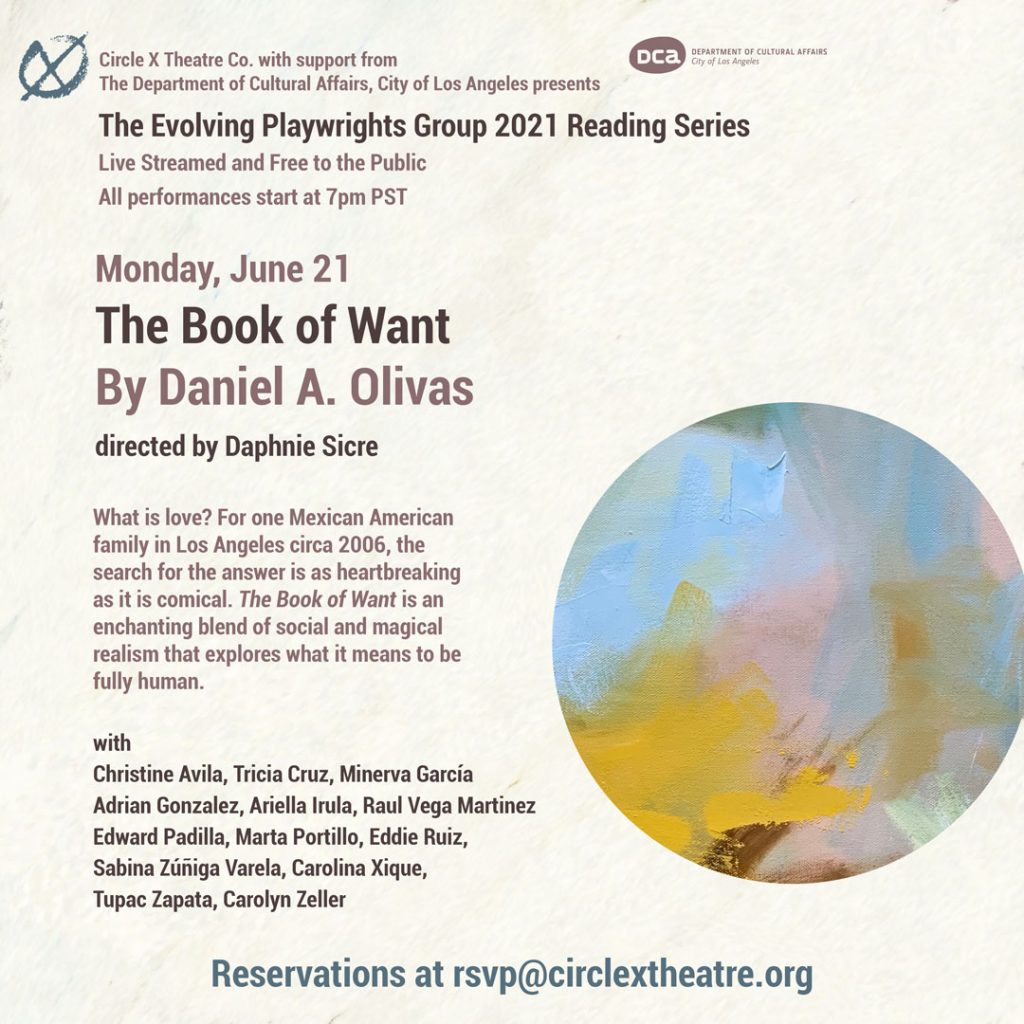
After many months of virtual evening workshops, Daniel completed his play and now has a Zoom reading set for June 21, 7:00 p.m. Pacific Time. Directed by Dr. Daphnie Sicre of Loyola Marymount University, the play has a cast of 12 actors playing 18 roles. The virtual event is free, but tickets are required and may be obtained by emailing rsvp@circlextheatre.org to reserve your spot.
Daniel agreed to answer a few questions about adapting his novel for the stage.
What was it like to turn your novel, The Book of Want, into a theater production?
It was both exhilarating and intimidating. I loved the characters in my novel, but the book’s structure was not traditional in form. It consisted of interconnected short stories told in various styles. Also, I don’t have an MFA. I am self-taught when it comes to fiction, poetry, nonfiction, and now playwriting. I had to teach myself what a play looks like. But with one play under my belt, I had the belief that I could do this. And with a lot of help from my mentor, fellow playwrights, the actors, and my director, I transformed my novel into what looks like a real play.
The project paired you with a mentor to create “the play you were scared to write.” What were the challenges for you?
Donald Jolly was my assigned mentor. I was so lucky! Donald is so thoughtful and kind, and also a great playwright. Donald understood my apprehension in writing a play that I knew would entail a tremendous amount of thought and creativity. The toughest part of adapting my novel was “killing my little darlings” all over again. That is, some things work in a novel that don’t work in a play. A novel can be very interior and focused on characters’ thoughts. How do I translate that to the stage so that I don’t have a bunch of talking heads and no action? What did I have to abandon? Also, because I had so many characters in the novel, I simply could not keep all of them in the play. So, I had to take about three dozen characters of the novel and trim that number. I ended up with 18 characters, which is larger than many plays, but it works. And the biggest device I created for the play was to take the novel’s late matriarch, Belén—who appears as a spirit through much of the novel—and turn her into the play’s host, if you will. She introduces the scenes with commentary all while smoking a fat, hand-rolled cigarette and drinking coffee. She really holds the play together.
Your writing is infused with wit, surprises, and humor. Are there differences in how humor is depicted on the page from how it comes to the stage?
My novel—as with most of my writing—is deeply steeped in Chicano culture, especially as centered in the urban setting of Los Angeles. I wanted to keep that spirit in the play. And yes, my novel uses a lot of humor which was actually the easier element to translate into a theatrical piece. But the biggest surprises came in working with the actors as they rehearsed for our June 21st virtual reading. When actual people read the lines and interacted with each other, it was easier to see what made people laugh, and what fell flat. I had such generous, smart actors and a great director who helped refine and shape the humor of my play. I owe them so much for their input and observations.
The Book of Want is a family story that explores what it means to be human. What does that look like on the stage?
Beautiful! My actors are magnificent in their interpretation of the text. They bring my play to life, and it would not be much of anything without them.
What are you working on now?
During the pandemic, I had a chance to review a lot of my past writing, and I decided to pull together many of my favorite stories along with a couple new pieces for a collection I’ve titled, How to Date a Flying Mexican: New and Collected Stories. It will be published by the University of Nevada Press sometime next year. The collection includes stories published in different volumes over the years including in books published by the University of Arizona Press and Bilingual Press. I am very excited about it, and I dedicate that book to my late father, Michael Augustine Olivas, who passed away last September. My father had wanted to be a writer, but he was never published in his lifetime. He was very proud that I became a published author even as I juggled a very busy day job as a government attorney. He was also excited that I started to write plays. I think that a lot of his spirit is in my adaptation of The Book of Want for the stage.
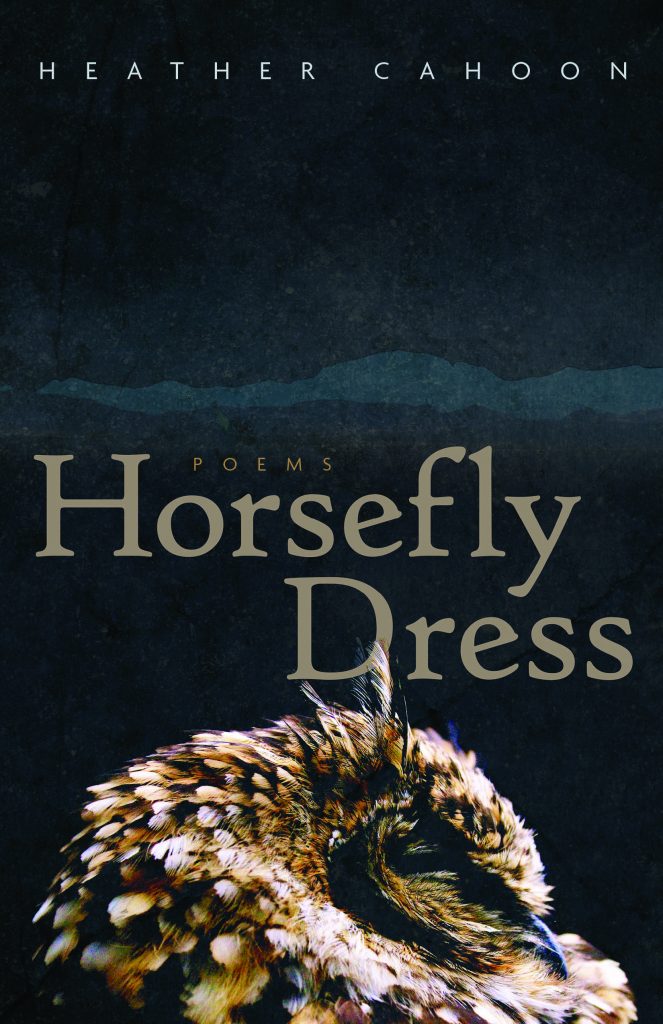
Horsefly Dress author Heather Cahoon was interviewed for Poetry Northwest by Shriram Sivaramakrishnan. Below, read an excerpt from this thoughtful interview and find a link to read the entire discussion.
Shriram Sivaramakrishnan: I would like to kickstart our discussion with the first thing that caught my attention when I was reading your book: the use of Salish words. In your recent reading for The University of Arizona Press, you spoke about weaving Salish into your poems as an act of reclaiming, among other things, the land. It reminded me of a quote by Maurice Merleau-Ponty (I came across it while reading Maggie Nelson’s Bluets), “words do not look like the things they designate.” In the same reading, you also mentioned that you do not speak Salish. Given that your poems are firmly situated in the realities of the land, its people, and their tradition, how does language inform your creative practice?
Heather Cahoon: My poems are definitely rooted in place and reflective of my personal relationships with the landscape, people, flora, and fauna where I live. In terms of how language, specifically my use of Salish, informs my creative practice, I would start by noting that the level of Salish that appears in Horsefly Dress roughly mirrors my speaking ability. Growing up, everyone learns a handful of words and in college I took Salish from one of our elders but I certainly never came close to being fluent. As a result, my decision to include Salish in my poems was very intentional and serves a sort of dual purpose. On a basic level it connects me to my community and reaffirms those ties but it also calls attention, at least momentarily, to American Indians generally and, by extension, the settler colonial history of America. This is why I say that the use of Salish is an act of reclaiming space, not only as a presence on the physical lands where Salish-speaking people have been living for thousands of years, but the non-physical landscapes as well, including the broader American psyche and the mainstream narratives that have largely omitted tribal people.
Horsefly Dress is a meditation on the experience and beauty of suffering, questioning its triggers and ultimate purpose through the lens of historical and contemporary interactions and complications of Séliš, Qĺispé, and Christian beliefs. Heather Cahoon’s collection explores dark truths about the world through first-person experiences, as well as the experiences of her family and larger tribal community. As a member of the Confederated Salish and Kootenai Tribes, Cahoon crafts poems that recount traditional stories and confront Coyote’s transformation of the world, including his decision to leave certain evils present, such as cruelty, greed, hunger, and death.
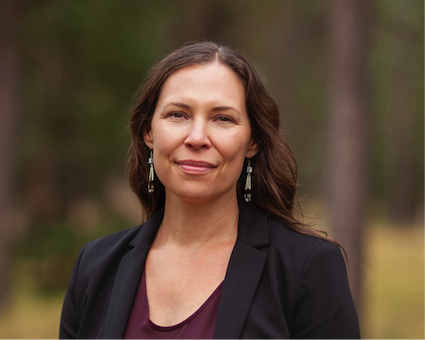
Heather Cahoon, PhD, earned her MFA in poetry from the University of Montana, where she was the Richard Hugo Scholar. She has received a Potlatch Fund Native Arts Grant and Montana Arts Council Artist Innovation Award. Her chapbook, Elk Thirst, won the Merriam-Frontier Prize. She is an assistant professor of Native American studies at the University of Montana. She is from the Flathead Reservation and is a member of the Confederated Salish and Kootenai Tribes.
Empowered!: Latinos Transforming Arizona Politics examines Arizona’s recent political history and how it has been shaped and propelled by Latinos. It also provides a distilled reflection of U.S. politics more broadly, where the politics of exclusion and the desire for inclusion are forces of change. Co-authors Lisa Magaña and César S. Silva argue that the state of Arizona is more inclusive and progressive then it has ever been. Draconian immigration policies have plagued Arizona’s political history. Empowered! shows innovative ways that Latinos have fought these policies.
Here, Magaña answers five questions about her new book.
With the elections, this book sure is timely. How does the book help us understand the recent elections in Arizona?
Well, the focus of this book is on Maricopa County or the Phoenix-Metropolitan area. Because it is the most populated area in Arizona, how the county voted is how the election turned out. This county was seen as a pivotal one in the presidential election, because of recent migration from other states, a growing suburban voting bloc and Latinos coming of age. This county is a great case study for other states that are changing demographically.
Why is it important to note how immigrants have changed our political landscape?
Latinos in Arizona are predominately born in the United States. However, in the Maricopa County there are some fierce immigrant advocates and immigrant political players. In some cases, Latino immigrants, that cannot vote, worked and canvassed in areas and encouraged other Latinos to vote. I once had a DACA student tell me “we may not be able to vote, but this is what democracy looks like.” Seeing immigrant activists involved in electoral politics is democracy at its most beautiful and basic form.
For years folks have been talking about Latinos being the Sleeping Giant. Did it take Donald Trump to wake that giant?
Donald Trump did not wake up the Sleeping Giant. In the case of Arizona, it was one-on-one activism and outreach that got first-time voters to come out and vote. And the Latino and first-time voters in Arizona have been growing. In fact, I think Donald Trump’s anti-immigration agenda did not work in Arizona, as evidenced by his loss.
Organizers and activists have been through so much in Arizona. What have been the biggest challenges?
That is a great question. Not sure what challenges there are that just doesn’t make them stronger and more formidable.
What are your hopes for the book and its readers?
This book is a story about how anti-immigrant rhetoric mobilized Latinos into a dynamic, political force. The demographics are changing. The story in Maricopa County is what is going on in America today.
Urayoán Noel’s latest collection, Transversal, takes a disruptive approach to poetic translation, opening up alternative ways of reading as poems get translated or transcreated into entirely new pieces. In this collection, Noel masterfully examines his native Puerto Rico and the broader Caribbean as sites of transversal poetics and politics. Featuring Noel’s bilingual playfulness, intellect, and irreverent political imagination, Transversal contains personal reflections on love, desire, and loss filtered through a queer approach to form, expanding upon Noel’s experiments with self-translation in his celebrated collection Buzzing Hemisphere/Rumor Hemisférico.
Below, read five questions with Urayoán about his latest collection.
What inspired you to write this collection?
There are many ways to answer this question. After the publication of my previous book of poetry, Buzzing Hemisphere/Rumor Hemisférico (2015), also with Camino del Sol, I was interested in getting back to a more imbricated lyric politics, beyond that book’s intra-Americanist politics of page as hemisphere. I was also returning to writing in traditional forms such as the sonnet, partly to rethink the performative and experimental, which have defined my work for so long. At the same time, I wanted to continue my walking improvisation poems (“wokitokitekis”) and the poetics of self-translation from Buzzing Hemisphere/Rumor Hemisférico and some of my earlier work, so I pushed forward on both and thought of the transversal line as a framing device for what I was doing, departing but connecting. A lot of this was about coping, as it tied into a whole process of mourning (the death of my father, the aftermath of Hurricane María) that on the one hand led me back to my native Puerto Rico and on the other made me commit to digging deeper into my writing practice. Paradoxically, this digging deeper manifested itself as two extremes: the formal poems where I could distill this emotional weight through a formal architecture and the improvisational poems where I could cut loose and let my mind (and walking body) wander and go to places my poet’s ego wouldn’t always let me: to be by turns mawkish and brutal, or funny and dark, sometimes in one breath.
How do you think the act of self-translation impacts the poems in this collection?
In Buzzing Hemisphere/Rumor Hemisférico the two languages were often scored as distinct though overlapping hemispheres on the page, and I knew I wanted to do something different here. One thing about hemispheric politics is they tend to privilege the landmass of the Americas as opposed to the islands, the archipelagos, the littorals… the places I come from. I wanted Transversal to be a more defiantly Caribbean book, partly in conversation with the work of Puerto Rican poets such as Raquel Salas Rivera and Nicole Cecilia Delgado, whose work reminds me of poetry’s power to dream of and structure modes of radical community, and partly in conversation with poet-critics like Aimé Césaire and Édouard Glissant, who map the knowledges of poetry. I had audited a poetry seminar with Glissant in the mid-2000s while working on my PhD at NYU, and I carried with me the memory of his discussion of Césaire with us. Rereading both of them as I was starting to conceptualize Transversal led me to the Glissant passage which would become the book’s epigraph and give it its title. I liked the transversal as a way of thinking of how poetry “knows,” as opposed to verticality of empire (and of the corporate university); I liked that it signified both translation and versification; I liked that it worked in both languages, making the “/” in the previous book moot; and I thought it was a great fit in terms of form, since I had been playing around with arranging both languages on the page in a staggered fashion, so that they were always rubbing up against one another but not presented as linear equivalences. In a sense, this was an attempt to move beyond the “galactic” poetics of Buzzing Hemisphere/Rumor Hemisférico, which was partly inspired by the neo-baroque babble/Babel of Brazilian poet Haroldo de Campos, and closer to a Caribbean vernacular, to my life under, across, and beyond imperial English and imperial Spanish, seeking a joy in jamming them up and jamming with them that may and need not render across the Americas. I also went back to Gloria Anzaldúa, whose “conocimiento” operates as a kind of self-translation, somewhere between inexactness and depth, and Julia de Burgos, for whom self-translation is linked to the performative construction and dissolution of the self.
Would you tell us more about the bold, experimental choices you make with poetic form in this collection?
I have always been really interested in the translatability of poetic form. One thing that happened between the previous book and Transversal is that I started getting more seriously into literary translation: publishing it, writing about it, judging it. I learned a lot from translating everything from the vanguardist 1920s sonnets of Chilean poet Pablo de Rokha to the 1970s concrete poems of Amanda Berenguer from Uruguay, written under the shadow of dictatorship, and the contemporary translingual work of Guatemalan Garifuna poet Wingston González. In all three cases, I made the innovative form of the originals central to my translation, often translating for form as much as for content, and it emboldened me even more to self-translate with an eye and ear for form, honoring the distinct properties and architectures of each form, whether an English ode, a villanelle, a concrete poem, or a free-form improvisation. There are also quieter, untranslated poems, which I wanted in order for the book to have room to breathe. Then there’s the contrasting fonts for the English and Spanish, which I had played around with in Buzzing Hemisphere/Rumor Hemisférico but is done a bit more subtly here, as if to insist less on the theatricality of it all. There’s always a lot of performance in my work, but as I’ve gotten used to self-translating (both ways and across forms) I’m less interested in having it be a statement of some kind and just content to let it be, something a poet like Salas Rivera does beautifully. By doing so, I also want to rethink the experimental as a way to center the reader: the experiment not as intent but as relation, where I figure it out for the page and you, the reader, refigure and configure on your terms. There’s one poem in the book that is all homographs (words that look the same but may mean different things in both languages): it’s actually multiple poems depending on how the reader reads. There’s a fair amount in the book that can work in modular fashion: readers can rearrange stuff to fit their layout.
Your voice notes poems, as well as other poems in the collection, feel rooted in specific moments. Could you tell us about the importance of place and observation in your work?
As I mentioned, Transversal was meant to be a Caribbean book. It’s ethos and concept are Glissantian, right down to the striking cover image by the artist Beatriz Santiago Muñoz, who is a great reader of Glissant. The book grew out of my return to the Caribbean, not only Puerto Rico, but also the Dominican Republic, where one of the earliest poems in the book is set, and Cuba, where I began the first draft of what would become the long poem “Periodo Espacial Spatial Period.” While some poems in the second section are ten or even 15 years years old, the book was conceived and largely written after my move to a waterfront area of the South Bronx in late 2016. Much of the improvisational poetry comes from walking along or around nearby Randalls Island Park, recording myself on video as I improvise, and then transcribing the improvisations with no editing. I noticed that after a while the islands of the Caribbean would blend with Randalls Island and Manhattan in my improvisations, all one sedimented archipelago poetics. This seemed like coming full circle, since the first of these wokitokiteki video improvisations were done while walking on a beach in Puerto Rico in early 2012. Before that, I was doing voice notes transcriptions only, since that’s what my phone at the time could handle: the poem “Unstatements,” composed while I was living and teaching in Albany, New York, is one of these early, voice-only improvisations. At some point, the poetics of statelessness (a word I play around with a lot and that resonates as a Puerto Rican) and the poetics of (un)statement just began to blur, and I went with it, letting poems become voice and movement exercises, become political or theoretical statements or meditations on the state of things (or “no state” of things, to echo the poet Victor Hernández Cruz). As a poet who plays with language a lot, I value how these durational language and walking exercises (a typical wokitokiteki is between 15 and 35 minutes with no pauses in the recording) allow for language to exhaust itself and something else to happen: a stutter, a confession, or just silence and listening to my surroundings, which generates observations or reactions that keep the exercise going. I have even applied this compositional method to conventional poems in the book, such as “Soverano,” written after I participated in the summer 2019 protests in Puerto Rico. A few days after attending the protests I was at the Macondo Writers Workshop in San Antonio studying creative nonfiction, and I wanted a more nonfictional and less conventionally poetic way to tell the story of what I saw at the protests, so I walked around my room and improvised, then transcribed and edited and added as minimally as possible. The result was “Soverano,” something like a prose poem but hopefully conveying a bit of the rawness of the experience of what I saw and felt at the event as I processed it a few days later.
Many of the poems in Transversal are rhythmic and musical, as if they are begging to be performed. Is speaking your poetry aloud a large part of your work?
Music, and the musicality of language in particular, are really important to me and to my sense of what poetry is and does. Poetry does not need to be super rhythmic (it does not need to be anything in particular) but my sense of the musicality of language is tied to how words are haunted by other words and worlds, by wordless sounds, bodies, silences. I have different influences as a performer, from the Puerto Rican décima tradition I grew up with to that of the Nuyorican poets, which I claim and write about in my critical work. I have also worked with bands and more recently incorporated phone apps into my performances: sometimes to create sound textures or loops but other times to create deliberate mistranslations, to generate found poems (anagrams, for instance), or to introduce multiple voices into my work and to complicate the immediacy of the relationship between performer and audience. As a poet and critic, I’m very interested in mediated performance, in how it shapes the politics of empire (as in the previous president) but can also sometimes unsettle them, in how the hyper-mediation and gadget-ification of everything is both a challenge and an opportunity for poetry. Poems for Transversal evolved as I performed them everywhere from the Poesiefestival Berlin and the Toronto Biennial of Art to colleges and community gardens in the South Bronx. I think of these performances as extending the sedimentation of the poems, their symbiotic relationships to the environments that birthed them. In our pandemic context, I have explored different approaches to digital performance that highlight but also push against the screened-ness of our present, whether by highlighting the space between my body and the screen, using my phone and computer simultaneously to create more weirdly stereophonic performances, or reclaiming analog forms such as the postcard. I have also done “live” wokitokiteki improvisations in my backyard over Zoom. Increasingly, all my longer readings and performances include at least a brief component of improvisation, and I anticipate that I will continue doing so for Transversal, partly to underscore that what’s in a book is not the end but just another beginning.
Okay, I know I said five questions… but I have one more. What are you working on now?
I’m researching the history of Latinx social media, translating two artist books by Nicole Cecilia Delgado, and editing a couple of long poetic sequences, including one based on the sequence of covid-19 (the latter build off two poems in Transversal). I’m also exploring the question of mediated and found language through experiments with media art: I turned one of the anagram poems from Transversal into a series of GIFs currently on display at the Museum of the City of New York as part of its New York Responds exhibition.
Urayoán Noel is a Puerto Rican poet, performer, translator, and critic living in the Bronx, New York. He has published seven books of poetry and the prize-winning study In Visible Movement: Nuyorican Poetry from the Sixties to Slam, and he edited and translated Architecture of Dispersed Life: Selected Poetry by Pablo de Rokha, which was a finalist for the National Translation Award. Noel teaches at New York University and at Stetson University’s MFA of the Americas.
Rewriting the Chicano Movement, edited by Mario T. García and Ellen McCraken, is a new collection of powerful new essays on the Chicano Movement that expand and revise the understanding of the movement. These essays capture the commitment, courage, and perseverance of movement activists, both men and women, and their struggles to achieve the promises of American democracy. The contributors to this book highlight the role of women in the movement, the regional and ideological diversification of the movement, and the various cultural fronts in which the movement was active.
Here, García and McCraken answer question about this new book:
Why is it important to revisit the history of the Chicano Movement through this book?
It’s important to revisit the history of the Chicano Movement through this book because the Movement represents a seminal part of the history of Chicanos (Mexican Americans) in the United States. It was the largest and most widespread civil rights and empowerment movement by people of Mexican descent up to the 1960s and 1970s. The Chicano Movement through its struggles opened up new opportunities for Chicanos in areas formerly restricted such as in education, especially higher education, politics, culture, media, and business. These opportunities were not given willingly, but had to be forced by mass peaceful struggles. The Movement for the first time made Chicanos, and by extension other Latinos, into national political actors. The roots of Latino political power, which is a reality, lie in the Chicano Movement as well as similar struggles by other Latino groups such as Puerto Ricans in the United States. It is important to know about the history of the Chicano Movement as a reminder of how power and opportunities are accessed. It comes through people power and the organization of this power. We need to learn these lessons at a time when reactionary forces led by Donald Trump would impose an American form of totalitarianism. Chicanos and Latinos must be in the forefront of defending American democracy and civil rights and we can be inspired to do so by learning how our communities in the past have struggled for our rights such as in the Chicano Movement.
Is there a commonality worth noting that runs through the book’s essays?
The commonality that runs through the book is the commitment by Chicanos through the Chicano Movement to achieve recognition, respect, and dignity in American society through various forms of struggles including political, educational, and cultural ones. What is also common in the book is that we need to rewrite the Chicano Movement to take into consideration the diversity of the Movement. There was no one Movement but many in different regions of the country, which included both men and women.
What conversations, in community or classroom, do you hope rise from the book?
We hope that the book will be used by both educational groups and community ones to re-discover the historical importance of the Chicano Movement and its continued relevance to today’s conditions and struggles. The Chicano Movement did not eliminate racism, class discrimination, cultural discrimination, and gender discrimination for Chicanos and other Latinos. What the Movement did was to empower Chicanos to believe that they and they alone could change history and pressure the system to become more equitable and democratic. We are not there yet, but the Movement can still inspire and guide us in continuing the struggle. We hope that readers will confront the question: How is the Chicano Movement still relevant to us today?
How can telling untold stories about the Movement help the momentum of today’s activists and organizers?
Telling untold stories about the Chicano Movement, as noted, can hopefully inspire and guide today’s activists in learning that the struggles for democratic rights has a long history and with many heroic figures, male and female, who have participated in earlier struggles to empower the Chicano and Latino communities. There is a praxis involved in our book. First, we want people to read about these untold stories of the Movement. Then we want readers to reflect on the meaning and importance of these stories. And then, and this is most important, we want readers to act on these stories. How can I take up the legacy of the Chicano Movement and apply it to my current conditions? How can I continue the struggle?
The struggle continues, does that mean the Movement continues, too?
We hope that the struggle inspired by the Chicano Movement will continue. Does this mean that the Chicano Movement is still alive? Yes and no. As a historical movement set in the late 1960s and 1970s, the Movement no longer exists as such; it is a historical movement set in time and place. However, the legacy of the Movement continues. It is a legacy of the struggle for democratic and human rights and for the rights of people such as Chicanos and other Latinos to define themselves and be proud of their ethnic background. That struggle has continued in the post-Movement years and still does in the new millennium.
***
Mario T. García is Distinguished Professor of Chicano Studies and History at the University of California, Santa Barbara, specializing in Chicano history, Chicano/Latino autobiography, and Chicano/Latino religion. He is the author, co-author, and editor of more than twenty books in Chicano history, including Blowout! Sal Castro and the Chicano Struggle for Educational Justice, The Making of a Mexican American Mayor, and Literature as History. He has won a number of awards, including a Guggenheim Fellowship.
Ellen McCracken is a professor in the Department of Spanish and Portuguese at University of California, Santa Barbara, specializing in U.S. Latino and Latin American literature. Her books include New Latina Narrative, The Life and Writing of Fray Angélico Chávez, and Paratexts and Performance in the Novels of Junot Díaz and Sandra Cisneros.
The desert inspires wonder. Attending to history, culture, science, and spirit, The Nature of Desert Naturecelebrates the bounty and the significance of desert places.
In Whale Snow: Iñupiat, Climate Change, and Multispecies Resilience in Arctic Alaskaauthor Chie Sakakibara uses multispecies ethnography to explore how the relatedness of the Iñupiat of Arctic Alaska and the bowhead whale forms and transforms “the human” through their encounters. Sakakibara shows how people of Arctic Alaska live in the world that intersects with other beings, how these connections came into being, and, most importantly, how such intimate and intense relations help humans survive the challenges of climate change. Today, Chie answers our questions.
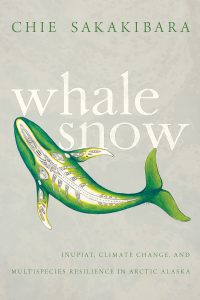
The artwork on the cover of your book is stunning. Please tell us more about the artist Nasuġraq Rainey Hopson.
Nasuġraq Rainey Hopson is an Iñupiaq artist and writer who was born and raised on the North Slope of Alaska. She is someone who I heartily admire for her deep commitment to her community through the promotion of Iñupiaq values, aesthetics, and environmentalism. As a dear friend, mentor, and collaborator, Nasuġraq kindly contributed the cover art, X-ray Whale, along with the original frontispiece and three illustrations included in Whale Snow. Her creations eloquently tell many stories, and they often point to a positive reciprocal relationship that goes across the boundary of humans and nonhuman animals, which gets intensified in our times of global climate change. This dynamism is the subject of Whale Snow.
Nasuġraq calls Anaktuvuk Pass (AKP) home, a beautiful village nestled in the foothills of the Brooks Range, and her days are filled with adventures with her daughter, husband, a small flock of chickens, a variety of types of artistic expression, and writing. She is also known as a groundbreaking Arctic gardening guru, and is the founder of America’s northernmost gardening project called “Gardens in the Arctic,” which has successfully grown fresh produce for her community since 2016. Visit Nasuġraq’s website, Nasuġraq Rainey Hopson: Iñupiaq Artist and Writer, to learn more about her career: https://www.nasugraqhopson.com/.
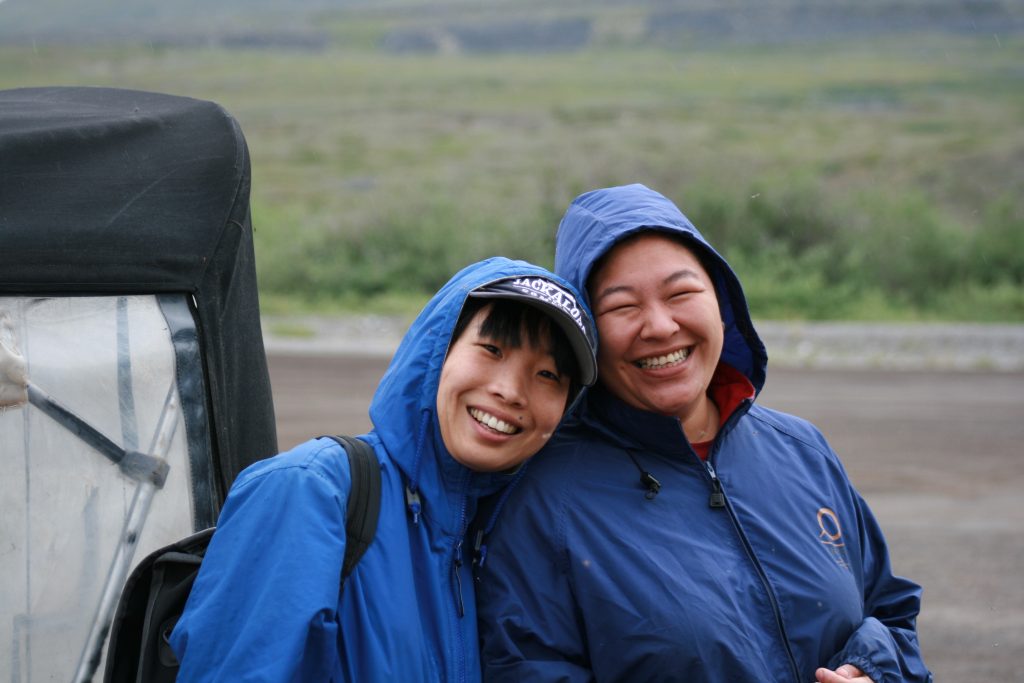
Portrait of Chie Sakakibara and Nasuġraq Rainey Hopson in Anaktuvuk Pass, Alaska. Photo by Aaron A. Fox.
In the Arctic, climate, culture, and human resilience are connected through bowhead whaling. You write that climate change has disrupted this ancient practice. What are some of the implications of this disruption?
In Whale Snow, I explored how Iñupiat live their values in the midst of pervading modernity in relation to colonial encounters and ongoing social and environmental transformations. Each of their social principles is now threatened by myriad ramifications of climate change. For so many times, on so many occasions, and in so many places, I have witnessed how the joy of getting a whale has worked a miracle to transform human lives, experiences, and relations. At the same time, it suggests the costs of not getting any whales. Without the whales, social tensions rise. Without the whales, the meaning and order the whales bring to sustain the community gets diluted—no whale means no harmony and no assurance of community integrity. When the ocean rises, sea ice deteriorates, and the tundra thaws, the devastation of not having any whales is immeasurable, and at times results in social rupture through violence, alcoholism, substance abuse, depression, and unexpected death, just to name a few. This is why whaling remains the central idiom of Iñupiaq well-being and sovereignty. Whaling maintains social health and solidarity as the foundation of survival. This is why the responsibility of the whalers is so immense.
At this time of further uncertainties for subsistence, the temptation of not observing the community norms gets much closer to the surface of their social fabric. At the same time, however, in the face of heightening anxiety and stress, development of interpersonal and interspecies bonds fosters resilience that ultimately strengthens the people. Such resilience can be invigorated through proactive adaptation to change, which leverages tradition and culture in modernity. This process of adaptation often manifests in a form of multispecies reciprocity in Arctic Alaska, which deeply intertwines the humans with humans, humans with animals, and humans with the environment. In the face of heightening anxiety and stress, development of interpersonal and interspecies bonds creates resilience that ultimately sustains the people.
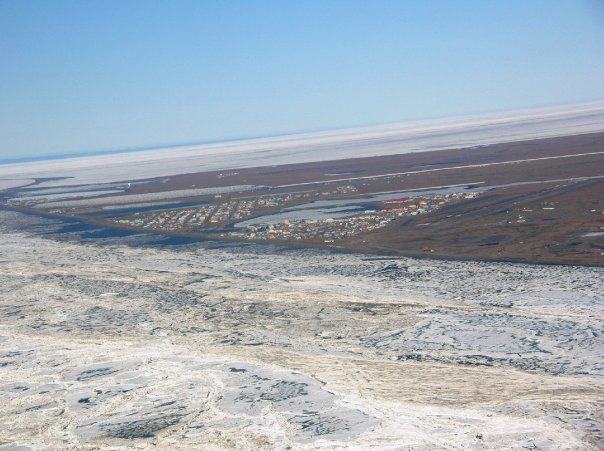
Aerial View of Utqiaġvik, Alaska – Photo by Chie Sakakibara
Global environmental change is all around us. In this time of ecological transition, why is exploring multispecies relatedness important?
As the COVID-19 pandemic and its interspecies origins underscore, we all live in the Anthropocene, an age in which humans and other animals are forced to live in closer proximity, share viruses, and confront new ones. Interspecies entanglements have increased their significance due to accelerating ecological dilemmas. My Iñupiaq mentors and collaborators taught me the importance of interspecies togetherness, or multispecies solidarity. Togetherness cultivates resilience, the capacity of individuals and communities to adapt, recover, and survive challenges and uncertainties. In this context, as Donna Haraway says, we must make kin as we are not the only important actors, and kin-making is a multispecies affair to cultivate resilience and mitigate vulnerability for survival. The Iñupiaq way of life clearly embodies this philosophy. Whale Snow is a journey to unpack such relations to better comprehend further entanglements between humans and nonhuman others as we are increasingly forced to live together.
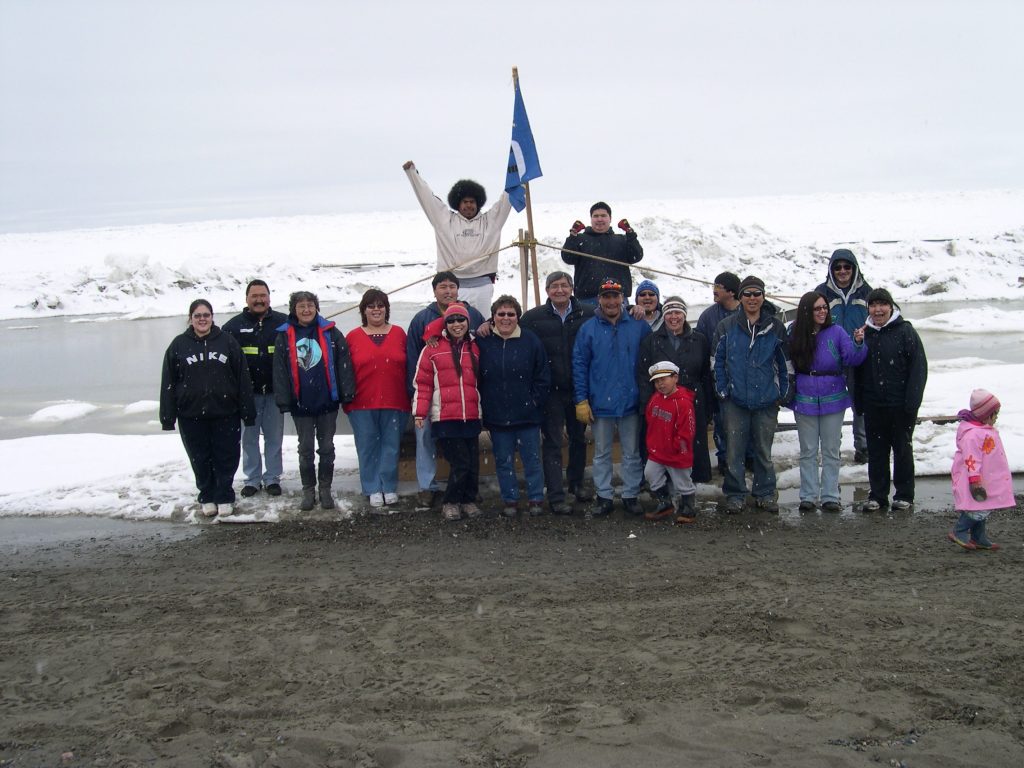
Kaleak Crew, successful whaling crew, celebrates the end of whaling season in Utqiaġvik, Alaska. Photo by Flossie Nageak.
You open the acknowledgements by describing a promise you make to a community member to “not disappear” once you completed your fieldwork. Why was this so important?
Academic researchers in Indigenous communities have a fraught relationship with Indigenous communities with data mining, and this history remains inseparable from the legacy of colonialism and colonization. It was this reputation for outsider extraction that my mentor Martha Aiken was afraid of. She had seen how local knowledge and experience were conveniently extracted, simplified, and plugged into the market economy as medicine, books, popular music, and designs, or when they were instantly turned into private property after being detached from their appropriate cultural contexts. Rarely was a plan to benefit the community part of this enterprise. On my first day in her community as a graduate student, Martha asked me to swear that I would commit myself to cultivate a long-term relationship with her and her community before starting to work on my dissertation research. I agreed to make the commitment. Now, many years later, I am still in the process of earning my place. The process of relationship-building has opened many doors to me that would have otherwise stayed closed; it is obvious but not an exaggeration to say that this study could not have been written without community participation and co-authorship. Martha has since passed away, but as a faculty member at Oberlin College, I continue to share her wisdom with my students to educate future generations of scholars—both Indigenous and non-Indigenous—about the importance of social justice, research ethics, community benefit, collaboration, and reciprocity so the future scholars will never disappear. Whale Snow is a token of my humble reciprocity with Martha and the community that adopted me and considered and cared for me as their own. As a partial fulfillment of Martha’s mandate, I wrote this book to offer insights into the depth of Iñupiaq-whale relations, and especially how they intersect with Iñupiaq struggles to achieve cultural sovereignty through the whaling cycle, and in so doing exhibit resilience in the face of unrelenting impacts of global climate change.
What do you hope people take away from your work?
Indigenous vulnerability to climate change has been discussed extensively in the fields of public policy, political science, anthropology, and geography, but comparatively few studies have actually shed light on the ways in which people emotionally invest themselves in their entanglements with animals and environments to nurture resilience. In contrast, Whale Snow shares powerful and positive stories about Indigenous experiences coping with climate change. As climate change increases environmental and cultural uncertainties, it also intensifies Iñupiaq emotions and relatedness with the bowhead whale to seek out cultural activities that strengthen social identities and a politics of Indigenous sovereignty. In this sense, my narrative departs from studies that emphasize human vulnerability and instead serves as an ethnography of hope cultivated and entangled with interspecies relations.
This book lies at the intersection of my personal life and stories of America’s northernmost Indigenous society. My narrative is steeped in a deep long-term relationship between a culturally adopted Japanese woman in the two Iñupiaq villages and her adoptive family members, relatives, mentors, collaborators, colleagues, friends, and acquaintances. This is the story of the people and the bowhead whale, and at the same time, the story of my own life. My fieldwork has become synonymous with my personal growth and fulfillment as an adopted member of whaling crews through participation in everyday life in contemporary rural Alaska. In many different ways and contexts, my adoptive families and kin taught me that the Iñupiaq-whale relationship is a force of innovation and adaptation that now serves as a way to cope with social stress and the unforeseeable future. In other words, this book was germinated in my own process of becoming an Iñupiaq (meaning “a complete person”) through building a relationship with Iñupiat and their nonhuman kin, and I present this book as a humble offering for the people and whales who are connected through emotive bonds, words, stories, and songs that they have so generously bestowed upon me.
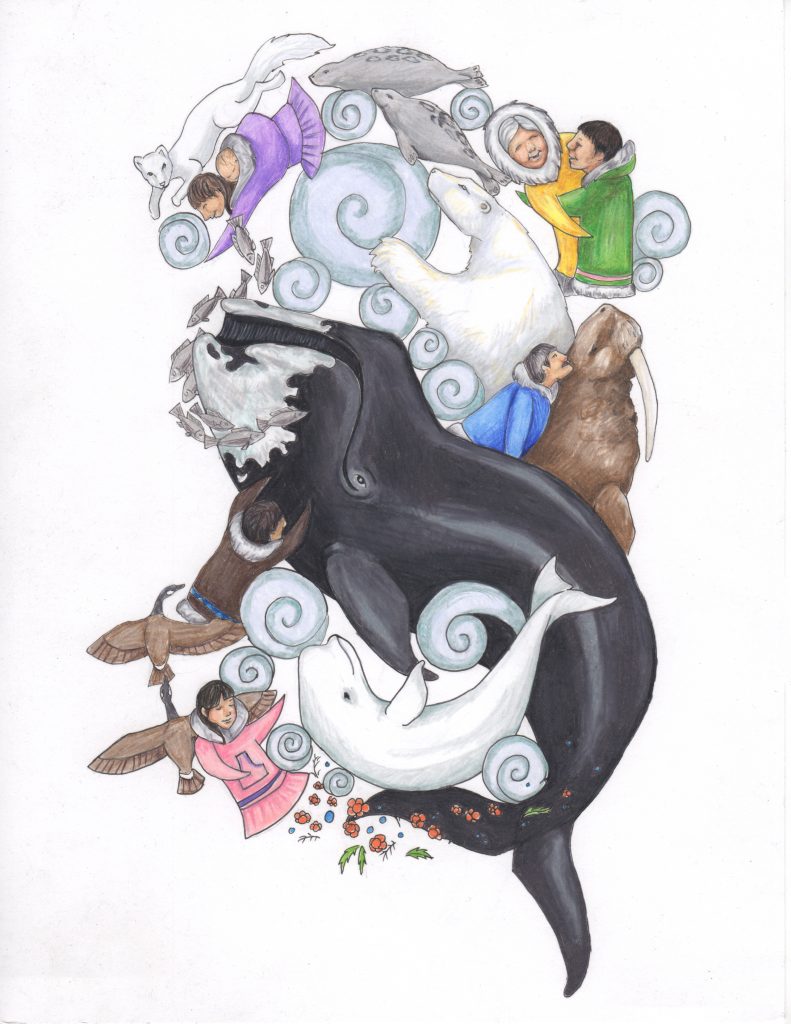
Whale Snow Frontispiece – By Nasuġraq Rainey Hopson.
Chie Sakakibara is an assistant professor of environmental studies at Oberlin College. She was trained in cultural geography, art history, and Indigenous studies. Her work explores human dimensions of global environmental change among Indigenous peoples. Native to Japan, Sakakibara is a proud adoptive member of the Iñupiaq whaling community. Her love of humans and nonhuman animals manifests in her academic work as well as in her life with one human daughter and two canine sons.
All royalties accruing from sale of this publication go to the North Slope Borough Iñupiat History, Language, and Culture Commission.
Fornes was one of the most significant American playwrights of the twentieth century, and her legacy is evident in the dozens of playwrights she mentored over the course of her long career. García-Romero shows how her unique pedagogy and her example as a successful Latina experimental playwright continue to inspire playwrights like Caridad Svich, Cusi Cram, Elaine Romero, Quiara Alegría Hudes, and Karen Zacarías.”
The University of Arizona Press publishes the work of leading scholars from around the globe. Learn more about submitting a proposal, preparing your final manuscript, and publication.
The University of Arizona Press is proud to share our books with readers, booksellers, media, librarians, scholars, and instructors. Join our email Newsletter. Request reprint licenses, information on subsidiary rights and translations, accessibility files, review copies, and desk and exam copies.
Support a premier publisher of academic, regional, and literary works. We are committed to sharing past, present, and future works that reflect the special strengths of the University of Arizona and support its land-grant mission.
 The University of Arizona Press