Flachs Examines Cotton Cultivation in India in Anthro Magazine Sapiens

March 15, 2021

Andrew Flachs, author of Cultivating Knowledge: Biotechnology, Sustainability, and the Human Cost of Cotton Capitalism in India, recently contributed a story for SAPIENS, an online anthropology magazine, edited by Chip Colwell.

Excerpt from the story by Flachs:

“Organic agriculture also offers an agrarian way of life for younger, educated generations in Telangana at a time when many young people have moved away to find work in larger cities, such as Hyderabad and Bangalore, leaving behind or even selling family land. Staff members recruited from farming communities by various organic projects in Telangana have found a way to give back to their agrarian roots while achieving a new form of rural professionalism.

It would be wrong to frame the success of these programs as either the triumph of eco-friendly clothing sales or as evidence of the inherent superiority of certified organic agriculture. Those perspectives miss the crucial efforts of NGOs and organic companies that make it easier to be a small farmer. They also hide the efforts of charismatic, opportunistic, and earnest farmers and rural professionals who take up the local cause.”

SAPIENS began in 2016 with a mission to bring anthropology to the public, and make a difference in how people see themselves and the people around them. An editorially independent magazine of the Wenner‑Gren Foundation for Anthropological Research Published in partnership with the University of Chicago Press.

You can read the entire story, and check out SAPIENS here.

Spring Into 2021 with a Great Discount on Books!

March 3, 2021

We are excited to kick off Spring 2021 with some incredible new books, and a great sale to match! From March 1, 2021 to March 15, 2021, use the code AZSPRING21 for 40% off ALL titles, plus free shipping in the continental U.S.

The Great Ages of Discovery is a fascinating conceptual framework for understanding the past 600 years of exploration by Western civilization and its relationship to contemporary society. Stephen J. Pyne expertly organizes the vast narrative of Western exploration into three distinctive ages of discovery.

On Saturday, March 6, Stephen Pyne will be presenting at the Tucson Festival of Books! Authors Simon Winchester and Stephen Pyne will discuss how the quest for land, ownership and discovery have shaped the modern world. . Learn more about this panel. You can also watch a book trailer for The Great Ages of Discovery here.

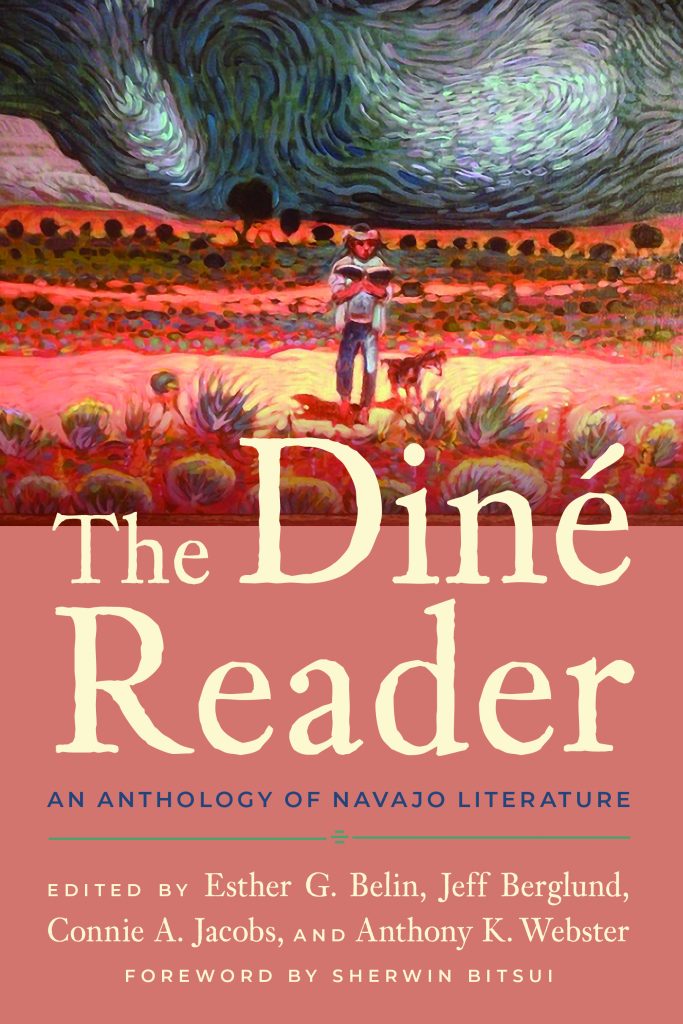
The Diné Reader: An Anthology of Navajo Literature is a comprehensive collection of creative works by Diné poets and writers. This anthology is the first of its kind.

“This collection is essential to American literature and should be required for anyone studying American, First Nations, or world literature.”—Joy Harjo, U.S. Poet Laureate

On Wednesday, April 21, tune into a virtual event with editors Esther G. Belin, Jeff Berglund, Connie A. Jacobs, and contributors to celebrate this ground-breaking anthology. Read more about the event and register here.

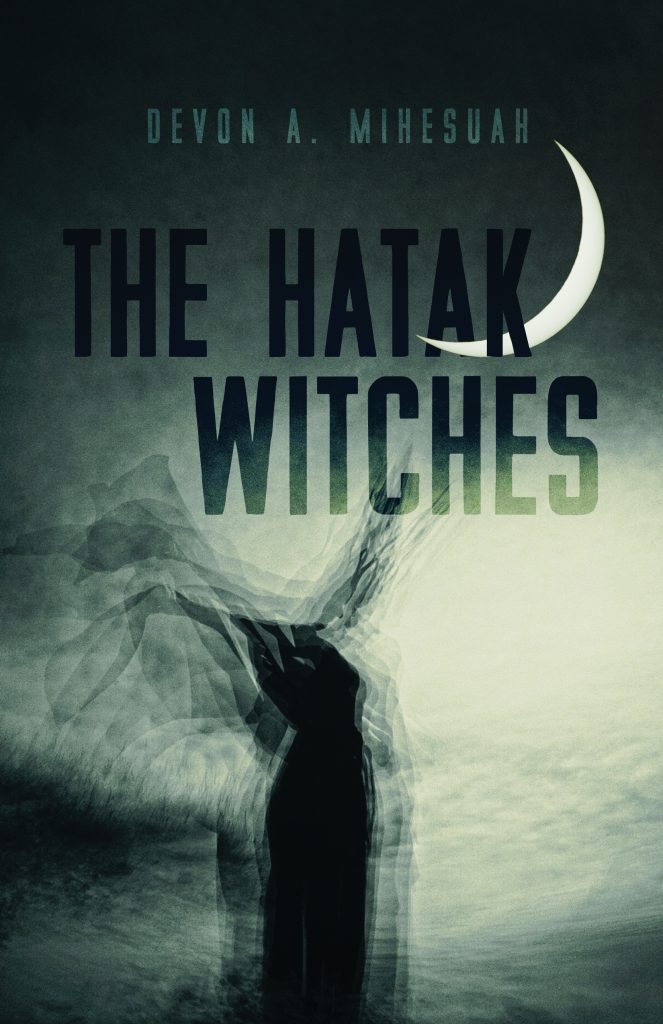
A baffling museum murder that appears to be the work of twisted human killers results in an unexpected and violent confrontation with powerful shape-shifters for Choctaw detective Monique Blue Hawk. Blending tribal beliefs and myths into a modern context, The Hatak Witches continues the storyline of Choctaw cosmology and cultural survival that are prominent in Devon A. Mihesuah’s award-winning novel, The Roads of My Relations.

“As informative as it is gripping, this supernatural mystery from Mihesuah—the 88th installment of Sun Tracks: An American Indian Literary series—is rooted in Choctaw cosmology and contemporary Native American life. … Readers looking for intelligent, diverse supernatural fiction will be captivated.”—Publisher’s Weekly

Read the entire Publisher’s Weekly review of The Hatak Witches here.

Danzirly is a stunning bilingual poetry collection that considers multigenerational Latinx identities in the rapidly changing United States. Winner of the Academy of American Poets’ Ambroggio Prize, Gloria Muñoz’s collection is an unforgettable reckoning of the grief and beauty that pulses through twenty-first-century America.

On Saturday, March 6, Gloria will be presenting at the Tucson Festival of Books! What does the American Dream look like for Latinx people living in the United States? What does it feel like? Felicia Zamora and Gloria Muñoz explore those questions in their award-winning poetry. They will share their thoughts, and some of their poems, with all of us. Learn more about this panel.

On Wednesday, April 14, Gloria Muñoz will read from her new collection, Danzirly, presented by the American Academy of Poets and the University of Arizona Press. Registration is required. Learn more here.

Transversal takes a groundbreaking, disruptive approach to poetic translation, opening up alternative ways of reading as poems get translated or transcreated into entirely new pieces. In this collection, Urayoán Noel masterfully examines his native Puerto Rico and the broader Caribbean as sites of transversal poetics and politics.

Learn more about the collection by reading an interview with Urayoán here. On Wednesday, March 17, celebrated poet Urayoán Noel will read from his new poetry collection, Transversal, joined by Camino del Sol series editor Rigoberto González for an online event. Registration is required. Learn more here.

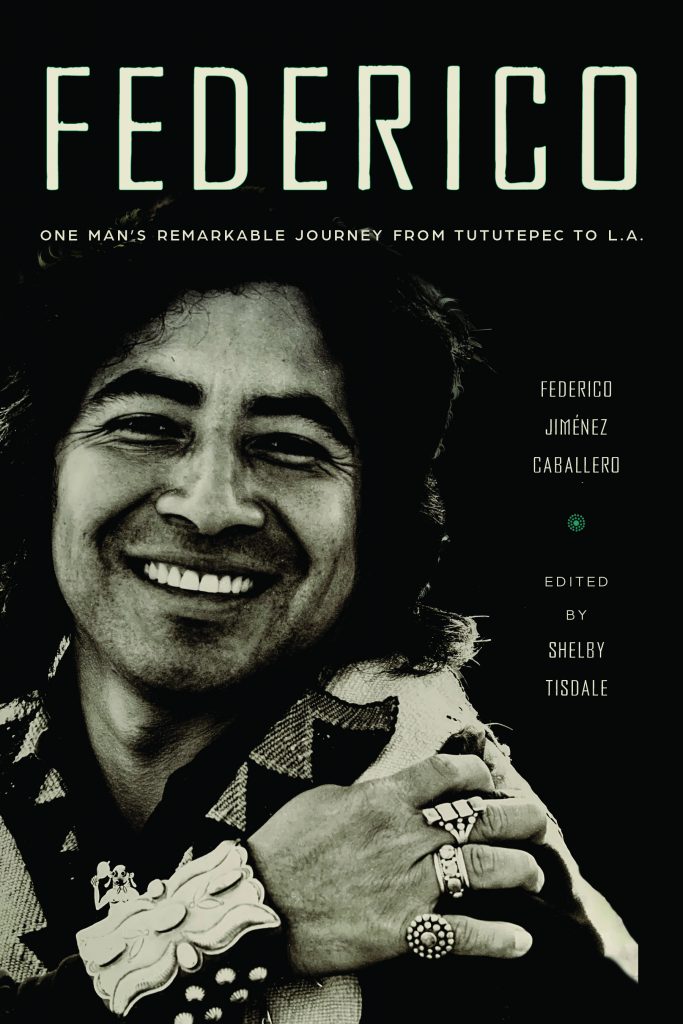
From the day he was born, Federico Jiménez Caballero was predicted to be a successful man. So, how exactly did a young boy from Tututepec, Oaxaca, become a famous Indigenous jewelry artist and philanthropist in Los Angeles? Federico tells the remarkable story of willpower, curiosity, hard work, and passion coming together to change one man’s life forever.

On Wednesday, April 7, learn about Federico Jiménez Caballero’s remarkable life and work during this online book release celebration and discussion with author Jiménez Caballero and editor Shelby Tisdale. Registration is required. Learn more about the event here.

UNDOCUMENTS is an expansive multi-genre exploration of Greater Mexican documentality that reveals the complicated ways all Latinx peoples, including the author, become objectified within cultures. John-Michael Rivera remixes the Florentine Codex and other documents as he takes an intense look at the anxieties and physical detriments tied to immigration.

Read an excerpt from UNDOCUMENTS here.

On Wednesday, March 31, join a special virtual event to celebrate the book release of UNDOCUMENTS with a reading a discussion with its author John-Michael Rivera. Registration is required. Learn more about the event here.

“Editors Johnson and Cokinos have created a profoundly stirring evocation of the glory and tragedy of spaceflight that lets us better see not only worlds beyond but also ourselves.”—Lee Billings, Scientific American

Mark McLemore, host and producer of Arizona Public Media’s Arizona Spotlight, recently interviewed Christopher Cokinos and Julie Swarstad Johnson, co-editors of Beyond Earth’s Edge: The Poetry of Spaceflight. Listen to the interview here. PBS’ The Open Mind featured Beyond Earth’s Edge: The Poetry of Spaceflights co-editors Julie Swarstad Johnson and Christopher Cokinos talking about the new poetry anthology and this celebration of poetics and the space sciences. Watch here.

The poetry anthology was also featured on Planetary Radio, the Planetary Society’s weekly podcast brilliantly hosted by Mat Kaplan. Listen here. Then, watch an incredible event with the editors and some contributors to the volume here! Ready to take your own space poetry journey? Read Swarstad Johnson’s post and writing prompts.

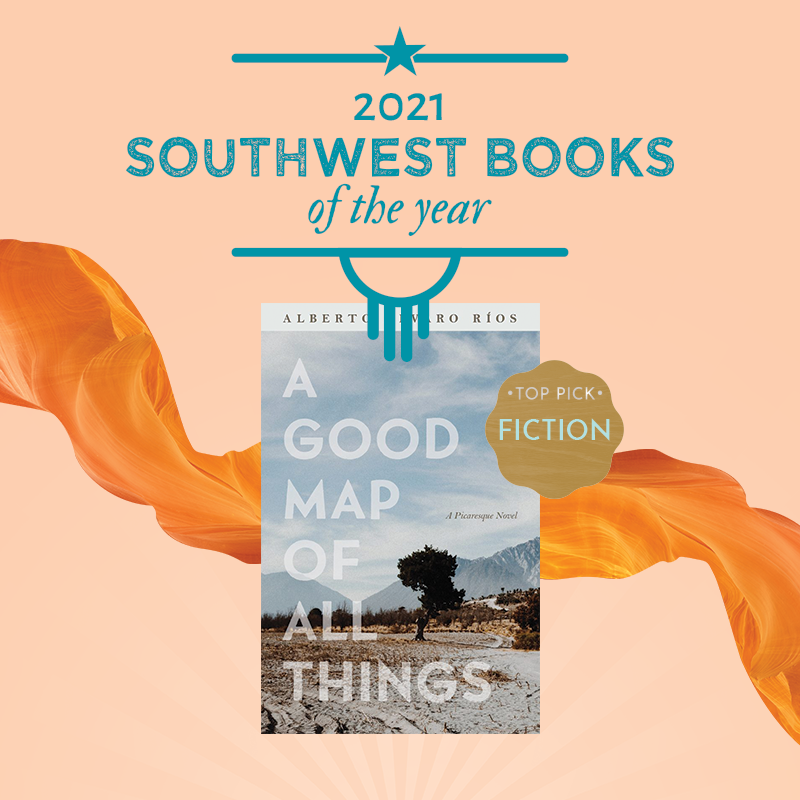
“Ríos’s finely crafted chronicle brings great depth to the vicissitudes of life in a small Mexican village.”—Publishers Weekly

Alberto Álvaro Ríos is presenting at the Tucson Festival of Books on Sunday, March 7! Arizona authors Alberto Álvaro Ríos and Lydia R. Otero will discuss their newest books, both of which explore the power of place and community along the border. Learn more about this panel.

We are thrilled that A Good Map of All Things was chosen as a Southwest Book of the Year! Listen to a KJZZ interview with Alberto Álvaro Ríos here, then read an interview with him here.

“The writings in this collection echo, each in their own ways, the surprising declaration made by contributor Paul Mirocha in ‘Staring at the Walls,’ an essay on Southern Arizona public art: “The desert is succulent—it’s downright juicy out there.”—Kristine Morris, Foreward Reviews

Watch editor Gary Nabhan and contributor Francisco Cantú discuss The Nature of Desert Nature here. The Desert Laboratory on Tumamoc Hill hosted a special online event to celebrate the book release of The Nature of Desert Nature, watch it here. Read an excerpt from the book here.

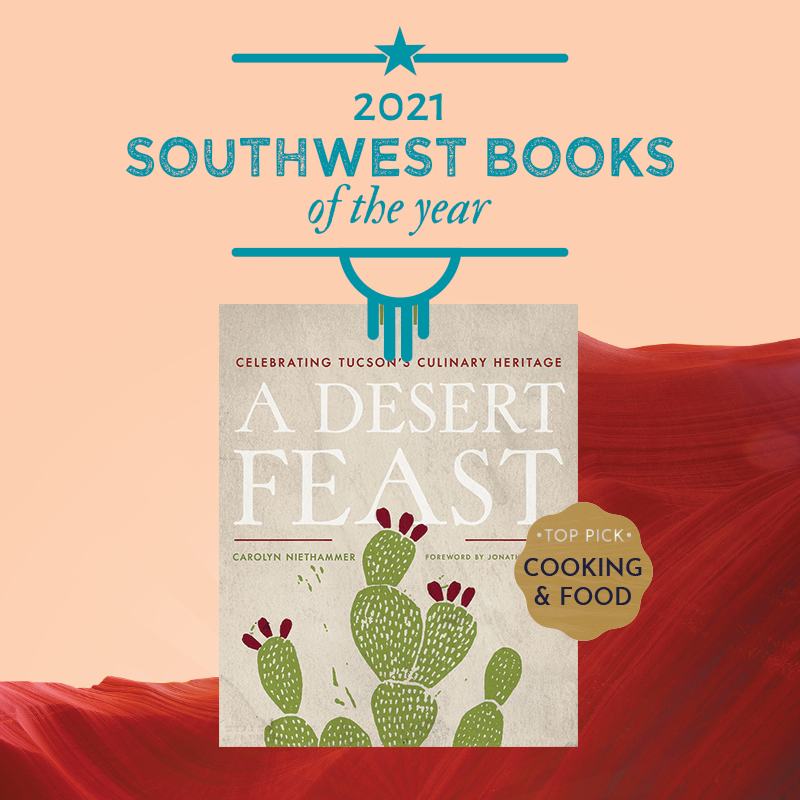
“Indispensable, Niethammer’s book is fascinating, taking us through the cultural and historical significance from 4,000 years ago at the base of “A” Mountain to the modern-day celebration of artisan growers and chefs who have all been a part of making Tucson a UNESCO Creative City of Gastronomy. This is not a book to finish in one sitting, but something to be savored along with the book’s many recipes, time and time again.”—Barry Infuso, President, Chefs Association of Southern Arizona

We are thrilled that A Desert Feast was chosen as a Southwest Book of the Year, and it also won a Pubwest Book Design Award! Read an excerpt from the book here, then watch a Tucson Festival of Books virtual event with Carolyn Niethammer and #ThisIsTucson food writer Andi Berlin here. Watch a fun series of videos from people featured in the book here!

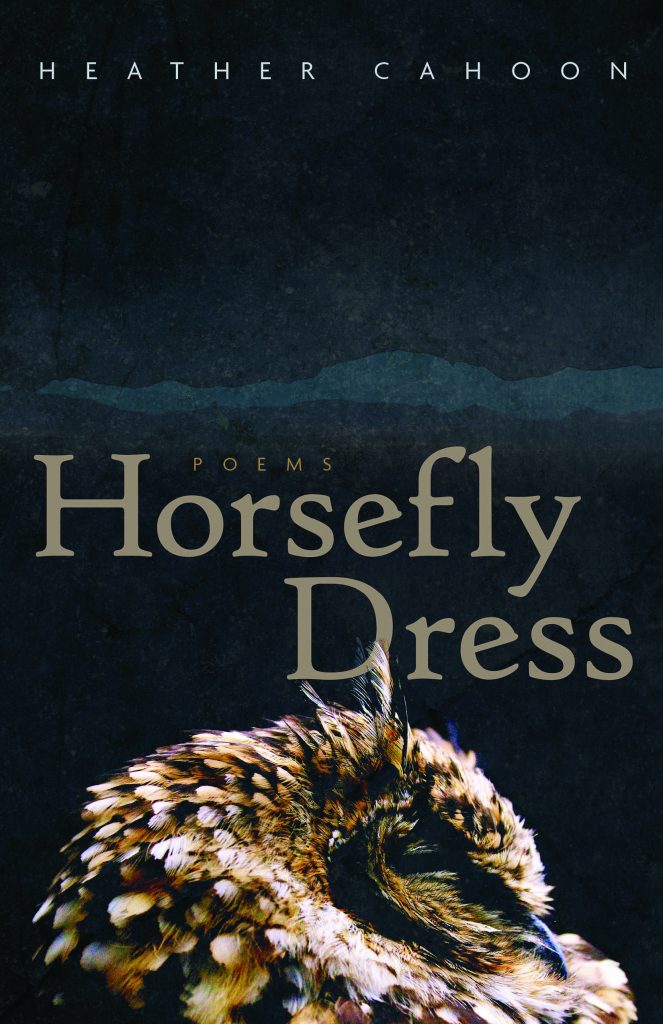
“It is such a pleasure to experience so many Old Stories told in and between the lines of Heather Cahoon’s gorgeous poems.”—Chris La Tray, High Country News

Read an interview about Horsefly Dress with poet Heather Cahoon here, then watch a virtual poetry reading with Heather here.

Tucson Daily Praises Southern Arizona Books

February 28, 2021

In a round-up of books by Southern Arizona authors or about Southern Arizona, the Arizona Daily Star included two University of Arizona Press books—Beyond Earth’s Edge: The Poetry of Spaceflight, and The Arizona Diary of Lily Frémont, 1878–1881.

Beyond Earth’s Edge is a groundbreaking anthology of poetry centered on space that features a beautiful line-up of poets, such as Robert Hayden, Rae Armantrout, N. Scott Momaday, Adrienne Rich, Tracy K. Smith, Ray Bradbury, May Swenson, Pablo Neruda, and many other engaging poetic voices. This book was edited by Julie Swarstad JohnsonChristopher Cokinos.

The Arizona Diary of Lily Frémont, edited by  Mary Lee Spence,  is a rich detail, and day-by-day narrative of Territorial life in Arizona. For students of western history, Lily Frémont’s diary provides a wealth of fresh information on frontier politics, mining, army life, social customs, and ethnicity. The book was recently released as a paperback.

Read the Star reviews here.

Five Questions with Mario T. García and Ellen McCraken on Rewriting the Chicano Movement

February 26, 2021

Rewriting the Chicano Movement, edited by Mario T. García and Ellen McCraken, is a new collection of powerful new essays on the Chicano Movement that expand and revise the understanding of the movement. These essays capture the commitment, courage, and perseverance of movement activists, both men and women, and their struggles to achieve the promises of American democracy. The contributors to this book highlight the role of women in the movement, the regional and ideological diversification of the movement, and the various cultural fronts in which the movement was active.

Here, García and McCraken answer question about this new book:

Why is it important to revisit the history of the Chicano Movement through this book?

It’s important to revisit the history of the Chicano Movement through this book because the Movement represents a seminal part of the history of Chicanos (Mexican Americans) in the United States. It was the largest and most widespread civil rights and empowerment movement by people of Mexican descent up to the 1960s and 1970s. The Chicano Movement through its struggles opened up new opportunities for Chicanos in areas formerly restricted such as in education, especially higher education, politics, culture, media, and business. These opportunities were not given willingly, but had to be forced by mass peaceful struggles. The Movement for the first time made Chicanos, and by extension other Latinos, into national political actors. The roots of Latino political power, which is a reality, lie in the Chicano Movement as well as similar struggles by other Latino groups such as Puerto Ricans in the United States. It is important to know about the history of the Chicano Movement as a reminder of how power and opportunities are accessed.  It comes through people power and the organization of this power. We need to learn these lessons at a time when reactionary forces led by Donald Trump would impose an American form of totalitarianism. Chicanos and Latinos must be in the forefront of defending American democracy and civil rights and we can be inspired to do so by learning how our communities in the past have struggled for our rights such as in the Chicano Movement.

Is there a commonality worth noting that runs through the book’s essays?

The commonality that runs through the book is the commitment by Chicanos through the Chicano Movement to achieve recognition, respect, and dignity in American society through various forms of struggles including political, educational, and cultural ones. What is also common in the book is that we need to rewrite the Chicano Movement to take into consideration the diversity of the Movement. There was no one Movement but many in different regions of the country, which included both men and women.

What conversations, in community or classroom, do you hope rise from the book?

We hope that the book will be used by both educational groups and community ones to re-discover the historical importance of the Chicano Movement and its continued relevance to today’s conditions and struggles. The Chicano Movement did not eliminate racism, class discrimination, cultural discrimination, and gender discrimination for Chicanos and other Latinos. What the Movement did was to empower Chicanos to believe that they and they alone could change history and pressure the system to become more equitable and democratic. We are not there yet, but the Movement can still inspire and guide us in continuing the struggle. We hope that readers will confront the question: How is the Chicano Movement still relevant to us today?

How can telling untold stories about the Movement help the momentum of today’s activists and organizers?

Telling untold stories about the Chicano Movement, as noted, can hopefully inspire and guide today’s activists in learning that the struggles for democratic rights has a long history and with many heroic figures, male and female, who have participated in earlier struggles to empower the Chicano and Latino communities. There is a praxis involved in our book. First, we want people to read about these untold stories of the Movement. Then we want readers to reflect on the meaning and importance of these stories.  And then, and this is most important, we want readers to act on these stories. How can I take up the legacy of the Chicano Movement and apply it to my current conditions? How can I continue the struggle?

The struggle continues, does that mean the Movement continues, too?

We hope that the struggle inspired by the Chicano Movement will continue.  Does this mean that the Chicano Movement is still alive? Yes and no. As a historical movement set in the late 1960s and 1970s, the Movement no longer exists as such; it is a historical movement set in time and place.  However, the legacy of the Movement continues. It is a legacy of the struggle for democratic and human rights and for the rights of people such as Chicanos and other Latinos to define themselves and be proud of their ethnic background. That struggle has continued in the post-Movement years and still does in the new millennium.   

***

Mario T. García is Distinguished Professor of Chicano Studies and History at the University of California, Santa Barbara, specializing in Chicano history, Chicano/Latino autobiography, and Chicano/Latino religion. He is the author, co-author, and editor of more than twenty books in Chicano history, including Blowout! Sal Castro and the Chicano Struggle for Educational JusticeThe Making of a Mexican American Mayor, and Literature as History. He has won a number of awards, including a Guggenheim Fellowship.

Ellen McCracken is a professor in the Department of Spanish and Portuguese at University of California, Santa Barbara, specializing in U.S. Latino and Latin American literature. Her books include New Latina NarrativeThe Life and Writing of Fray Angélico Chávez, and Paratexts and Performance in the Novels of Junot Díaz and Sandra Cisneros.

Publisher’s Weekly Reviews Mihesuah’s Supernatural Mystery ‘Hatak Witches’

February 24, 2021

Publisher’s Weekly, an international news platform for book publishing and bookselling, recently reviewed Devon A. Mihesuah’s new mystery novel, The Hatak Witches.

Set to publish in late April 2021, The Hatak Witches follows Detective Monique Blue Hawk in Norman, Oklahoma. Blending tribal beliefs and myths into a modern context, the book continues the storyline of Choctaw cosmology and cultural survival that are prominent in Mihesuah’s award-winning novel, The Roads of My Relations.

From Publisher’s Weekly:

“As informative as it is gripping, this supernatural mystery from Mihesuah—the 88th installment of Sun Tracks: An American Indian Literary Series—is rooted in Choctaw cosmology and contemporary Native American life. … The author’s ability to immerse the reader in the lives of her characters is prodigious, making the social realism of Monique’s life as fascinating as the supernatural elements. … Readers looking for intelligent, diverse supernatural fiction will be captivated.”—Publishers Weekly

Read the entire review here.

Tucson Weekly Features Excerpt from ‘The Nature of Desert Nature’

February 23, 2021

The Tucson Weekly gave a bit of love to The Nature of Desert Nature, edited by Gary Paul Nabhan.

The book is a collection of essays that celebrate the bounty and the significance of desert places, including an extended essay by Nabhan. The celebrated author and ethnobiologist brought friends, colleagues, and advisors together from his more than four decades of study of deserts—to bring their own perspectives. Scientists, artists, desert contemplatives, poets, and writers bring the desert into view and investigate why these places compel us to walk through their sands and beneath their cacti and acacia.

Thank you, Jim Nintzel, Weekly editor, for the kind words and sharing a bit of Nabhan’s desert love.

Here’s some of the excerpt shared from Nabhan’s essay:

The horizon was dull edged and hazy from a recent sandstorm. Nevertheless, the sun beamed down on me with what seemed to be a preternatural force.

I stood there alone (I believed), silent enough to hear my own heart beating and the breeze brushing at my sleeves. I could not immediately figure out the patterns of the place—the relationships among weather, substrate, flora, fauna and human influence.

A dust devil, or chachipira, suddenly swept by me and then disappeared into thin air, leaving bushes rustling and empty beer cans rolling around in eddies.

Then my eyes began to tear up in brightness, and I wiped them clean with a sweep of my shirtsleeve. Instantly, I was looking at this world as if I had come to another planet for the very first time.

Tile Martyrs: An Excerpt from John-Michael Rivera’s ‘UNDOCUMENTS’

February 22, 2021

While grappling with anxiety and the physical and mental health consequences of the way the United States treats immigrant bodies, in UNDOCUMENTS, John-Michael Rivera documents and scrutinizes what it means to seek opportunities in America. With a focus on the poetics of Latinx documentality itself, this book is concerned with the complicated and at times contradictory ways peoples of Greater Mexico have been documented and undocumented within systems of colonial knowledges, and how these peoples have been rendered as specters of the bureaucratic state. Rivera takes us through the painful, anxiety-ridden, and complex nature of what it means to be documented or undocumented, and the cruelty married to each of these states of being.

Below, read an excerpt from UNDOCUMENTS:

Tile Martyrs
Two unsolved murder mysteries remain open in Boulder: one surrounding
the murder of a young girl named JonBenét Ramsey who has received hundreds of thousands of hours of news coverage, and another surrounding the murders of six young Chicanx activists who, to Chicanxs, are known as Los Seis de Boulder, the lost children of El Movimiento. Boulder and the nation have nearly been successful in erasing the bodies of Francisco Dougherty, 20; Heriberto Terán, 24; Florencio Granado, 31; Reyes Martínez, 26; Una Jaakola, 24; and Neva Romero, 21. Their cars were blown up with professionally made car bombs two days apart in the month of May 1974. Their homicides are still listed as a cold case, but Chicanxs know it was the work of the FBI. The FBI had been trying to infiltrate El Movimiento and break down its resistance. Reports state that the blasts were so powerful that pieces of their bodies were found miles away from the explosion site.

Forty-five years later in a studio on the Boulder campus, my daughter and I join dozens of activists who are attempting to reconstruct the bodies of Los Seis and build a memorial called “Los Seis de Boulder.” She and I work on small colored tiles that will re-create the face of Reyes Martínez. With each tile we attempt to piece together his dead body and resurrect it from obscurity. The ceremony is haunting. It feels like something between a celebration of community and a somber wake that I was not invited to. We all hope, perhaps in vain, that the university will allow us to resurrect the memorial by Temporary Building 1, the place on campus where one of the cars blew up, making it a sacred site and a haunting reminder of those who lost their lives here. An older woman working on the tiles says that we should be listening to their corrido. Dad, what is a corrido? The lady smiles at me and begins to hum:

Voy a cantar un corrido,
Que . . . en Colorado pasó.
Murieron los Seis de Boulder,
Dos noches en mayo,
En setenta y cuatro
Los almas de seis soldados
Seis fusilados
Seis hijos del bien

The same month that we fight for the memorialization of these young activists, John Ramsey sits down with Dr. Oz to do yet another in-depth interview about the JonBenét murder. Let me begin by saying this is such a tragedy, Dr. Oz laments. America’s daughter is lost to us forever.

***
John-Michael Rivera is an associate professor and writer at the University of Colorado Boulder, where he serves as director of the Program for Writing and Rhetoric. He has published memoir, creative nonfiction, poetry, and scholarship. He is the curator of El Laboratorio, a literary space for Latinx writers, and was co-founder of Shadowbox Magazine, a literary journal for creative nonfiction.

Excerpt: ‘Rewriting the Chicano Movement’

January 19, 2020

In the forthcoming book, Rewriting the Chicano Movement offers an insightful new history of the Chicano Movement that expands the meaning and understanding of this seminal historical period in Chicano history. The essays introduce new individuals and struggles previously omitted from Chicano Movement history. Today we offer a brief excerpt:

From the Introduction
By Mario T. García
The profound changes directly and indirectly attributable to the Chicano Movement have led to increased interest in the history of the Chicano Movement. It is not that historians neglected the movement in the post-movement period of the 1980s and 1990s. However, with some exceptions, historians focused on earlier periods in order to better understand the roots of the Chicano experience. This was understandable given the dearth of research in Chicano history as a whole. Moreover, the immediacy of the movement meant historical perspective was lacking.

As a result of this research, publications on Chicano history as a whole have exploded over the last fifty years. This research includes studies of the Spanish conquest of areas that became part of the United States, such as from Texas to California. Others have focused on the Mexican experience after Mexican independence in 1821 and up to the time the United States forced a war on Mexico and conquered its northern frontier—El Norte. The period following the American conquest of what became the American Southwest has also received attention. However, historians have tended to study the twentieth century more, including mass Mexican immigration to the United States during the first three decades of the century. The Great Depression years have likewise received attention, as has World War II, when thousands of Mexican Americans went to war in support of the United States. Finally, the post–World War II era, especially the 1950s, is also beginning to receive attention. Some pioneering studies on the Chicano Movement also appeared during the last two decades of the twentieth century. These include works by Juan Gómez-Quiñones, Gerald Rosen, Carlos Muñoz, Richard Santillán, Christine Marín, Ignacio García, Ernesto Chávez, and Marguerite Marín. Gómez-Quiñones wrote on the Chicano student movement, as did Carlos Muñoz with a focus on Los Angeles. Gerald Rosen examined the ideology of the movement. One of the best works in this early literature was Ignacio García’s history of La Raza Unida Party. Richard Santillán also focused on La Raza Unida Party. Ernesto Chávez and Marguerite Marín, like Muñoz, focused on Los Angeles as a key location by examining manifestations other than the student movement. Finally, Christine Marín wrote one of the first biographies of Corky Gonzales, a key movement leader in Denver.

These early studies are being significantly augmented in the new millennium. There has emerged a renaissance of Chicano Movement studies. Historians and other scholars, many of them younger professors or graduate students, are rediscovering the Chicano Movement. This new generation seems even more aware of how the movement impacted the lives of many Chicanos and other Latinos in the country. They recognize the movement as a seminal event in the long history of Mexican Americans. While they note that there were earlier civil rights and labor rights struggles, they recognize that the Chicano Movement was unprecedented in its size and impact. The Chicano Movement created the new Chicano and Chicana, and by extension the new Latino and Latina. Contemporary Latino political power is the direct result of the movement.

What distinguishes this new historiography is its focus on the diversity of the movement. Earlier views seemed to suggest that the movement was more monolithic and that the cultural nationalism of the movement was adhered to by most activists. Contemporary historians and other students of the movement see much more diversity in all movement aspects. For example, the movement is being studied in a variety of locations and spaces, not just the main centers of the movement such as California and Texas. Now movement history is being excavated in the Pacific Northwest, New Mexico, Arizona, and the Midwest.

Also, greater attention is being paid to the role of women in the movement and their key contributions. Studies of new locations and different communities reveal how the movement manifested itself regionally and locally and how it was mobilized around community issues pertinent to that locale. In other words, the Chicano Movement was not only a national movement but a local one. Moreover, beginning with Jorge Mariscal’s groundbreaking 2005 book, Brown-Eyed Children of the Sun, some scholars revealed how the cultural nationalism of the movement, Chicanismo, was not monolithic. Other ideological influences such as Third World consciousness, Marxism, and feminism also affected the mindset of Chicano activists, and we saw how the four could be combined. As a result of looking at the Chicano Movement in such a diverse way, this new literature is revisionist and critical. It is a rewriting of the Chicano Movement. This new Chicano Movement history is also impacting our understanding of American history.

***
Mario T. García is Distinguished Professor of Chicano Studies and History at the University of California, Santa Barbara, specializing in Chicano history, Chicano/Latino autobiography, and Chicano/Latino religion. He is the author, co-author, and editor of more than twenty books in Chicano history, including Blowout! Sal Castro and the Chicano Struggle for Educational JusticeThe Making of a Mexican American Mayor, and Literature as History. He has won a number of awards, including a Guggenheim Fellowship.

SHA 2021: Discover Our Recent and Forthcoming Historical Archaeology Titles

January 6, 2021

We are excited to participate in the first virtual Society for Historical Archaeology conference this year! You can visit our virtual exhibitor booth here.

Below, browse our recent and forthcoming historical archaeology titles, and get a 35% discount with free U.S. shipping when you use the code AZSHA21 at checkout. If you would like to know more about our publishing program, visit our proposal guidelines page here, or contact our Senior Editor, Allyson Carter, at acarter@uapress.arizona.edu.

The Global Spanish Empire tackles broad questions about indigenous cultural persistence, pluralism, and place making using a global comparative perspective grounded in the shared experience of Spanish colonialism. Through an expansive range of essays that look at Africa, the Americas, Asia, the Caribbean and the Pacific, this volume brings often-neglected regions into conversation.

Watch a lecture with the editors, Christine D. Beaule and John G. Douglass, here, and read a Q&A with the editors here.

Tewa Worlds by Samuel Duwe offers an archaeological history of eight centuries of Tewa Pueblo history in the Rio Chama Valley through the lens of contemporary Pueblo philosophical and historical discourse. The result gives weight to the deep past, colonial encounters, and modern experiences. It challenges archaeologists to both critically reframe interpretation and to acknowledge the Tewa’s deep but ongoing connection with the land.

More than a history of coveted commodities, the unique story that unfolds in John R. Gust and Jennifer P. Mathews’s new history Sugarcane and Rum is told through the lens of Maya laborers who worked under brutal conditions on small haciendas to harvest sugarcane and produce rum in the Yucatan Peninsula of Mexico.

Read an excerpt from the book here. We are thrilled that Smithsonian Magazine chose Sugarcane and Rum for their weekly reading series!

Narratives of Persistence charts the remarkable persistence of California’s Ohlone and Paipai people over the past five centuries. Lee M. Panich draws connections between the events and processes of the deeper past and the way the Ohlone and Paipai today understand their own histories and identities.

Read a Q & A with author Lee M. Panich here.

Discover our forthcoming historical archaeology titles below.

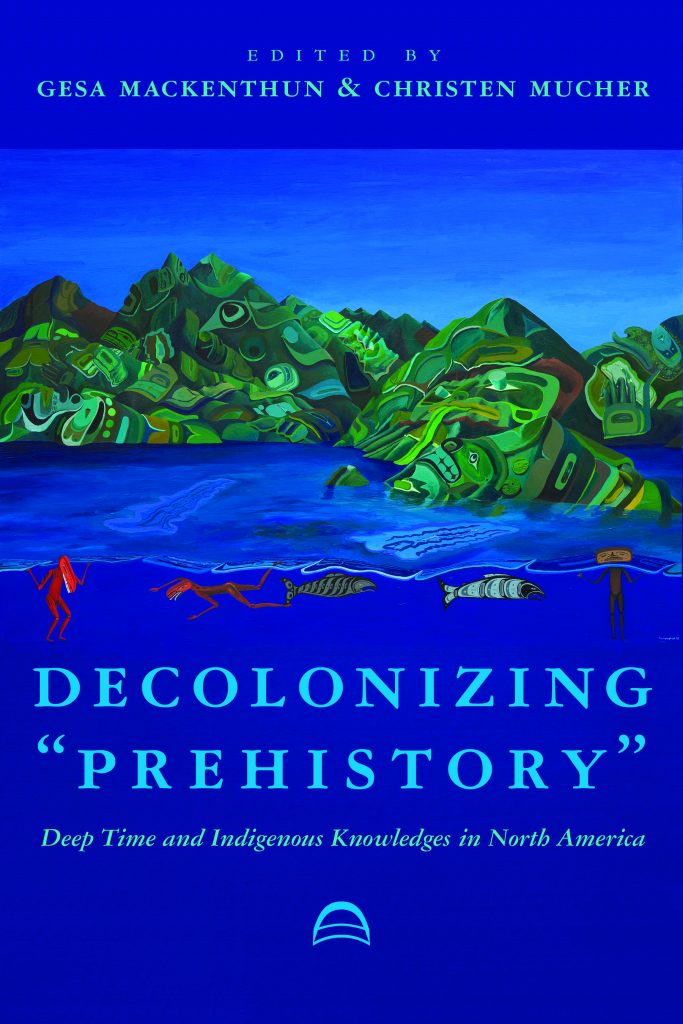
Decolonizing “Prehistory” critically examines and challenges the paradoxical role that modern historical-archaeological scholarship plays in adding legitimacy to, but also delegitimizing, contemporary colonialist practices. Using an interdisciplinary approach, this volume empowers Indigenous voices and offers a nuanced understanding of the American deep past.

How people eat today is a record of food use through the ages, and Famine Foods offers the first ever overview of the use of alternative foods during food shortages. Paul E. Minnis explores the unusual plants that have helped humanity survive throughout history.

Alluvium and Empire examines the archaeology of Indigenous communities and landscapes that were subject to Spanish colonial forced resettlement during the sixteenth century. Written at the intersections of history and archaeology, the book critiques previous approaches to the study of empire and models a genealogical approach that attends to the open-ended—and often unpredictable—ways in which empires take shape.

Explore Our Recent Ethnobiology and Ethnobotany Titles

December 17, 2020

The University of Arizona Press publishes a wide range of fascinating ethnobiology and ethnobotany titles. Below, read about our most recent titles in these fields.

Use the code AZETHNO20 to receive 35% off all of the titles mentioned in this post, plus free U.S. shipping, until January 15, 2021.

Do you have an ethnobiology or ethnobotany manuscript? To learn more about our publishing program, visit here.

The Prehispanic Ethnobotany of Paquimé and Its Neighbors is a major ethnobotanical study for the ancient U.S. Southwest and northwestern Mexico. The results reorient our perspective in the rise of one of the most impressive communities in the international region.

See some photographs and field notes from editors Paul Minnis and Michael Whalen here.

Based on Valentina Peveri’s prolonged engagement with this “virtuous” plant of southwestern Ethiopia, The Edible Gardens of Ethiopia provides a nuanced reading of the ensete ventricosum (avant-)garden and explores how the life in tiny, diverse, and womanly plots may indeed offers alternative visions of nature, food policy, and conservation efforts.

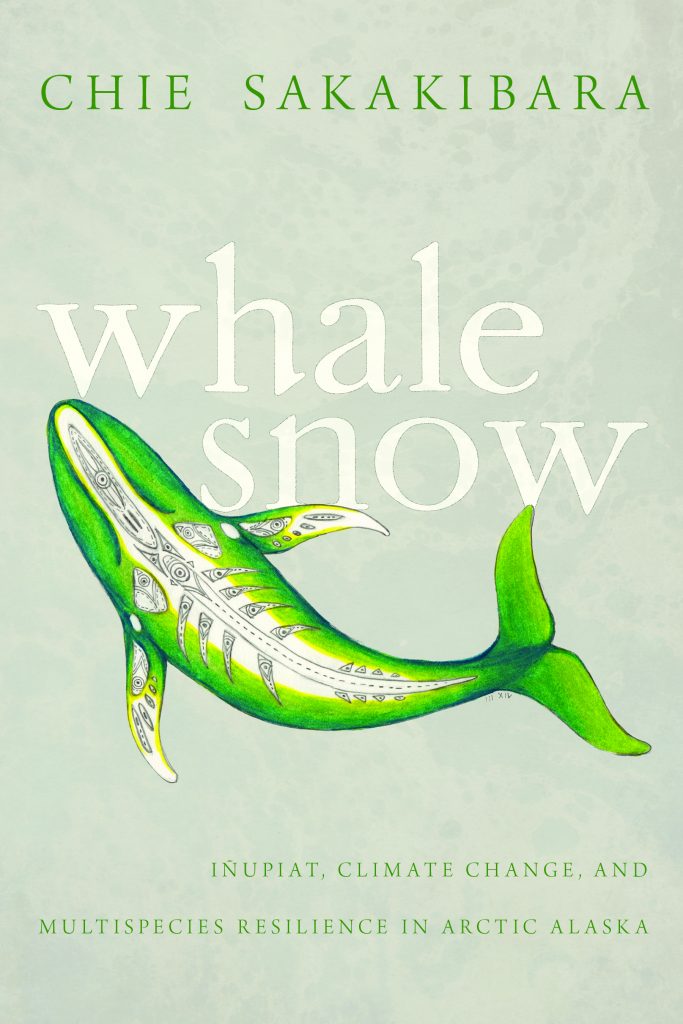
Chie Sakakibara shows how knots of connection came into being between humans and nonhuman others and how such intimate and intense relations will help humans survive the Anthropocene. Whale Snow offers an important and thought-provoking look at global climate change as it manifests in the everyday life of the Iñupiat in Arctic Alaska.

Read a Q & A with author Chie Sakakibara here.

The desert inspires wonder. Attending to history, culture, science, and spirit, The Nature of Desert Nature celebrates the bounty and the significance of desert places.

Watch editor Gary Nabhan and contributor Francisco Cantú discuss The Nature of Desert Nature here.

A Desert Feast offers a food pilgrimage, where stories and recipes demonstrate why the desert city of Tucson became American’s first UNESCO City of Gastronomy. You’ll meet the farmers, small-scale food entrepreneurs, and chefs who are dedicated to making Tucson taste like nowhere else.

Watch the Tucson Festival Of Books’ virtual event with Carolyn Niethammer & Andi Berlin here, then watch Carolyn introduce her new book here. Read an excerpt from A Desert Feast here, then visit our Facebook page or YouTube page to watch a video series about the book.

More than a history of coveted commodities, the unique story that unfolds in John R. Gust and Jennifer P. Mathews’s new history Sugarcane and Rum is told through the lens of Maya laborers who worked under brutal conditions on small haciendas to harvest sugarcane and produce rum in the Yucatan Peninsula of Mexico.

Read an excerpt from Sugarcane and Rum here. We are thrilled that Smithsonian Magazine selected Sugarcane and Rum for their weekly reading series!

The saguaro, with its great size and characteristic shape, has become the emblem of the Sonoran Desert of southwestern Arizona and northwestern Mexico. The Saguaro Cactus offers a complete natural history of this enduring cactus, the largest and tallest in the United States. From its role in Sonoran Desert ecology, to its adaptations to the desert climate, to its sacred place in Indigenous culture, this book offers a definitive source on a distinguished desert plant.

Read an excerpt from The Saguaro Cactus here. Read about a great book release event we hosted for The Saguaro Cactus, back in the pre-covid days, here.

For Authors

The University of Arizona Press publishes the work of leading scholars from around the globe. Learn more about submitting a proposal, preparing your final manuscript, and publication.
Inquire

Requests

The University of Arizona Press is proud to share our books with readers, booksellers, media, librarians, scholars, and instructors. Join our email Newsletter. Request reprint licenses, information on subsidiary rights and translations, accessibility files, review copies, and desk and exam copies.
Request

Support the Press
Support a premier publisher of academic, regional, and literary works. We are committed to sharing past, present, and future works that reflect the special strengths of the University of Arizona and support its land-grant mission.
Give